
Healthcare IoT Security Market Report 2026
Global Outlook – By Component (Solution, Services), By Security Type (Application Security, Cloud Security, Endpoint Security, Network Security, Other Security Types), By End-use (Hospitals, Surgical Centers, and Clinics, Clinical Research Organizations, Research and Diagnostic Laboratories ) - Market Size, Trends, Strategies, and Forecast to 2030
Healthcare IoT Security Market Overview
• Healthcare IoT Security market size has reached to $3.54 billion in 2025 • Expected to grow to $12.46 billion in 2030 at a compound annual growth rate (CAGR) of 28.6% • Growth Driver: Surging Cybersecurity Concerns Propel Growth In The Healthcare IoT Security Market • Market Trend: Innovative Security Solutions For Medical Devices Drive Advancements In The Healthcare IoT Security Market • North America was the largest region in 2025.What Is Covered Under Healthcare IoT Security Market?
Healthcare Internet of Things (IoT) security refers to a network of linked devices that can collect and distribute data without the need for people. These solutions aim to mitigate the security risks associated with medical IoT devices and ensure the protection of patient data and care. The main components of healthcare IoT security are solutions and services. A solution typically refers to a comprehensive set of measures, technologies, and practices implemented to address and mitigate security challenges and risks. The various security types are application security, cloud security, endpoint security, network security, and other security types and are used by various end-users such as hospitals, surgical centers, and clinics, government and defense institutions, clinical research organizations, and research and diagnostic laboratories.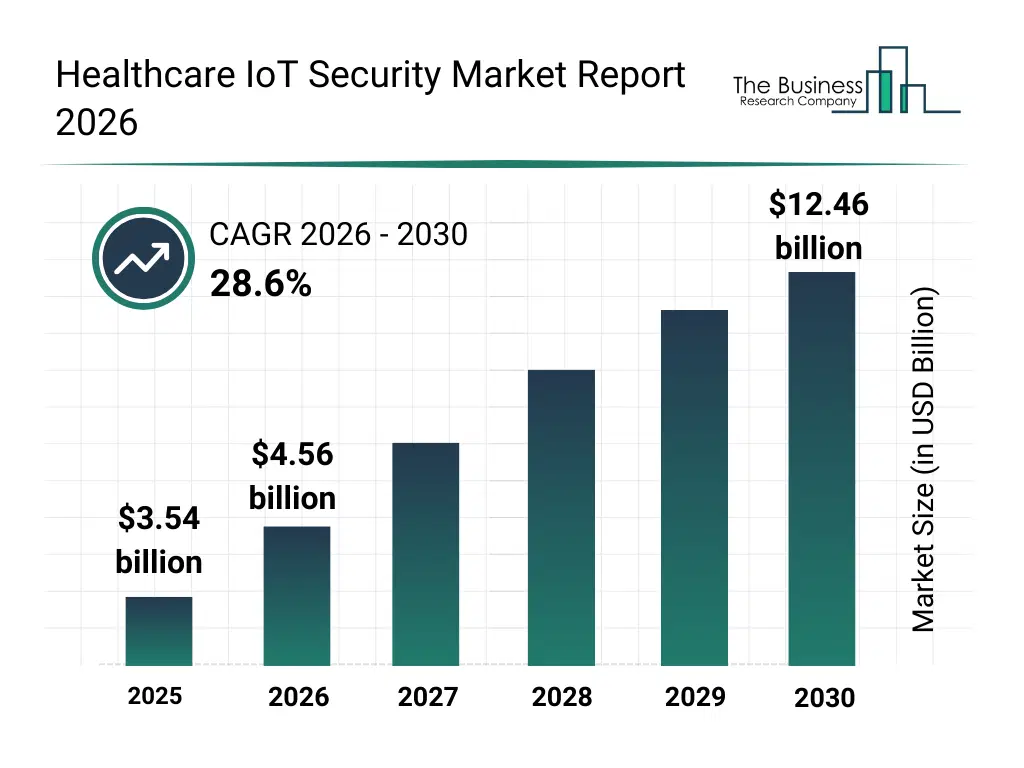
What Is The Healthcare IoT Security Market Size and Share 2026?
The healthcare iot security market size has grown exponentially in recent years. It will grow from $3.54 billion in 2025 to $4.56 billion in 2026 at a compound annual growth rate (CAGR) of 28.8%. The growth in the historic period can be attributed to increasing adoption of connected medical devices, rising incidents of healthcare data breaches, expansion of remote patient monitoring systems, growth in cloud-based healthcare platforms, increasing regulatory scrutiny on patient data security.What Is The Healthcare IoT Security Market Growth Forecast?
The healthcare iot security market size is expected to see exponential growth in the next few years. It will grow to $12.46 billion in 2030 at a compound annual growth rate (CAGR) of 28.6%. The growth in the forecast period can be attributed to increasing investments in ai-driven security analytics, rising demand for end-to-end iot security platforms, expansion of telehealth ecosystems, growing focus on compliance-driven security frameworks, increasing adoption of managed healthcare security services. Major trends in the forecast period include increasing adoption of zero-trust security frameworks, rising deployment of device authentication solutions, growing use of encrypted medical iot communications, expansion of cloud security for healthcare iot, enhanced focus on real-time threat detection.
Global Healthcare IoT Security Market Segmentation
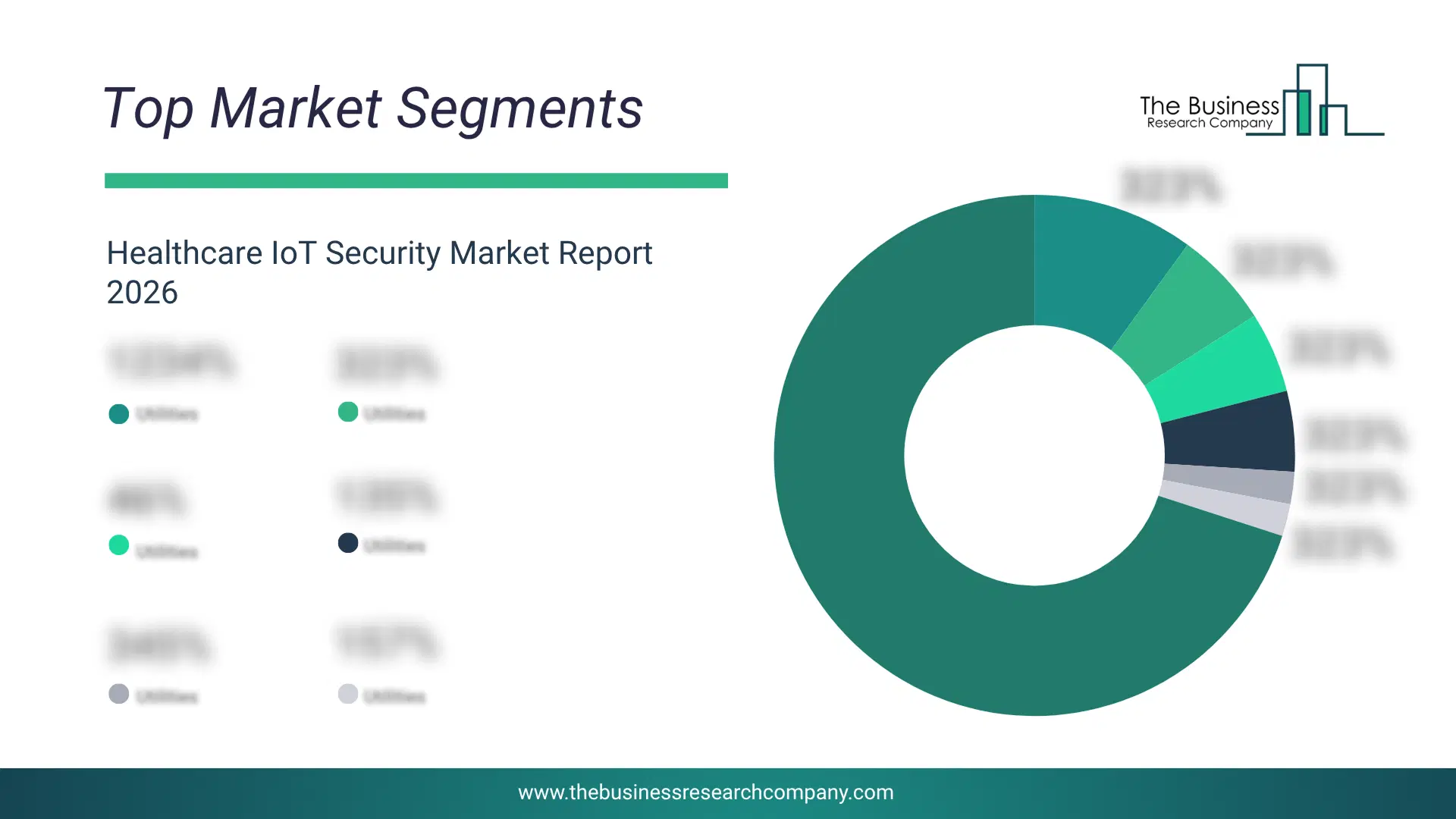
1) By Component: Solution, Services 2) By Security Type: Application Security, Cloud Security, Endpoint Security, Network Security, Other Security Types 3) By End-use: Hospitals, Surgical Centers, and Clinics, Clinical Research Organizations, Research and Diagnostic Laboratories Subsegments: 1) By Solution: Identity And Access Management (IAM), Data Encryption And Tokenization, Intrusion Detection And Prevention Systems (IDPS), Device Authentication And Management, Secure Network Communication 2) By Services: Consulting Services, Risk Assessment And Management, Managed Security Services, Training And Education Services, Support And Maintenance ServicesWhat Is The Driver Of The Healthcare IoT Security Market?
Rising cybersecurity concerns are expected to propel the growth of the healthcare IoT security market going forward. Cybersecurity concerns refer to the potential threats, risks, and vulnerabilities associated with the use of information technology and digital systems. Healthcare IoT security reduces cybersecurity risks in the healthcare sector by guaranteeing the security of private patient information and medical records. For instance, in October 2025, according to the Australian Signals Directorate, an Australia-based government department, in FY2024–25, ASD’s ACSC received over 42,500 calls to the Australian Cyber Security Hotline, a 16% increase from the previous year. ASD’s ACSC also responded to over 1,200 cyber security incidents, an 11% increase. Therefore, rising cybersecurity concerns are driving the growth of the healthcare IoT security industry.Key Players In The Global Healthcare IoT Security Market
Major companies operating in the healthcare iot security market are Microsoft Corporation, Deutsche Telekom AG, Dell Corporation, Intel Corporation, IBM Corporation, Cisco Systems, Oracle Corporation, Palo Alto Networks Inc., Fortinet Inc., Symantec Corporation (NortonLifeLock), Check Point Software Technologies, Trend Micro Inc., Kaspersky Lab, Sophos Group Plc, Claroty, Eurotech SpA, Inside Secure SA, CloudWave, Cynerio, ICterra, Medigate by Claroty, Asimily, CyberMDX, SecureFLO LLC, Agile Cyber Security Solutions LLC, Intelen Inc., Security Mentor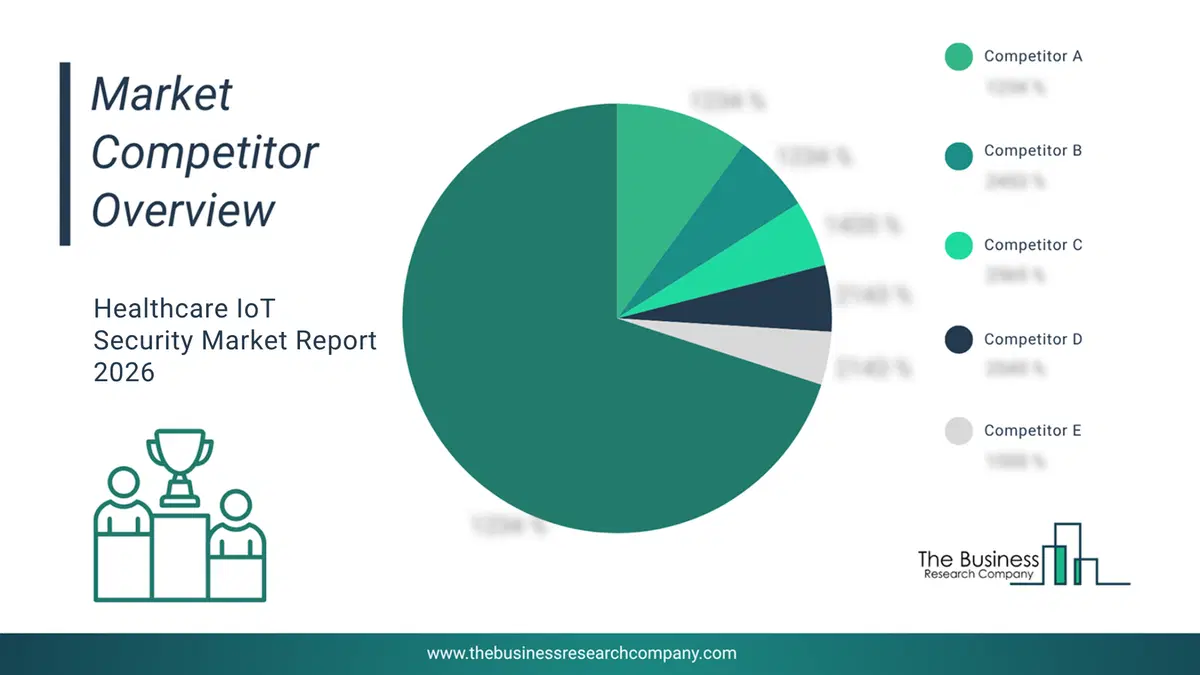
This chart is for illustrative purposes; the full report includes a detailed competitor analysis and comprehensive overview of the top 10 companies in the market.
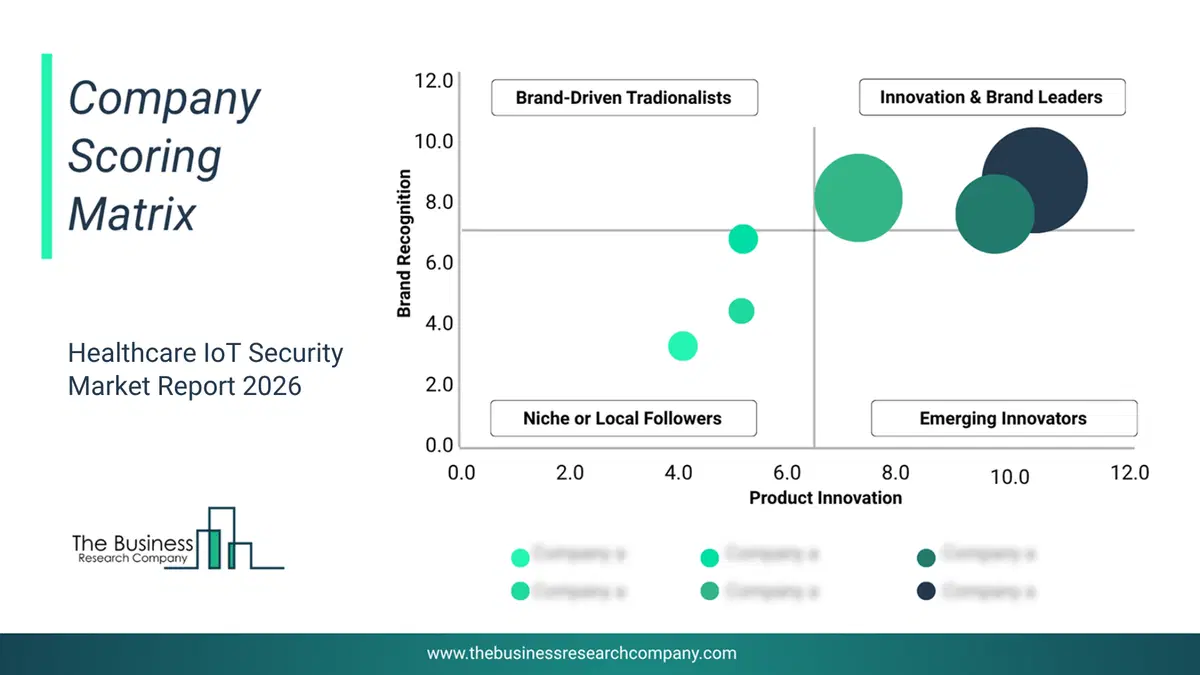
This chart maps companies by product innovation and brand strength, with bubble size indicating relative revenue, helping identify market leaders, challengers, and niche players. This is an illustrative chart; the full report provides a complete and accurate competitive analysis.
Global Healthcare IoT Security Market Trends and Insights
Major companies operating in the healthcare IoT security market are focusing on developing innovative products, such as AI-driven patient-data summarisation to transform vast streams of connected health-device data into actionable clinical insights and streamline care workflows. AI-driven patient-data summarisation is defined as a capability where AI models automatically analyse longitudinal sensor and device data, detect significant changes or risks, and generate clinician-ready summaries and notes for integration into electronic health records (EHRs). For instance, in February 2025, Validic Inc., a US-based digital health company, launched its full suite of health IoT and remote-patient-management solutions powered by generative AI on the AWS Marketplace. It supports hundreds of FDA-listed in-home monitoring devices and consumer wearables and streams real-world data into client applications for engagement, outcomes tracking, and device ecosystem management. It integrates longitudinal personal-health data into the EHR, enables programmes for chronic-disease management, high-risk pregnancy, GLP-1 weight-management, transitions of care, and physical-activity tracking allowing rollout of enterprise-scale programmes without new integrations.What Are Latest Mergers And Acquisitions In The Healthcare IoT Security Market?
In July 2025, Axonius, a US-based cybersecurity asset management company, acquired Cynerio in a deal reportedly valued at up to $250 million. With this acquisition, Axonius aims to strengthen its presence in the healthcare cybersecurity market by integrating Cynerio’s Internet of Medical Things (IoMT) security capabilities, expanding its platform to better protect connected medical devices, enhance threat detection, and reduce security vulnerabilities across healthcare facilities. Cynerio is a Isreal-based healthcare cybersecurity company specializing in securing medical and IoT devices used in hospitals and clinical environments.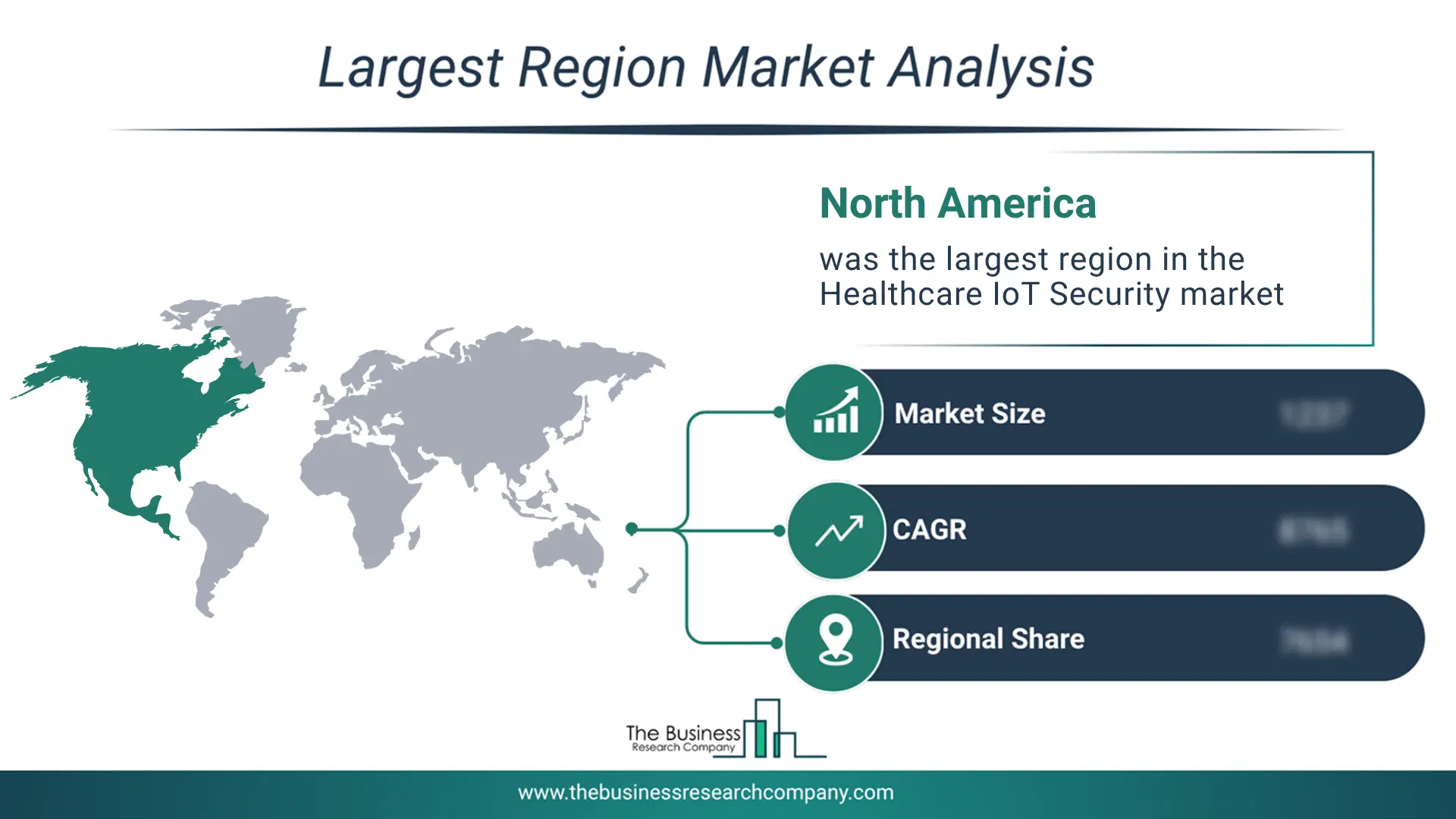
Regional Outlook
North America was the largest region in the healthcare IoT security market in 2025. The regions covered in this market report are Asia-Pacific, South East Asia, Western Europe, Eastern Europe, North America, South America, Middle East, Africa. The countries covered in this market report are Australia, Brazil, China, France, Germany, India, Indonesia, Japan, Taiwan, Russia, South Korea, UK, USA, Canada, Italy, Spain.What Defines the Healthcare IoT Security Market?
The healthcare internet of things (IoT) security market includes revenues earned by entities by device authentication, data encryption, network security, endpoint security, and access control. The market value includes the value of related goods sold by the service provider or included within the service offering. The healthcare internet of things (IoT) security market consists of sales of trusted platform modules (TPMs) and biometric security solutions. Values in this market are ‘factory gate’ values, that is the value of goods sold by the manufacturers or creators of the goods, whether to other entities (including downstream manufacturers, wholesalers, distributors and retailers) or directly to end customers. The value of goods in this market includes related services sold by the creators of the goods.How is Market Value Defined and Measured?
The market value is defined as the revenues that enterprises gain from the sale of goods and/or services within the specified market and geography through sales, grants, or donations in terms of the currency (in USD unless otherwise specified). The revenues for a specified geography are consumption values that are revenues generated by organizations in the specified geography within the market, irrespective of where they are produced. It does not include revenues from resales along the supply chain, either further along the supply chain or as part of other products.
This chart presents market attractiveness based on a quantitative evaluation of growth, competition, strategic alignment, and risk, offering a clear view of opportunity areas for decision-making. This chart is for illustrative purposes; the full report contains the complete analysis.

This chart highlights the Total Addressable Market (TAM) by estimating the maximum revenue opportunity using an assumption-driven approach, supporting strategic planning and opportunity sizing across markets. The chart is illustrative; the full report provides a more comprehensive analysis.
What Key Data and Analysis Are Included in the Healthcare IoT Security Market Report 2026?
The healthcare iot security market research report is one of a series of new reports from The Business Research Company that provides market statistics, including industry global market size, regional shares, competitors with the market share, detailed market segments, market trends and opportunities, and any further data you may need to thrive in the healthcare iot security industry. The market research report delivers a complete perspective of everything you need, with an in-depth analysis of the current and future state of the industry.Healthcare IoT Security Market Report Forecast Analysis
| Report Attribute | Details |
|---|---|
| Market Size Value In 2026 | $4.56 billion |
| Revenue Forecast In 2030 | $12.46 billion |
| Growth Rate | CAGR of 28.6% from 2026 to 2030 |
| Base Year For Estimation | 2025 |
| Actual Estimates/Historical Data | 2020-2025 |
| Forecast Period | 2026 - 2030 |
| Market Representation | Revenue in USD Billion and CAGR from 2026 to 2030 |
| Segments Covered | Component, Security Type, End-use |
| Regional Scope | Asia-Pacific, Western Europe, Eastern Europe, North America, South America, Middle East, Africa |
| Country Scope | The countries covered in the report are Australia, Brazil, China, France, Germany, India, Indonesia, Japan, Taiwan, Russia, South Korea, UK, USA, Canada, Italy, Spain |
| Key Companies Profiled | Microsoft Corporation, Deutsche Telekom AG, Dell Corporation, Intel Corporation, IBM Corporation, Cisco Systems, Oracle Corporation, Palo Alto Networks Inc., Fortinet Inc., Symantec Corporation (NortonLifeLock), Check Point Software Technologies, Trend Micro Inc., Kaspersky Lab, Sophos Group Plc, Claroty, Eurotech SpA, Inside Secure SA, CloudWave, Cynerio, ICterra, Medigate by Claroty, Asimily, CyberMDX, SecureFLO LLC, Agile Cyber Security Solutions LLC, Intelen Inc., Security Mentor |
| Customization Scope | Request for Customization |
| Pricing And Purchase Options | Explore Purchase Options |