

Healthcare Revenue Cycle Management Software Market Report 2026
Global Outlook – By Component (Services, Software), By Function (Payment Processing, Claims And Denial Management, Medical Billing And Coding, Patient Insurance Eligibility Verification, Other Functions), By Technology (Cloud Computing Solutions, Artificial Intelligence Based Revenue Cycle Management, Automation And Robotic Process Automation, Predictive Analytics), By End User (Laboratories, Hospitals, Clinics, Ambulatory Surgical Centers, Other End Users) – Market Size, Trends, Strategies, and Forecast to 2030
Healthcare Revenue Cycle Management Software Market Overview
• Healthcare Revenue Cycle Management Software market size has reached to $37.08 billion in 2025 • Expected to grow to $57.35 billion in 2030 at a compound annual growth rate (CAGR) of 9% • Growth Driver: Rising Healthcare Expenditure Worldwide Fueling The Growth Of The Market Due To Increasing Chronic Disease Burden And Healthcare Cost Inflation • Market Trend: AI-Powered Automation Transforming Healthcare Revenue Cycle Management • North America was the largest region in 2025 and Asia-Pacific is the fastest growing region.What Is Covered Under Healthcare Revenue Cycle Management Software Market?
Healthcare revenue cycle management (RCM) software is a digital solution that helps healthcare organizations manage financial and administrative processes related to patient care. It supports functions such as insurance verification, medical billing, claims processing, payment collection, and reimbursement tracking. The primary use of this software is to streamline revenue workflows, reduce claim denials, improve billing accuracy, and accelerate payment collections for healthcare providers. The main components of healthcare revenue cycle management software include services and software. Services refer to professional support offerings that help healthcare organizations optimize billing workflows, reimbursement processes, and financial operations. These solutions support functions including payment processing, claims and denial management, medical billing and coding, patient insurance eligibility verification, and other functions. They are developed using technologies such as cloud computing solutions, artificial intelligence based revenue cycle management, automation and robotic process automation, and predictive analytics, and they are used by several end users such as laboratories, hospitals, clinics, ambulatory surgical centers, and others.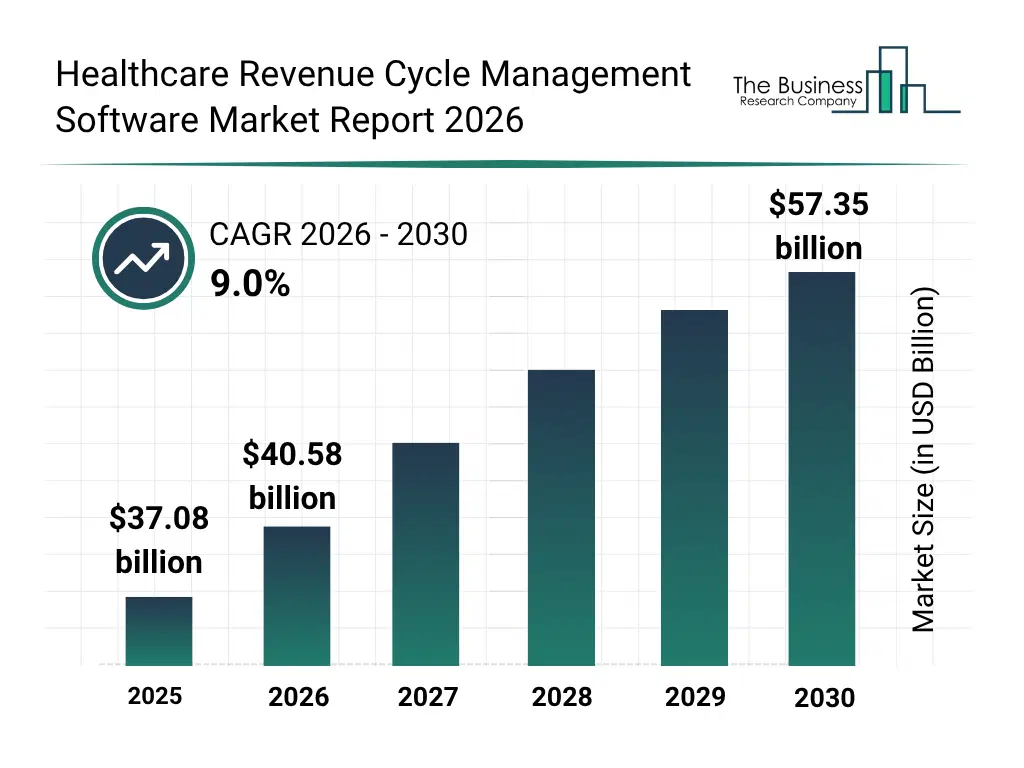
What Is The Healthcare Revenue Cycle Management Software Market Size and Share 2026?
The healthcare revenue cycle management software market size has grown strongly in recent years. It will grow from $37.08 billion in 2025 to $40.58 billion in 2026 at a compound annual growth rate (CAGR) of 9.5%. The growth in the historic period can be attributed to rising healthcare expenditure and complex reimbursement structures, increasing adoption of electronic health records in healthcare systems, growing administrative burden and billing inefficiencies in hospitals, expansion of insurance coverage and payer networks, increasing regulatory requirements for healthcare billing compliance.What Is The Healthcare Revenue Cycle Management Software Market Growth Forecast?
The healthcare revenue cycle management software market size is expected to see strong growth in the next few years. It will grow to $57.35 billion in 2030 at a compound annual growth rate (CAGR) of 9.0%. The growth in the forecast period can be attributed to expansion of ai enabled intelligent revenue cycle automation systems, growing adoption of cloud native healthcare it infrastructure, increasing demand for real time claims processing and payment analytics, rising shift toward value based care reimbursement models, increasing integration of predictive analytics for revenue optimization. Major trends in the forecast period include increasing adoption of cloud based healthcare revenue cycle management platforms for scalable billing operations, rising integration of AI driven claims denial prediction and resolution systems, growing use of automated medical coding and billing workflows to reduce administrative burden, expansion of interoperability enabled rcm systems for seamless payer provider data exchange, increasing deployment of predictive analytics for revenue leakage detection and optimization.
Global Healthcare Revenue Cycle Management Software Market Segmentation
1) By Component: Services; Software 2) By Function: Payment Processing; Claims And Denial Management; Medical Billing And Coding; Patient Insurance Eligibility Verification; Other Functions 3) By Technology: Cloud Computing Solutions; Artificial Intelligence Based Revenue Cycle Management; Automation And Robotic Process Automation; Predictive Analytics 4) By End User: Laboratories; Hospitals; Clinics; Ambulatory Surgical Centers; Other End Users Subsegments: 1) By Services: Revenue Optimization Services; Implementation Services; Consulting Services; Training And Education Services; Support And Maintenance Services; Managed Revenue Cycle Services; Outsourcing Services; System Integration Services 2) By Software: Accounts Receivable Management Software; Medical Coding Software; Payment Processing Software; Revenue Analytics SoftwareWhat Is The Driver Of The Healthcare Revenue Cycle Management Software Market?
The rising healthcare expenditure worldwide is expected to propel the growth of the healthcare revenue cycle management software market going forward. Healthcare expenditure refers to the total amount spent on healthcare goods and services, including hospital care, physician services, medications, medical devices, preventive care, health administration, and public health activities by governments, private organizations, and individuals. The rising healthcare expenditure worldwide is due to the increasing prevalence of chronic diseases, which drives higher demand for long-term treatments, hospital services, and continuous patient care. Rising healthcare expenditure increases patient volumes, billing complexity, and insurance claim transactions, thereby driving demand for healthcare revenue cycle management software to streamline financial operations and improve reimbursement efficiency. For instance, in November 2025, according to WTW Global Medical Trends Survey, a UK-based advisory and insurance services company, global medical cost trends increased from 9.5% in 2024 to 10.0% in 2025 and are projected to reach 10.3% in 2026. Therefore, the rising healthcare expenditure worldwide is driving the growth of the healthcare revenue cycle management software industry.Key Players In The Global Healthcare Revenue Cycle Management Software Market
Major companies operating in the healthcare revenue cycle management software market are Epic Systems Corporation; Optum; Oracle Health; R1 RCM; Waystar Holding Corp.; eClinicalWorks LLC; FinThrive Inc.; Veradigm LLC; Experian Health Inc.; Tebra Technologies Inc.; Conifer Health Solutions; SSI Group; Ensemble Health Partners; CureMD Healthcare; Advanced Data Systems Corporation; PracticeSuite Inc.; AKASA Inc.; BellMedEx LLC; Practice EHR; DocVilla Health Systems Inc.; RapidClaimsGlobal Healthcare Revenue Cycle Management Software Market Trends and Insights
Major companies operating in the healthcare revenue cycle management software market are focusing on developing advanced solutions, such as intelligent automation platforms, to improve operational efficiency, reduce administrative burdens, and optimize financial performance for healthcare providers. Intelligent automation platforms refer to technology-driven systems that combine artificial intelligence (AI), robotic process automation (RPA), and analytics to automate complex revenue cycle workflows, enhance claim accuracy, and accelerate reimbursement processes. For instance, in October 2024, Infinx Inc., a US-based healthcare technology company, launched its next-generation Intelligent Automation Platform for Revenue Cycle Management (RCM). The platform is designed to streamline healthcare financial operations through AI-powered automation, enabling providers to improve claims processing, reduce denials, enhance patient payment experiences, and optimize end-to-end revenue cycle performance. The solution also supports operational scalability and workflow efficiency across healthcare organizations.What Are Latest Mergers And Acquisitions In The Healthcare Revenue Cycle Management Software Market?
In October 2025, Waystar Holding Corp., a US-based cloud-based healthcare technology company, acquired Iodine Software LLC for $1.25 billion. Through this acquisition, Waystar aimed to strengthen its AI-powered healthcare revenue cycle management capabilities, enhance clinical intelligence and reimbursement optimization solutions, and improve financial performance and operational efficiency for healthcare providers. Iodine Software LLC is a US-based healthcare AI company that provides clinical intelligence and revenue cycle optimization solutions for healthcare providers.Regional Outlook
North America was the largest region in the healthcare revenue cycle management software market in 2025. Asia-Pacific is expected to be the fastest-growing region in the forecast period. The regions covered in this market report are Asia-Pacific, South East Asia, Western Europe, Eastern Europe, North America, South America, Middle East, Africa. The countries covered in this market report are Australia, Brazil, China, France, Germany, India, Indonesia, Japan, Taiwan, Russia, South Korea, UK, USA, Canada, Italy, Spain.What Defines the Healthcare Revenue Cycle Management Software Market?
The healthcare revenue cycle management software market includes revenues earned by entities by providing services such as consulting, implementation, training, support, maintenance, and outsourcing. The market value includes the value of related goods sold by the service provider or included within the service offering. Only goods and services traded between entities or sold to end consumers are included.How is Market Value Defined and Measured?
The market value is defined as the revenues that enterprises gain from the sale of goods and/or services within the specified market and geography through sales, grants, or donations in terms of the currency (in USD unless otherwise specified). The revenues for a specified geography are consumption values that are revenues generated by organizations in the specified geography within the market, irrespective of where they are produced. It does not include revenues from resales along the supply chain, either further along the supply chain or as part of other products.What Key Data and Analysis Are Included in the Healthcare Revenue Cycle Management Software Market Report 2026?
The healthcare revenue cycle management software market research report is one of a series of new reports from The Business Research Company that provides market statistics, including industry global market size, regional shares, competitors with the market share, detailed market segments, market trends and opportunities, and any further data you may need to thrive in the healthcare revenue cycle management software industry. The market research report delivers a complete perspective of everything you need, with an in-depth analysis of the current and future state of the industry.Healthcare Revenue Cycle Management Software Market Report Forecast Analysis
| Report Attribute | Details |
|---|---|
| Market Size Value In 2026 | $40.58 billion |
| Revenue Forecast In 2030 | $57.35 billion |
| Growth Rate | CAGR of 9% from 2026 to 2030 |
| Base Year For Estimation | 2025 |
| Actual Estimates/Historical Data | 2020-2025 |
| Forecast Period | 2026 - 2030 |
| Market Representation | Revenue in USD Billion and CAGR from 2026 to 2030 |
| Segments Covered | Component, Function, Technology, End User |
| Regional Scope | Asia-Pacific, Western Europe, Eastern Europe, North America, South America, Middle East, Africa |
| Country Scope | The countries covered in the report are Australia, Brazil, China, France, Germany, India, ... |
| Key Companies Profiled | Epic Systems Corporation; Optum; Oracle Health; R1 RCM; Waystar Holding Corp.; eClinicalWorks LLC; FinThrive Inc.; Veradigm LLC; Experian Health Inc.; Tebra Technologies Inc.; Conifer Health Solutions; SSI Group; Ensemble Health Partners; CureMD Healthcare; Advanced Data Systems Corporation; PracticeSuite Inc.; AKASA Inc.; BellMedEx LLC; Practice EHR; DocVilla Health Systems Inc.; RapidClaims |
| Customization Scope | Request for Customization |
| Pricing And Purchase Options | Explore Purchase Options |