

Healthcare Supply Chain Management Market Report 2026
Global Outlook – By Component (Software Application, Hardware Type ), By Delivery Mode (On-Premise, Cloud-Based ), By End-User (Healthcare Providers, Healthcare Manufacturers, Other End-Users ) - Market Size, Trends, And Global Forecast 2026-2030
Healthcare Supply Chain Management Market Overview
• Healthcare Supply Chain Management market size has reached to $3.5 billion in 2025 • Expected to grow to $6.21 billion in 2030 at a compound annual growth rate (CAGR) of 12% • Growth Driver: Expanding Pharmaceutical Markets Is Expected To Fuel The Growth Of The Healthcare Supply Chain Management Market • Market Trend: UPS Launches Symphony For Enhanced Healthcare Supply Chain Management • North America was the largest region in 2025 and Asia-Pacific is the fastest growing region.Market Gains By 2030 – Top Opportunities By Segment
Market Gain identifies the most promising market opportunities by highlighting the segments or products expected to generate the highest incremental revenue growth over the next five years.
What Is Covered Under Healthcare Supply Chain Management Market?
Healthcare supply chain management refers to a process that efficiently manages the workflow of the supply of medical goods and services from manufacturers to patients. It involves obtaining resources, managing supplies, and delivering goods and services to providers and patients. The main types of components in the healthcare supply chain management market are software applications and hardware components. Hardware refers to the physical parts of a computer and related devices. The delivery mode is on-premise and cloud-based. The end-users involved are healthcare providers, healthcare manufacturers, and other end-users.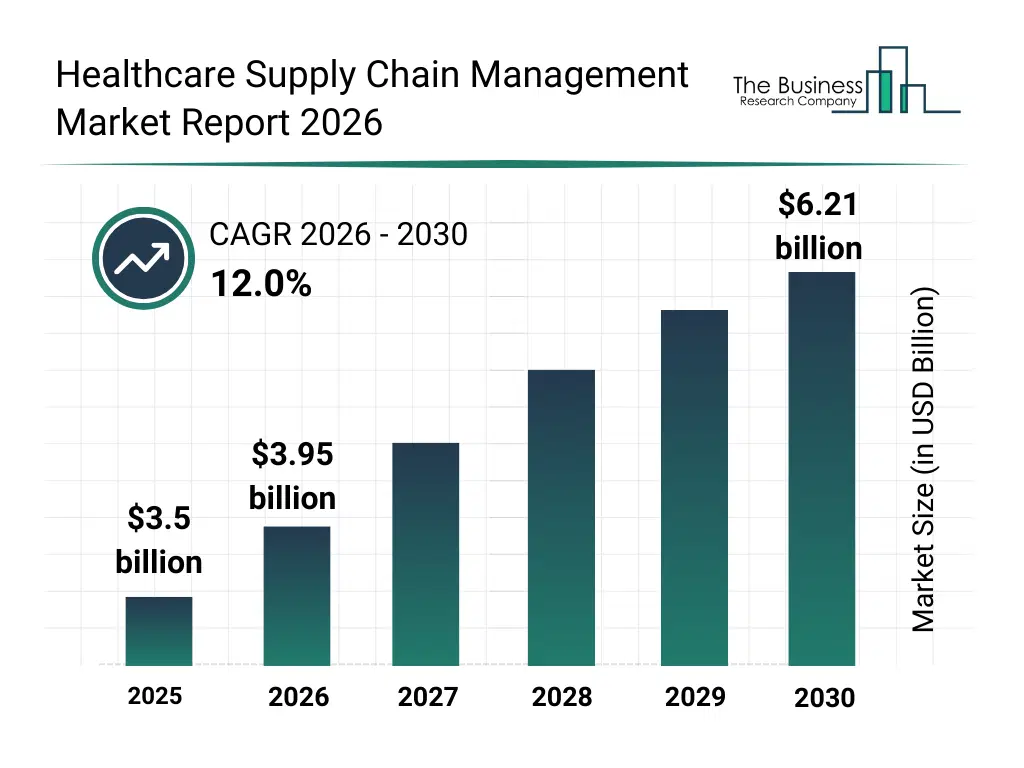
What Is The Healthcare Supply Chain Management Market Size and Share 2026?
The healthcare supply chain management market size has grown rapidly in recent years. It will grow from $3.5 billion in 2025 to $3.95 billion in 2026 at a compound annual growth rate (CAGR) of 12.8%. The growth in the historic period can be attributed to increasing complexity of healthcare logistics, rising demand for cost containment in hospitals, expansion of pharmaceutical distribution networks, growing use of inventory digitization tools, adoption of basic supply chain software.What Is The Healthcare Supply Chain Management Market Growth Forecast?
The healthcare supply chain management market size is expected to see rapid growth in the next few years. It will grow to $6.21 billion in 2030 at a compound annual growth rate (CAGR) of 12.0%. The growth in the forecast period can be attributed to increasing focus on predictive demand planning, rising investments in digital health infrastructure, growing need for resilient medical supply chains, expansion of analytics-driven procurement, increasing adoption of end-to-end visibility solutions. Major trends in the forecast period include increasing adoption of cloud-based inventory platforms, rising use of real-time supply chain analytics, growing integration of rfid and barcode tracking, expansion of centralized procurement models, enhanced focus on supply chain resilience.

Global Healthcare Supply Chain Management Market Segmentation
1) By Component: Software Application, Hardware Type 2) By Delivery Mode: On-Premise, Cloud-Based 3) By End-User: Healthcare Providers, Healthcare Manufacturers, Other End-Users Subsegments: 1) By Software Application: Inventory Management Software, Procurement Management Software, Supply Chain Analytics Software, Order Management Software 2) By Hardware Type: Barcode Scanners, RFID Systems, Mobile Computing Devices The top segments in the healthcare supply chain management market will be: • Software Application will reach $4.43 Billion by 2030. • Hardware Type will reach $1.75 Billion by 2030.What Is The Driver Of The Healthcare Supply Chain Management Market?
The expanding pharmaceutical industry is expected to boost the growth of the healthcare supply chain management market going forward. The pharmaceutical industry refers to the sector of the economy responsible for the research, development, production, and distribution of drugs and medications. A growing pharmaceutical industry leads to the production and distribution of a larger volume of medications. This necessitates more efficient supply chain management to ensure the timely and accurate delivery of pharmaceutical products to healthcare providers and patients. For instance, in January 2023, according to a report published by IQVIA Inc., a US-based pharmaceutical company, over the next five years, both global spending on and the demand for medicines are projected to rise, reaching an approximate total of $1.9 trillion by 2027. The increased access to medications has led to a 36% growth in medicine use, measured in defined daily doses, over the past decade. By 2027, specialty medicines are anticipated to account for around 43% of global spending and a majority share of 56% in developed markets. Global expenditure on cancer drugs is expected to reach $370 billion by 2027, driven by the introduction and utilization of innovative drugs, with limited impact from new biosimilars. Therefore, the increase in the geriatric population is driving the growth of the healthcare mobility solutions market.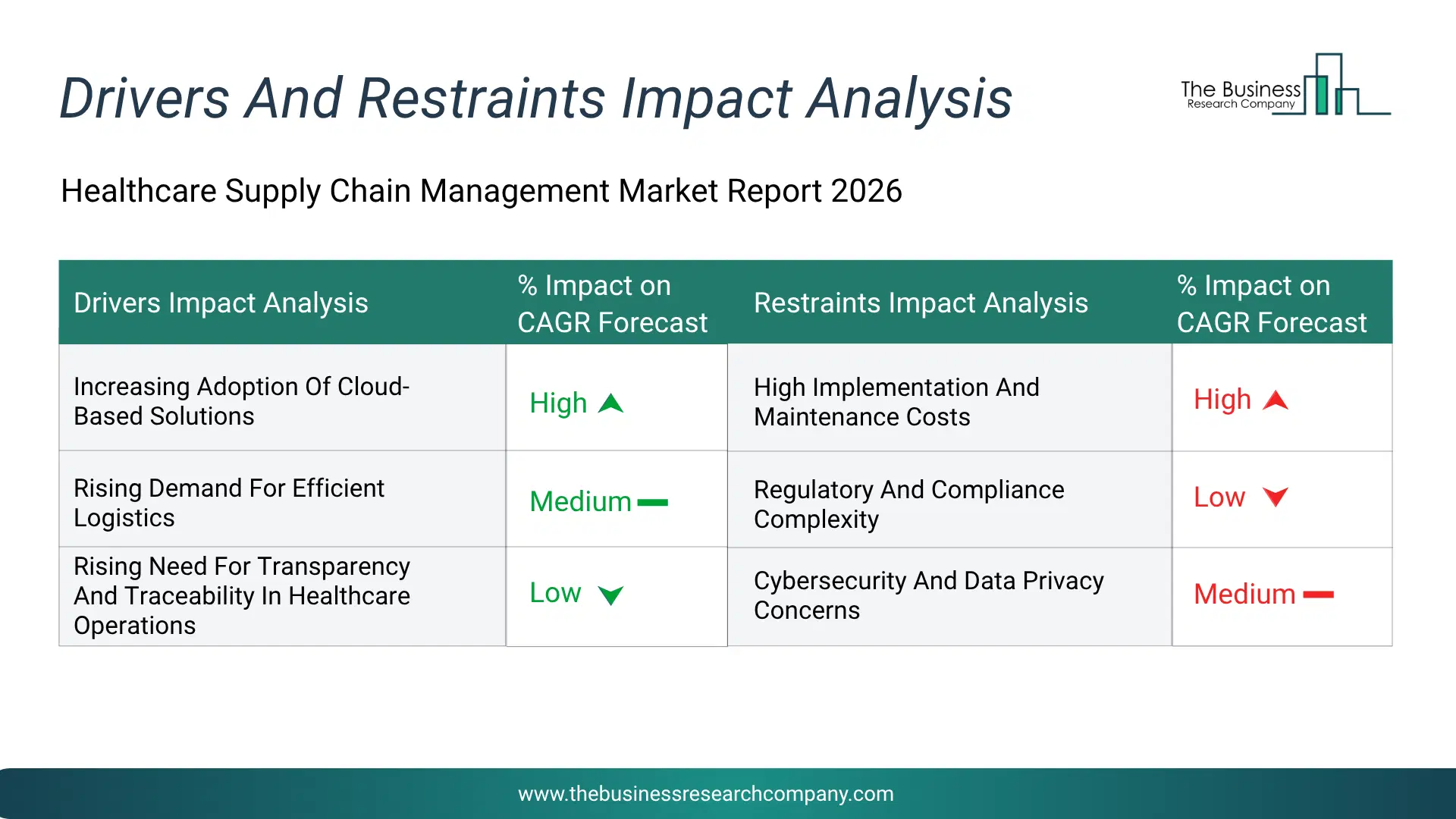
Infographic Chart Showing Key Market Drivers Analysis And Restraints For Healthcare Supply Chain Management Market
The chart presents an impact analysis of key drivers and restraints, quantifying their relative influence on the market's growth rate and helping assess the balance between growth enablers and limiting factors. This chart offers a high-level perspective; the full report contains more detailed insights.
How Will The Drivers Impact Growth In The Global Healthcare Supply Chain Management Market?
• Increasing Adoption Of Cloud-Based Solutions (High) – During the forecast period, the increasing adoption of cloud-based solutions is expected to become a key growth driver for the healthcare supply chain management market by 2030. Healthcare organizations are increasingly deploying cloud-enabled platforms to improve supply chain visibility, streamline procurement activities, and enable centralized management of inventory and supplier networks across multiple facilities. Cloud-based systems also support faster data sharing, scalability, and remote accessibility, allowing healthcare providers to respond more effectively to changing operational demands. In addition, these platforms enhance interoperability with hospital management systems and analytics tools, improving decision-making efficiency. • Rising Demand For Efficient Logistics (Medium) – During the forecast period, the rising demand for efficient logistics is expected to emerge as a major factor driving the expansion of the healthcare supply chain management market by 2030. Healthcare providers and manufacturers are focusing on improving transportation efficiency, warehouse coordination, and delivery accuracy to ensure uninterrupted availability of medical supplies and pharmaceutical products. The growing complexity of healthcare distribution networks is accelerating investments in route optimization, automated fulfillment systems, and real-time shipment monitoring technologies. Additionally, increasing patient expectations for timely healthcare services are encouraging organizations to modernize logistics operations. • Rising Need For Transparency And Traceability In Healthcare Operations (Low) – During the forecast period, the rising need for transparency and traceability in healthcare operations is expected to act as a key growth catalyst for the healthcare supply chain management market by 2030. Healthcare organizations are increasingly emphasizing end-to-end tracking of medical products, pharmaceuticals, and surgical equipment to improve compliance, reduce counterfeiting risks, and enhance patient safety. Advanced tracking technologies such as RFID, barcode systems, and digital monitoring platforms are being integrated into healthcare supply chains to improve visibility and accountability throughout procurement and distribution processes. Furthermore, growing regulatory requirements for accurate product tracking are reinforcing adoption of traceability-focused supply chain systems.How Will The Restraints Impact Growth In The Global Healthcare Supply Chain Management Market?
• High Implementation And Maintenance Costs (High) – During the forecast period, the high implementation and maintenance costs act as a major restraint for the healthcare supply chain management market by limiting adoption, especially among small and mid-sized healthcare providers. The initial investment required for software, hardware, and system integration can be significantly high, creating financial barriers. In addition, ongoing costs related to system upgrades, technical support, and employee training further increase the total cost of ownership. Many organizations hesitate to invest due to uncertain return on investment and budget constraints. This slows down the pace of digital transformation in supply chain operations. As a result, cost-related challenges restrict market expansion and reduce adoption rates across price-sensitive regions. • Regulatory And Compliance Complexity (Medium) – During the forecast period, the regulatory and compliance complexity restrains the healthcare supply chain management market as organizations must adhere to strict and evolving regulations. Compliance with standards related to drug safety, storage, transportation, and data handling requires continuous monitoring and system upgrades. These regulations vary across regions, making it difficult for global companies to maintain uniform operations. Non-compliance can lead to heavy penalties, legal issues, and reputational damage, increasing operational risks. The need for specialized expertise and compliance-focused systems adds to implementation challenges. This complexity discourages smaller players from adopting advanced solutions. Consequently, regulatory burdens slow down market growth and innovation. • Cybersecurity And Data Privacy Concerns (Low) – During the forecast period, the cybersecurity and data privacy concerns act as a significant restraint for the healthcare supply chain management market due to the sensitive nature of healthcare data. Supply chain systems handle critical information such as patient records, supplier details, and inventory data, making them attractive targets for cyberattacks. Any data breach can lead to financial losses, operational disruptions, and loss of trust among stakeholders. Organizations must invest heavily in security infrastructure, which increases overall costs and complexity. Additionally, strict data protection regulations require continuous monitoring and compliance measures. Fear of cyber threats and data misuse discourages adoption of digital supply chain solutions. This ultimately hampers the growth of the market.Key Players In The Global Healthcare Supply Chain Management Market
Major companies operating in the healthcare supply chain management market are SAP AG Group, Oracle Corporation, McKesson Corporation, TECSYS Inc., Global Healthcare Exchange LLC, Cardinal Health Inc., Epicor, Llamasoft Ltd., Manhattan Associates, Blue Yonder Group Inc., Cerner Corporation, Jump Technologies Inc., LogiTag Systems, Premier Ltd., Accurate InfoSoft Pvt. Ltd., Hybrent Inc., Arvato Systems, Jabil Inc., AmerisourceBergen Corporation, Infor Global Solutions, Henry Schein Inc., Becton Dickinson and Company, Owens & Minor Inc., Medtronic plc, Novo Nordisk AS, Stryker Corporation, F. Hoffmann-La Roche AG, Boston Scientific Corp., Biogen Inc., Johnson & Johnson Services Inc.
This chart is for illustrative purposes; the full report includes a detailed competitor analysis and comprehensive overview of the top 10 companies in the market.

This chart maps companies by product innovation and brand strength, with bubble size indicating relative revenue, helping identify market leaders, challengers, and niche players. This is an illustrative chart; the full report provides a complete and accurate competitive analysis.
Global Healthcare Supply Chain Management Market Trends and Insights
Major companies operating in the healthcare supply chain management market are developing advanced products, such as cloud-based platforms, to improve operational efficiency, enhance real-time data visibility, and streamline procurement, inventory, and logistics processes within healthcare organizations. Cloud-based platforms are digital infrastructures that operate on remote servers accessed via the internet, rather than being hosted on local or on-premise servers. For instance, in March 2024, United Parcel Service (UPS) Inc., a US-based shipping & receiving and supply chain management company launched UPS Supply Chain Symphony for UPS Healthcare. UPS Supply Chain Symphony is a cloud-based platform designed to enhance healthcare supply chain management by integrating various logistics components into a single system. This tool allows users to manage and visualize their warehouse and transportation data efficiently, providing insights that can optimize supply chain operations. Users can monitor shipment details from origin to destination, along with on-demand reports that detail UPS shipments, warehouse status, and inventory levels.What Are Latest Mergers And Acquisitions In The Healthcare Supply Chain Management Market?
In November 2025, UPS, a US-based package delivery and supply chain management company, acquired Andlauer Healthcare Group, for $1.6 billion. With this acquisition, UPS aims to expand its healthcare logistics capabilities, enhance temperature-controlled and specialized transportation services, and strengthen its position in the North American healthcare supply chain market. Andlauer Healthcare Group is a Canada-based provider of healthcare logistics and transportation solutions, offering temperature-sensitive and specialized delivery services for the pharmaceutical and healthcare industry.Regional Outlook
North America will be the largest region in the healthcare supply chain management market in 2025. Asia-Pacific is expected to be the fastest-growing region in the forecast period. The regions covered in this market report are Asia-Pacific, South East Asia, Western Europe, Eastern Europe, North America, South America, Middle East, Africa. The countries covered in this market report are Australia, Brazil, China, France, Germany, India, Indonesia, Japan, Taiwan, Russia, South Korea, UK, USA, Canada, Italy, Spain.What Defines the Healthcare Supply Chain Management Market?
The healthcare supply chain management market includes revenues earned by entities by providing supplu chain quality management, planning, supply chain automation and optimization, and supplier relationship and risk management services. The market value includes the value of related goods sold by the service provider or included within the service offering. Only goods and services traded between entities or sold to end consumers are included.How is Market Value Defined and Measured?
The market value is defined as the revenues that enterprises gain from the sale of goods and/or services within the specified market and geography through sales, grants, or donations in terms of the currency (in USD unless otherwise specified). The revenues for a specified geography are consumption values that are revenues generated by organizations in the specified geography within the market, irrespective of where they are produced. It does not include revenues from resales along the supply chain, either further along the supply chain or as part of other products.
This chart presents market attractiveness based on a quantitative evaluation of growth, competition, strategic alignment, and risk, offering a clear view of opportunity areas for decision-making. This chart is for illustrative purposes; the full report contains the complete analysis.

This chart highlights the Total Addressable Market (TAM) by estimating the maximum revenue opportunity using an assumption-driven approach, supporting strategic planning and opportunity sizing across markets. The chart is illustrative; the full report provides a more comprehensive analysis.
What Key Data and Analysis Are Included in the Healthcare Supply Chain Management Market Report 2026?
The healthcare supply chain management market research report is one of a series of new reports from The Business Research Company that provides market statistics, including industry global market size, regional shares, competitors with the market share, detailed market segments, market trends and opportunities, and any further data you may need to thrive in the healthcare supply chain management industry. The market research report delivers a complete perspective of everything you need, with an in-depth analysis of the current and future state of the industry.Healthcare Supply Chain Management Market Report Forecast Analysis
| Report Attribute | Details |
|---|---|
| Market Size Value In 2026 | $3.95 billion |
| Revenue Forecast In 2030 | $6.21 billion |
| Growth Rate | CAGR of 12.8% from 2026 to 2030 |
| Base Year For Estimation | 2025 |
| Actual Estimates/Historical Data | 2020-2025 |
| Forecast Period | 2026 - 2030 |
| Market Representation | Revenue in USD Billion and CAGR from 2026 to 2030 |
| Segments Covered | Component, Delivery Mode, End-User |
| Regional Scope | Asia-Pacific, Western Europe, Eastern Europe, North America, South America, Middle East, Africa |
| Country Scope | The countries covered in the report are Australia, Brazil, China, France, Germany, India, Indonesia, Japan, Taiwan, Russia, South Korea, UK, USA, Canada, Italy, Spain. |
| Key Companies Profiled | SAP AG Group, Oracle Corporation, McKesson Corporation, TECSYS Inc., Global Healthcare Exchange LLC, Cardinal Health Inc., Epicor, Llamasoft Ltd., Manhattan Associates, Blue Yonder Group Inc., Cerner Corporation, Jump Technologies Inc., LogiTag Systems, Premier Ltd., Accurate InfoSoft Pvt. Ltd., Hybrent Inc., Arvato Systems, Jabil Inc., AmerisourceBergen Corporation, Infor Global Solutions, Henry Schein Inc., Becton Dickinson and Company, Owens & Minor Inc., Medtronic plc, Novo Nordisk AS, Stryker Corporation, F. Hoffmann-La Roche AG, Boston Scientific Corp., Biogen Inc., Johnson & Johnson Services Inc. |
| Customization Scope | Request for Customization |
| Pricing And Purchase Options | Explore Purchase Options |