

Heat Moisture Exchanger Market Report 2026
Global Outlook – By Product Type (Hygroscopic Heat Moisture Exchangers, Hydrophobic Heat Moisture Exchangers, Combined Hygroscopic Hydrophobic Heat Moisture Exchangers, Disposable Heat Moisture Exchangers, Reusable Heat Moisture Exchangers), By Material (Polyurethane Foam, Polypropylene Materials, Electrostatic Filter Media), By Application (Intensive Care Units, Mechanical Ventilation, Anesthesia, Emergency Care, Neonatal Care), By End User (Hospitals, Specialty Clinics, Ambulatory Surgical Centers, Homecare Settings, Emergency Care Centers, Rehabilitation Centers) – Market Size, Trends, Strategies, and Forecast to 2030
Heat Moisture Exchanger Market Overview
• Heat Moisture Exchanger market size has reached to $1.02 billion in 2025 • Expected to grow to $1.43 billion in 2030 at a compound annual growth rate (CAGR) of 6.9% • Growth Driver: Surge In Respiratory Diseases And Chronic Pulmonary Disorders Fueling The Growth Of The Market Due To Rising Air Pollution Exposure And Respiratory Mortality Burden • North America was the largest region in 2025 and Asia-Pacific is the fastest growing region.What Is Covered Under Heat Moisture Exchanger Market?
A heat moisture exchanger is a respiratory device designed to retain heat and humidity from a patient’s exhaled breath and return it during inhalation. It functions as an artificial substitute for the natural warming and humidifying role of the upper airway. A heat moisture exchanger helps maintain appropriate moisture and temperature levels in the inhaled gases within a breathing circuit. The main product types of heat moisture exchanger include hygroscopic heat moisture exchangers, hydrophobic heat moisture exchangers, combined hygroscopic hydrophobic heat moisture exchangers, disposable heat moisture exchangers, and reusable heat moisture exchangers. Hygroscopic heat moisture exchangers refer to respiratory devices that conserve heat and moisture from exhaled air and return them during inhalation to help maintain airway humidity. These products are manufactured using polyurethane foam, polypropylene materials, and electrostatic filter media. They find application in intensive care units, mechanical ventilation, anesthesia, emergency care, and neonatal care, serving end users including hospitals, specialty clinics, ambulatory surgical centers, homecare settings, emergency care centers, and rehabilitation centers.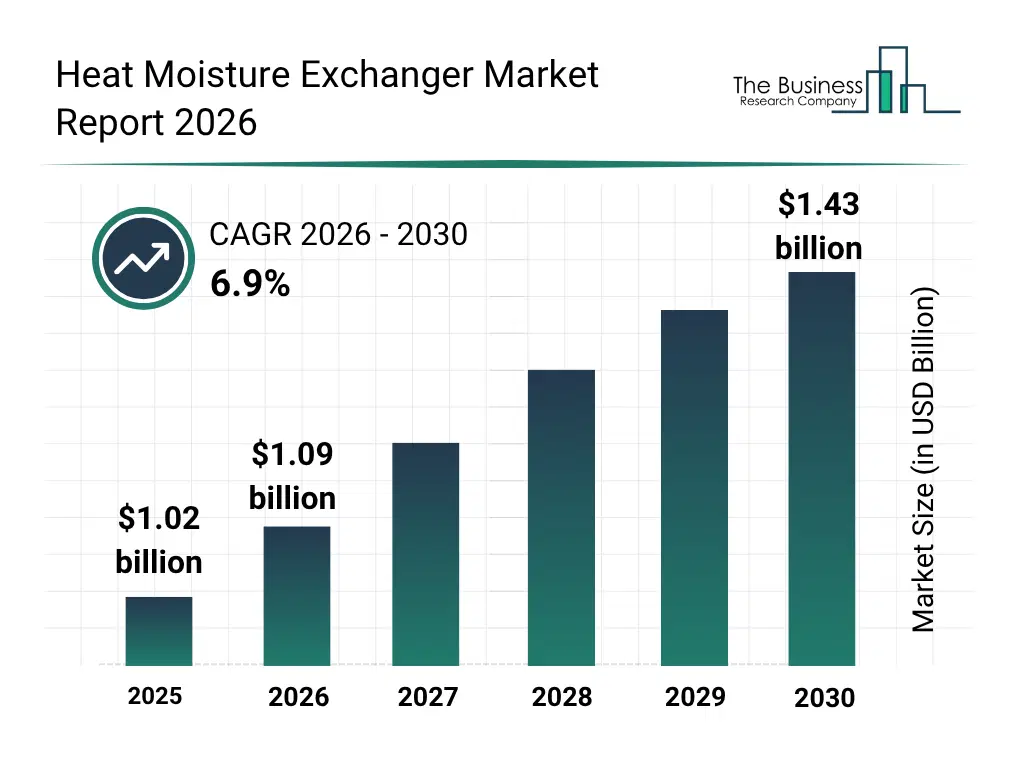
What Is The Heat Moisture Exchanger Market Size and Share 2026?
The heat moisture exchanger market size has grown strongly in recent years. It will grow from $1.02 billion in 2025 to $1.09 billion in 2026 at a compound annual growth rate (CAGR) of 7.3%. The growth in the historic period can be attributed to growth in mechanical ventilation usage in icus, increasing prevalence of respiratory diseases, expansion of hospital critical care infrastructure, rising adoption of anesthesia procedures, early development of basic hygroscopic hmex devices.What Is The Heat Moisture Exchanger Market Growth Forecast?
The heat moisture exchanger market size is expected to see strong growth in the next few years. It will grow to $1.43 billion in 2030 at a compound annual growth rate (CAGR) of 6.9%. The growth in the forecast period can be attributed to integration of smart respiratory monitoring systems, rising demand for infection-resistant disposable medical consumables, increasing adoption of portable ventilator technologies, growth in home-based respiratory care solutions, advancement in high-efficiency filtration materials for respiratory support. Major trends in the forecast period include rising adoption of advanced heat moisture exchangers in intensive care ventilation systems, increasing demand for high efficiency bacterial and viral filtration hmex devices in critical care settings, growing preference for disposable heat moisture exchangers to reduce infection risks in hospitals, expansion of neonatal and pediatric respiratory care applications driving specialized hmex usage, rising integration of lightweight low-resistance hmex devices in portable ventilator systems.
Global Heat Moisture Exchanger Market Segmentation
1) By Product Type: Hygroscopic Heat Moisture Exchangers; Hydrophobic Heat Moisture Exchangers; Combined Hygroscopic Hydrophobic Heat Moisture Exchangers; Disposable Heat Moisture Exchangers; Reusable Heat Moisture Exchangers 2) By Material: Polyurethane Foam; Polypropylene Materials; Electrostatic Filter Media 3) By Application: Intensive Care Units; Mechanical Ventilation; Anesthesia; Emergency Care; Neonatal Care 4) By End User: Hospitals; Specialty Clinics; Ambulatory Surgical Centers; Homecare Settings; Emergency Care Centers; Rehabilitation Centers Subsegments: 1) By Hygroscopic Heat Moisture Exchangers: Paper Based Hygroscopic Heat Moisture Exchanger; Foam Based Hygroscopic Heat Moisture Exchanger; Salt Coated Hygroscopic Heat Moisture Exchanger; High Moisture Retention Heat Moisture Exchanger; Low Resistance Hygroscopic Heat Moisture Exchanger 2) By Hydrophobic Heat Moisture Exchangers: Pleated Membrane Heat Moisture Exchanger; Bacterial Filtration Heat Moisture Exchanger; Viral Filtration Heat Moisture Exchanger; Water Repellent Membrane Heat Moisture Exchanger; High Efficiency Hydrophobic Heat Moisture Exchanger 3) By Combined Hygroscopic Hydrophobic Heat Moisture Exchangers: Dual Layer Heat Moisture Exchanger; Integrated Filter Heat Moisture Exchanger; High Filtration Combination Heat Moisture Exchanger; Ventilator Compatible Combination Heat Moisture Exchanger; Intensive Care Unit Grade Combined Heat Moisture Exchanger 4) By Disposable Heat Moisture Exchangers: Single Patient Use Heat Moisture Exchanger; Short Term Use Heat Moisture Exchanger; Sterile Disposable Heat Moisture Exchanger; Portable Disposable Heat Moisture Exchanger; Adult Disposable Heat Moisture Exchanger 5) By Reusable Heat Moisture Exchangers: Autoclavable Heat Moisture Exchanger; Multi Patient Reusable Heat Moisture Exchanger; Long Life Heat Moisture Exchanger; Washable Heat Moisture Exchanger; Durable Silicone Heat Moisture ExchangerWhat Are The Drivers Of The Heat Moisture Exchanger Market?
The rising prevalence of respiratory diseases and chronic pulmonary disorders is expected to propel the growth of the heat-moisture exchanger market going forward. Respiratory diseases and chronic pulmonary disorders refer to a group of conditions that affect the airways and lungs, leading to impaired breathing and long-term respiratory dysfunction. The rising prevalence of respiratory diseases and chronic pulmonary disorders is driven by increasing exposure to air pollution, which contributes to long-term lung damage and impaired respiratory function. A heat moisture exchanger helps in respiratory diseases and chronic pulmonary disorders by conserving heat and humidity in inhaled gases, thereby maintaining airway moisture, improving mucociliary function, and reducing the risk of airway dryness and associated complications in patients with impaired lung function. For instance, in May 2025, according to the Centers for Disease Control and Prevention, a US-based government public health agency, chronic obstructive pulmonary disease (COPD) was reported as the fifth leading cause of death in the United States in 2023, resulting in 141,733 deaths. In the same year, the age-adjusted prevalence of diagnosed COPD in adults aged 18 years and older was 3.8 percent. Therefore, the rising prevalence of respiratory diseases and chronic pulmonary disorders is driving the growth of the heat moisture exchanger industry. The expansion of hospital infrastructure is expected to propel the growth of the heat-moisture exchanger market going forward. Hospital infrastructure refers to the physical facilities, medical equipment, utilities, and support systems required for the effective delivery of healthcare services in hospitals. The expansion of hospital infrastructure is driven by rising healthcare demand, as growing patient populations and increasing chronic disease cases require advanced medical facilities and greater treatment capacity. Heat moisture exchangers help hospital infrastructure by improving respiratory care efficiency, reducing ventilator-associated complications, and supporting effective patient management in critical care settings. For instance, in April 2026, according to the UK Parliament, a UK-based government department announced a $69.83 billion (£60 billion) initiative in 2025 to deliver 46 new hospitals. Therefore, the expansion of hospital infrastructure is driving the growth of the heat moisture exchanger industry.Key Players In The Global Heat Moisture Exchanger Market
Major companies operating in the heat moisture exchanger market are Medtronic plc; Fisher & Paykel Healthcare Corporation Limited; Drägerwerk AG & Co. KGaA; ICU Medical Inc.; Hamilton Medical; BD (Becton Dickinson and Company); Intersurgical Limited; GVS S.p.A.; Medline Industries LP; Flexicare Medical Limited; Well Lead Medical Co. Ltd.; GaleMed Corporation; Eakin Healthcare Group Limited; Amsino International Inc.; Air Liquide Medical Systems S.A.S.; Angiplast Private Limited; Vadi Medical Technology Co. Ltd.; Besmed Health Business Corp.; Medikop Life Science Private Limited; SBRG MedTech Private Limited.What Are Latest Mergers And Acquisitions In The Heat Moisture Exchanger Market?
In October 2023, AirLife, a US-based respiratory care and medical device company, acquired the respiratory health business of Avanos Medical Inc. for an undisclosed amount. Through this acquisition, AirLife aimed to strengthen its respiratory care and ventilation consumables portfolio, expand airway management capabilities, and increase its presence in the respiratory devices market, including heat-moisture exchanger-related products. Avanos Medical, Inc. is a US-based company that manufactured and supplied heat moisture exchangers through its Respiratory Health division, BALLARD.Regional Outlook
North America was the largest region in the heat moisture exchanger market in 2025. Asia-Pacific is expected to be the fastest-growing region in the forecast period. The regions covered in this market report are Asia-Pacific, South East Asia, Western Europe, Eastern Europe, North America, South America, Middle East, Africa. The countries covered in this market report are Australia, Brazil, China, France, Germany, India, Indonesia, Japan, Taiwan, Russia, South Korea, UK, USA, Canada, Italy, Spain.What Defines the Heat Moisture Exchanger Market?
The heat moisture exchanger market consists of sales of airway humidification filter, ventilator humidification cartridge, and tracheal hme humidifier filter. Values in this market are ‘factory gate’ values, that is, the value of goods sold by the manufacturers or creators of the goods, whether to other entities (including downstream manufacturers, wholesalers, distributors, and retailers) or directly to end customers. The value of goods in this market includes related services sold by the creators of the goods.How is Market Value Defined and Measured?
The market value is defined as the revenues that enterprises gain from the sale of goods and/or services within the specified market and geography through sales, grants, or donations in terms of the currency (in USD unless otherwise specified). The revenues for a specified geography are consumption values that are revenues generated by organizations in the specified geography within the market, irrespective of where they are produced. It does not include revenues from resales along the supply chain, either further along the supply chain or as part of other products.What Key Data and Analysis Are Included in the Heat Moisture Exchanger Market Report 2026?
The heat moisture exchanger market research report is one of a series of new reports from The Business Research Company that provides market statistics, including industry global market size, regional shares, competitors with the market share, detailed market segments, market trends and opportunities, and any further data you may need to thrive in the heat moisture exchanger industry. The market research report delivers a complete perspective of everything you need, with an in-depth analysis of the current and future state of the industry.Heat Moisture Exchanger Market Report Forecast Analysis
| Report Attribute | Details |
|---|---|
| Market Size Value In 2026 | $1.09 billion |
| Revenue Forecast In 2030 | $1.43 billion |
| Growth Rate | CAGR of 6.9% from 2026 to 2030 |
| Base Year For Estimation | 2025 |
| Actual Estimates/Historical Data | 2020-2025 |
| Forecast Period | 2026 - 2030 |
| Market Representation | Revenue in USD Billion and CAGR from 2026 to 2030 |
| Segments Covered | Product Type, Material, Application, End User |
| Regional Scope | Asia-Pacific, Western Europe, Eastern Europe, North America, South America, Middle East, Africa |
| Country Scope | The countries covered in the report are Australia, Brazil, China, France, Germany, India, ... |
| Key Companies Profiled | Medtronic plc; Fisher & Paykel Healthcare Corporation Limited; Drägerwerk AG & Co. KGaA; ICU Medical Inc.; Hamilton Medical; BD (Becton Dickinson and Company); Intersurgical Limited; GVS S.p.A.; Medline Industries LP; Flexicare Medical Limited; Well Lead Medical Co. Ltd.; GaleMed Corporation; Eakin Healthcare Group Limited; Amsino International Inc.; Air Liquide Medical Systems S.A.S.; Angiplast Private Limited; Vadi Medical Technology Co. Ltd.; Besmed Health Business Corp.; Medikop Life Science Private Limited; SBRG MedTech Private Limited. |
| Customization Scope | Request for Customization |
| Pricing And Purchase Options | Explore Purchase Options |