
Heat Recovery Steam Generator Market Report 2026
Global Outlook – By Design Type (Modular Construction, C-Section Construction, Bundle Construction, Fully Assembled), By Configuration Type (Horizontal Drum Units, Vertical Drum Units, Horizontal-Once Through Units), By Output Power Type (0 To 60 Megawatt (MW), 60 To 100 Megawatt (MW), 100 Megawatt (MW) And Above), By Application Type (Co-Generation (Process Heating), Combined Cycle, Combined Heat And Power (CHP)), By End User (Utility, Chemicals, Refineries, Pulp And Paper, Other End Users) – Market Size, Trends, Strategies, and Forecast to 2030
Heat Recovery Steam Generator Market Overview
• Heat Recovery Steam Generator market size has reached to $1.79 billion in 2025 • Expected to grow to $2.34 billion in 2030 at a compound annual growth rate (CAGR) of 5.5% • Growth Driver: Industrial Sector Expansion To Fuel Growth In Heat Recovery Steam Generator Market • Market Trend: Enhancing Power Generation Sustainability With Future-Fuel Flexibility • North America was the largest region in 2025 and Asia-Pacific is the fastest growing region.Market Gains By 2030 – Top Opportunities By Segment
Market Gain identifies the most promising market opportunities by highlighting the segments or products expected to generate the highest incremental revenue growth over the next five years.
What Is Covered Under Heat Recovery Steam Generator Market?
A heat recovery steam generator (HRSG) is an energy recovery device that captures waste heat from exhaust gases, typically from gas turbines or other industrial processes, and converts it into steam. This steam can then be used to drive a steam turbine for power generation or utilized in industrial heating processes. HRSGs are integral to combined cycle power plants, enhancing overall efficiency by utilizing otherwise wasted heat. The main design types of heat recovery steam generators are modular construction, c-section construction, bundle construction, and fully assembled. Modular construction refers to heat recovery steam generators (HRSGs) built in separate, prefabricated modules that are assembled on-site. The configuration is horizontal drum units, vertical drum units, and horizontal-once through units, and the output power is 0 to 60 megawatts (MW), 60 to 100 megawatts (MW), 100 megawatts (MW) and above. The application includes co-generation (process heating), combined cycle, and combined heat and power (CHP), and it is used by various end users such as utilities, chemicals, refineries, pulp and paper, and others.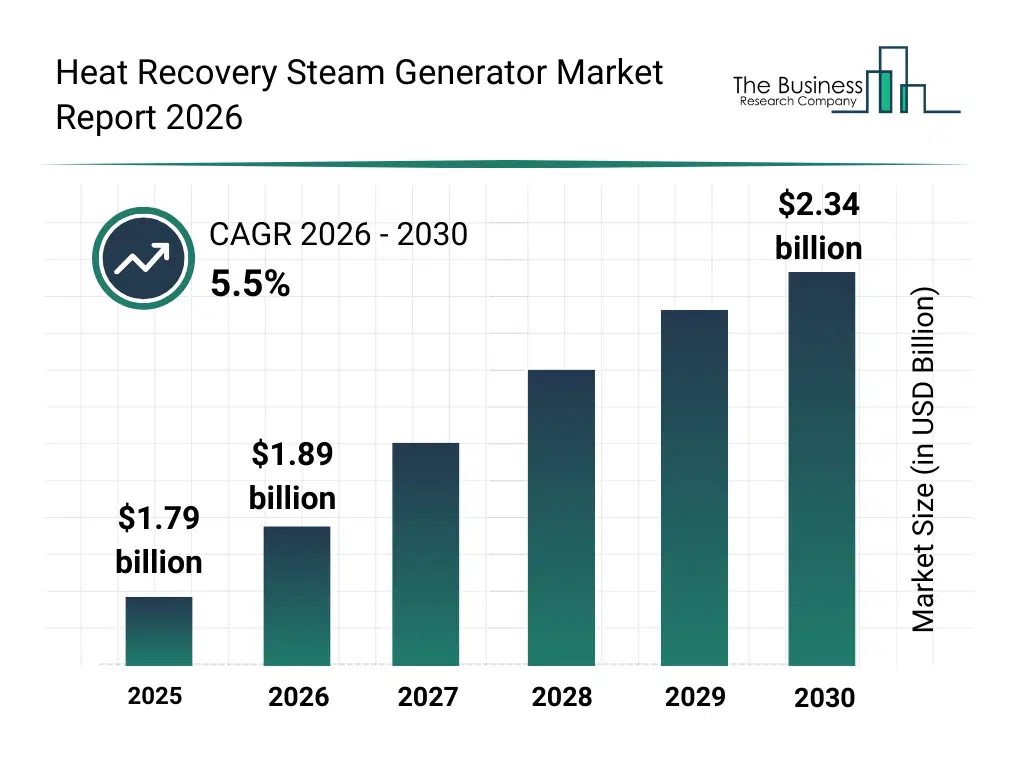
What Is The Heat Recovery Steam Generator Market Size and Share 2026?
The heat recovery steam generator market size has grown strongly in recent years. It will grow from $1.79 billion in 2025 to $1.89 billion in 2026 at a compound annual growth rate (CAGR) of 5.5%. The growth in the historic period can be attributed to expansion of gas-based power generation, need for improved plant efficiency, growth of industrial steam demand, replacement of conventional boilers, investment in large-scale power infrastructure.What Is The Heat Recovery Steam Generator Market Growth Forecast?
The heat recovery steam generator market size is expected to see strong growth in the next few years. It will grow to $2.34 billion in 2030 at a compound annual growth rate (CAGR) of 5.5%. The growth in the forecast period can be attributed to decarbonization of power sector, expansion of combined heat and power plants, investments in flexible power generation, demand for high-efficiency thermal systems, growth in industrial energy recovery. Major trends in the forecast period include expansion of combined cycle power plants, increasing focus on waste heat utilization, demand for high-efficiency steam generation systems, adoption of modular hrsg designs, growth in industrial co-generation projects.
Global Heat Recovery Steam Generator Market Segmentation
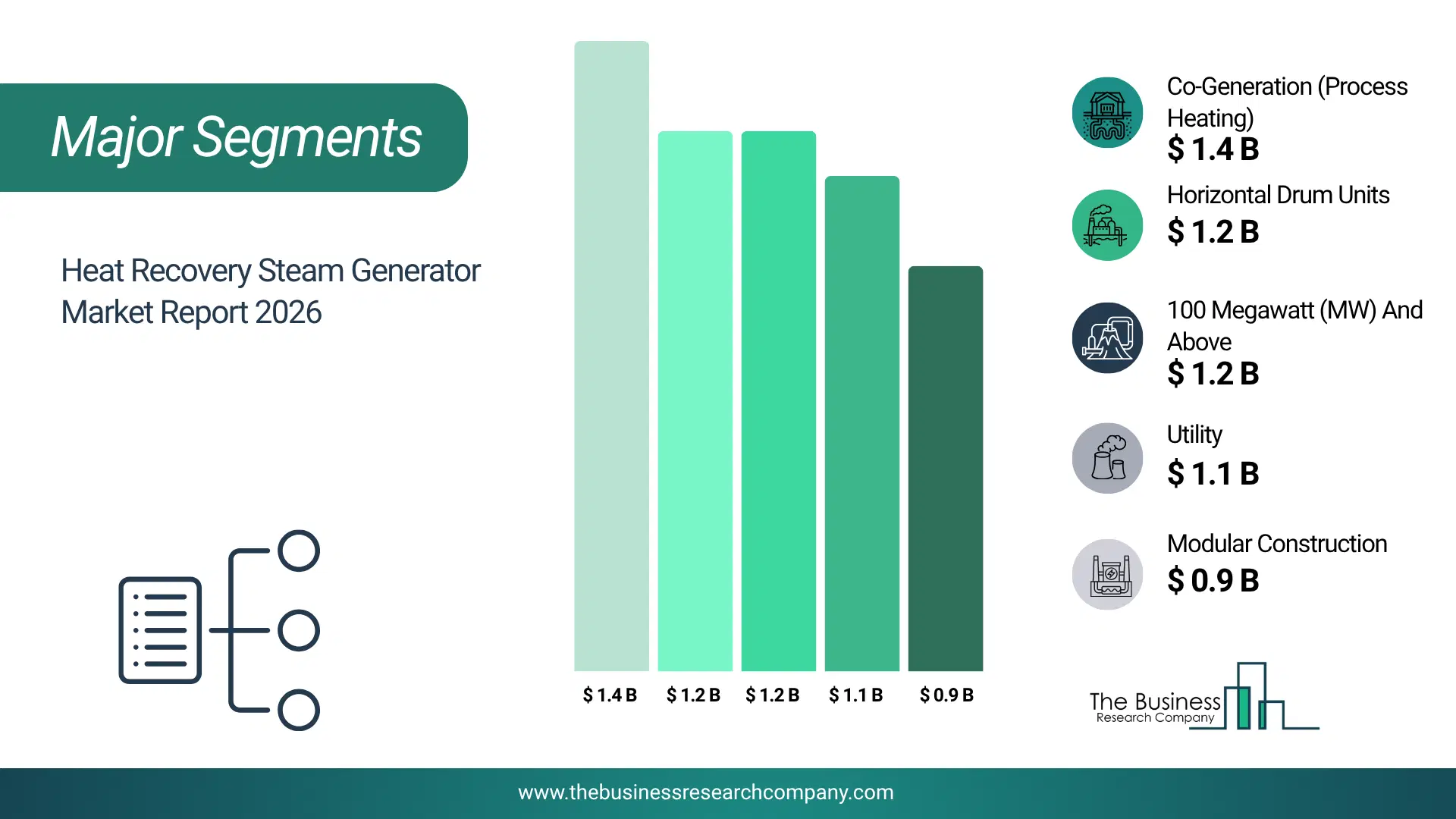
1) By Design Type: Modular Construction, C-Section Construction, Bundle Construction, Fully Assembled 2) By Configuration Type: Horizontal Drum Units, Vertical Drum Units, Horizontal-Once Through Units 3) By Output Power Type: 0 To 60 Megawatt (MW), 60 To 100 Megawatt (MW), 100 Megawatt (MW) And Above 4) By Application Type: Co-Generation (Process Heating), Combined Cycle, Combined Heat And Power (CHP) 5) By End User: Utility, Chemicals, Refineries, Pulp And Paper, Other End Users Subsegments: 1) By Modular Construction: Pre-Fabricated Modules, Skid-Mounted Modules, Compact Modular Systems 2) By C-Section Construction: Horizontal C-Section HRSGs, Vertical C-Section HRSGs, Single-Pressure C-Section HRSGs 3) By Bundle Construction: Horizontal Bundle HRSGs, Vertical Bundle HRSGs, Double Pressure Bundle HRSGs 4) By Fully Assembled: Factory-Assembled HRSGs, Site-Assembled HRSGs, Custom-Built Fully Assembled Units The top segments in the heat recovery steam generator market will be: • Co-Generation (Process Heating) will reach $1485.43 Million by 2030. • Horizontal Drum Units will reach $1274.7 Million by 2030. • 100 Megawatt (MW) And Above will reach $1190.7 Million by 2030. • Utility will reach $1179 Million by 2030. • Modular Construction will reach $969.61 Million by 2030.What Is The Driver Of The Heat Recovery Steam Generator Market?
The expansion of the industrial sector is expected to propel the heat recovery steam generator market going forward. The industrial sector refers to the part of the economy involved in producing goods through manufacturing, construction, and related industries. The industrial sector is expanding due to increased demand for manufactured goods and technological advancements driving efficiency and production. A heat recovery steam generator (HRSG) in the industrial sector is used to capture and convert waste heat from industrial processes into steam, improving energy efficiency and reducing fuel consumption. For instance, in July 2023, according to Eurostat, a Luxembourg-based government statistical agency, in May 2023, seasonally adjusted industrial production in the European area rose by 0.2%, while in the European Union, it increased by 0.1% compared to April 2023. Therefore, the expansion of the industrial sector is driving the heat recovery steam generator industry.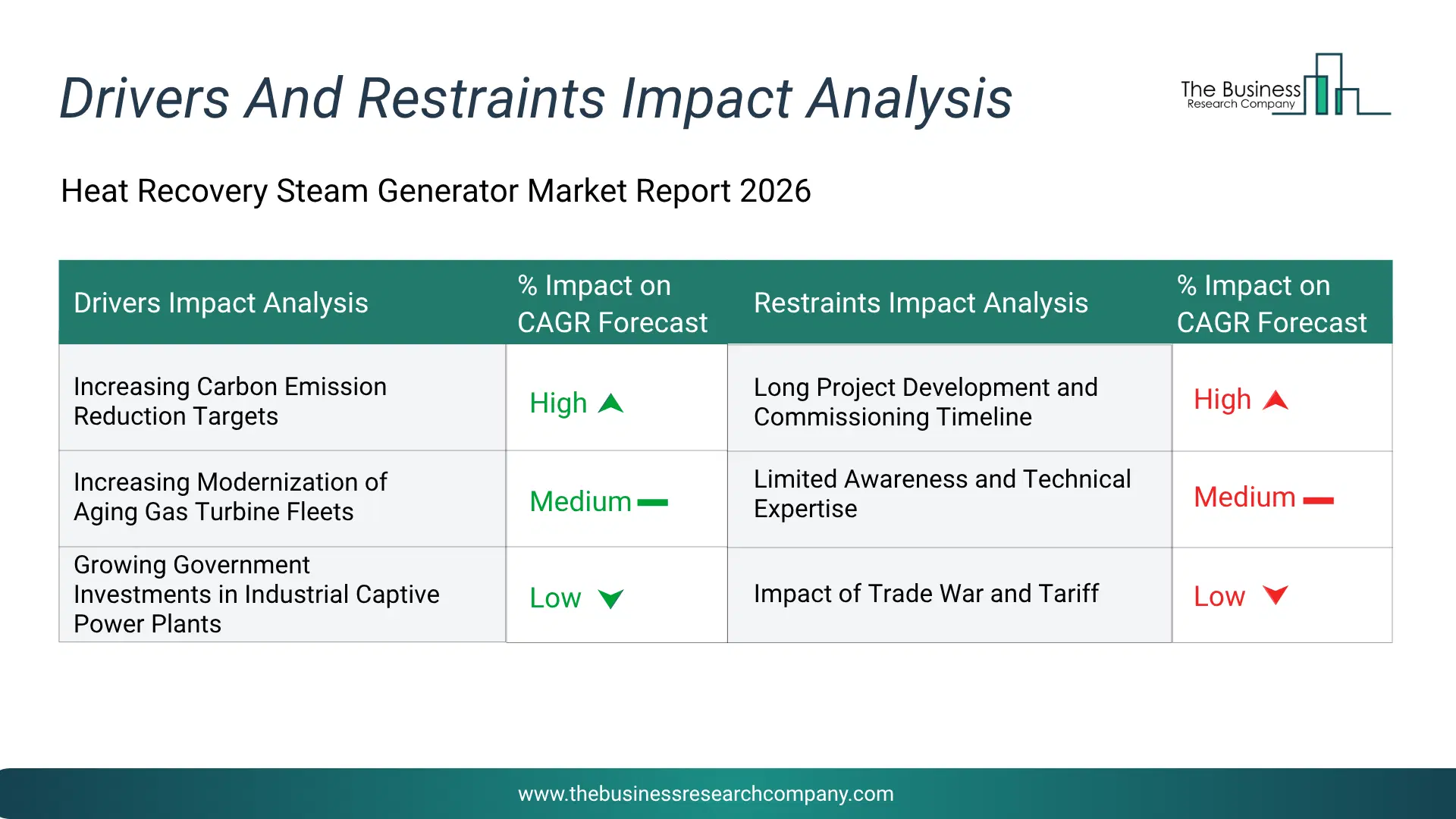
Infographic Chart Showing Key Market Drivers Analysis And Restraints For Heat Recovery Steam Generator Market
The chart presents an impact analysis of key drivers and restraints, quantifying their relative influence on the market's growth rate and helping assess the balance between growth enablers and limiting factors. This chart offers a high-level perspective; the full report contains more detailed insights.
How Will The Drivers Impact Growth In The Global Heat Recovery Steam Generator Market?
• Increasing Carbon Emission Reduction Targets (High) – During the forecast period, the increasing carbon emission reduction target will propel the growth of the heat recovery steam generator market. HRSGs enable the recovery of waste heat from gas turbines, significantly improving overall plant efficiency and reducing fuel consumption per unit of electricity generated. This efficiency enhancement directly supports decarbonization goals by lowering carbon dioxide emissions without compromising power output. As regulatory pressure intensifies to phase down coal-based generation and improve the environmental performance of thermal power assets, HRSG-equipped combined cycle plants are increasingly favored as a cleaner transitional solution, reinforcing sustained demand for advanced and high-performance HRSG technologies. The increasing carbon emission reduction target growth contribution during the forecast period in 2025 is 2.0 %. • Increasing Modernization of Aging Gas Turbine Fleets (Medium) – During the forecast period, increasing modernization of aging gas turbine fleets is expected to be a key driver of the growth of the heat recovery steam generator market in the forecast period. many existing gas turbine installations operate with outdated or less efficient heat recovery systems, creating opportunities for hrsg retrofits, replacements and performance upgrades. modern hrsg designs offer improved thermal efficiency, enhanced operational flexibility and better compatibility with advanced gas turbines, making them central to plant life-extension strategies. as power producers prioritize asset optimization over greenfield expansion, demand for technologically advanced hrsgs capable of supporting fast-cycling and variable load operations continues to rise. the increasing modernization of aging gas turbine fleets growth contribution during the forecast period in 2025 is 1.0%. • Growing Government Investments in Industrial Captive Power Plants (Low) – During the forecast period, during the forecast period, the growing government investments in industrial captive power plants will propel the growth of the heat recovery steam generator market. captive power plants increasingly rely on gas-based combined cycle configurations to ensure stable energy supply, cost control and compliance with environmental regulations. hrsgs play a vital role in these systems by maximizing energy recovery and enabling combined heat and power applications, which improve overall energy utilization within industrial facilities. as governments promote industrial competitiveness, energy security and emissions reduction through policy support and infrastructure development, hrsg-based captive power solutions are gaining traction across multiple industrial sectors. the growing government investments in industrial captive power plants growth contribution during the forecast period in 2025 is 0.8%. • Growing Demand for Renewable Energy Sources (Low) – During the forecast period, growing demand for renewable energy sources is expected to be a key driver of the growth of the heat recovery steam generator market in the forecast period. as renewable energy penetration rises, grid operators require fast-responding and high-efficiency thermal power plants to maintain grid stability during fluctuations in wind and solar generation. hrsg-based combined cycle power plants play a critical role in this transition by enabling higher efficiency power generation with lower fuel consumption and emissions compared to conventional thermal plants. the ability of modern hrsgs to support rapid start-up, cycling and efficient waste heat utilization positions them as an essential component in hybrid power systems that balance renewable energy with reliable baseload and backup power generation. the growing demand for renewable energy sources growth contribution during the forecast period in 2025 is 0.5%.How Will The Restraints Impact Growth In The Global Heat Recovery Steam Generator Market?
• Long Project Development and Commissioning Timeline (High) – During the forecast period, long project development and commissioning timeline is restricting the growth of the heat recovery steam generator market during the forecast period. hrsg projects involve detailed engineering, customized design, manufacturing of large pressure components, complex logistics and careful on-site assembly, all of which contribute to extended execution schedules. these prolonged timelines increase project risk exposure, raise financing costs and reduce flexibility for power producers responding to rapidly changing energy market conditions. in markets where faster deployment is critical to meet demand or policy targets, lengthy hrsg project cycles can discourage investment and slow the pace of new installations. growth affected by the long project development and commissioning timeline during the forecast period in 2025 is -2.0%. • Limited Awareness and Technical Expertise (Medium) – During the forecast period, limited awareness and technical expertise are restricting the growth of the heat recovery steam generator market during the forecast period. hrsg systems require specialized knowledge in thermal engineering, combined cycle integration, water and steam chemistry management and advanced control systems. a shortage of skilled personnel for design, installation and long-term operation can lead to concerns over reliability, maintenance complexity and operational risks. these capability gaps can make utilities and industrial users hesitant to adopt or upgrade hrsg systems, slowing market penetration and increasing reliance on established or less complex power generation alternatives. growth affected by the limited awareness and technical expertise during the forecast period in 2025 is -1.5%. • Impact of Trade War and Tariff (Low) – During the forecast period, the impact of the trade war and tariffs restricting the growth of the heat recovery steam generator market during the forecast period. hrsg manufacturing relies on specialized materials, pressure vessels and fabricated modules that are often sourced internationally. tariffs and trade restrictions raise procurement costs, lengthen delivery timelines and introduce uncertainty into project economics. this cost volatility can discourage cross-border investments, delay project approvals and reduce competitiveness for manufacturers and epc contractors, ultimately slowing the pace of hrsg deployment and limiting market growth. growth affected by the impact of the trade war and tariffs during the forecast period in 2025 is -0.3%.Key Players In The Global Heat Recovery Steam Generator Market
Major companies operating in the heat recovery steam generator market are General Electric Company, Siemens Energy AG, Mitsubishi Heavy Industries Ltd., Hitachi Ltd., Alstom SA, Kawasaki Heavy Industries Ltd., Sumitomo Heavy Industries Ltd., Bharat Heavy Electricals Limited, John Wood Group PLC, Babcock & Wilcox Enterprises Inc., Nooter/Eriksen Inc., Thermax Limited, Hamon & Cie International, Rentech Boiler Systems Inc., Clyde Bergemann Power Group, Bosch Industriekessel GmbH, Doosan Heavy Industries & Construction, John Cockerill, Aalborg Industries, and CMI Energy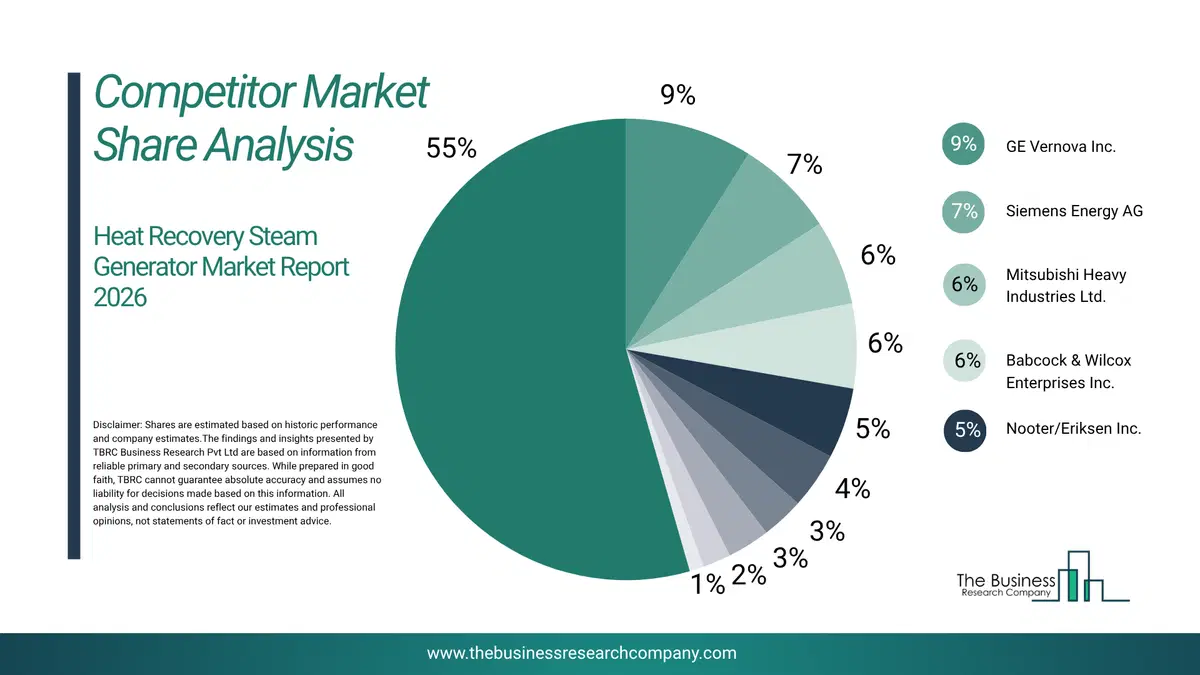
This chart is for illustrative purposes; the full report includes a detailed competitor analysis and comprehensive overview of the top 10 companies in the market.
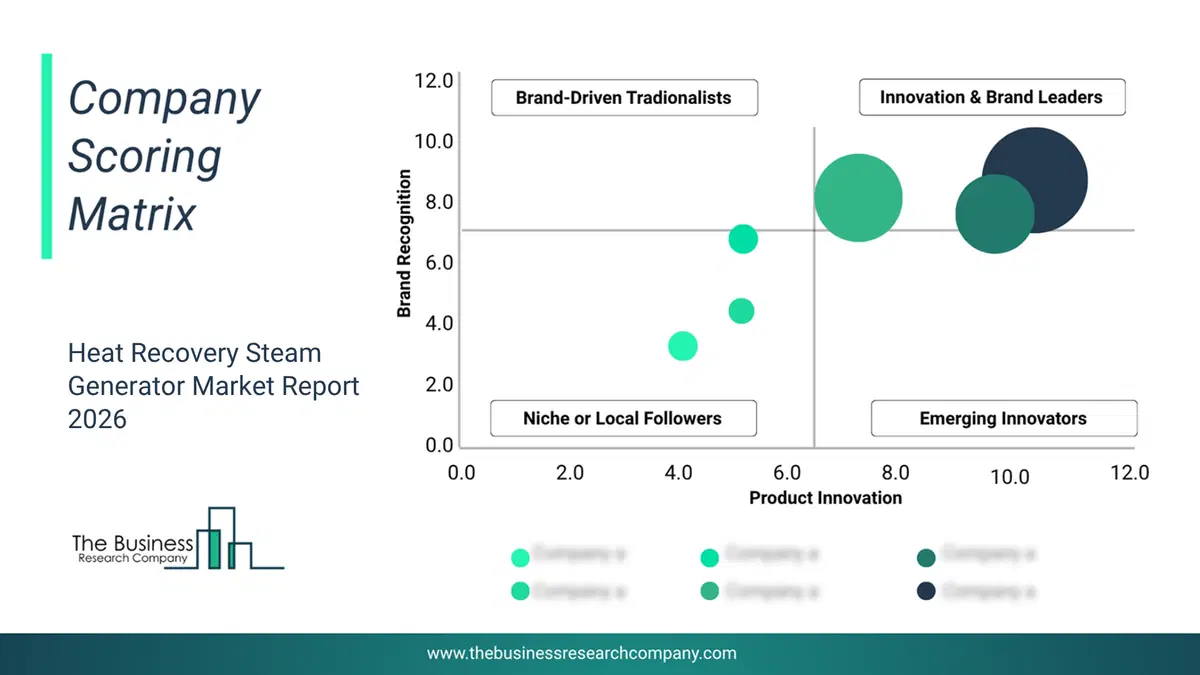
This chart maps companies by product innovation and brand strength, with bubble size indicating relative revenue, helping identify market leaders, challengers, and niche players. This is an illustrative chart; the full report provides a complete and accurate competitive analysis.
Global Heat Recovery Steam Generator Market Trends and Insights
Major companies operating in the heat‑recovery steam generator market are developing innovative products, such as hydrogen‑ready heat recovery steam generator (HRSG) systems, to support the transition to zero‑carbon power generation. A hydrogen‑ready HRSG is a conventional heat‑recovery steam generator modified to operate using hydrogen (instead of fossil fuels), incorporating design, safety and combustion adaptations so it can recover turbine exhaust‑heat and convert it to steam while supporting hydrogen’s combustion characteristics. For instance, in January 2025, John Cockerill a Belgium‑based power‑equipment manufacturer announced that it had been awarded a “Concept Certificate” by TÜV‑SÜD for the H₂‑readiness of its HRSGs (including both drum‑type and once‑through boiler variants), certifying that its heat‑recovery boilers are ready to operate with up to 100% hydrogen. The modified HRSG design includes controls for ventilation, purging, fire/explosion protection and safety analyses ensuring safe operation under hydrogen combustion. This hydrogen‑ready HRSG can be used in combined‑cycle or cogeneration plants, offering power and/or steam output similar to traditional HRSGs, but aligned with decarbonization targets and future‑fuel flexibility.What Are Latest Mergers And Acquisitions In The Heat Recovery Steam Generator Market?
In March 2025, Bharat Heavy Electricals Limited (BHEL), an India‑based power equipment manufacturing company, partnered with Vogt Power International Inc. (VPI) for heat recovery steam generators (HRSGs). With this collaboration, BHEL aims to strengthen its technological capabilities in HRSG design and supply, maintaining competitiveness in combined‑cycle and cogeneration power projects. Vogt Power International Inc. is a US–based boiler and HRSG technology company which specializes in providing HRSG designs, engineering expertise, and components for efficient steam-generation systems used in power and industrial applications.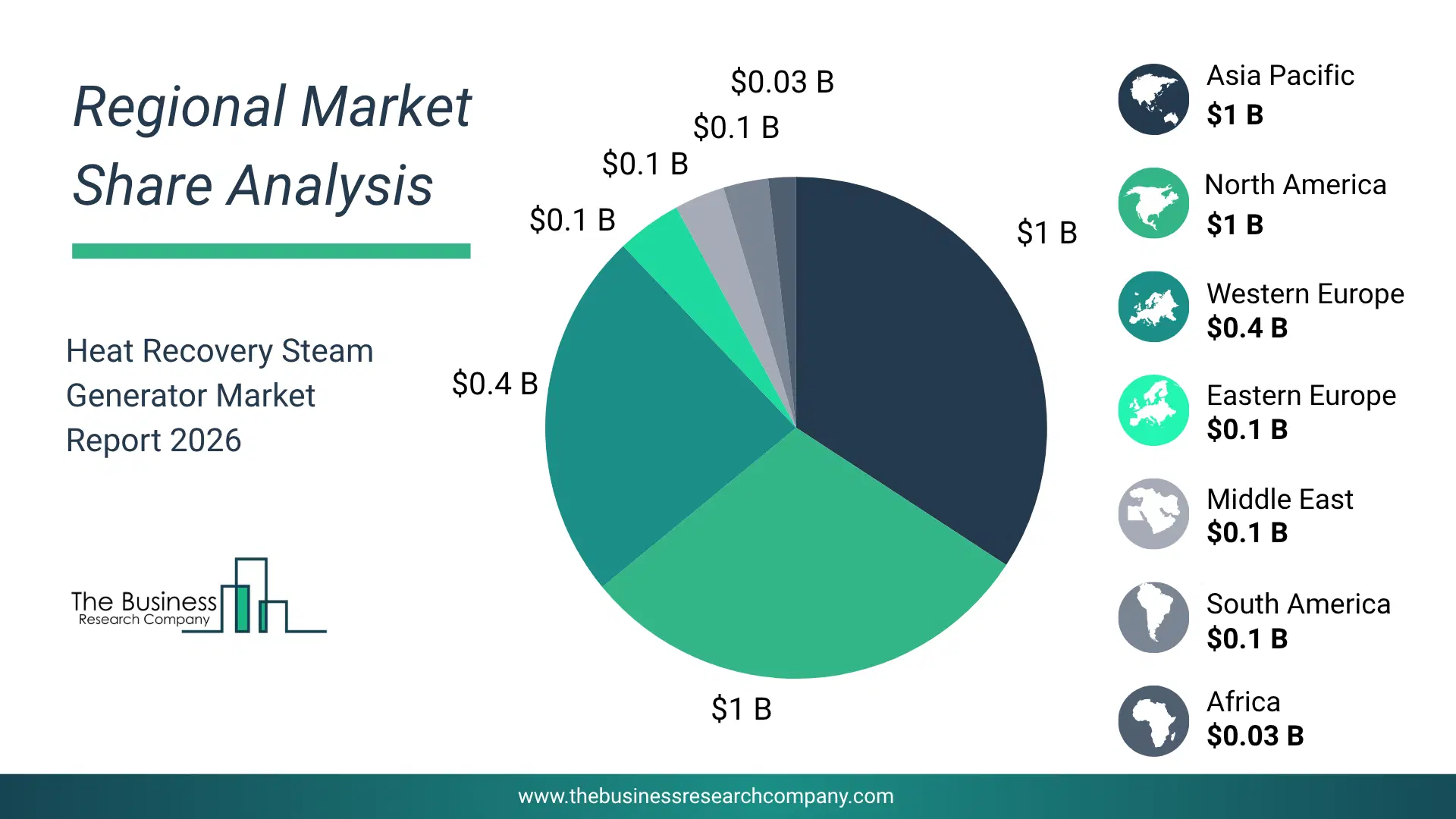
Regional Outlook
North America was the largest region in the heat recovery steam generator market in 2025. Asia-Pacific is expected to be the fastest-growing region in the forecast period. The regions covered in this market report are Asia-Pacific, South East Asia, Western Europe, Eastern Europe, North America, South America, Middle East, Africa The countries covered in this market report are Australia, Brazil, China, France, Germany, India, Indonesia, Japan, Taiwan, Russia, South Korea, UK, USA, Canada, Italy, Spain.What Defines the Heat Recovery Steam Generator Market?
The heat recovery steam generator market consists of sales of natural circulation heat recovery steam generators, dual pressure heat recovery steam generators, triple pressure heat recovery steam generators, modular heat recovery steam generators, and forced circulation heat recovery steam generators. Values in this market are ‘factory gate’ values, that is, the value of goods sold by the manufacturers or creators of the goods, whether to other entities (including downstream manufacturers, wholesalers, distributors, and retailers) or directly to end customers. The value of goods in this market includes related services sold by the creators of the goods.How is Market Value Defined and Measured?
The market value is defined as the revenues that enterprises gain from the sale of goods and/or services within the specified market and geography through sales, grants, or donations in terms of the currency (in USD unless otherwise specified). The revenues for a specified geography are consumption values that are revenues generated by organizations in the specified geography within the market, irrespective of where they are produced. It does not include revenues from resales along the supply chain, either further along the supply chain or as part of other products.
This chart presents market attractiveness based on a quantitative evaluation of growth, competition, strategic alignment, and risk, offering a clear view of opportunity areas for decision-making. This chart is for illustrative purposes; the full report contains the complete analysis.

This chart highlights the Total Addressable Market (TAM) by estimating the maximum revenue opportunity using an assumption-driven approach, supporting strategic planning and opportunity sizing across markets. The chart is illustrative; the full report provides a more comprehensive analysis.
What Key Data and Analysis Are Included in the Heat Recovery Steam Generator Market Report 2026?
The heat recovery steam generator market research report is one of a series of new reports from The Business Research Company that provides market statistics, including industry global market size, regional shares, competitors with the market share, detailed market segments, market trends and opportunities, and any further data you may need to thrive in the heat recovery steam generator industry. The market research report delivers a complete perspective of everything you need, with an in-depth analysis of the current and future state of the industry.Heat Recovery Steam Generator Market Report Forecast Analysis
| Report Attribute | Details |
|---|---|
| Market Size Value In 2026 | $1.89 billion |
| Revenue Forecast In 2030 | $2.34 billion |
| Growth Rate | CAGR of 5.5% from 2026 to 2030 |
| Base Year For Estimation | 2025 |
| Actual Estimates/Historical Data | 2020-2025 |
| Forecast Period | 2026 - 2030 - 2035 |
| Market Representation | Revenue in USD Billion and CAGR from 2026 to 2030 |
| Segments Covered | Design Type, Configuration Type, Output Power Type, Application Type, End User |
| Regional Scope | Asia-Pacific, Western Europe, Eastern Europe, North America, South America, Middle East, Africa |
| Country Scope | The countries covered in the report are Australia, Brazil, China, France, Germany, India, Indonesia, Japan, Taiwan, Russia, South Korea, UK, USA, Canada, Italy, Spain. |
| Key Companies Profiled | General Electric Company, Siemens Energy AG, Mitsubishi Heavy Industries Ltd., Hitachi Ltd., Alstom SA, Kawasaki Heavy Industries Ltd., Sumitomo Heavy Industries Ltd., Bharat Heavy Electricals Limited, John Wood Group PLC, Babcock & Wilcox Enterprises Inc., Nooter/Eriksen Inc., Thermax Limited, Hamon & Cie International, Rentech Boiler Systems Inc., Clyde Bergemann Power Group, Bosch Industriekessel GmbH, Doosan Heavy Industries & Construction, John Cockerill, Aalborg Industries, and CMI Energy |
| Customization Scope | Request for Customization |
| Pricing And Purchase Options | Explore Purchase Options |