

Heating Equipment (Except Warm Air Furnaces) Market Report 2026
Global Outlook – By Equipment Type (Boilers and Hydronic Heating Equipment, Steam Heating Equipment, Electric Process Heating Equipment, Thermal Fluid (Hot Oil) Heating Systems, Laboratory and Analytical Heating Equipment, Supplemental and Temporary Heating Equipment), By Energy Source (Electric, Natural Gas, Oil, Biomass), By Application (Industrial Process Heating, Laboratory and Analytical Heating, Commercial Building Heating, District and Institutional Heating, Other Applications), By End-Use Industry (Chemicals and Petrochemicals, Pharmaceuticals and Biotechnology, Food and Beverage Processing, Oil and Gas, Power Generation, Research and Academic Laboratories, Commercial and Institutional Facilities) – Market Size, Trends, Strategies, and Forecast to 2030
Heating Equipment (Except Warm Air Furnaces) Market Overview
• Heating Equipment (Except Warm Air Furnaces) market size has reached to $55.79 billion in 2025 • Expected to grow to $75.05 billion in 2030 at a compound annual growth rate (CAGR) of 6.3% • Growth Driver: Residential Construction Boom Is A Catalyst For Surging Demand In The Heating Equipment Market • Market Trend: Air-To-Water Heat Pump Gaining Popularity • North America was the largest region in 2025.What Is Covered Under Heating Equipment (Except Warm Air Furnaces) Market?
Heating equipment (except for warm air furnaces) is a device that heats either the air or a liquid to provide warmth, using an energy source. This equipment is used to perform industrial and commercial operations such as purification of solvents by distillation, extraction using rotary evaporators, and determination of physical parameters such as boiling point, melting point, flashpoint, and others. The main types of heating equipment (except warm air furnaces) are fireplaces, wood-burning stoves, supplemental heaters, low-pressure steam, hot water boilers, and furnaces. The fireplace is an open area built into the structure of a home where a fire can be safely contained to generate heat and provide a relaxing atmosphere, while waste gases and smoke are allowed to leave via a chimney. The various business types include new construction and retrofits. These are used in various applications such as household, commercial, and industrial.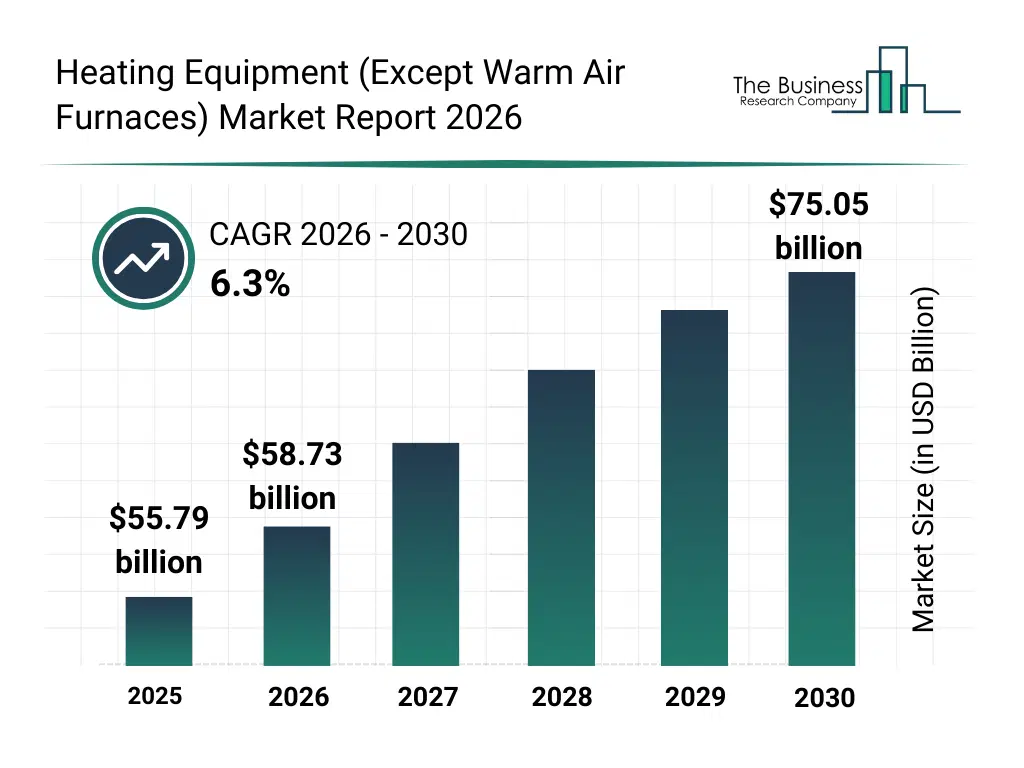
What Is The Heating Equipment (Except Warm Air Furnaces) Market Size and Share 2026?
The heating equipment (except warm air furnaces) market size has grown strongly in recent years. It will grow from $55.79 billion in 2025 to $58.73 billion in 2026 at a compound annual growth rate (CAGR) of 5.3%. The growth in the historic period can be attributed to expansion of industrial processing facilities, demand for precise temperature control, growth of laboratory testing activities, adoption of boiler-based heating, industrial safety requirements.What Is The Heating Equipment (Except Warm Air Furnaces) Market Growth Forecast?
The heating equipment (except warm air furnaces) market size is expected to see strong growth in the next few years. It will grow to $75.05 billion in 2030 at a compound annual growth rate (CAGR) of 6.3%. The growth in the forecast period can be attributed to industrial decarbonization initiatives, replacement of legacy heating systems, adoption of high-efficiency boilers, growth in chemical and pharmaceutical processing, automation of industrial heating. Major trends in the forecast period include growing demand for process heating equipment, expansion of laboratory heating applications, adoption of energy-efficient boiler systems, rising use in industrial fluid heating, modernization of heating infrastructure.Tariff Impact On Heating Equipment (Except Warm Air Furnaces) Market
Tariffs are impacting the heating equipment except warm air furnaces market by increasing the cost of imported boilers, pressure vessels, heating elements, and control systems. Industrial and commercial users in North America and Europe are most affected due to reliance on imported specialized equipment, while Asia-Pacific exporters face pricing pressure. These tariffs are increasing capital expenditure and delaying system upgrades. However, they are also encouraging domestic manufacturing, localized sourcing of components, and development of efficient and application-specific heating solutions.
Global Heating Equipment (Except Warm Air Furnaces) Market Segmentation
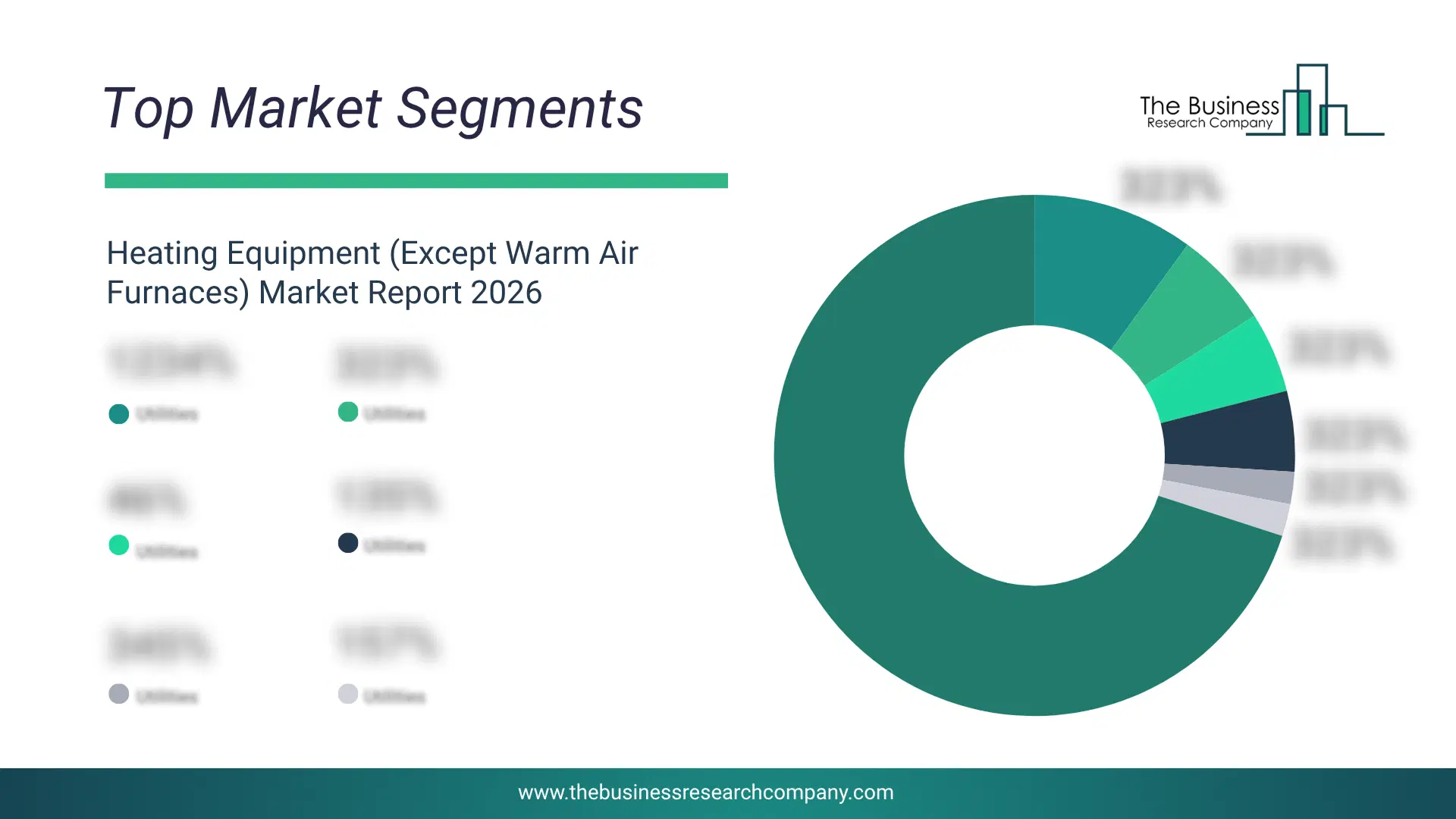
1) By Equipment Type: Boilers and Hydronic Heating Equipment, Steam Heating Equipment, Electric Process Heating Equipment, Thermal Fluid (Hot Oil) Heating Systems, Laboratory and Analytical Heating Equipment, Supplemental and Temporary Heating Equipment 2) By Energy Source: Electric, Natural Gas, Oil, Biomass, Other Energy Sources 3) By Application: Industrial Process Heating, Laboratory and Analytical Heating, Commercial Building Heating, District and Institutional Heating, Other Applications 4) By End-Use Industry: Chemicals and Petrochemicals, Pharmaceuticals and Biotechnology, Food and Beverage Processing, Oil and Gas, Power Generation, Research and Academic Laboratories, Commercial and Institutional Facilities, Other End-Use Industries Subsegments: 1) By Boilers and Hydronic Heating Equipment: Hot Water Boilers, Condensing Boilers, Combi Boilers, Commercial and Industrial Hydronic Systems 2) By Steam Heating Equipment: Low-Pressure Steam Boilers, Steam Radiators and Heat Exchangers, Steam Distribution and Control Equipment 3) By Electric Process Heating Equipment: Immersion Heaters, Circulation Heaters, Cartridge and Band Heaters 4) By Thermal Fluid (Hot Oil) Heating Systems: Thermal Fluid Heaters, Heat Transfer Oil Systems, Indirect Fired Heating Systems 5) By Laboratory and Analytical Heating Equipment: Heating Mantles, Hot Plates and Stirrers, Heating Baths (Oil, Water, Sand), Rotary Evaporator Heating Units 6) By Supplemental and Temporary Heating Equipment: Electric Space and Infrared Heaters, Portable Industrial Heaters, Temporary Construction and Event HeatersWhat Is The Driver Of The Heating Equipment (Except Warm Air Furnaces) Market?
The increasing number of residential construction projects is expected to propel the growth of the heating equipment (except warm air furnaces) market going forward. Residential projects refer to the construction of houses, apartments, and high-rise buildings. Heating equipment is used to control the temperature and humidity in a residential project and the goal is to provide thermal comfort and acceptable indoor air quality, as a result, an increase in the number of residential and commercial construction projects increases the demand for heating equipment (except warm air furnaces) market. For instance, in January 2023, according to the U.S. Census Bureau and the U.S. Department of Housing and Urban Development, 1.4 million residential houses are constructed, a 12.8% above compared to January 2022. Therefore, the increasing number of residential construction projects drives the heating equipment (except warm air furnaces) industry.Key Players In The Global Heating Equipment (Except Warm Air Furnaces) Market
Major companies operating in the heating equipment (except warm air furnaces) market are Thermal Solutions Products LLC, New Yorker Boiler Company Inc., Bard HVAC, Fulton Thermal Corporation, John Zink Company LLC, Toyotomi Co. Ltd., ECR International Inc., Daikin Industries Ltd., Robert Bosch GmbH, A.O. Smith Corporation, Bosch Thermotechnology Corp., Bradford White Corporation, Burnham Holdings Inc., Carrier Corporation, Danfoss A/S, Emerson Electric Co., Honeywell International Inc., HTP Comfort Solutions LLC, Johnson Controls International plc, Laars Heating Systems Company, Lochinvar LLC, Mitsubishi Electric Corporation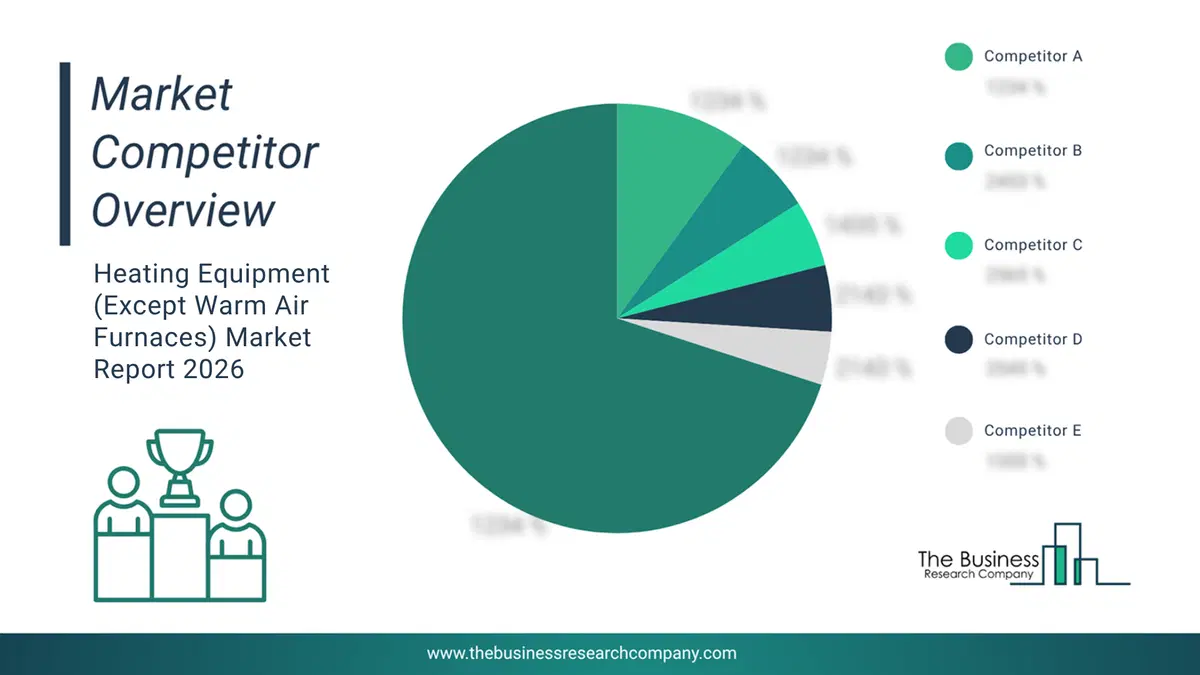
This chart is for illustrative purposes; the full report includes a detailed competitor analysis and comprehensive overview of the top 10 companies in the market.
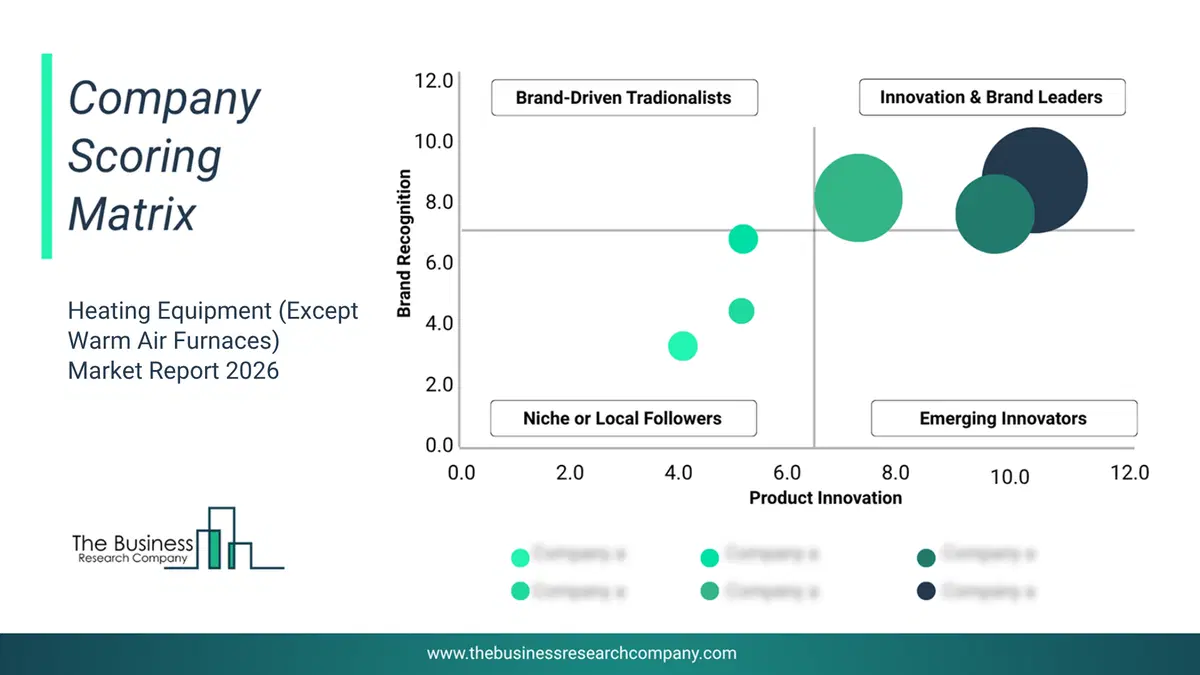
This chart maps companies by product innovation and brand strength, with bubble size indicating relative revenue, helping identify market leaders, challengers, and niche players. This is an illustrative chart; the full report provides a complete and accurate competitive analysis.
Global Heating Equipment (Except Warm Air Furnaces) Market Trends and Insights
Major companies operating in the heating equipment (except warm air furnaces) market are focusing on air-to-water heat pump to drive revenues in their market. An air-to-water heat pump is a device that, depending on the mode of operation, uses ambient air to either reject or absorb heat for heating or cooling. For instance, in May 2023, Daikin Industries Ltd., a Japan-based company that specializes in air conditioning, heating, ventilation, and refrigeration systems, launched an air-to-water heat pump. It has a reversing function that enables the chiller to alternate between heating and cooling modes in accordance with the process's or space's temperature requirements. With a coefficient of performance (COP) of 3.12 in heating mode and a seasonal coefficient of performance (SCOP) of 3.31, the device has a heating capacity of 91.2 kW and a cooling capacity of 23.58 tons. The heat pump has a brazed plate evaporator with low refrigerant pressure drops, low discharge pressure, continuous fan speed modulation, large condenser coil surface area for optimal heat transfer, and high-efficiency scroll compressors.What Are Latest Mergers And Acquisitions In The Heating Equipment (Except Warm Air Furnaces) Market?
In July 2024, Bradford White Corporation, a US-based provider of residential, commercial, and industrial water heaters, boilers, and storage-tank products, acquired Heat-flo Inc. for an undisclosed amount. With this acquisition, Bradford White Corporation gains access to Heat-flo’s portfolio of stainless-steel indirect water-heating solutions and hydronic storage tanks for residential, commercial, and industrial applications, thereby enhancing its water- and space-heating product capabilities while improving its ability to serve a broader customer base and respond to evolving regulatory requirements in the water-heater industry. Heat-flo Inc. is a US-based provider of stainless-steel indirect water-heating systems and hydronic storage tanks, known for its specialization in multi-energy and solar-compatible water-heating solutions as well as hydronic and radiant-heating applications.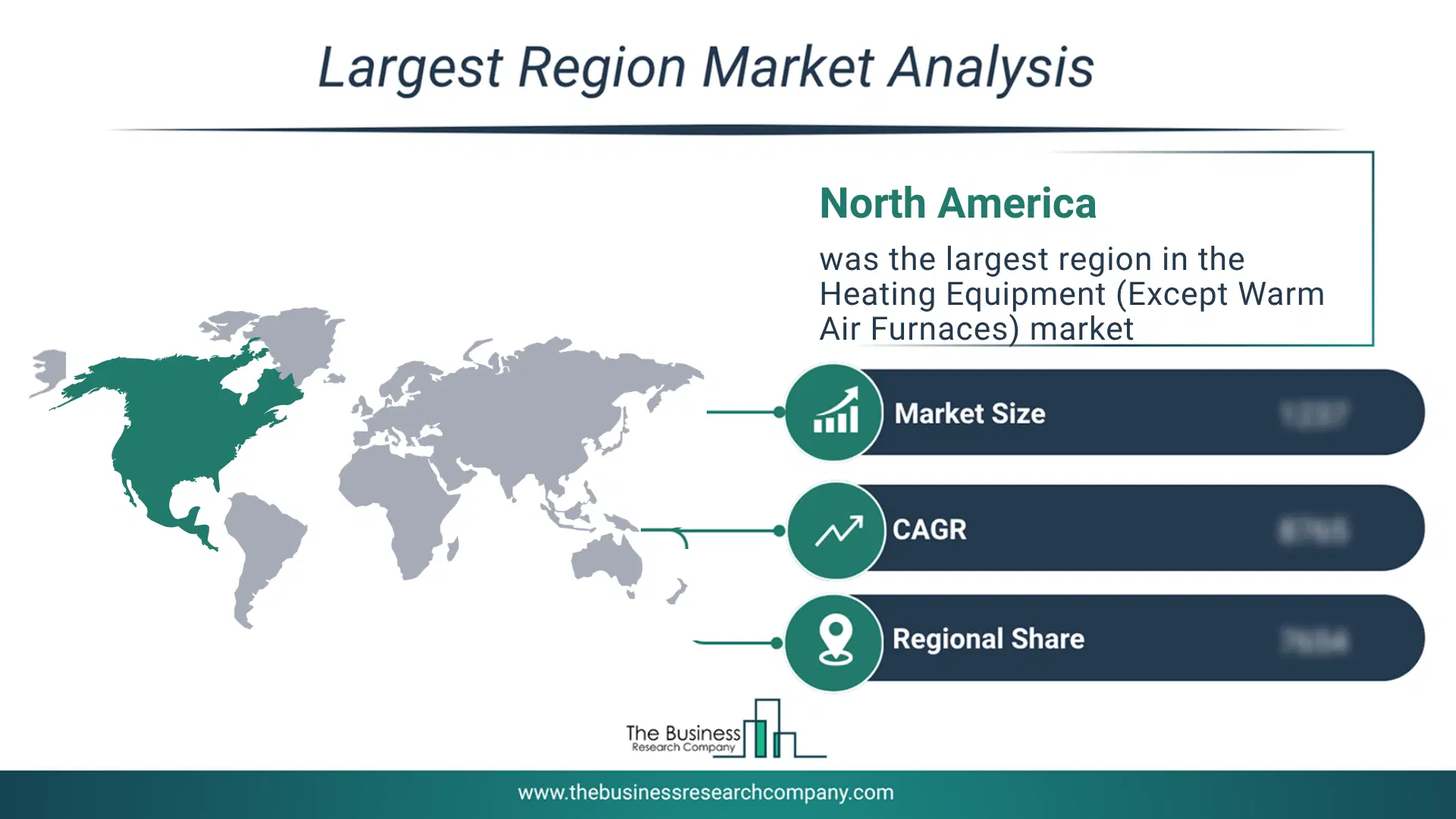
Regional Outlook
North America was the largest region in the heating equipment (except warm air furnaces) market in 2025. The regions covered in this market report are Asia-Pacific, South East Asia, Western Europe, Eastern Europe, North America, South America, Middle East, Africa The countries covered in this market report are Australia, Brazil, China, France, Germany, India, Indonesia, Japan, Taiwan, Russia, South Korea, UK, USA, Canada, Italy, Spain.What Defines the Heating Equipment (Except Warm Air Furnaces) Market?
The heating equipment (except for warm air furnaces) market consists of sales of heating boilers, heating stoves, floor and wall furnaces, wall and baseboard heaters, and heating units. Values in this market are ‘factory gate’ values, that is the value of goods sold by the manufacturers or creators of the goods, whether to other entities (including downstream manufacturers, wholesalers, distributors, and retailers) or directly to end customers. The value of goods in this market includes related services sold by the creators of the goods.How is Market Value Defined and Measured?
The market value is defined as the revenues that enterprises gain from the sale of goods and/or services within the specified market and geography through sales, grants, or donations in terms of the currency (in USD unless otherwise specified). The revenues for a specified geography are consumption values that are revenues generated by organizations in the specified geography within the market, irrespective of where they are produced. It does not include revenues from resales along the supply chain, either further along the supply chain or as part of other products.
This chart presents market attractiveness based on a quantitative evaluation of growth, competition, strategic alignment, and risk, offering a clear view of opportunity areas for decision-making. This chart is for illustrative purposes; the full report contains the complete analysis.

This chart highlights the Total Addressable Market (TAM) by estimating the maximum revenue opportunity using an assumption-driven approach, supporting strategic planning and opportunity sizing across markets. The chart is illustrative; the full report provides a more comprehensive analysis.
What Key Data and Analysis Are Included in the Heating Equipment (Except Warm Air Furnaces) Market Report 2026?
The heating equipment (except warm air furnaces) market research report is one of a series of new reports from The Business Research Company that provides market statistics, including industry global market size, regional shares, competitors with the market share, detailed market segments, market trends and opportunities, and any further data you may need to thrive in the heating equipment (except warm air furnaces) industry. The market research report delivers a complete perspective of everything you need, with an in-depth analysis of the current and future state of the industry.Heating Equipment Except Warm Air Furnaces Market Report Forecast Analysis
| Report Attribute | Details |
|---|---|
| Market Size Value In 2026 | $58.73 billion |
| Revenue Forecast In 2030 | $75.05 billion |
| Base Year For Estimation | 2025 |
| Actual Estimates/Historical Data | 2020-2025 |
| Forecast Period | 2026 - 2030 |
| Market Representation | Revenue in USD Billion and CAGR from 2026 to 2030 |
| Segments Covered | Equipment Type, Energy Source, Application, End-Use Industry |
| Regional Scope | Asia-Pacific, Western Europe, Eastern Europe, North America, South America, Middle East, Africa |
| Key Companies Profiled | Thermal Solutions Products LLC, New Yorker Boiler Company Inc., Bard HVAC, Fulton Thermal Corporation, John Zink Company LLC, Toyotomi Co. Ltd., ECR International Inc., Daikin Industries Ltd., Robert Bosch GmbH, A.O. Smith Corporation, Bosch Thermotechnology Corp., Bradford White Corporation, Burnham Holdings Inc., Carrier Corporation, Danfoss A/S, Emerson Electric Co., Honeywell International Inc., HTP Comfort Solutions LLC, Johnson Controls International plc, Laars Heating Systems Company, Lochinvar LLC, Mitsubishi Electric Corporation |
| Customization Scope | Request for Customization |
| Pricing And Purchase Options | Explore Purchase Options |