

Heating Oil Additives Market Report 2026
Global Outlook – By Type (Biocide, Water Controller, Heating Oil Stabilizer, Oil Gun Cleaner), By Application (Residential Heating Systems, Commercial Building Heating Systems, Industrial Boilers And Furnaces, Backup And Emergency Heating Systems, District And Centralized Heating Systems), By End-User (Industrial, Residential, Commercial) – Market Size, Trends, Strategies, and Forecast to 2030
Heating Oil Additives Market Overview
• Heating Oil Additives market size has reached to $6.57 billion in 2025 • Expected to grow to $9.11 billion in 2030 at a compound annual growth rate (CAGR) of 6.8% • Growth Driver: Soaring Automobile Manufacturing Fuels Expansion In The Heating Oil Additives Market • Asia-Pacific was the largest region and fastest growing region.What Is Covered Under Heating Oil Additives Market?
Heating oil additives refer to chemicals used to improve the efficiency of a tank's ignition by altering fuel specifications, such as its thickness and temperature. Heating oil additives contain antioxidants that stabilize the oil, preventing it from degrading and making sure the fuel combusts correctly. The main types of heating oil additives are biocide, water controller, heating oil stabilizer, and oil gun cleaner. Biocides are heating oil additives that treat microbial growth inside the tank to control sulfate-reducing bacteria, iron-oxidizing bacteria, and others that cause corrosion and degrade products. The applications include diesel, gasoline, aviation fuel, and others that are used by industrial, residential, and commercial sectors.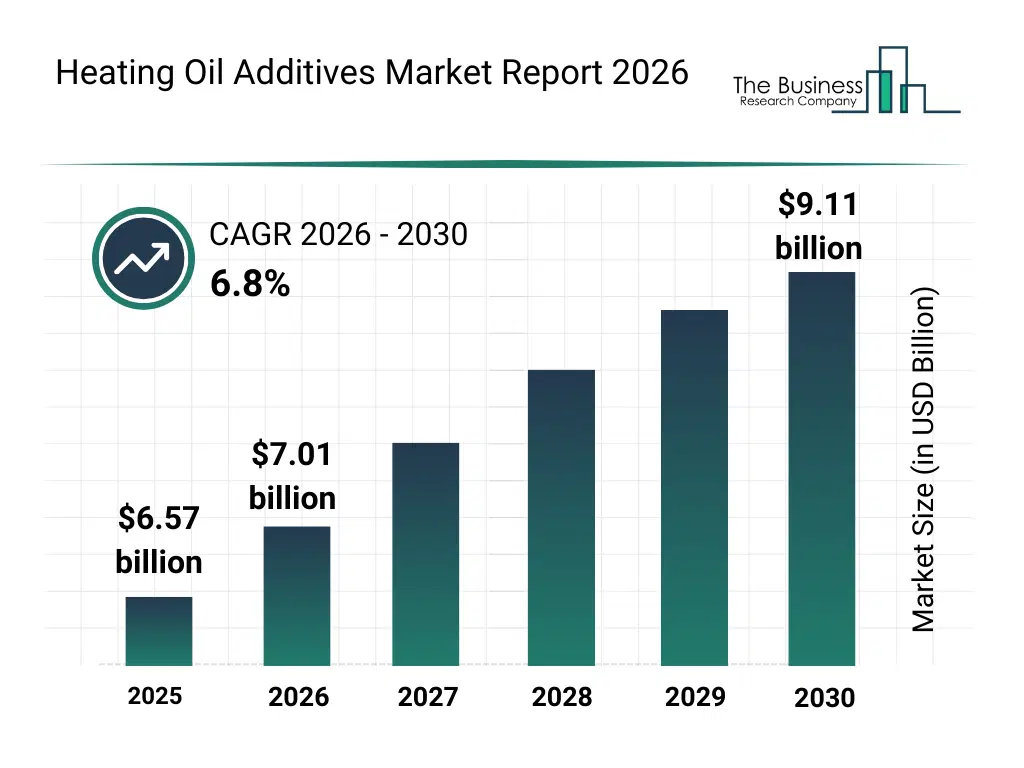
What Is The Heating Oil Additives Market Size and Share 2026?
The heating oil additives market size has grown strongly in recent years. It will grow from $6.57 billion in 2025 to $7.01 billion in 2026 at a compound annual growth rate (CAGR) of 6.7%. The growth in the historic period can be attributed to expansion of residential heating oil usage, growth of commercial heating systems, increasing fuel storage requirements, rising cold climate energy demand, availability of additive blending technologies.What Is The Heating Oil Additives Market Growth Forecast?
The heating oil additives market size is expected to see strong growth in the next few years. It will grow to $9.11 billion in 2030 at a compound annual growth rate (CAGR) of 6.8%. The growth in the forecast period can be attributed to increasing focus on cleaner heating fuels, rising adoption of advanced additive formulations, expansion of energy efficiency regulations, growing demand for long-term fuel storage solutions, increasing investments in low-emission heating technologies. Major trends in the forecast period include increasing demand for fuel stability enhancers, rising use of cold-weather performance additives, growing focus on emission reduction in heating systems, expansion of residential heating efficiency solutions, enhanced fuel storage protection.
Global Heating Oil Additives Market Segmentation
1) By Type: Biocide, Water Controller, Heating Oil Stabilizer, Oil Gun Cleaner 2) By Application: Residential Heating Systems, Commercial Building Heating Systems, Industrial Boilers And Furnaces, Backup And Emergency Heating Systems, District And Centralized Heating Systems 3) By End-User: Industrial, Residential, Commercial Subsegments: 1) By Biocide: Microbiocide, Fungicide 2) By Water Controller: Demulsifiers, Defoamers 3) By Heating Oil Stabilizer: Antioxidants, Corrosion Inhibitors 4) By Oil Gun Cleaner: Solvent-Based Cleaners, Detergent-Based CleanersWhat Are The Drivers Of The Heating Oil Additives Market?
The growing manufacturing of automobiles is expected to propel the growth of the heating oil additives market going forward. An automobile refers to motor vehicle with a gasoline or diesel internal-combustion engine designed for operation on ordinary roads. Heating oil additives are used in automobiles to clean the engine, improve fuel efficiency and combustion efficiency, and prevent local overheating and chimney fires. As the growth of manufacturing of automobiles is increasing, it enables the growth of the heating oil additives market. For instance, in January 2024, according to the Society of Motor Manufacturers and Traders (SMMT), a UK-based trade association, in 2023, total vehicle production in the UK (cars + commercial vehicles) reached about 1,025,474 units, up 17% from the year before. Therefore, the growing manufacturing of automobiles is driving the growth of the heating oil additives industry. The growth in the aviation sector is expected to propel the growth of the heating oil additives market going forward. The aviation sector, also known as the aerospace industry, encompasses a broad range of activities related to the design, development, production, operation, and maintenance of aircraft and spacecraft. The aviation sector uses heating oil additives to enhance the performance and reliability of aircraft fuels, especially in cold climates. For instance, in June 2023, according to the International Air Transport Association (IATA), a Canada-based trade association, airline industry net profits are expected to reach $9.8 billion in 2023, which is more than double the previous forecast of $4.7 billion. Therefore, growth in the aviation sector is driving the growth of the heating oil additives industry.Key Players In The Global Heating Oil Additives Market
Major companies operating in the heating oil additives market are Afton Chemical, Lubrizol Corporation, Chevron Oronite Company, Infineum International Limited, BASF SE, Clariant AG, Innospec Inc., Dorf Ketal Chemicals, LANXESS AG, Evonik Industries AG, Nouryon Holding B.V., Croda International Plc, Arkema S.A., Dow Inc., ExxonMobil Chemical Company, BP Plc, Chevron Corporation, TotalEnergies SE, Valvoline Inc., Mitsubishi Chemical Group Corporation, Sumitomo Chemical Company Limited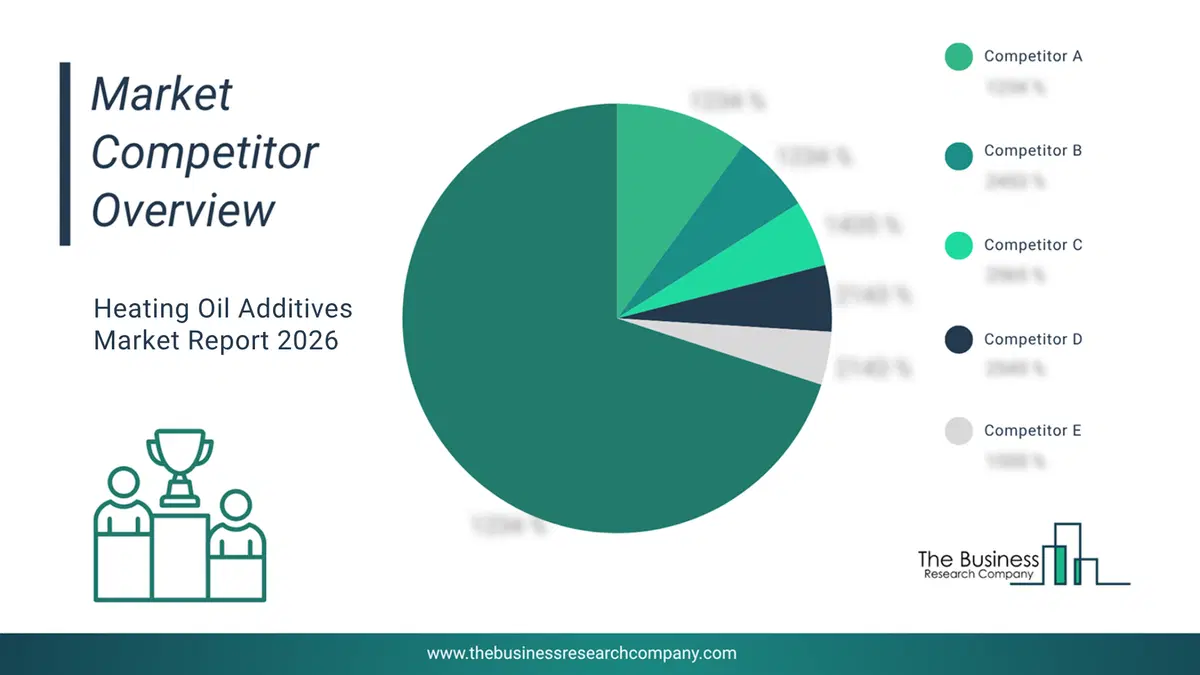
This chart is for illustrative purposes; the full report includes a detailed competitor analysis and comprehensive overview of the top 10 companies in the market.
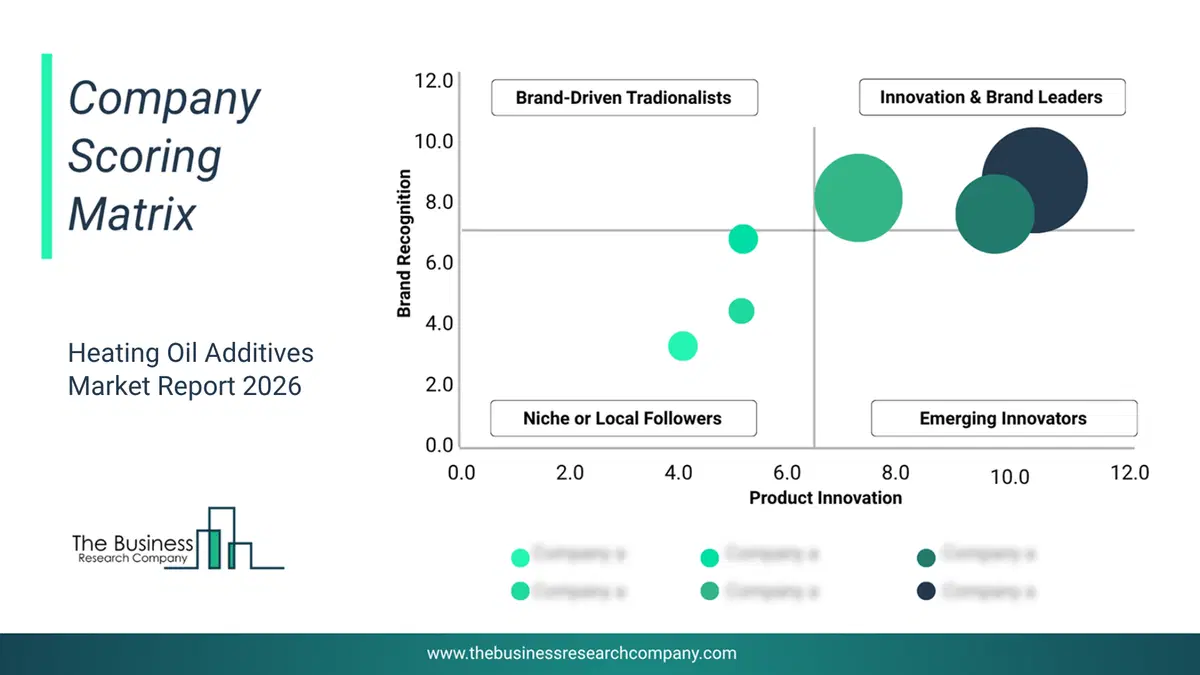
This chart maps companies by product innovation and brand strength, with bubble size indicating relative revenue, helping identify market leaders, challengers, and niche players. This is an illustrative chart; the full report provides a complete and accurate competitive analysis.
What Are Latest Mergers And Acquisitions In The Heating Oil Additives Market?
In June 2023, Macfarlane Energy Inc., a US-based provider of heating oil products and services, successfully acquired the complete assets of the full-service heating fuels business from Horan Oil Corp. for an undisclosed amount. This strategic acquisition facilitated Macfarlane's expansion of its customer base and the incorporation of HVAC installation and service into the suite of services offered by Horan Oil. Concurrently, Macfarlane Energy pursued an initiative to enhance and modernize its facilities while also introducing innovative fuel additives to its product lineup. Horan Oil Corp. is a US-based heating oil and additive producer.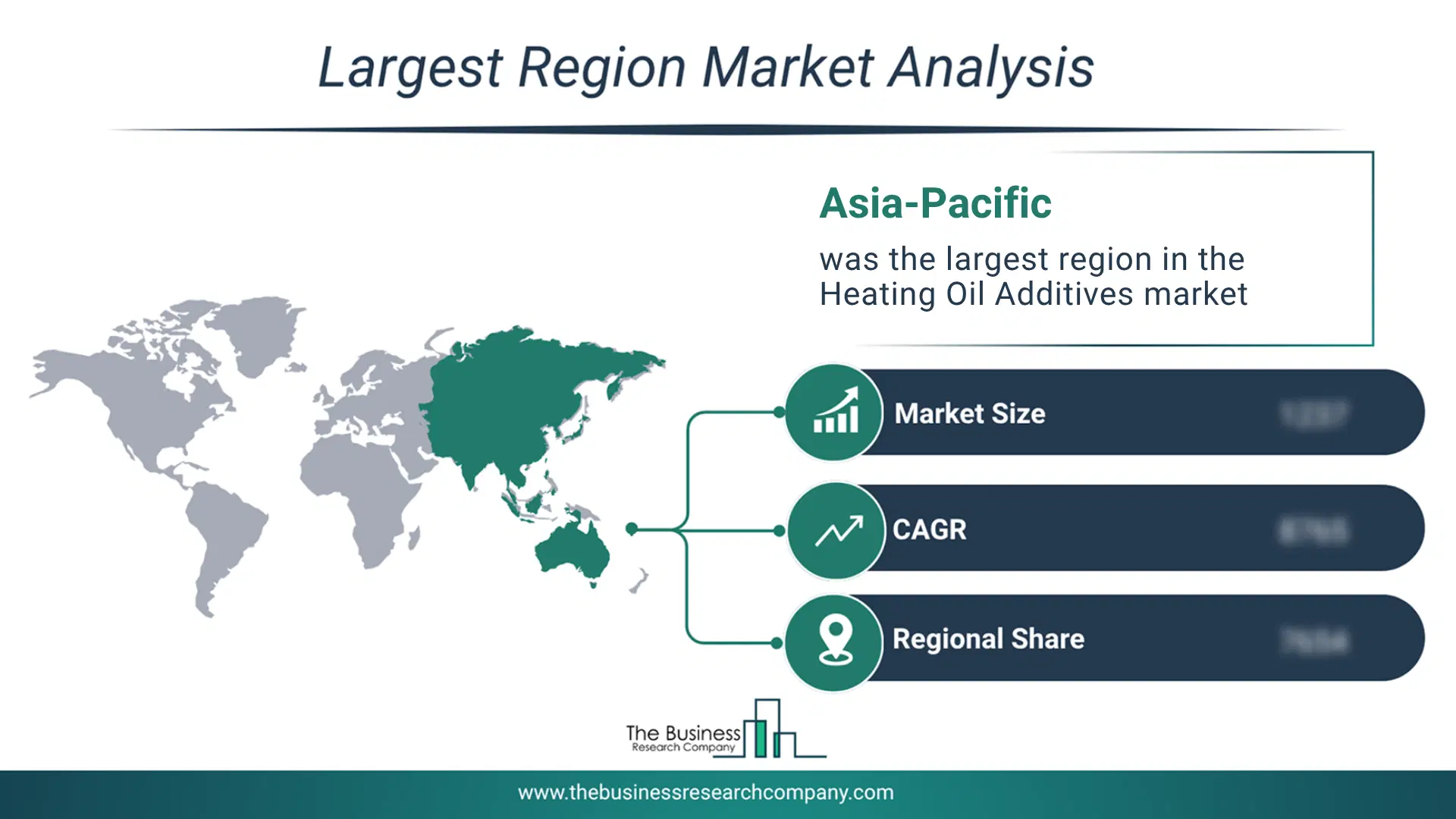
Regional Insights
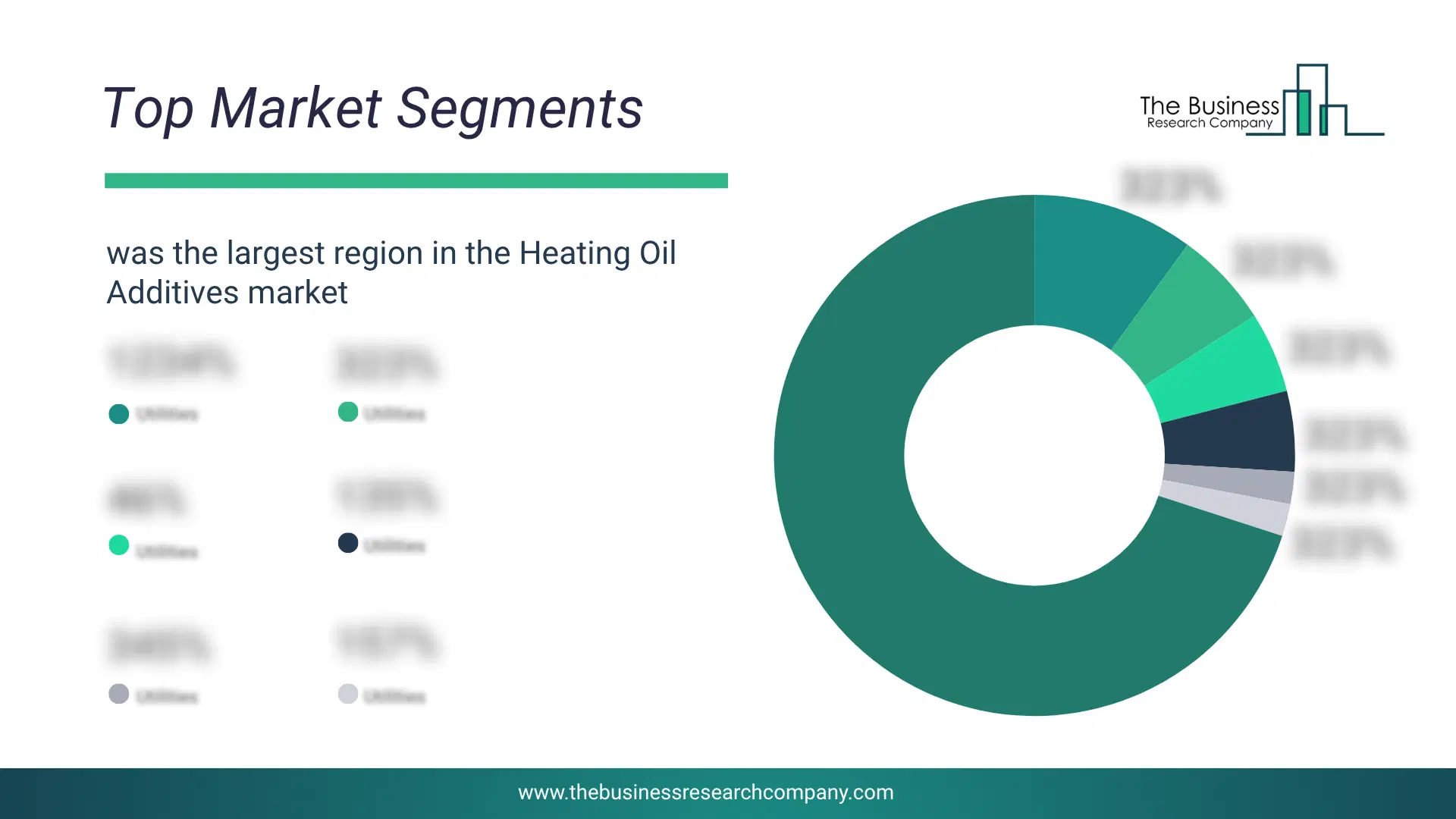
Asia-Pacific was the largest region in the heating oil additives market in 2025. Europe was the second-largest region in the global heating oil additives market during the forecast period. The regions covered in this market report are Asia-Pacific, South East Asia, Western Europe, Eastern Europe, North America, South America, Middle East, Africa The countries covered in this market report are Australia, Brazil, China, France, Germany, India, Indonesia, Japan, Taiwan, Russia, South Korea, UK, USA, Canada, Italy, SpainWhat Defines the Heating Oil Additives Market?
The heating oil additives market consists of sales of corrosion inhibitors, friction modifiers, antioxidants, and viscosity index improvers. Values in this market are ‘factory gate’ values, that is the value of goods sold by the manufacturers or creators of the goods, whether to other entities (including downstream manufacturers, wholesalers, distributors, and retailers) or directly to end customers. The value of goods in this market includes related services sold by the creators of the goods.How is Market Value Defined and Measured?
The market value is defined as the revenues that enterprises gain from the sale of goods and/or services within the specified market and geography through sales, grants, or donations in terms of the currency (in USD unless otherwise specified). The revenues for a specified geography are consumption values that are revenues generated by organizations in the specified geography within the market, irrespective of where they are produced. It does not include revenues from resales along the supply chain, either further along the supply chain or as part of other products.
This chart presents market attractiveness based on a quantitative evaluation of growth, competition, strategic alignment, and risk, offering a clear view of opportunity areas for decision-making. This chart is for illustrative purposes; the full report contains the complete analysis.

This chart highlights the Total Addressable Market (TAM) by estimating the maximum revenue opportunity using an assumption-driven approach, supporting strategic planning and opportunity sizing across markets. The chart is illustrative; the full report provides a more comprehensive analysis.
What Key Data and Analysis Are Included in the Heating Oil Additives Market Report 2026?
The heating oil additives market research report is one of a series of new reports from The Business Research Company that provides market statistics, including industry global market size, regional shares, competitors with the market share, detailed market segments, market trends and opportunities, and any further data you may need to thrive in the heating oil additives industry. The market research report delivers a complete perspective of everything you need, with an in-depth analysis of the current and future state of the industry.Heating Oil Additives Market Report Forecast Analysis
| Report Attribute | Details |
|---|---|
| Market Size Value In 2026 | $7.01 billion |
| Revenue Forecast In 2030 | $9.11 billion |
| Growth Rate | CAGR of 6.7% from 2026 to 2030 |
| Base Year For Estimation | 2025 |
| Actual Estimates/Historical Data | 2020-2025 |
| Forecast Period | 2026 - 2030 |
| Market Representation | Revenue in USD Billion and CAGR from 2026 to 2030 |
| Segments Covered | Type, Application, End-User |
| Regional Scope | Asia-Pacific, Western Europe, Eastern Europe, North America, South America, Middle East, Africa |
| Country Scope | The countries covered in this market report are Australia, Brazil, China, France, Germany, India, Indonesia, Japan, Taiwan, Russia, South Korea, UK, USA, Canada, Italy, Spain |
| Key Companies Profiled | Afton Chemical, Lubrizol Corporation, Chevron Oronite Company, Infineum International Limited, BASF SE, Clariant AG, Innospec Inc., Dorf Ketal Chemicals, LANXESS AG, Evonik Industries AG, Nouryon Holding B.V., Croda International Plc, Arkema S.A., Dow Inc., ExxonMobil Chemical Company, BP Plc, Chevron Corporation, TotalEnergies SE, Valvoline Inc., Mitsubishi Chemical Group Corporation, Sumitomo Chemical Company Limited |
| Customization Scope | Request for Customization |
| Pricing And Purchase Options | Explore Purchase Options |