

Heating, Ventilation, And Air Conditioning Control Systems Market Report 2026
Global Outlook – By Control Function (Temperature And Humidity Control System, Integrated Control System, Ventilation Control System), By Product (Sensors, Controlled Devices, Controllers), By Implementation (Retrofit, New Construction), By End-User (Automotive, Residential, Commercial, Industrial) – Market Size, Trends, Strategies, and Forecast to 2030
Heating, Ventilation, And Air Conditioning Control Systems Market Overview
• Heating, Ventilation, And Air Conditioning Control Systems market size has reached to $25.15 billion in 2025 • Expected to grow to $46.07 billion in 2030 at a compound annual growth rate (CAGR) of 12.8% • Growth Driver: Rising Construction Activities Fueling The Growth Of The Market Due To Urbanization And Infrastructure Development • Market Trend: Next-Generation AC Drives Deliver Precise Motor Control And Lower Emissions • North America was the largest region in 2025 and Asia-Pacific is the fastest growing region.What Is Covered Under Heating, Ventilation, And Air Conditioning Control Systems Market?
Heating, ventilation, and air conditioning (HVAC) control systems are automated systems that regulate and maintain indoor environmental conditions such as temperature, humidity, and air quality. These systems use sensors and controllers to automate the operation of heating, cooling, and ventilation equipment to ensure comfort, energy efficiency, and air safety in residential, commercial, and industrial buildings. The main types of heating, ventilation, and air conditioning (HVAC) control systems are temperature and humidity control systems, integrated control systems, and ventilation control systems. A temperature and humidity control system is designed to regulate and maintain specific environmental conditions by managing both temperature and humidity levels. These systems typically consist of products such as sensors, controlled devices, and controllers. They are implemented in both retrofit and new construction projects and serve a wide range of end users, including the automotive, residential, commercial, and industrial sectors.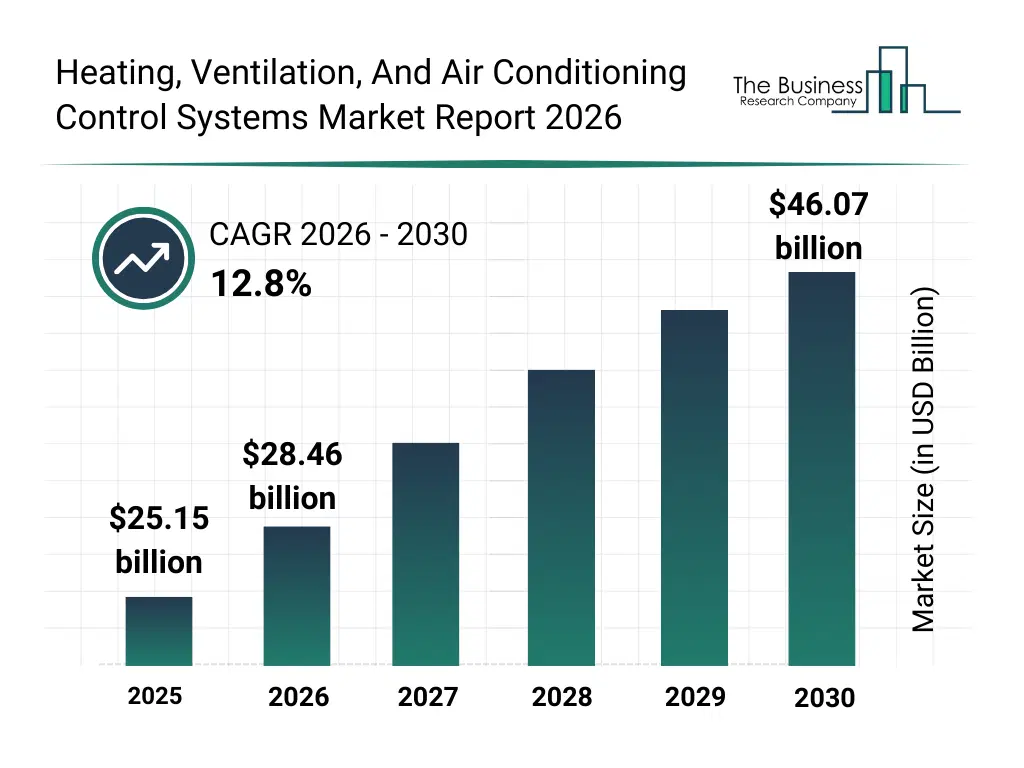
What Is The Heating, Ventilation, And Air Conditioning Control Systems Market Size and Share 2026?
The heating, ventilation, and air conditioning control systems market size has grown rapidly in recent years. It will grow from $25.15 billion in 2025 to $28.46 billion in 2026 at a compound annual growth rate (CAGR) of 13.1%. The growth in the historic period can be attributed to commercial building expansion, rising energy efficiency standards, adoption of automated climate systems, urbanization growth, demand for indoor air quality control.What Is The Heating, Ventilation, And Air Conditioning Control Systems Market Growth Forecast?
The heating, ventilation, and air conditioning control systems market size is expected to see rapid growth in the next few years. It will grow to $46.07 billion in 2030 at a compound annual growth rate (CAGR) of 12.8%. The growth in the forecast period can be attributed to smart building investments, stringent carbon emission norms, expansion of retrofit projects, growth in commercial real estate, adoption of ai driven hvac systems. Major trends in the forecast period include growing adoption of smart hvac controls, expansion of building management systems, rising demand for energy efficient climate control, increasing use of ai based predictive controls, integration of multi zone control systems.Tariff Impact On Heating, Ventilation, And Air Conditioning Control Systems Market
Tariffs have impacted the hvac control systems market by increasing costs of imported sensors, controllers, communication modules, and electronic components. Integrated and iot based systems are most affected, particularly in Asia Pacific and Europe. Higher system costs have slowed adoption in retrofit projects. However, tariffs have encouraged local electronics manufacturing and software driven control solutions.
Global Heating, Ventilation, And Air Conditioning Control Systems Market Segmentation
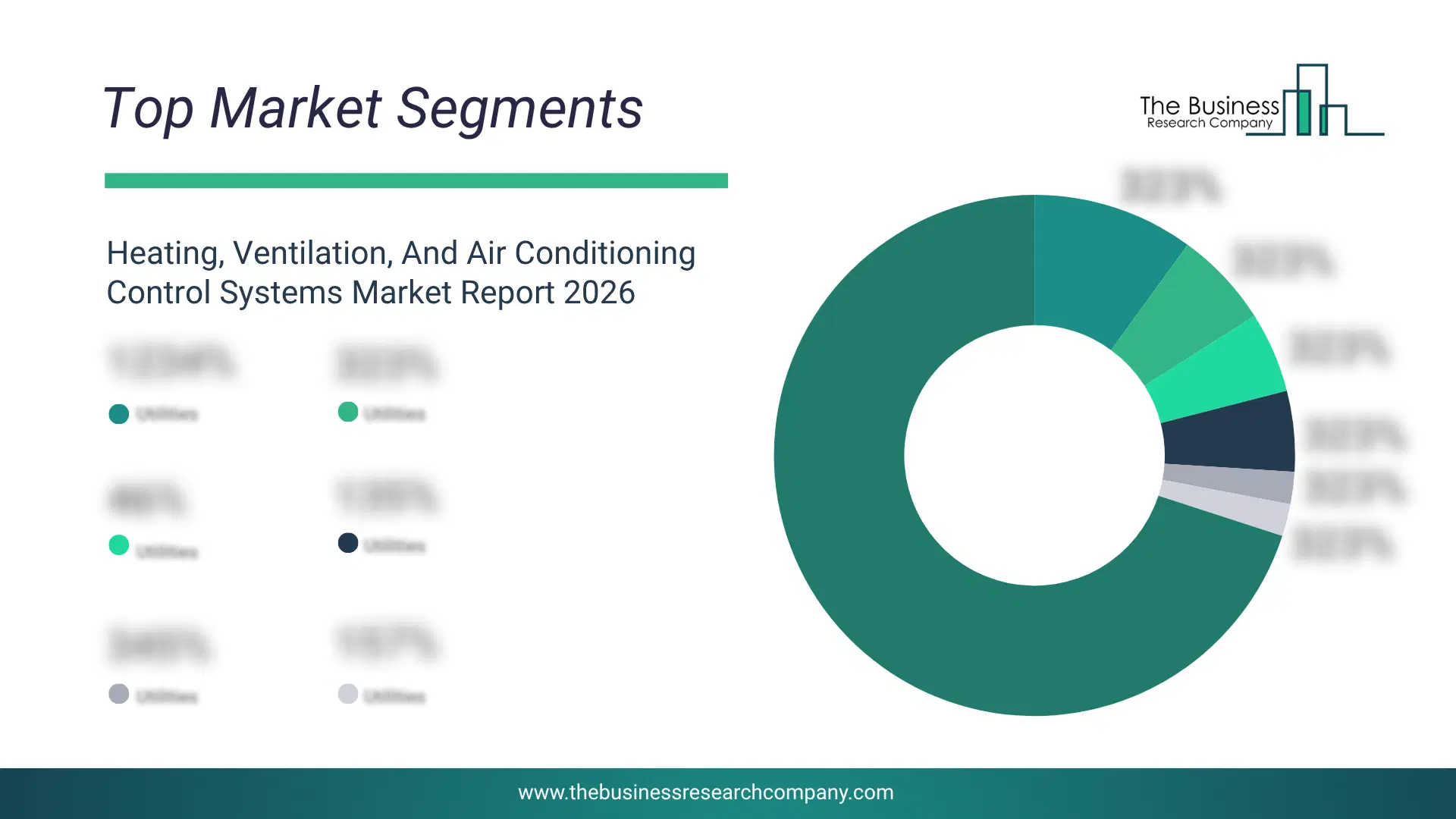
1) By Control Function: Temperature And Humidity Control System, Integrated Control System, Ventilation Control System 2) By Product: Sensors, Controlled Devices, Controllers 3) By Implementation: Retrofit, New Construction 4) By End-User: Automotive, Residential, Commercial, Industrial Subsegments: 1) By Temperature And Humidity Control System: Thermostats, Humidistats, Temperature Sensors, Humidity Sensors, Smart Temperature Controllers 2) By Integrated Control System: Building Management Systems, Centralized Heating, Ventilation, And Air Conditioning Control Systems Control Units, Internet of Things-Based Control Platforms, Artificial Intelligence-Enabled Predictive Control Systems, Multi-Zone Control Systems 3) By Ventilation Control System: Variable Air Volume Systems, Exhaust And Return Air Systems, Air Quality Monitoring Sensors, CO₂-Based Ventilation ControllersWhat Is The Driver Of The Heating, Ventilation, And Air Conditioning Control Systems Market?
The rising construction activities are expected to propel the growth of the heating, ventilation, and air conditioning (HVAC) control systems market going forward. Construction activities refer to the processes involved in building, repairing, or altering structures such as buildings, roads, bridges, and other infrastructure. The rising construction activities are due to urbanization, as increasing population concentration in cities creates a higher demand for residential, commercial, and infrastructure development. Heating, ventilation, and air conditioning (HVAC) control systems enhance construction activities by enabling precise climate management and energy-efficient building operations. They improve indoor air quality and occupant comfort, making new buildings smarter and more sustainable. For instance, in April 2025, according to the United States Census Bureau, a US-based government agency, construction spending reached $2,156,495 million in 2024, an increase from $2,023,662 million in 2023. Therefore, the rising construction activities are driving the growth of the heating, ventilation, and air conditioning (HVAC) control systems market.Key Players In The Global Heating, Ventilation, And Air Conditioning Control Systems Market
Major companies operating in the heating, ventilation, and air conditioning control systems market are Siemens AG, LG Electronics Inc., Hitachi Ltd., Midea Group Co. Ltd., Honeywell International Inc., Mitsubishi Electric Corporation, Schneider Electric SE, Daikin Industries Ltd, Toshiba Corporation, Johnson Controls International plc, Carrier Corporation, Trane Technologies plc, Emerson Electric Co., Danfoss Group, Jackson Control, Ingersoll-Rand plc, Lennox International Inc., Distech Controls Inc., KMC Controls Inc., Regin Group, Delta Controls Inc., Samsung Electronics Co. Ltd.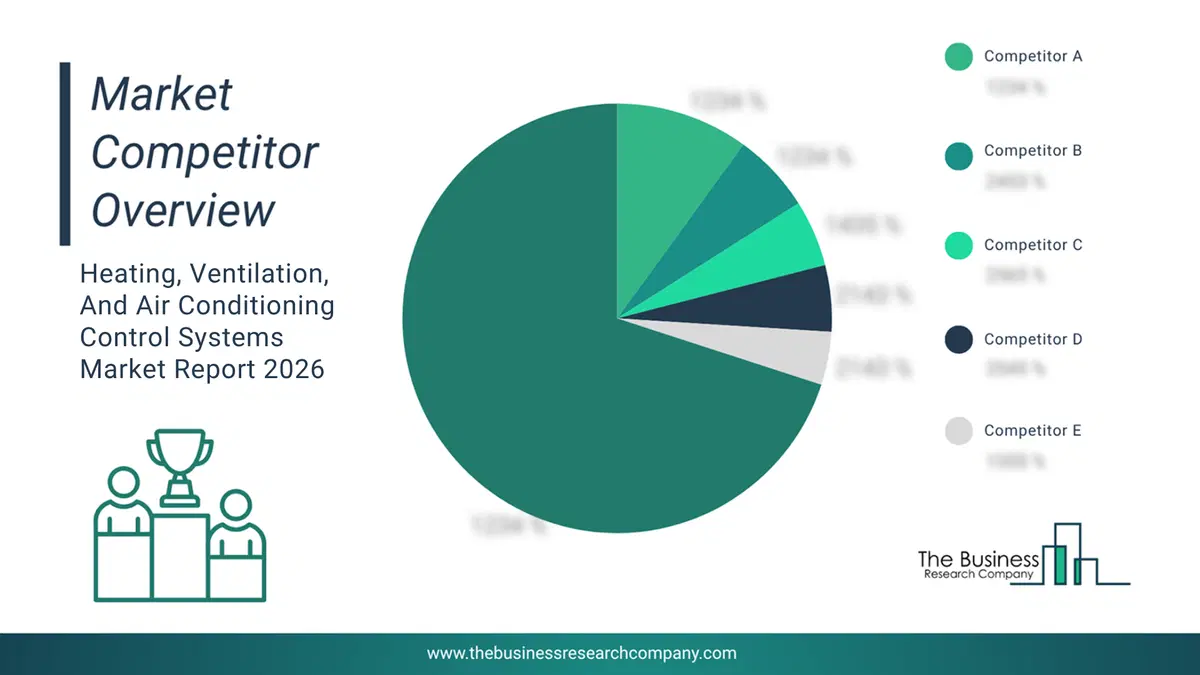
This chart is for illustrative purposes; the full report includes a detailed competitor analysis and comprehensive overview of the top 10 companies in the market.
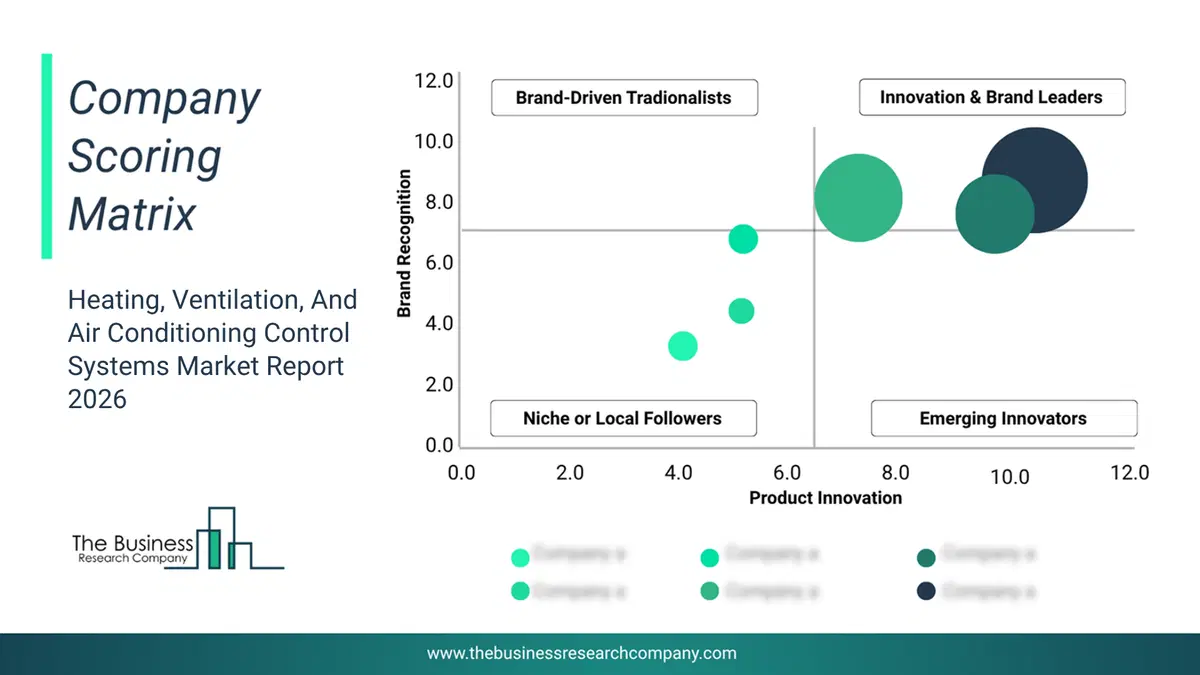
This chart maps companies by product innovation and brand strength, with bubble size indicating relative revenue, helping identify market leaders, challengers, and niche players. This is an illustrative chart; the full report provides a complete and accurate competitive analysis.
Global Heating, Ventilation, And Air Conditioning Control Systems Market Trends and Insights
Major companies operating in the heating, ventilation, and air conditioning (HVAC) control systems market are focusing on developing technologically advanced solutions, such as compact, low-voltage alternating current (AC) drives, to enhance energy efficiency and system performance. Low-voltage alternating current (AC) drives refer to compact motor control devices designed to regulate HVAC system speed and efficiency while minimizing energy consumption. For instance, in February 2024, ABB India Limited, an India-based engineering services company, launched ACH180, a next-generation compact drive tailored for heating, ventilation, air conditioning, and refrigeration (HVACR) systems. The ACH180 is a compact, space-saving AC drive with HVACR-specific features such as a fireman’s override and freeze stat for easier installation and improved safety. It precisely controls high-efficiency motors based on actual needs, reducing energy consumption and CO₂ emissions.What Are Latest Mergers And Acquisitions In The Heating, Ventilation, And Air Conditioning Control Systems Market?
In January 2025, Trane Technologies plc, an Ireland-based manufacturing company, acquired BrainBox AI for an undisclosed amount. With this acquisition, Trane Technologies aims to accelerate the global deployment of sustainable, AI-driven smart building solutions that reduce energy consumption and greenhouse gas emissions. BrainBox AI Inc. is a Canada-based AI-driven SaaS company that focuses on heating, ventilation, and air conditioning (HVAC) management solutions for commercial buildings.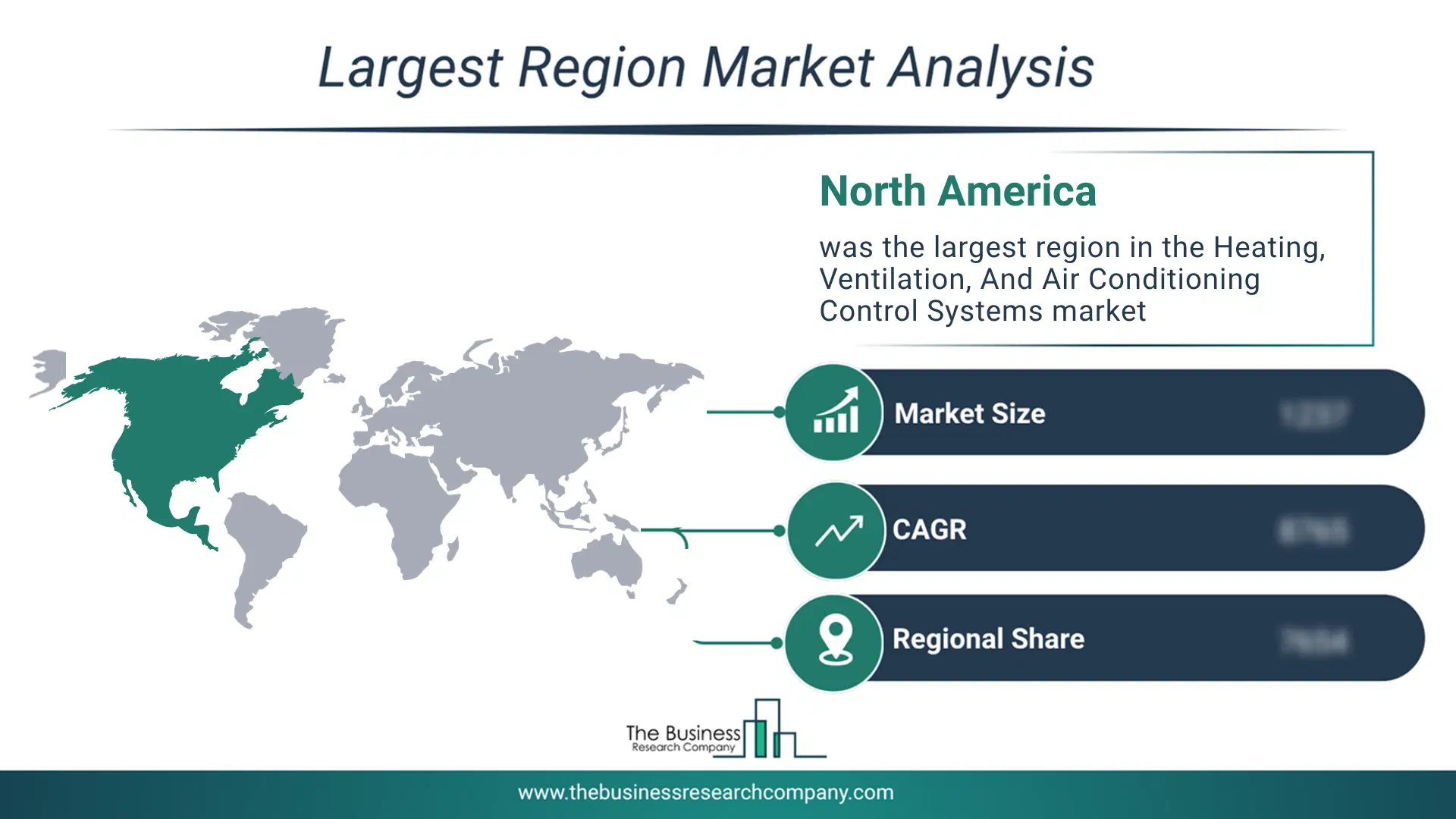
Regional Outlook
North America was the largest region in the heating, ventilation, and air conditioning (HVAC) control systems market in 2025. Asia-Pacific is expected to be the fastest-growing region in the forecast period. The regions covered in this market report are Asia-Pacific, South East Asia, Western Europe, Eastern Europe, North America, South America, Middle East, Africa The countries covered in this market report are Australia, Brazil, China, France, Germany, India, Indonesia, Japan, Taiwan, Russia, South Korea, UK, USA, Canada, Italy, Spain.What Defines the Heating, Ventilation, And Air Conditioning Control Systems Market?
The heating, ventilation, and air conditioning (HVAC) control systems market consists of revenues earned by entities by providing services such as installation and integration services, maintenance and repair services, remote monitoring and management, energy management and optimization services, and design and engineering services. The market value includes the value of related goods sold by the service provider or included within the service offering. The heating, ventilation, and air conditioning control systems (HVAC) market also includes sales of thermostats, actuators, and dampers, building automation systems, and zone controls. Values in this market are ‘factory gate’ values, that is, the value of goods sold by the manufacturers or creators of the goods, whether to other entities (including downstream manufacturers, wholesalers, distributors, and retailers) or directly to end customers. The value of goods in this market includes related services sold by the creators of the goods.How is Market Value Defined and Measured?
The market value is defined as the revenues that enterprises gain from the sale of goods and/or services within the specified market and geography through sales, grants, or donations in terms of the currency (in USD unless otherwise specified). The revenues for a specified geography are consumption values that are revenues generated by organizations in the specified geography within the market, irrespective of where they are produced. It does not include revenues from resales along the supply chain, either further along the supply chain or as part of other products.
This chart presents market attractiveness based on a quantitative evaluation of growth, competition, strategic alignment, and risk, offering a clear view of opportunity areas for decision-making. This chart is for illustrative purposes; the full report contains the complete analysis.

This chart highlights the Total Addressable Market (TAM) by estimating the maximum revenue opportunity using an assumption-driven approach, supporting strategic planning and opportunity sizing across markets. The chart is illustrative; the full report provides a more comprehensive analysis.
What Key Data and Analysis Are Included in the Heating, Ventilation, And Air Conditioning Control Systems Market Report 2026?
The heating, ventilation, and air conditioning control systems market research report is one of a series of new reports from The Business Research Company that provides market statistics, including industry global market size, regional shares, competitors with the market share, detailed market segments, market trends and opportunities, and any further data you may need to thrive in the heating, ventilation, and air conditioning control systems industry. The market research report delivers a complete perspective of everything you need, with an in-depth analysis of the current and future state of the industry.Heating Ventilation And Air Conditioning Control Systems Market Report Forecast Analysis
| Report Attribute | Details |
|---|---|
| Market Size Value In 2026 | $28.46 billion |
| Revenue Forecast In 2030 | $46.07 billion |
| Base Year For Estimation | 2025 |
| Actual Estimates/Historical Data | 2020-2025 |
| Forecast Period | 2026 - 2030 |
| Market Representation | Revenue in USD Billion and CAGR from 2026 to 2030 |
| Segments Covered | Control Function, Product, Implementation, End-User |
| Regional Scope | Asia-Pacific, Western Europe, Eastern Europe, North America, South America, Middle East, Africa |
| Key Companies Profiled | Siemens AG, LG Electronics Inc., Hitachi Ltd., Midea Group Co. Ltd., Honeywell International Inc., Mitsubishi Electric Corporation, Schneider Electric SE, Daikin Industries Ltd, Toshiba Corporation, Johnson Controls International plc, Carrier Corporation, Trane Technologies plc, Emerson Electric Co., Danfoss Group, Jackson Control, Ingersoll-Rand plc, Lennox International Inc., Distech Controls Inc., KMC Controls Inc., Regin Group, Delta Controls Inc., Samsung Electronics Co. Ltd. |
| Customization Scope | Request for Customization |
| Pricing And Purchase Options | Explore Purchase Options |