

Contact Us
  Search
The Business Research Company Logo
Heavy And Civil Engineering Construction Market 2025
Published :May 2025
Pages :477
Format :PDF
Delivery Time :2-3 Business Days
Why 2-3 days? We update the report with the latest data and news before delivery. Let us know if you need us to expedite.
Report Price :$4,490.00

Heavy And Civil Engineering Construction Market 2025

By Type (Utility System Construction, Highway, Street And Bridge Construction, Other Heavy And Civil Engineering Construction), By Organization Size (Large Contractors, Medium Contractors, Small Contractors), By End-User (Private, Public), And By Region, Opportunities And Strategies – Global Forecast To 2035
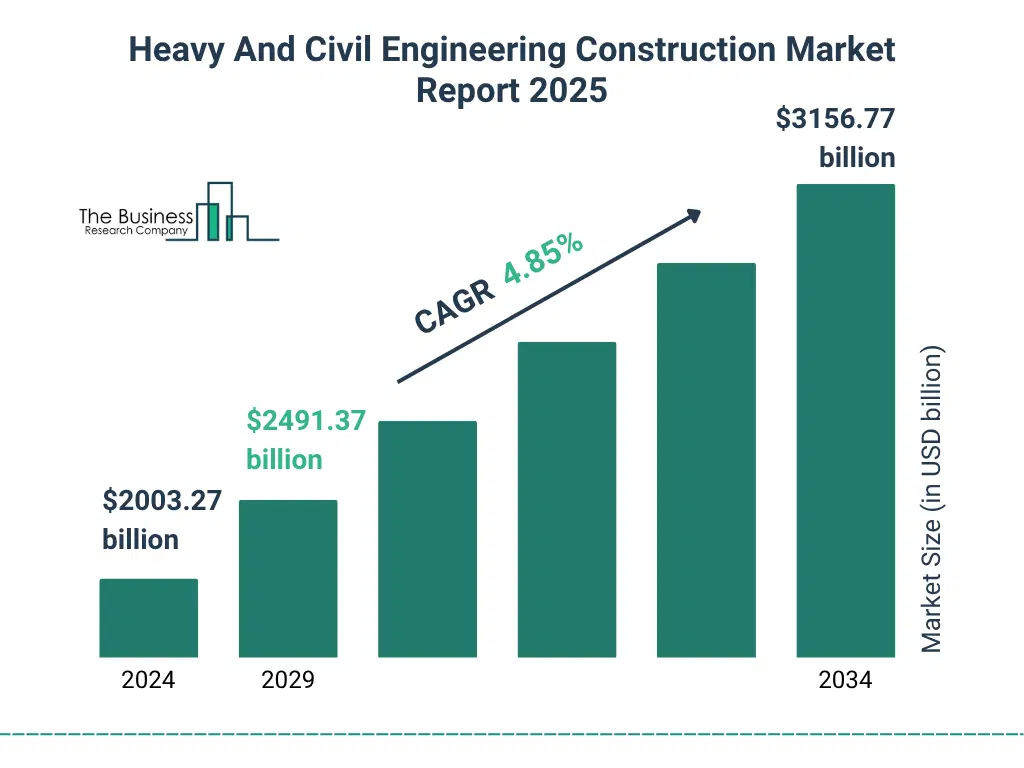
Heavy And Civil Engineering Construction Market Size and growth rate 2025 to 2029: Graph

Heavy And Civil Engineering Construction Market Definition

Heavy and civil engineering construction refers to a branch of civil engineering that focuses on the design, construction and maintenance of large-scale infrastructure projects. These projects often involve significant use of heavy equipment and materials. The heavy and civil engineering construction market consists of sales of heavy and civil engineering construction services by entities (organizations, sole traders and partnerships) that undertake heavy and civil engineering construction projects (for example, highways, airports, tunnels and dams). The work performed may include new work, additions, alterations or maintenance and repairs.
Research Expert

Book your 30 minutes free consultation with our research experts

Heavy And Civil Engineering Construction Market Size

The global heavy and civil engineering construction market reached a value of nearly $1,991.38 billion in 2023, having grown at a compound annual growth rate (CAGR) of 4.30% since 2018. The market is expected to grow from $1,991.38 billion in 2023 to $2,519.42 billion in 2028 at a rate of 4.82%. The market is then expected to grow at a CAGR of 4.91% from 2028 and reach $3,201.75 billion in 2033. Growth in the historic period resulted from the investment in renewable power generation capabilities, growing investments in infrastructure, rapid industrialization, increasing public-private partnerships and increased focus on urban planning and development policies. Factors that negatively affected growth in the historic period include high material prices. Going forward, the increasing electricity demand, increasing population, development of transportation infrastructure, increasing government support, urban redevelopment will drive the market. Factors that could hinder the growth of the heavy and civil engineering construction market in the future include a lack of skilled workers.

Heavy And Civil Engineering Construction Market Drivers

The key drivers of the heavy and civil engineering construction market include: Development Of Transportation Infrastructure The increasing development of transportation infrastructure is expected to drive the growth of the heavy and civil engineering construction market. As transportation networks such as roads, bridges, railways and airports expand, there is a heightened demand for heavy construction services to build and maintain these critical assets. Additionally, improved transportation infrastructure requires enhanced utility services, including energy, water and communications, to support new and existing facilities. For instance, in February 2024, according to an article published by Big Rentz, a US-based equipment rental company, in the USA, the Department of Transportation allocated $68.9 billion to the federal highway program in 2023. $9.4 billion stems from the Bipartisan Infrastructure Law. Therefore, the increasing development of transportation infrastructure will drive the growth of the heavy and civil engineering construction market.

Heavy And Civil Engineering Construction Market Restraints

The key restraints on the heavy and civil engineering construction market include: Lack Of Skilled Workers The shortage of suitably trained employees in the construction industry will contribute to a labor deficit during the forecast period. This industry suffers from a lack of a technologically proficient workforce, which impedes operational efficiency, raises costs and restricts the sector's capacity to innovate and adapt to new technologies. For example, in 2022, according to a report by Associated Builders and Contractors, a US-based trade association representing the non-union construction industry, the construction industry will need to hire an additional almost 650,000 people on top of the regular hiring rate. According to a report by Korn Ferry, a California-based management consulting firm, by 2030, the global talent shortage is expected to reach 85.2 million people. Knowledge-intensive industries such as heavy and civil engineering construction market will be hit strongly due to a lack of skilled workers.

Need data on a specific region in this market?

Opportunities And Recommendations In The Heavy And Civil Engineering Construction Market

Opportunities – The top opportunities in the heavy and civil engineering construction market segmented by type will arise in the highway, street, and bridge construction segment, which will gain $269.95 billion of global annual sales by 2028. The top opportunities in the heavy and civil engineering construction market by organization size will arise in the large contractors segment, which will gain $215.87 billion of global annual sales by 2028. The top opportunities in the heavy and civil engineering construction market by end user will arise in the private segment, which will gain $363.64 billion of global annual sales by 2028. The heavy and civil engineering construction market size will gain the most in Turkey at $79.34 billion. Recommendations- To take advantage of the opportunities, The Business Research Company recommends the heavy and civil engineering construction to focus on expanding hybrid renewable energy capabilities, focus on advancing flexible nuclear energy integration, focus on the highway, street and bridge construction segment, focus on strategic partnerships to expand renewable infrastructure capabilities, expand in emerging markets, provide competitively priced offerings, continue to use B2B promotions and focus on the private market segment for higher growth returns.
Chat with us