
Heavy-Duty Autonomous Vehicle Market Report 2026
Global Outlook – By Vehicle Type (Heavy Trucks, Heavy Buses, Roboshuttles), By Sensor Type (Light Detection And Ranging (LiDAR), Radio Detection And Ranging (RADAR), Camera, Other Sensor Types), By Level Of Autonomy (Semi-Autonomous Vehicles, Autonomous Vehicles), By Capacity (3.5 - 7.5 Tons, 7.5 - 16 Tons, Above 16 Tons), By Application (Logistics, Public Transportation, Construction And Mining, Other Applications) – Market Size, Trends, Strategies, and Forecast to 2030
Heavy-Duty Autonomous Vehicle Market Overview
• Heavy-Duty Autonomous Vehicle market size has reached to $179.51 billion in 2025 • Expected to grow to $491.59 billion in 2030 at a compound annual growth rate (CAGR) of 22.3% • Growth Driver: E-Commerce Expansion Fuels Growth In The Heavy-Duty Autonomous Vehicle Market • Market Trend: Innovative Advancement In Autonomous Public Transportation Systems • North America was the largest region in 2025 and Asia-Pacific is the fastest growing region.What Is Covered Under Heavy-Duty Autonomous Vehicle Market?
A heavy-duty autonomous vehicle is a self-driving, large-scale vehicle designed for tasks that require significant power and durability, such as transporting goods, construction, mining, or agriculture. These vehicles operate autonomously, using advanced sensors, AI, and machine learning to navigate and perform tasks without human intervention, enhancing efficiency and safety in demanding environments. The main types of heavy-duty autonomous vehicles are heavy trucks, heavy buses, and roboshuttles. Heavy trucks are large commercial vehicles designed to transport goods over long distances and are crucial for moving bulk materials and products across regions and countries, playing a significant role in the supply chain. They are equipped with various sensors such as light detection and ranging (LiDAR), radio detection and ranging (RADAR), cameras, and others with different levels of autonomy, including semi-autonomous and autonomous vehicles. They have capacity ranges of 3.5–7.5 tons, 7.5–16 tons, and above 16 tons for several applications such as logistics, public transportation, construction, mining, and others.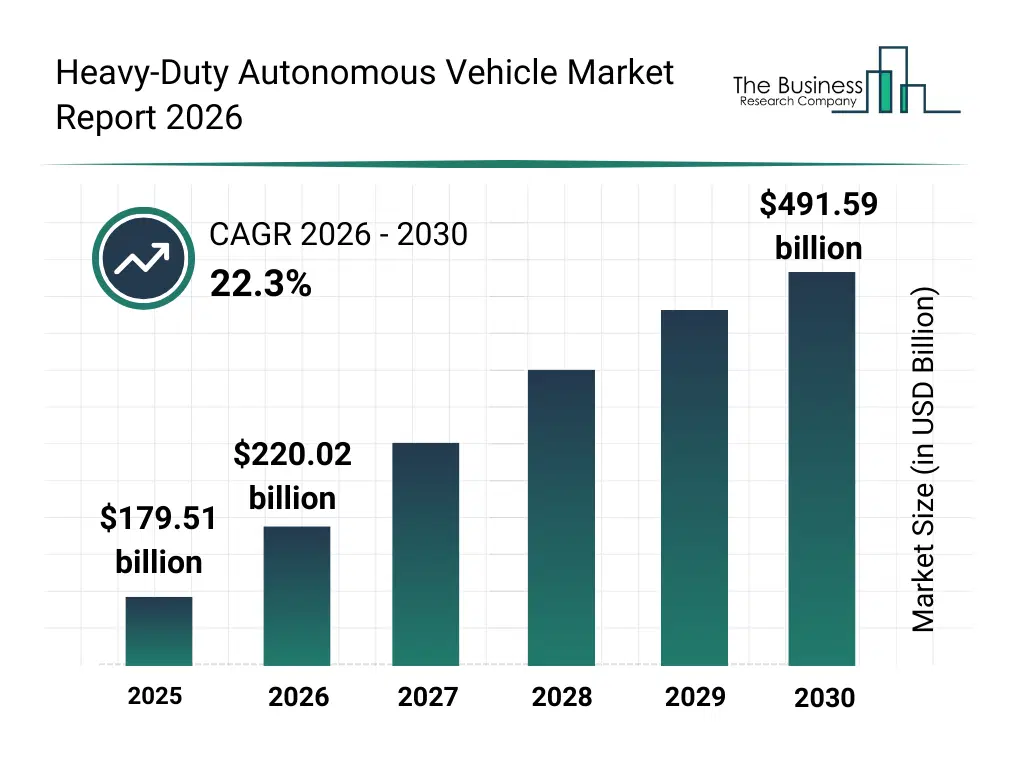
What Is The Heavy-Duty Autonomous Vehicle Market Size and Share 2026?
The heavy-duty autonomous vehicle market size has grown exponentially in recent years. It will grow from $179.51 billion in 2025 to $220.02 billion in 2026 at a compound annual growth rate (CAGR) of 22.6%. The growth in the historic period can be attributed to mining automation pilots, demand for labor safety, fleet productivity optimization, adoption of driver assistance systems, industrial digitization.What Is The Heavy-Duty Autonomous Vehicle Market Growth Forecast?
The heavy-duty autonomous vehicle market size is expected to see exponential growth in the next few years. It will grow to $491.59 billion in 2030 at a compound annual growth rate (CAGR) of 22.3%. The growth in the forecast period can be attributed to regulatory approvals for autonomy, ai maturity in perception systems, electrification of heavy vehicles, demand for cost-efficient logistics, smart infrastructure investments. Major trends in the forecast period include deployment of autonomous mining fleets, expansion of self-driving freight corridors, integration of advanced sensor fusion, adoption of remote operations, focus on operational safety.
Global Heavy-Duty Autonomous Vehicle Market Segmentation
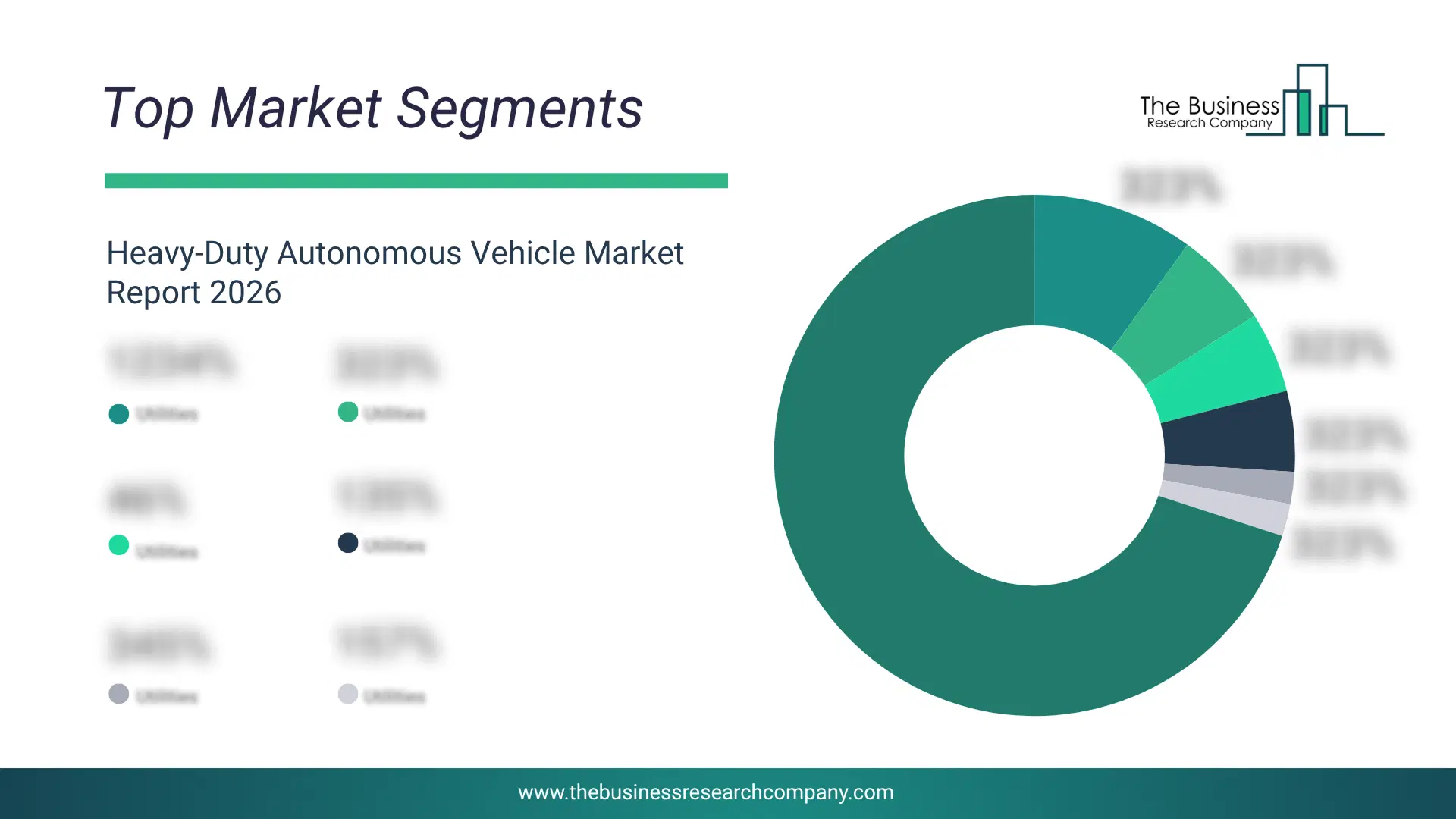
1) By Vehicle Type: Heavy Trucks, Heavy Buses, Roboshuttles 2) By Sensor Type: Light Detection And Ranging (LiDAR), Radio Detection And Ranging (RADAR), Camera, Other Sensor Types 3) By Level Of Autonomy: Semi-Autonomous Vehicles, Autonomous Vehicles 4) By Capacity: 3.5 - 7.5 Tons, 7.5 - 16 Tons, Above 16 Tons 5) By Application: Logistics, Public Transportation, Construction And Mining, Other Applications Subsegments: 1) By Heavy Trucks: Autonomous Freight Trucks, Long-Haul Autonomous Trucks, Autonomous Dump Trucks, Autonomous Delivery Trucks, Electric Autonomous Trucks, Autonomous Construction Trucks 2) By Heavy Buses: Autonomous City Buses, Autonomous Shuttle Buses, Autonomous Coach Buses, Electric Autonomous Buses, Autonomous Transit Buses 3) By Roboshuttles: Autonomous Airport Shuttles, Autonomous Public Transit Shuttles, Autonomous Corporate Campus Shuttles, Electric Roboshuttles, Low-Speed Autonomous Shuttles For Urban MobilityWhat Is The Driver Of The Heavy-Duty Autonomous Vehicle Market?
The expanding e-commerce sector is expected to propel the growth of the heavy-duty autonomous vehicle market going forward. The e-commerce sector encompasses businesses that buy and sell goods and services over the internet, leveraging online platforms to facilitate commercial transactions. The growth in the e-commerce sector is driven by factors such as internet penetration, mobile commerce, digital payment solutions, and social media integration. Heavy-duty autonomous vehicles (HDAVs) boost e-commerce by allowing for faster, more dependable long-distance transportation, minimizing human error, and enhancing supply chain efficiency, all of which improve delivery speed and safety. For instance, in August 2025, according to the U.S. Census Bureau, a U.S. federal government agency, e-commerce sales in the second quarter of 2025 totaled $304.2 billion, marking a 1.4 percent (±0.9%) increase from the first quarter. Total retail sales for the same period were estimated at $1,865.4 billion, reflecting a 0.4 percent (±0.4%) rise from the previous quarter. Therefore, the expanding e-commerce sector is driving the growth of the heavy-duty autonomous vehicle industry.Key Players In The Global Heavy-Duty Autonomous Vehicle Market
Major companies operating in the heavy-duty autonomous vehicle market report include Volkswagen AG, Caterpillar Inc., Daimler Truck AG, AB Volvo, Traton Group, Continental AG, PACCAR Inc., Baidu Inc., Schaeffler AG, MAN Truck & Bus, Yutong Bus Co. Ltd., Mobileye N.V., Anhui Ankai Automobile Co. Ltd., Torc Robotics, Embark Trucks Inc., EasyMile, Aurora Innovation Inc., Einride AB, Navya Technology, TuSimple Holdings Inc.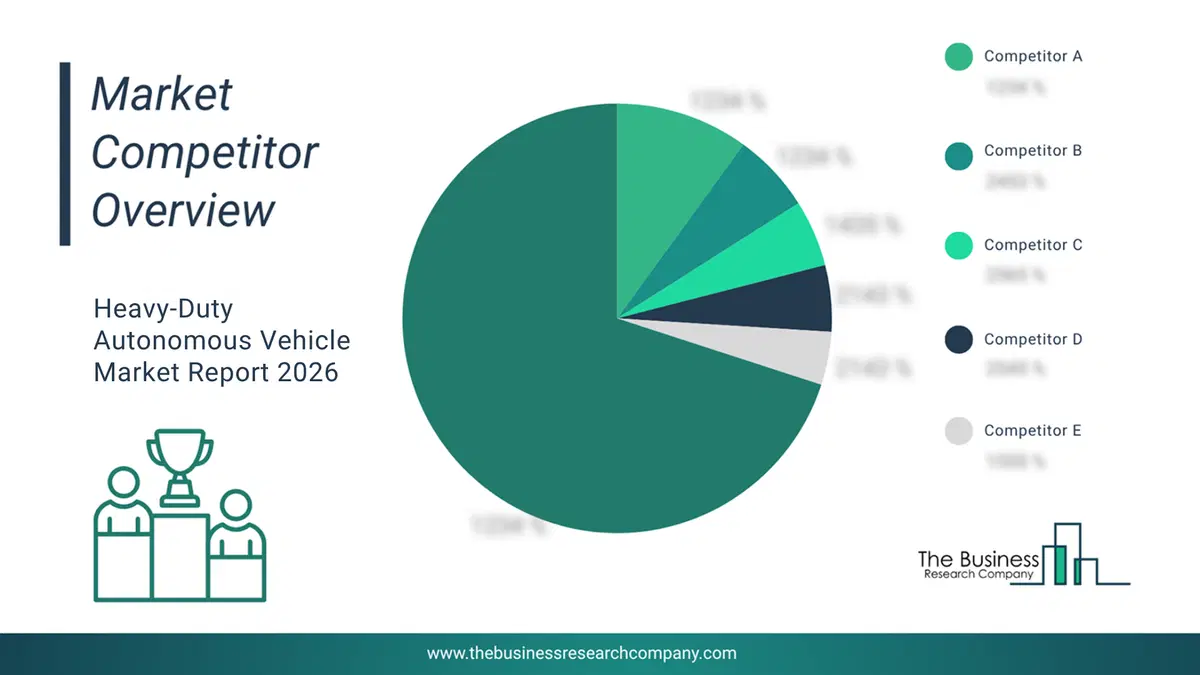
This chart is for illustrative purposes; the full report includes a detailed competitor analysis and comprehensive overview of the top 10 companies in the market.
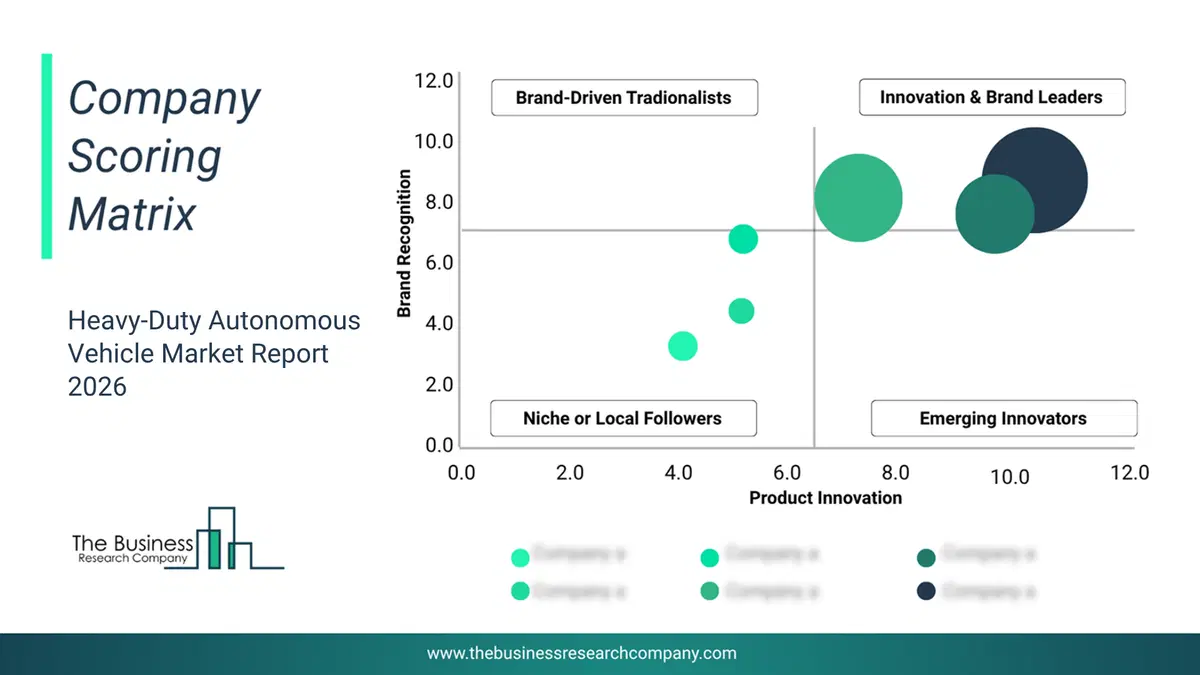
This chart maps companies by product innovation and brand strength, with bubble size indicating relative revenue, helping identify market leaders, challengers, and niche players. This is an illustrative chart; the full report provides a complete and accurate competitive analysis.
Global Heavy-Duty Autonomous Vehicle Market Trends and Insights
Major companies operating in the heavy-duty autonomous vehicle market are focused on developing advanced technology, such as a new generation of autonomous public transport, to enhance efficiency and improve safety in urban mobility solutions. A new generation of autonomous public transportation is the most innovative development in public transit systems, capable of navigating highways, interacting with traffic, and transporting passengers safely, resulting in a more reliable and sustainable public transit choice. For instance, in August 2023, Schaeffler AG, a Germany-based automotive industry company, partnered with VDL Groep, a Netherlands-based manufacturing company, to launch self-driving electric shuttles. These shuttles will utilize Mobileye's autonomous driving systems, which have attained society of automotive engineers (SAE) Level 4 for full self-driving capability, eliminating the need for a human driver. Each shuttle is around 5 meters in length, 2.2 meters in width, and 2.8 meters in height, with six fixed seats and three movable seats, accommodating a total of nine passengers. With a cargo capacity of 1,000 kg and a weight of up to 5,000 kg, the vehicle can travel at speeds of up to 70 km/h.What Are Latest Mergers And Acquisitions In The Heavy-Duty Autonomous Vehicle Market?
In June 2024, Gatik, a US-based autonomous truck developer, partnered with Isuzu Motors Limited to establish a production facility for mass-producing society of automotive engineers (SAE) Level 4 autonomous trucks. Isuzu is investing $30 million in Gatik as part of this collaboration, which aims to expedite the deployment of Gatik's freight-only operations, with the first deliveries expected from the newly built plant. Isuzu Motors Limited is a Japan-based automobile manufacturer.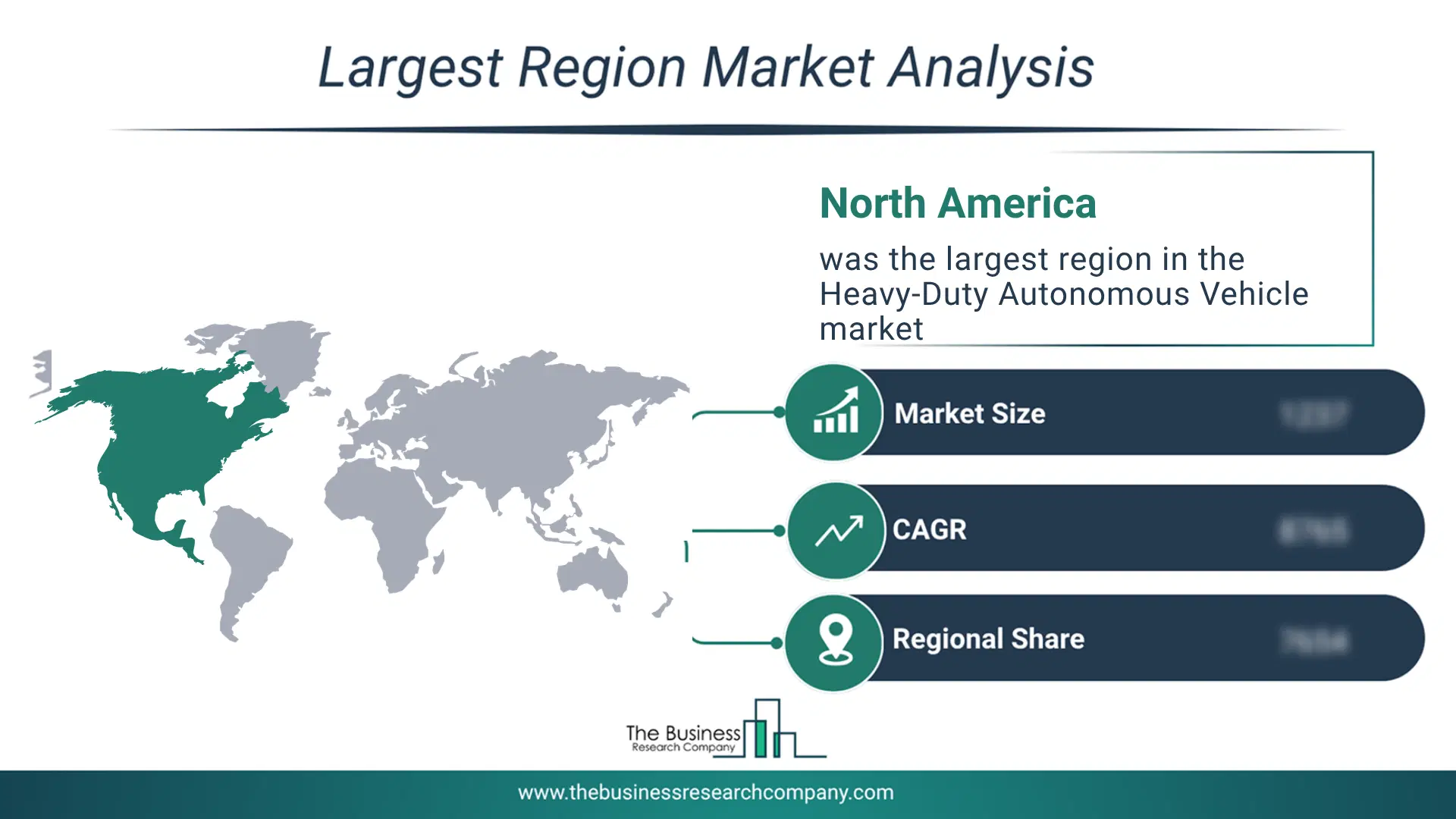
Regional Outlook
North America was the largest region in the heavy-duty autonomous vehicle market in 2025. Asia-Pacific is expected to be the fastest-growing region in the forecast period. The regions covered in this market report include Asia-Pacific, South East Asia, Western Europe, Eastern Europe, North America, South America, Middle East, Africa. The countries covered in this market report include Australia, Brazil, China, France, Germany, India, Indonesia, Japan, Taiwan, Russia, South Korea, UK, USA, Canada, Italy, SpainWhat Defines the Heavy-Duty Autonomous Vehicle Market?
The heavy-duty autonomous vehicle market consists of revenues earned by entities by providing services such as navigation systems, vehicle-to-everything (V2X) communication, fleet management, cybersecurity solutions, and remote monitoring. The market value includes the value of related goods sold by the service provider or included within the service offering. The heavy-duty autonomous vehicle market also includes sales of processing units, control systems, and connectivity modules. Values in this market are ‘factory gate’ values, that is, the value of goods sold by the manufacturers or creators of the goods, whether to other entities (including downstream manufacturers, wholesalers, distributors, and retailers) or directly to end customers. The value of goods in this market includes related services sold by the creators of the goods.How is Market Value Defined and Measured?
The market value is defined as the revenues that enterprises gain from the sale of goods and/or services within the specified market and geography through sales, grants, or donations in terms of the currency (in USD unless otherwise specified). The revenues for a specified geography are consumption values that are revenues generated by organizations in the specified geography within the market, irrespective of where they are produced. It does not include revenues from resales along the supply chain, either further along the supply chain or as part of other products.
This chart presents market attractiveness based on a quantitative evaluation of growth, competition, strategic alignment, and risk, offering a clear view of opportunity areas for decision-making. This chart is for illustrative purposes; the full report contains the complete analysis.

This chart highlights the Total Addressable Market (TAM) by estimating the maximum revenue opportunity using an assumption-driven approach, supporting strategic planning and opportunity sizing across markets. The chart is illustrative; the full report provides a more comprehensive analysis.
What Key Data and Analysis Are Included in the Heavy-Duty Autonomous Vehicle Market Report 2026?
The heavy-duty autonomous vehicle market research report is one of a series of new reports from The Business Research Company that provides market statistics, including industry global market size, regional shares, competitors with the market share, detailed market segments, market trends and opportunities, and any further data you may need to thrive in the heavy-duty autonomous vehicle industry. The market research report delivers a complete perspective of everything you need, with an in-depth analysis of the current and future state of the industry.Heavy-Duty Autonomous Vehicle Market Report Forecast Analysis
| Report Attribute | Details |
|---|---|
| Market Size Value In 2026 | $220.02 billion |
| Revenue Forecast In 2030 | $491.59 billion |
| Growth Rate | CAGR of 22.6% from 2026 to 2030 |
| Base Year For Estimation | 2025 |
| Actual Estimates/Historical Data | 2020-2025 |
| Forecast Period | 2026 - 2030 - 2030 |
| Market Representation | Revenue in USD Billion and CAGR from 2026 to 2030 |
| Segments Covered | Vehicle Type, Sensor Type, Level Of Autonomy, Capacity, Application |
| Regional Scope | Asia-Pacific, Western Europe, Eastern Europe, North America, South America, Middle East, Africa |
| Country Scope | The countries covered in the report are Australia, Brazil, China, France, Germany, India, Indonesia, Japan, Taiwan, Russia, South Korea, UK, USA, Canada, Italy, Spain. |
| Key Companies Profiled | Volkswagen AG, Caterpillar Inc., Daimler Truck AG, AB Volvo, Traton Group, Continental AG, PACCAR Inc., Baidu Inc., Schaeffler AG, MAN Truck & Bus, Yutong Bus Co. Ltd., Mobileye N.V., Anhui Ankai Automobile Co. Ltd., Torc Robotics, Embark Trucks Inc., EasyMile, Aurora Innovation Inc., Einride AB, Navya Technology, TuSimple Holdings Inc. |
| Customization Scope | Request for Customization |
| Pricing And Purchase Options | Explore Purchase Options |