
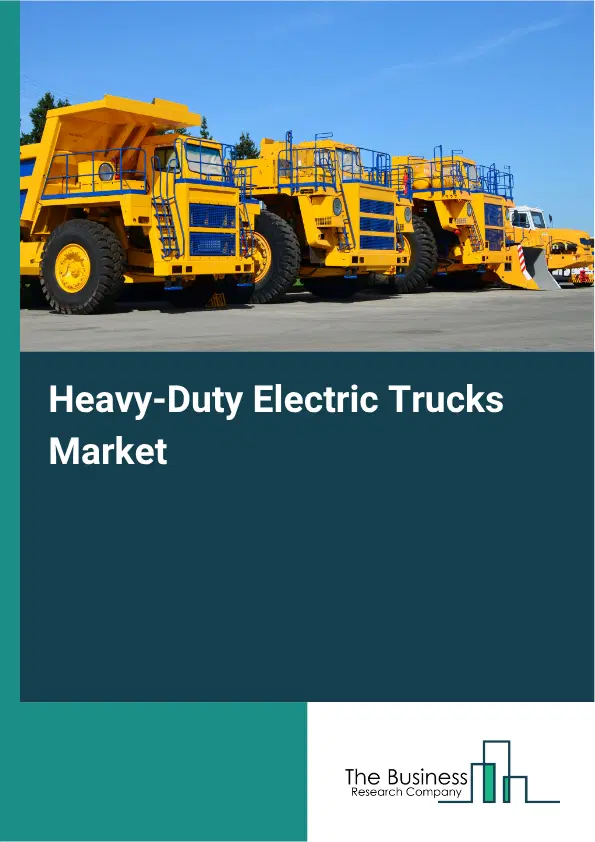
Heavy-Duty Electric Trucks Market Report 2026
Global Outlook – By Propulsion Type (Battery Electric Trucks, Fuel Cell Electric Trucks), By Range (Less Than 300 Kilometers, 300 To 500 Kilometers, More Than 500 Kilometers), By Battery Type (Lithium Ion, Solid State, Other Battery Types), By End User (Logistics Companies, Construction Companies, Mining Companies, Municipal Authorities, Other End Users) – Market Size, Trends, Strategies, and Forecast to 2030
Heavy-Duty Electric Trucks Market Overview
• Heavy-Duty Electric Trucks market size has reached to $4.72 billion in 2025 • Expected to grow to $14.32 billion in 2030 at a compound annual growth rate (CAGR) of 24.8% • Growth Driver: Rising Diesel Fuel Prices Driving The Market Growth Due To Increasing Operating Costs Of Conventional Freight Transportation • Market Trend: Innovation In Electrified Heavy-Duty Trucks Transforming Sustainable Logistics Operations • Asia-Pacific was the largest region and fastest growing region.What Is Covered Under Heavy-Duty Electric Trucks Market?
Heavy-duty electric trucks refer to large commercial vehicles powered primarily by electric drivetrains, using high-capacity battery systems and electric motors to perform high-load transportation tasks over short to long distances. These trucks are designed to replace or supplement conventional diesel-powered freight vehicles by reducing emissions, lowering operating costs, and improving energy efficiency. They rely on advanced battery management systems, power electronics, and regenerative braking technologies to optimize performance under demanding load and route conditions. The main propulsion types of heavy-duty electric trucks include battery electric trucks and fuel cell electric trucks. Battery electric trucks refer to heavy-duty vehicles powered entirely by electricity stored in rechargeable battery systems, offering zero tailpipe emissions and improved energy efficiency for freight transportation. These trucks are available in ranges including less than 300 kilometers, 300 to 500 kilometers, and more than 500 kilometers. They utilize battery types such as lithium ion, solid state, and others and are used by end users including logistics companies, construction companies, mining companies, municipal authorities, and others.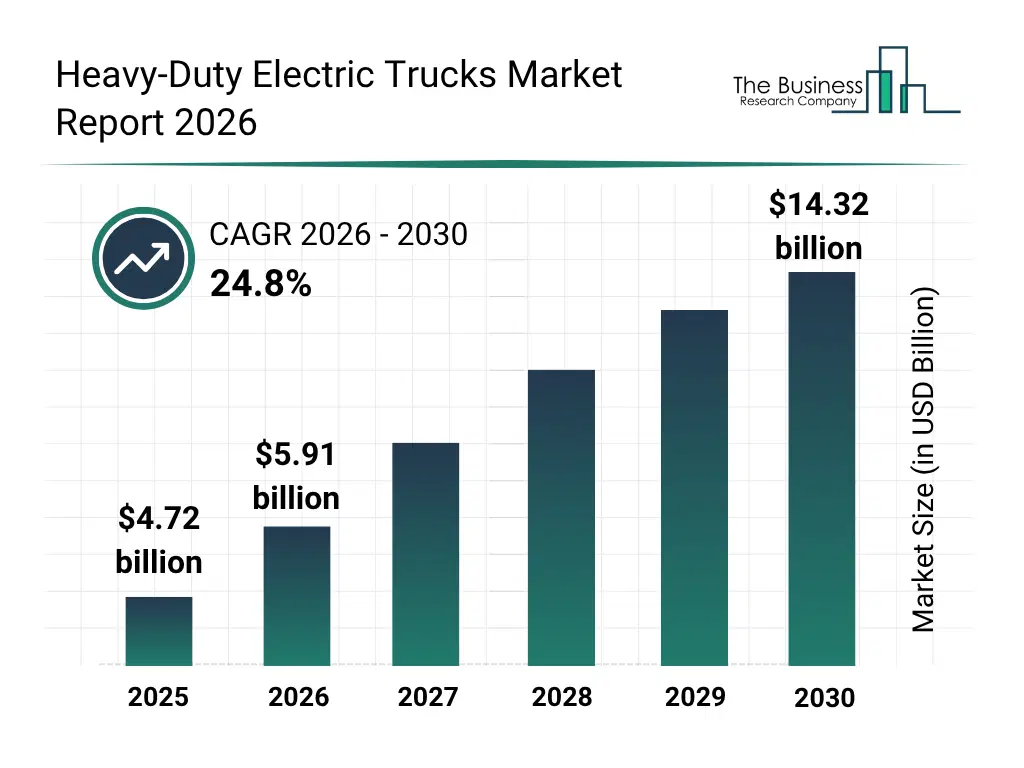
What Is The Heavy-Duty Electric Trucks Market Size and Share 2026?
The heavy-duty electric trucks market size has grown exponentially in recent years. It will grow from $4.72 billion in 2025 to $5.91 billion in 2026 at a compound annual growth rate (CAGR) of 25.2%. The growth in the historic period can be attributed to increasing focus on reducing transportation emissions, growing adoption of electric vehicle technologies, rising fuel cost pressures on freight operators, increasing government support for commercial vehicle electrification, growing demand for lower operating cost transportation solutions.What Is The Heavy-Duty Electric Trucks Market Growth Forecast?
The heavy-duty electric trucks market size is expected to see exponential growth in the next few years. It will grow to $14.32 billion in 2030 at a compound annual growth rate (CAGR) of 24.8%. The growth in the forecast period can be attributed to increasing deployment of high capacity battery systems, rising expansion of electric charging infrastructure, growing adoption of zero emission freight transportation, increasing integration of connected vehicle technologies, rising demand for efficient heavy duty electric mobility solutions. Major trends in the forecast period include advanced battery management systems for heavy duty electric trucks, development of high capacity battery technologies for long range operations, increasing adoption of regenerative braking systems in commercial vehicles, expansion of fast charging infrastructure for electric freight transportation, growing demand for efficient electric drivetrain components.
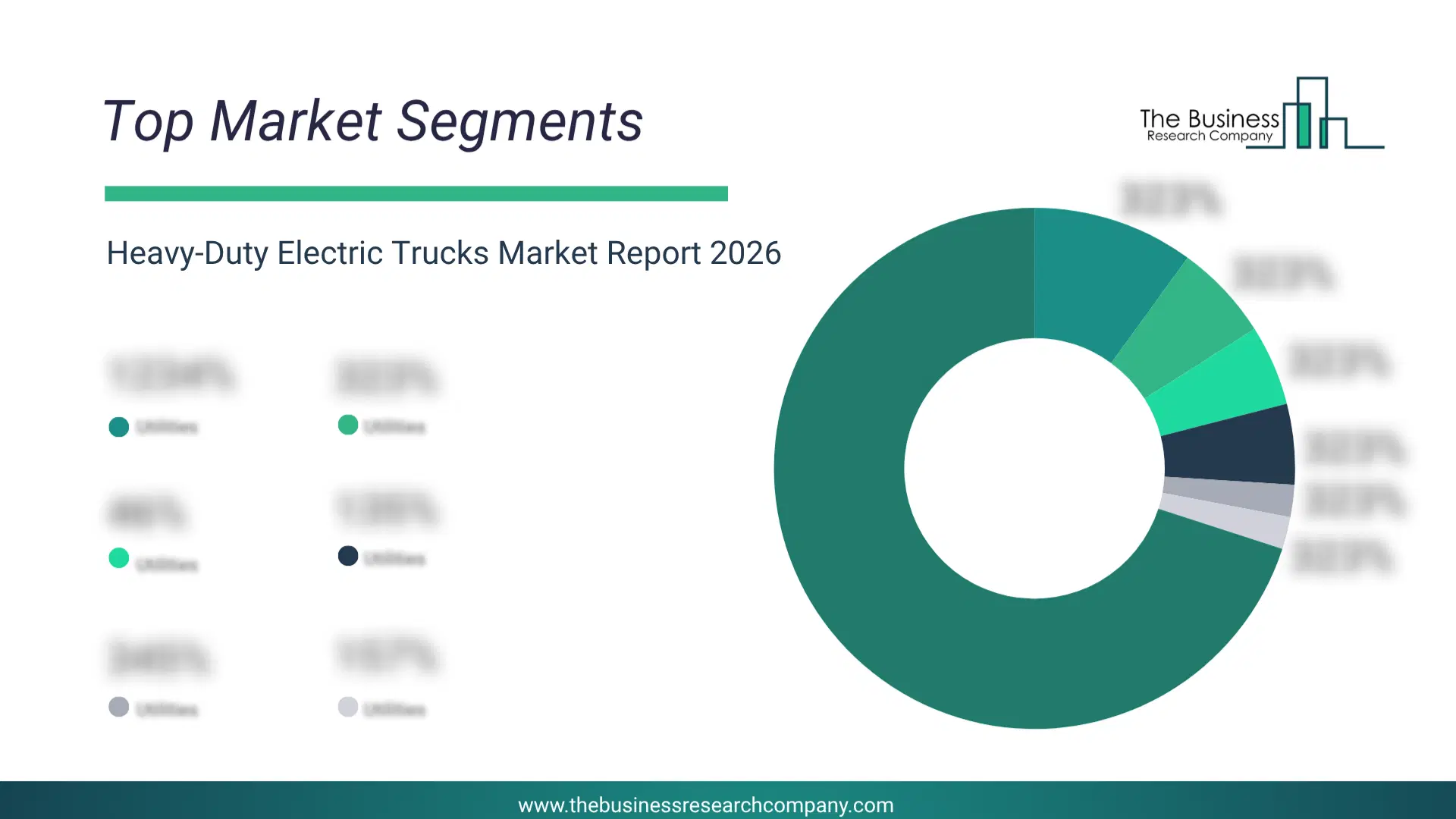
Global Heavy-Duty Electric Trucks Market Segmentation
2) By Range: Less Than 300 Kilometers, 300 To 500 Kilometers, More Than 500 Kilometers 3) By Battery Type: Lithium Ion, Solid State, Other Battery Types 4) By End User: Logistics Companies, Construction Companies, Mining Companies, Municipal Authorities, Other End Users Subsegments: 1) By Battery Electric Trucks: Long Haul Battery Electric Trucks, Regional Distribution Battery Electric Trucks, Urban Delivery Battery Electric Trucks, Construction Battery Electric Trucks, Mining Battery Electric Trucks 2) By Fuel Cell Electric Trucks: Long Haul Fuel Cell Electric Trucks, Regional Distribution Fuel Cell Electric Trucks, Urban Delivery Fuel Cell Electric Trucks, Construction Fuel Cell Electric Trucks, Mining Fuel Cell Electric TrucksWhat Is The Driver Of The Heavy-Duty Electric Trucks Market?
The rising diesel fuel prices are expected to propel the growth of the heavy duty electric trucks market going forward. Diesel fuel prices refer to the cost of diesel per unit volume, which directly impacts the operating expenses of freight and logistics vehicles powered by internal combustion engines. Diesel fuel prices are increasing due to geopolitical tensions, as conflicts, trade restrictions, and instability in major oil-producing regions disrupt crude oil supply and transportation, leading to reduced global availability and higher market prices for diesel. Diesel fuel prices drive the growth of heavy duty electric trucks by increasing the operating costs of conventional diesel-powered freight vehicles, which encourages fleet operators to shift toward electric trucks that offer lower and more stable energy expenses, reduced exposure to fuel price volatility, and improved long-term cost efficiency. For instance, in April 2026, according to the Statistics South Africa, a South Africa-based national statistical service provider, diesel prices increased by 39.4% and petrol prices rose by 18.3%. These were the highest recorded increases for diesel and petrol, respectively, since the beginning of the PPI series. Therefore, the rising diesel fuel prices are driving the growth of the heavy duty electric trucks market.Key Players In The Global Heavy-Duty Electric Trucks Market
Major companies operating in the heavy-duty electric trucks market are AB Volvo, Daimler Truck Holding AG, Tesla Inc., BYD Company Limited, PACCAR Inc., Hyundai Motor Company, SAIC Motor Corporation Limited, China FAW Group Co. Ltd., Dongfeng Motor Corporation, Zhejiang Geely Holding Group Co. Ltd., Scania AB, MAN Truck & Bus SE, Iveco Group, Renault Trucks, SANY Group Co. Ltd., Beiqi Foton Motor Co. Ltd., Shacman Automobile, Sinotruk Group, Isuzu Motors Limited, Beiben Heavy-Duty Truck Co. Ltd., Anhui Jianghuai Automobile Group Corp. Ltd.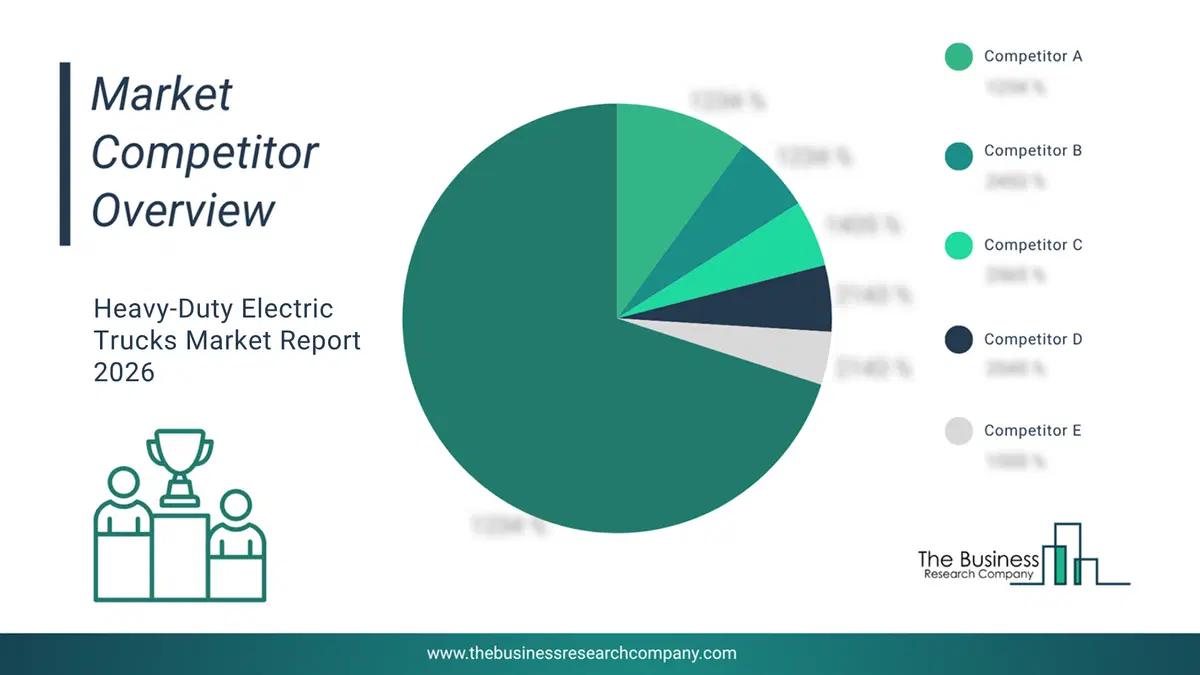
This chart is for illustrative purposes; the full report includes a detailed competitor analysis and comprehensive overview of the top 10 companies in the market.
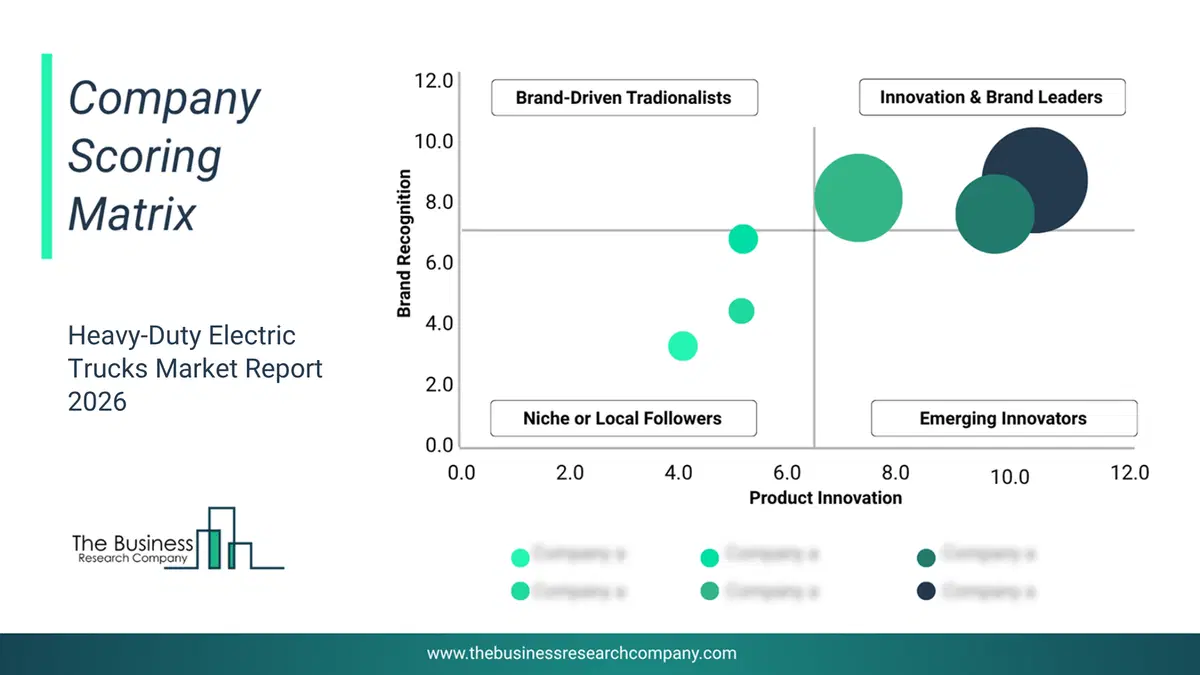
This chart maps companies by product innovation and brand strength, with bubble size indicating relative revenue, helping identify market leaders, challengers, and niche players. This is an illustrative chart; the full report provides a complete and accurate competitive analysis.
Global Heavy-Duty Electric Trucks Market Trends and Insights
Major companies operating in the heavy-duty electric trucks market are focusing on developing innovative products, such as zero-emission heavy-duty trucks to reduce carbon emissions, improve energy efficiency, and support sustainable freight transportation. Zero-emission heavy-duty trucks are large commercial freight vehicles powered by electricity or other non-combustion energy sources that produce no tailpipe emissions, helping reduce greenhouse gas emissions, improve air quality, and support sustainable and regulatory-compliant freight transportation. For instance, in March 2026, Volvo Trucks, a Sweden-based commercial vehicle manufacturer, in collaboration with CJ Darcl Logistics Ltd., an India-based logistics company, launched a heavy-duty battery electric vehicle as part of efforts to decarbonize freight transportation in India. The electric truck was developed over an 18-month collaboration focusing on route optimization, payload requirements, and operational integration to ensure real-world feasibility in logistics networks. The vehicle supports CJ Darcl’s broader sustainability strategy aimed at reducing Scope 1, 2, and 3 emissions and transitioning toward carbon-neutral logistics operations. This initiative highlights the growing adoption of electric heavy-duty trucks in commercial freight as companies shift toward cleaner and more sustainable transportation solutions.What Are Latest Mergers And Acquisitions In The Heavy-Duty Electric Trucks Market?
In May 2023, Iveco Group N.V., an Italy-based commercial vehicle manufacturing company, partnered with Nikola Corporation to enter a new phase of their existing joint venture agreement. With this partnership, Iveco Group N.V. aims to strengthen and streamline its zero-emission commercial vehicle strategy in Europe by assuming full ownership of the joint venture, improving operational efficiency, and focusing on accelerating the development and deployment of battery-electric and hydrogen fuel cell truck technologies in collaboration with Nikola Corporation. Nikola Corporation is a US-based manufacturing company that specializes in providing electric and hydrogen fuel cell trucks.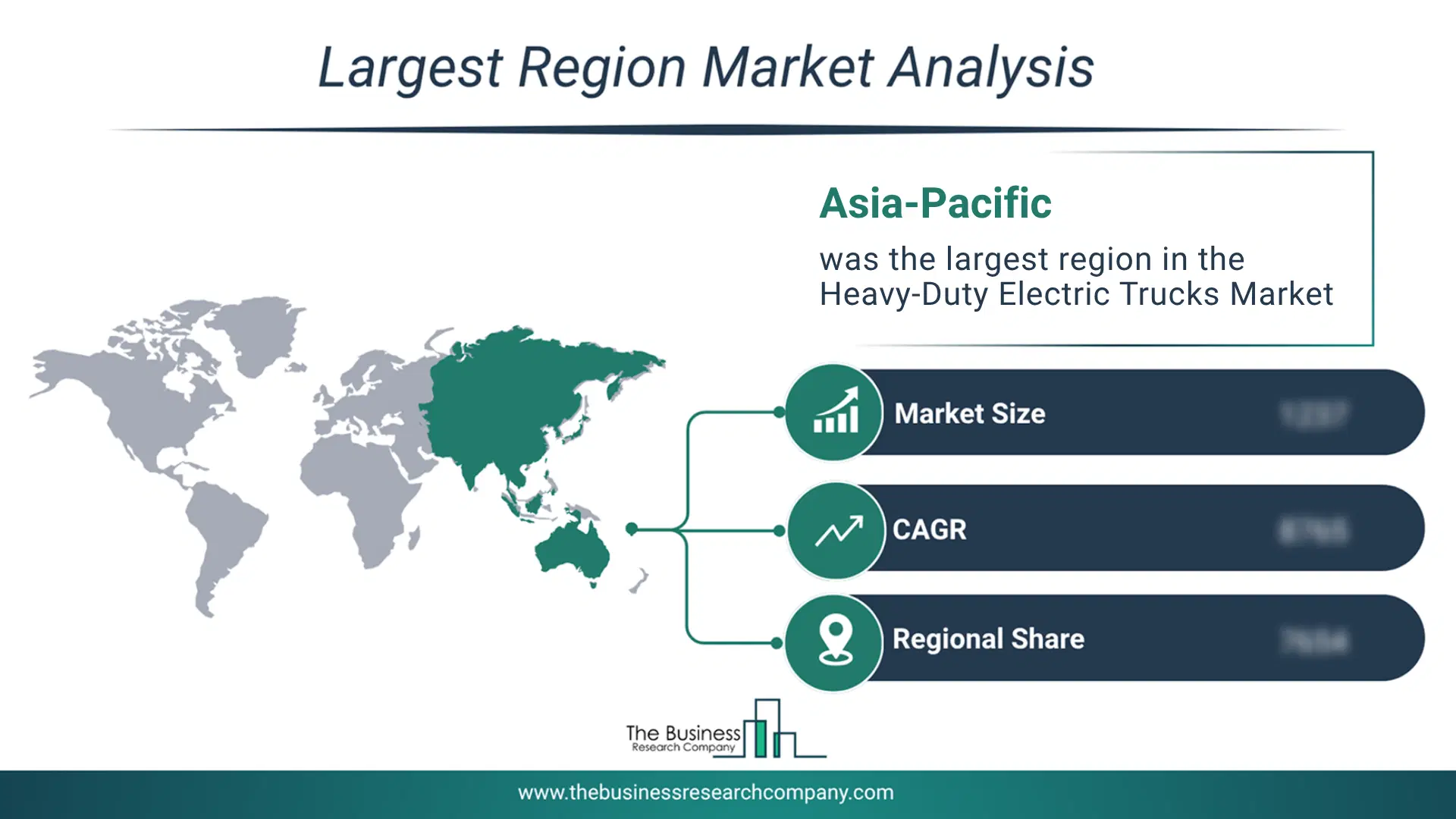
Regional Outlook/Insights
Asia-Pacific was the largest region in the heavy-duty electric trucks market in 2025. Asia-Pacific is expected to be the fastest-growing region in the forecast period. The regions covered in this market report are Asia-Pacific, South East Asia, Western Europe, Eastern Europe, North America, South America, Middle East, Africa. The countries covered in this market report are Australia, Brazil, China, France, Germany, India, Indonesia, Japan, Taiwan, Russia, South Korea, UK, USA, Canada, Italy, Spain.What Defines the Heavy-Duty Electric Trucks Market?
The heavy-duty electric trucks market consists of sales of electric tractor-trailers, electric rigid trucks, electric dump trucks, electric refuse trucks, and electric long-haul freight trucks. Values in this market are ‘factory gate’ values, that is, the value of goods sold by the manufacturers or creators of the goods, whether to other entities (including downstream manufacturers, wholesalers, distributors, and retailers) or directly to end customers. The value of goods in this market includes related services sold by the creators of the goods.How is Market Value Defined and Measured?
The market value is defined as the revenues that enterprises gain from the sale of goods and/or services within the specified market and geography through sales, grants, or donations in terms of the currency (in USD unless otherwise specified). The revenues for a specified geography are consumption values that are revenues generated by organizations in the specified geography within the market, irrespective of where they are produced. It does not include revenues from resales along the supply chain, either further along the supply chain or as part of other products.
This chart presents market attractiveness based on a quantitative evaluation of growth, competition, strategic alignment, and risk, offering a clear view of opportunity areas for decision-making. This chart is for illustrative purposes; the full report contains the complete analysis.

This chart highlights the Total Addressable Market (TAM) by estimating the maximum revenue opportunity using an assumption-driven approach, supporting strategic planning and opportunity sizing across markets. The chart is illustrative; the full report provides a more comprehensive analysis.
What Key Data and Analysis Are Included in the Heavy-Duty Electric Trucks Market Report 2026?
The heavy-duty electric trucks market research report is one of a series of new reports from The Business Research Company that provides heavy-duty electric trucks market statistics, including heavy-duty electric trucks industry global market size, regional shares, competitors with a heavy-duty electric trucks market share, detailed heavy-duty electric trucks market segments, market trends and opportunities, and any further data you may need to thrive in the heavy-duty electric trucks industry. This heavy-duty electric trucks market research report delivers a complete perspective of everything you need, with an in-depth analysis of the current and future scenario of the industry.Heavy-Duty Electric Trucks Market Report Forecast Analysis
| Report Attribute | Details |
|---|---|
| Market Size Value In 2026 | $5.91 billion |
| Revenue Forecast In 2030 | $14.32 billion |
| Growth Rate | CAGR of 24.8% from 2026 to 2030 |
| Base Year For Estimation | 2025 |
| Actual Estimates/Historical Data | 2020-2025 |
| Forecast Period | 2026 - 2030 |
| Market Representation | Revenue in USD Billion and CAGR from 2026 to 2030 |
| Segments Covered | Propulsion Type, Range, Battery Type, End User |
| Regional Scope | Asia-Pacific, Western Europe, Eastern Europe, North America, South America, Middle East, Africa |
| Country Scope | The countries covered in the report are Australia, Brazil, China, France, Germany, India, Indonesia, Japan, Taiwan, Russia, South Korea, UK, USA, Canada, Italy, Spain. |
| Key Companies Profiled | AB Volvo, Daimler Truck Holding AG, Tesla Inc., BYD Company Limited, PACCAR Inc., Hyundai Motor Company, SAIC Motor Corporation Limited, China FAW Group Co. Ltd., Dongfeng Motor Corporation, Zhejiang Geely Holding Group Co. Ltd., Scania AB, MAN Truck & Bus SE, Iveco Group, Renault Trucks, SANY Group Co. Ltd., Beiqi Foton Motor Co. Ltd., Shacman Automobile, Sinotruk Group, Isuzu Motors Limited, Beiben Heavy-Duty Truck Co. Ltd., Anhui Jianghuai Automobile Group Corp. Ltd. |
| Customization Scope | Request for Customization |
| Pricing And Purchase Options | Explore Purchase Options |