
Heavy Metal Testing In Food And Beverage Application Market Report 2026
Global Outlook – By Metal Type (Arsenic, Cadmium, Lead, Mercury, Chromium, Other Metal Type), By Sample (Food, Water), By Technology (Inductively Coupled Plasma Mass Spectrometry (ICP-MS) And Optical Emission Spectrometry (OES), Atomic Absorption Spectroscopy (AAS), Other Technology), By End-Use Industry (Food, Beverage, Dietary Supplement, Animal Feed, Fat And Oil) – Market Size, Trends, Strategies, and Forecast to 2030
Heavy Metal Testing In Food And Beverage Application Market Overview
• Heavy Metal Testing In Food And Beverage Application market size has reached to $3.99 billion in 2025 • Expected to grow to $6.02 billion in 2030 at a compound annual growth rate (CAGR) of 8.5% • Growth Driver: Rising Consumer Health Awareness Fuels Expansion Of Heavy Metal Testing In The Food And Beverage Application Market • Market Trend: Enhancing Safety Through Soil-to-Spoon Transparency • North America was the largest region in 2025.What Is Covered Under Heavy Metal Testing In Food And Beverage Application Market?
Heavy metal testing in food and beverage applications refers to checking for high levels of toxic or potentially harmful heavy metals in foods and beverages, including lead, mercury, cadmium, chromium, and arsenic. Tests for lead, cadmium, copper, and zinc can be performed using atomic absorption spectrometry (AAS). The main metal types for heavy metal testing in the food and beverage application market are arsenic, cadmium, lead, mercury, chromium, and other metal types. Arsenic refers to a solid chemical element that is used in a range of products such as wood preservatives, alloys, and semiconductors. The various samples include food, water, blood, and other samples. The various technologies include inductively coupled plasma mass spectrometry and optical emission spectrometry, atomic absorption spectroscopy, and other technology used by various end-user industries such as food, beverage, dietary supplement, animal feed, fat and oil, and other end-user industries.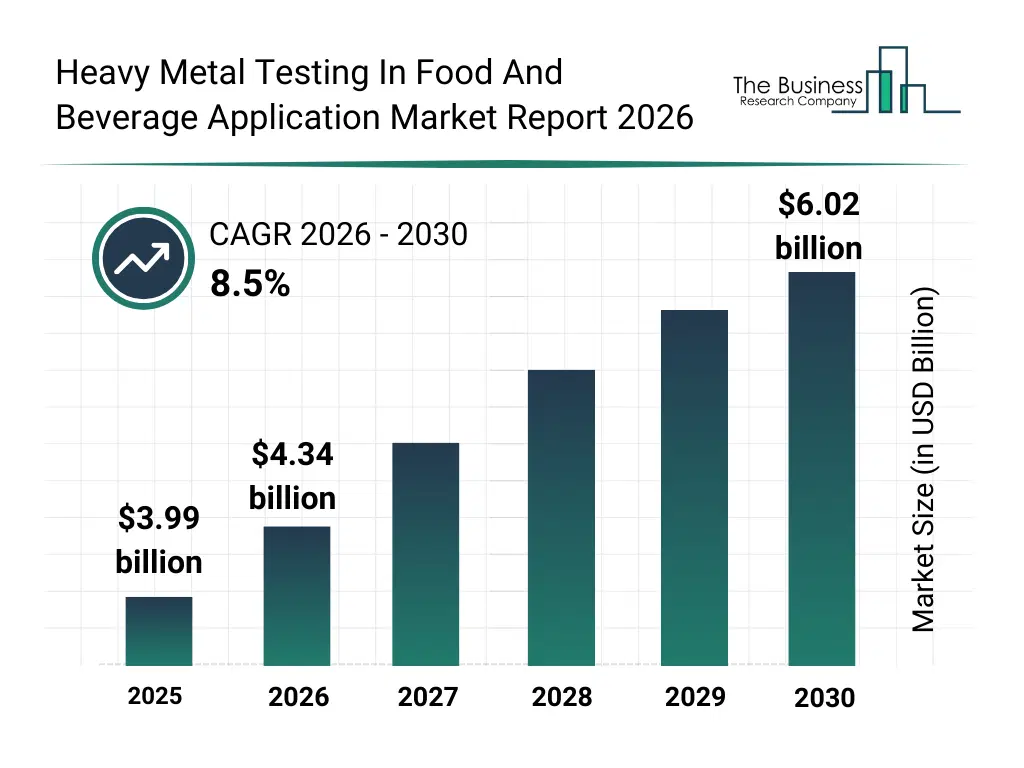
What Is The Heavy Metal Testing In Food And Beverage Application Market Size and Share 2026?
The heavy metal testing in food and beverage application market size has grown strongly in recent years. It will grow from $3.99 billion in 2025 to $4.34 billion in 2026 at a compound annual growth rate (CAGR) of 8.9%. The growth in the historic period can be attributed to rising awareness of food contamination risks, early enforcement of safety regulations, increasing food industry quality testing needs, expansion of analytical laboratory infrastructure, initial development of heavy metal detection solutions.What Is The Heavy Metal Testing In Food And Beverage Application Market Growth Forecast?
The heavy metal testing in food and beverage application market size is expected to see strong growth in the next few years. It will grow to $6.02 billion in 2030 at a compound annual growth rate (CAGR) of 8.5%. The growth in the forecast period can be attributed to increasing regulatory stringency in food safety standards, rising demand for consumer protection in food supply chains, growing adoption of precision testing technologies, expanding applications in beverage and dietary supplements, strengthening focus on public health assurance. Major trends in the forecast period include increasing emphasis on food safety and contamination detection, growing adoption of advanced heavy metal testing technologies, rising focus on regulatory compliance in food quality testing, increasing demand for rapid and accurate contaminant detection, growing expansion of laboratory and on site testing solutions.
Global Heavy Metal Testing In Food And Beverage Application Market Segmentation
1) By Metal Type: Arsenic, Cadmium, Lead, Mercury, Chromium, Other Metal Type 2) By Sample: Food, Water 3) By Technology: Inductively Coupled Plasma Mass Spectrometry (ICP-MS) And Optical Emission Spectrometry (OES), Atomic Absorption Spectroscopy (AAS), Other Technology 4) By End-Use Industry: Food, Beverage, Dietary Supplement, Animal Feed, Fat And Oil Subsegments: 1) By Arsenic: Inorganic Arsenic, Organic Arsenic 2) By Cadmium: Cadmium In Food, Cadmium In Beverages 3) By Lead: Lead In Food, Lead In Beverages 4) By Mercury: Methylmercury, Elemental Mercury 5) By Chromium: Chromium VI, Chromium III 6) By Other Metal Types: Nickel, Zinc, Copper, IronWhat Is The Driver Of The Heavy Metal Testing In Food And Beverage Application Market?
The increase in consumer health awareness is expected to propel the growth of the heavy metal testing in food and beverage application market going forward. Consumer health awareness refers to the level of knowledge, understanding, and consciousness that consumers have about various aspects of health and wellness, including their own physical and mental well-being, as well as the impact of products, services, and lifestyle choices on health. Consumers who are health-conscious and aware of the potential risks associated with heavy metal contamination in food are more likely to demand products that meet stringent safety standards. They actively seek out food and beverage items that are certified as heavy metal-free, which drives the need for testing. For instance, in January 2023, according to the Global Wellness Institute, a US-based leading nonprofit research and educational organization, the global wellness economy has climbed to a record $6.3 trillion and is projected to grow further, reaching $9 trillion by 2028. Therefore, the increase in consumer health awareness is driving the growth of heavy metal testing in the food and beverage application market.Key Players In The Global Heavy Metal Testing In Food And Beverage Application Market
Major companies operating in the heavy metal testing in food and beverage application market report are Société Générale de Surveillance S.A., Eurofins Scientific SE, Intertek Group PLC, Bureau Veritas S.A., Mérieux NutriSciences, Neogen Corporation, AsureQuality Limited, AES Laboratories Private Limited, EMSL Analytical Inc., CIS Laboratory, Cotecna SA, Activation Laboratories Limited, AGQ Labs USA, Microbac Laboratories Inc., TÜV SÜD AG, Symbio Laboratories, LGC Limited, TÜV Rheinland AG, ALS Scandinavia AB, Silliker Inc.
This chart is for illustrative purposes; the full report includes a detailed competitor analysis and comprehensive overview of the top 10 companies in the market.
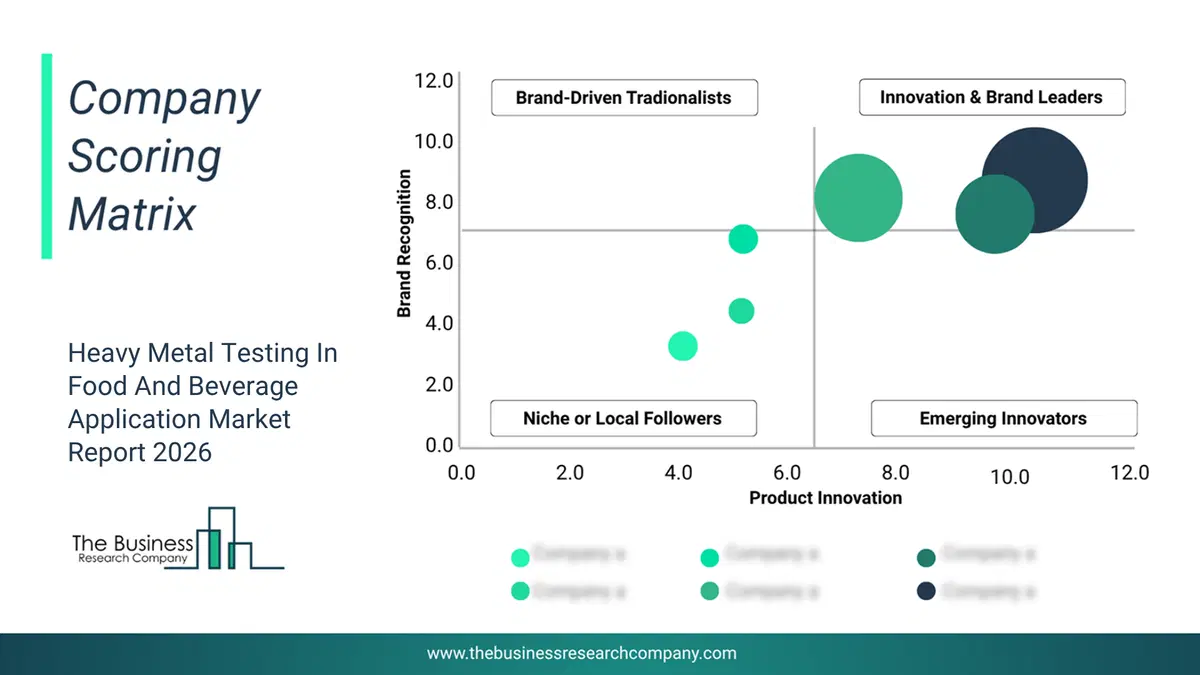
This chart maps companies by product innovation and brand strength, with bubble size indicating relative revenue, helping identify market leaders, challengers, and niche players. This is an illustrative chart; the full report provides a complete and accurate competitive analysis.
Global Heavy Metal Testing In Food And Beverage Application Market Trends and Insights
Major companies operating in the heavy metal testing in the food and beverage applications market are focusing on innovative technologies such as soil-to-spoon transparency to enhance the accuracy and reliability of testing processes, ensuring safer products for consumers and improving traceability throughout the supply chain. Soil-to-spoon transparency is a holistic approach that tracks food from its origin to the consumer, ensuring safety and quality at every stage. For instance, in October 2024, Babylife Organics, a Canada-based company that specializes in organic products for babies and toddlers, launched a new line of baby food. Babylife Organics tests for heavy metals at four critical points in the supply chain, ensuring comprehensive safety measures.What Are Latest Mergers And Acquisitions In The Heavy Metal Testing In Food And Beverage Application Market?
In September 2024, Hitachi Ltd., a Japan-based wide range of products across various sectors, acquired MA Micro Automation GmbH for an undisclosed amount. Through this acquisition, Hitachi Ltd. aims to enhance its technology and expand its market presence. MA Micro Automation GmbH is a Germany-based company, specializing in manufacturing automation solutions, particularly for industrial applications.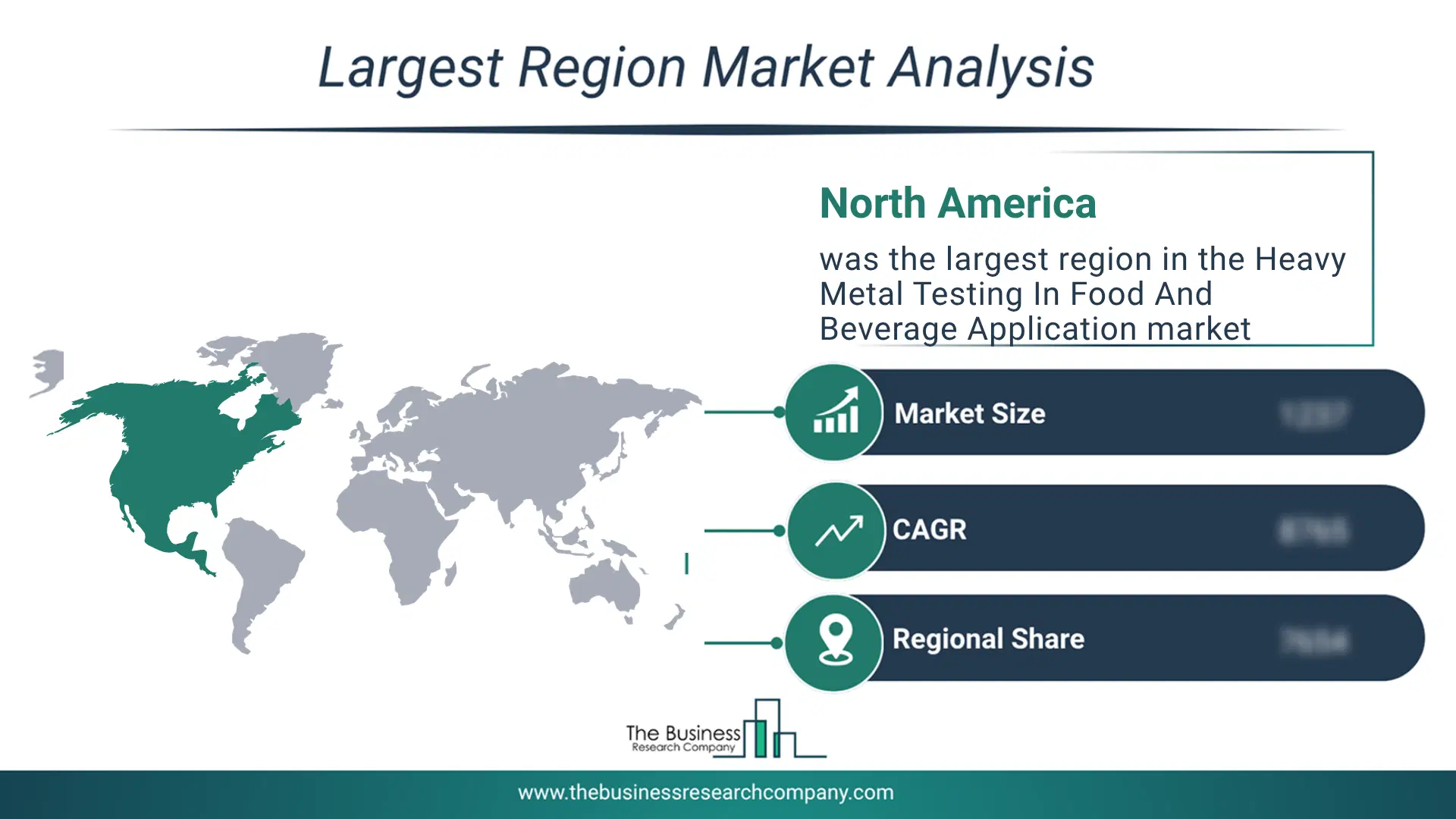
Regional Outlook
North America was the largest region in the heavy metal testing in food and beverage application market in 2025. The regions covered in this market report are Asia-Pacific, South East Asia, Western Europe, Eastern Europe, North America, South America, Middle East, Africa. The countries covered in this market report are Australia, Brazil, China, France, Germany, India, Indonesia, Japan, Taiwan, Russia, South Korea, UK, USA, Canada, Italy, SpainWhat Defines the Heavy Metal Testing In Food And Beverage Application Market?
The heavy metal testing in food and beverage application market consists of revenues earned by providing food testing services for foods such as meat, poultry, seafood, dairy products, processed foods, nuts, seeds, spices, and cereals. The market value includes the value of related goods sold by the service provider or included within the service offering. Heavy metal testing in the food and beverage application market also includes sales of inductively coupled plasma atomic emission spectroscopy, molecular spectroscopy, near-infrared spectroscopy, far-infrared spectroscopy, and fluorescence spectroscopy for testing heavy metals in food ingredients and beverages. Values in this market are ‘factory gate’ values, that is, the value of goods sold by the manufacturers or creators of the goods, whether to other entities (including downstream manufacturers, wholesalers, distributors, and retailers) or directly to end customers. The value of goods in this market includes related services sold by the creators of the goods.How is Market Value Defined and Measured?
The market value is defined as the revenues that enterprises gain from the sale of goods and/or services within the specified market and geography through sales, grants, or donations in terms of the currency (in USD unless otherwise specified). The revenues for a specified geography are consumption values that are revenues generated by organizations in the specified geography within the market, irrespective of where they are produced. It does not include revenues from resales along the supply chain, either further along the supply chain or as part of other products.
This chart presents market attractiveness based on a quantitative evaluation of growth, competition, strategic alignment, and risk, offering a clear view of opportunity areas for decision-making. This chart is for illustrative purposes; the full report contains the complete analysis.

This chart highlights the Total Addressable Market (TAM) by estimating the maximum revenue opportunity using an assumption-driven approach, supporting strategic planning and opportunity sizing across markets. The chart is illustrative; the full report provides a more comprehensive analysis.
What Key Data and Analysis Are Included in the Heavy Metal Testing In Food And Beverage Application Market Report 2026?
The heavy metal testing in food and beverage application market research report is one of a series of new reports from The Business Research Company that provides market statistics, including industry global market size, regional shares, competitors with the market share, detailed market segments, market trends and opportunities, and any further data you may need to thrive in the heavy metal testing in food and beverage application industry. The market research report delivers a complete perspective of everything you need, with an in-depth analysis of the current and future state of the industry.Heavy Metal Testing In Food And Beverage Application Market Report Forecast Analysis
| Report Attribute | Details |
|---|---|
| Market Size Value In 2026 | $4.34 billion |
| Revenue Forecast In 2030 | $6.02 billion |
| Growth Rate | CAGR of 8.9% from 2026 to 2030 |
| Base Year For Estimation | 2025 |
| Actual Estimates/Historical Data | 2020-2025 |
| Forecast Period | 2026 - 2030 - 2030 |
| Market Representation | Revenue in USD Billion and CAGR from 2026 to 2030 |
| Segments Covered | Metal Type, Sample, Technology, End-Use Industry |
| Regional Scope | Asia-Pacific, Western Europe, Eastern Europe, North America, South America, Middle East, Africa |
| Country Scope | The countries covered in the report are Australia, Brazil, China, France, Germany, India, Indonesia, Japan, Taiwan, Russia, South Korea, UK, USA, Canada, Italy, Spain. |
| Key Companies Profiled | Société Générale de Surveillance S.A., Eurofins Scientific SE, Intertek Group PLC, Bureau Veritas S.A., Mérieux NutriSciences, Neogen Corporation, AsureQuality Limited, AES Laboratories Private Limited, EMSL Analytical Inc., CIS Laboratory, Cotecna SA, Activation Laboratories Limited, AGQ Labs USA, Microbac Laboratories Inc., TÜV SÜD AG, Symbio Laboratories, LGC Limited, TÜV Rheinland AG, ALS Scandinavia AB, Silliker Inc. |
| Customization Scope | Request for Customization |
| Pricing And Purchase Options | Explore Purchase Options |