
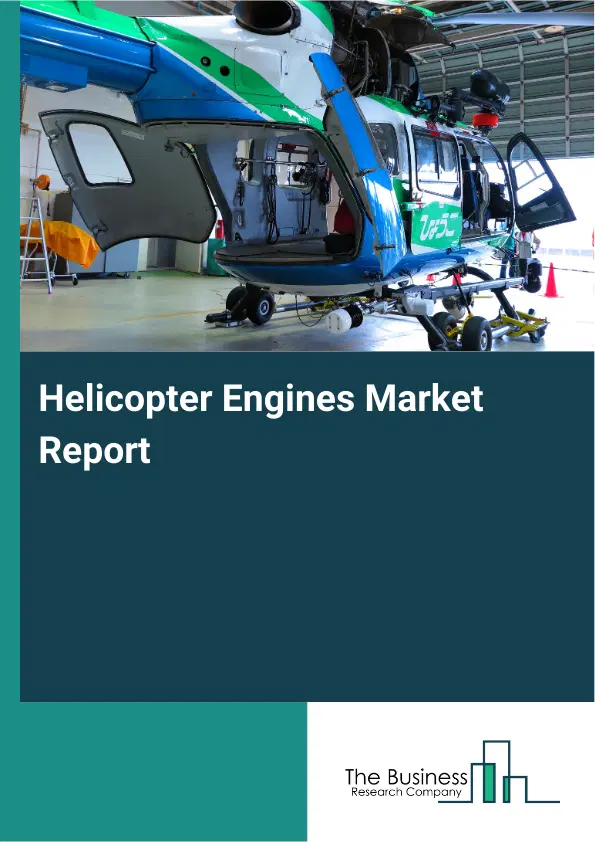
Helicopter Engines Market Report 2026
Global Outlook – By Type (Piston Engine, Gas Turbine Engine), By Weight (Light, Medium, Heavy), By Point Of Sale (New, Pre-Owned), By Application (Emergency Medical Services, Corporate Services, Search And Rescue Operations, Oil And Gas, Defense, Homeland Security, Other Applications) – Market Size, Trends, Strategies, and Forecast to 2030
Helicopter Engines Market Overview
• Helicopter Engines market size has reached to $23.61 billion in 2025 • Expected to grow to $28.81 billion in 2030 at a compound annual growth rate (CAGR) of 4.2% • Growth Driver: Surging Military Expenditure Propels Expansion In The Helicopter Engines Market • Market Trend: Emerging Electrification Strategies Driving The Transformation Of Rotorcraft Propulsion Toward Low Emissions And Higher Efficiency • North America was the largest region in 2025 and Asia-Pacific is the fastest growing region.What Is Covered Under Helicopter Engines Market?
Helicopter engines refer to the component of the propulsion system for a helicopter that generates mechanical power. These are used as auxiliaries to temporarily increase power during take-off or the landing of helicopter. The main types of helicopter engines are piston engines, gas turbine engines, and stamping engines. A piston engine refers to an engine that uses one or more pistons for the production of power by converting pressure into a rotational motion. These are available in various types of weight, including light, medium, and heavy, and can be sold new or pre-owned. These are used in several applications, such as emergency medical services, corporate services, search and rescue operations, oil and gas, defense, homeland security, and others.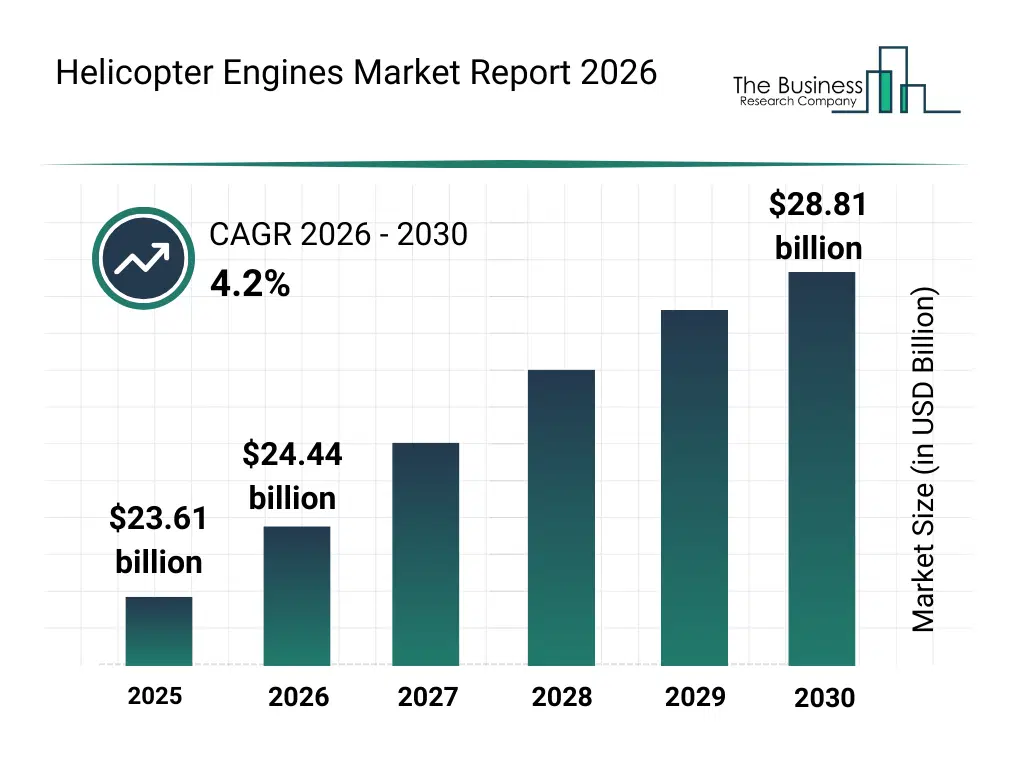
What Is The Helicopter Engines Market Size and Share 2026?
The helicopter engines market size has grown steadily in recent years. It will grow from $23.61 billion in 2025 to $24.44 billion in 2026 at a compound annual growth rate (CAGR) of 3.5%. The growth in the historic period can be attributed to growth of military helicopter fleets, expansion of emergency medical services aviation, demand for reliable rotorcraft propulsion, defense modernization programs, oil and gas offshore helicopter usage.What Is The Helicopter Engines Market Growth Forecast?
The helicopter engines market size is expected to see steady growth in the next few years. It will grow to $28.81 billion in 2030 at a compound annual growth rate (CAGR) of 4.2%. The growth in the forecast period can be attributed to fleet modernization initiatives, rising defense budgets, demand for fuel-efficient engines, expansion of search and rescue operations, adoption of advanced materials in engines. Major trends in the forecast period include advancements in turboshaft engine efficiency, rising demand for lightweight helicopter engines, increasing use in emergency and defense operations, focus on engine reliability and safety, growth of retrofit and upgrade programs.Tariff Impact On Helicopter Engines Market
Tariffs are impacting the helicopter engines market by increasing the cost of imported turbine blades, high-temperature alloys, precision castings, and electronic control units used in piston and gas turbine engines. Defense, emergency medical, and offshore operators in North America and Europe are most affected due to reliance on globally sourced aerospace components, while Asia-Pacific manufacturers face export pricing pressure. These tariffs are raising engine procurement and maintenance costs and extending overhaul cycles. However, they are also encouraging localized engine component manufacturing, regional supply chain development, and innovation in cost-efficient and lightweight helicopter engine designs.
Global Helicopter Engines Market Segmentation
1) By Type: Piston Engine, Gas Turbine Engine 2) By Weight: Light, Medium, Heavy 3) By Point Of Sale: New, Pre-Owned 4) By Application: Emergency Medical Services, Corporate Services, Search And Rescue Operations, Oil And Gas, Defense, Homeland Security, Other Applications Subsegments: 1) By Piston Engine: Two-Stroke Piston Engines, Four-Stroke Piston Engines, Horizontally Opposed (Boxer) Piston Engines, Radial Piston Engines 2) By Gas Turbine Engine: Turboshaft EnginesWhat Is The Driver Of The Helicopter Engines Market?
The rising military expenditure is expected to drive the growth of the helicopter engines market going forward. Military expenditure refers to the total amount of financial resources that a country allocates for its defense and military-related activities within a specific time frame, usually annually. As military forces worldwide prioritize helicopter capabilities for missions such as transport, reconnaissance, and search and rescue, the resulting contracts and investments contribute to the growth of the helicopter engines market. For instance, in September 2025, according to the Stockholm International Peace Research Institute (SIPRI), a Sweden-based institute providing data and analysis on global military expenditure, global military spending hit US$ 2.7 trillion in 2024, and is projected to reach US$ 6.6 trillion by 2035. Therefore, the rising military expenditure will contribute to the growth of the helicopter engines industry.Key Players In The Global Helicopter Engines Market
Major companies operating in the helicopter engines market are Safran S.A., Rolls-Royce PLC, GE Aerospace, Pratt & Whitney Canada, Honeywell Aerospace, MTU Aero Engines, ITP Aero, Aviation Industry Corporation of China (AVIC), United Engine Corporation, JSC Klimov, The Omsk Engine Design Bureau, Rostec State Corporation, Mitsubishi Heavy Industries Ltd., Kawasaki Heavy Industries Ltd., IHI Corporation, Hindustan Aeronautics Limited, Turbomeca (Safran Helicopter Engines), Motor Sich JSC, Ivchenko-Progress State Enterprise, Lycoming Engines, Rotax Aircraft Engines, ULPower Aero Engines
This chart is for illustrative purposes; the full report includes a detailed competitor analysis and comprehensive overview of the top 10 companies in the market.
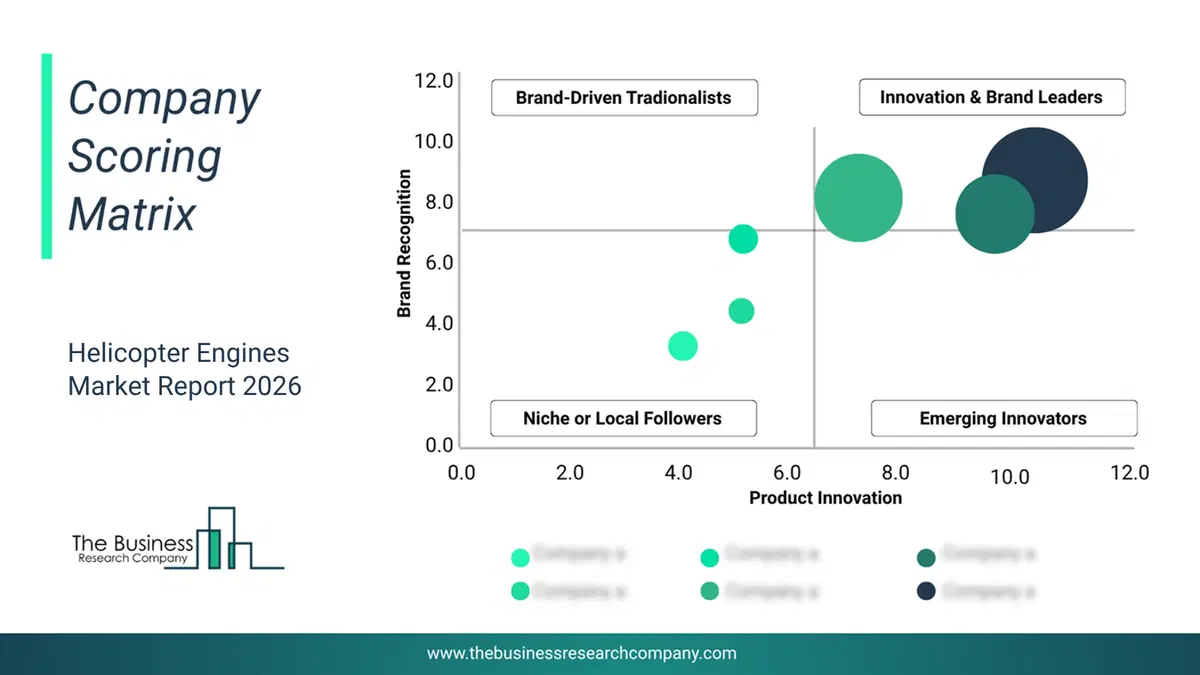
This chart maps companies by product innovation and brand strength, with bubble size indicating relative revenue, helping identify market leaders, challengers, and niche players. This is an illustrative chart; the full report provides a complete and accurate competitive analysis.
Global Helicopter Engines Market Trends and Insights
Major companies operating in the helicopter engines market are focusing on incorporating a shift toward electric propulsion such as high-speed electric motors to enhance sustainability weight efficiency and operational simplicity. Electric motor-based propulsion refers to the use of electric motors powered by batteries or hybrid electric powertrains instead of conventional combustion turboshaft or piston engines enabling capabilities such as lighter weight propulsion simpler drivetrain direct drive no gearbox scalable power output and lower emissions. For instance, in March 2025 magniX, a US-based electric aviation company, launched HeliStorm an electric engine range designed specifically for helicopters from light single engine to hybrid electric twin engine rotorcraft offering a complete electric propulsion solution when paired with its battery packs. HeliStorm features include a peak power output of 330 kW at a weight of just 75 kg operating speeds of 6000 to 7000 RPM scalable power output ranges and built in fault handling for reliability. HeliStorm improves key benefits including reduced weight simplified propulsion architecture and potential for lower emissions and maintenance costs helping the helicopter industry move toward cleaner more efficient vertical lift aircraft.What Are Latest Mergers And Acquisitions In The Helicopter Engines Market?
In June 2025, Avio Aero, an Italy-based aerospace engine manufacturer, partnered with Safran Helicopter Engines and MTU Aero Engines to develop a new 100 % European helicopter engine for use in future European military rotorcraft. With this partnership, the companies aim to build the European next generation helicopter engine (ENGHE) with the primary goal of strengthening European defence autonomy and delivering a high-performance rotorcraft powerplant, focusing on increased engine efficiency, reduced operating and maintenance costs, greater range, higher speed, improved maneuverability and increased availability. Safran Helicopter Engines is a France-based specialist in helicopter turboshaft engines, and MTU Aero Engines is a Germany-based aircraft-engine manufacturer with broad experience in civil and military propulsion systems.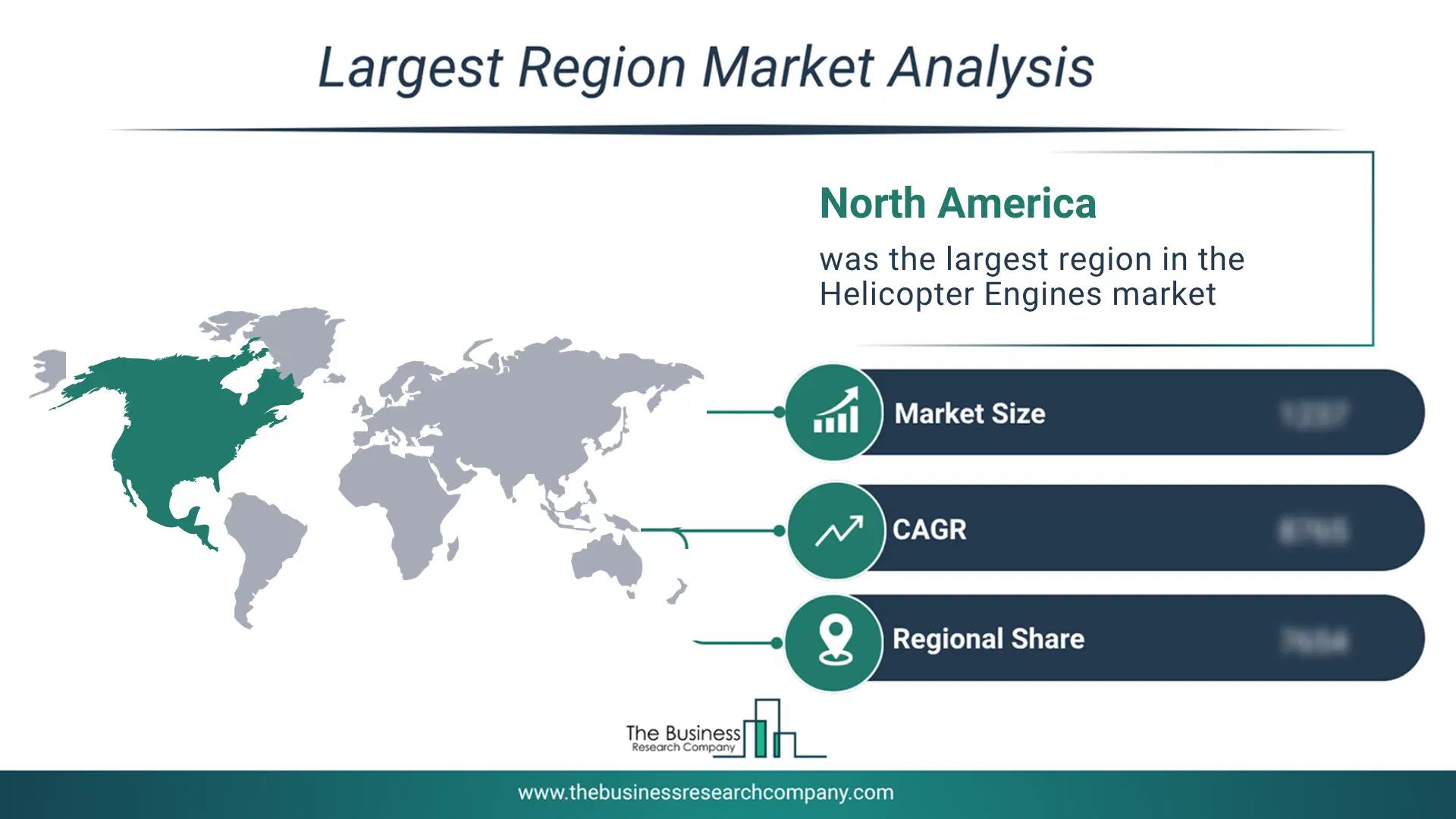
Regional Outlook
North America was the largest region in the helicopter engines market in 2025. Asia-Pacific is expected to be the fastest-growing region in the forecast period. The regions covered in this market report are Asia-Pacific, South East Asia, Western Europe, Eastern Europe, North America, South America, Middle East, Africa The countries covered in this market report are Australia, Brazil, China, France, Germany, India, Indonesia, Japan, Taiwan, Russia, South Korea, UK, USA, Canada, Italy, Spain.What Defines the Helicopter Engines Market?
The helicopter engines market consists of sales of magnetos, fuel injection system, alternator, starter motor, and engine block. Values in this market are ‘factory gate’ values, that is the value of goods sold by the manufacturers or creators of the goods, whether to other entities (including downstream manufacturers, wholesalers, distributors and retailers) or directly to end customers. The value of goods in this market includes related services sold by the creators of the goods.How is Market Value Defined and Measured?
The market value is defined as the revenues that enterprises gain from the sale of goods and/or services within the specified market and geography through sales, grants, or donations in terms of the currency (in USD unless otherwise specified). The revenues for a specified geography are consumption values that are revenues generated by organizations in the specified geography within the market, irrespective of where they are produced. It does not include revenues from resales along the supply chain, either further along the supply chain or as part of other products.
This chart presents market attractiveness based on a quantitative evaluation of growth, competition, strategic alignment, and risk, offering a clear view of opportunity areas for decision-making. This chart is for illustrative purposes; the full report contains the complete analysis.

This chart highlights the Total Addressable Market (TAM) by estimating the maximum revenue opportunity using an assumption-driven approach, supporting strategic planning and opportunity sizing across markets. The chart is illustrative; the full report provides a more comprehensive analysis.
What Key Data and Analysis Are Included in the Helicopter Engines Market Report 2026?
The helicopter engines market research report is one of a series of new reports from The Business Research Company that provides market statistics, including industry global market size, regional shares, competitors with the market share, detailed market segments, market trends and opportunities, and any further data you may need to thrive in the helicopter engines industry. The market research report delivers a complete perspective of everything you need, with an in-depth analysis of the current and future state of the industry.Helicopter Engines Market Report Forecast Analysis
| Report Attribute | Details |
|---|---|
| Market Size Value In 2026 | $24.44 billion |
| Revenue Forecast In 2030 | $28.81 billion |
| Growth Rate | CAGR of 4.2% from 2026 to 2030 |
| Base Year For Estimation | 2025 |
| Actual Estimates/Historical Data | 2020-2025 |
| Forecast Period | 2026 - 2030 |
| Market Representation | Revenue in USD Billion and CAGR from 2026 to 2030 |
| Segments Covered | Type, Weight, Point Of Sale, Application |
| Regional Scope | Asia-Pacific, Western Europe, Eastern Europe, North America, South America, Middle East, Africa |
| Key Companies Profiled | Safran S.A., Rolls-Royce PLC, GE Aerospace, Pratt & Whitney Canada, Honeywell Aerospace, MTU Aero Engines, ITP Aero, Aviation Industry Corporation of China (AVIC), United Engine Corporation, JSC Klimov, The Omsk Engine Design Bureau, Rostec State Corporation, Mitsubishi Heavy Industries Ltd., Kawasaki Heavy Industries Ltd., IHI Corporation, Hindustan Aeronautics Limited, Turbomeca (Safran Helicopter Engines), Motor Sich JSC, Ivchenko-Progress State Enterprise, Lycoming Engines, Rotax Aircraft Engines, ULPower Aero Engines |
| Customization Scope | Request for Customization |
| Pricing And Purchase Options | Explore Purchase Options |