

Herbicide Safeners Market Report 2026
Global Outlook – By Type (Benoxacor, Furilazole, Dichlormid, Isoxadifen, Other Types), By Herbicide Selectivity (Selective Herbicides, Non-Selective Herbicides), By Crop (Corn, Soybean, Wheat, Sorghum, Barley, Rice, Other Crops), By Application (Post-Emergence, Pre-Emergence) – Market Size, Trends, Strategies, and Forecast to 2030
Herbicide Safeners Market Overview
• Herbicide Safeners market size has reached to $1.29 billion in 2025 • Expected to grow to $1.88 billion in 2030 at a compound annual growth rate (CAGR) of 7.9% • Growth Driver: Rising Food Demand Driving Growth In The Market Due To Increasing Crop Protection Needs • Market Trend: Herbicide Safeners Market Leaders Drive Advancements In Herbicide Technology • South America was the largest region in 2025 and Asia-Pacific is the fastest growing region.What Is Covered Under Herbicide Safeners Market?
Herbicide safeners are substances used in conjunction with herbicides to enhance the selectivity and safety of herbicide applications. The primary function is to protect crops from the potential phytotoxic effects of herbicides while allowing the herbicides to control weeds effectively. Herbicide safeners work by inducing specific metabolic pathways in crops that detoxify the herbicide, thereby reducing damage to the crops without compromising the herbicide's effectiveness against weeds. The main types of herbicide safeners are benoxacor, furilazole, dichlormid, isoxadifen, and others. Benoxacor is a type of herbicide that belongs to the chemical class of aryloxyphenoxypropionates. The various herbicide selectivity includes selective herbicides, and non-selective herbicides applied to various crops such as corn, soybean, wheat, sorghum, barley, rice, and others. These are used in various applications such as post-emergence, and pre-emergence.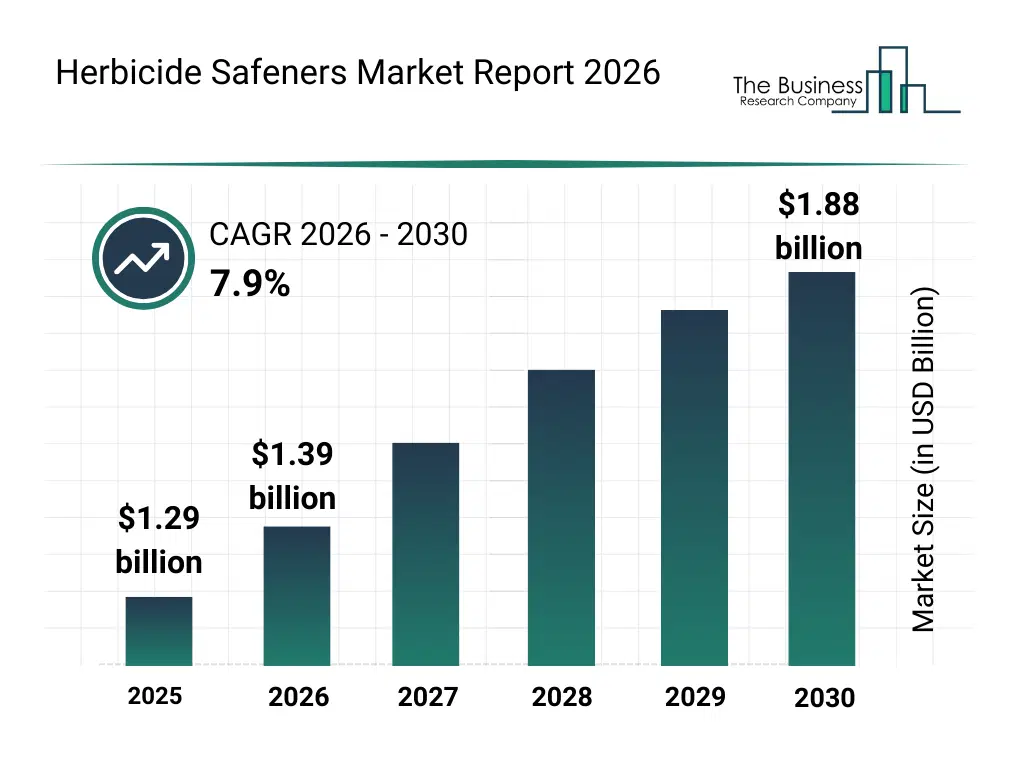
What Is The Herbicide Safeners Market Size and Share 2026?
The herbicide safeners market size has grown strongly in recent years. It will grow from $1.29 billion in 2025 to $1.39 billion in 2026 at a compound annual growth rate (CAGR) of 7.6%. The growth in the historic period can be attributed to expansion of commercial agriculture, increasing herbicide usage in row crops, growth of cereal crop cultivation, rising awareness of crop damage prevention, availability of advanced agrochemical formulations.What Is The Herbicide Safeners Market Growth Forecast?
The herbicide safeners market size is expected to see strong growth in the next few years. It will grow to $1.88 billion in 2030 at a compound annual growth rate (CAGR) of 7.9%. The growth in the forecast period can be attributed to increasing demand for sustainable weed control, rising adoption of precision agriculture practices, expansion of safener use in emerging markets, growing focus on herbicide resistance management, increasing investment in crop protection R&D. Major trends in the forecast period include increasing adoption of crop-safe herbicide formulations, rising demand for selective weed control solutions, growing use of safeners in cereal crops, expansion of integrated weed management practices, enhanced regulatory focus on crop protection safety.
Global Herbicide Safeners Market Segmentation
1) By Type: Benoxacor, Furilazole, Dichlormid, Isoxadifen, Other Types 2) By Herbicide Selectivity: Selective Herbicides, Non-Selective Herbicides 3) By Crop: Corn, Soybean, Wheat, Sorghum, Barley, Rice, Other Crops 4) By Application: Post-Emergence, Pre-EmergenceWhat Are The Drivers Of The Herbicide Safeners Market?
The rising food demand is expected to propel the growth of the herbicide safeners market going forward. Food demand refers to the quantity of food that consumers are willing and able to purchase at different price levels over a specific period. Food demand rising demand is largely fueled by population growth, as more people require greater amounts of food to meet their nutritional needs. Herbicide safeners contribute to meeting this demand by protecting crops from herbicide damage, enabling farmers to manage weeds effectively without harming the crop, resulting in higher yields. For example, in January 2024, the United States Department of Agriculture reported that in 2023, food expenditures accounted for an average of 12.9% of U.S. household spending, up slightly from 12.8% in 2022. Therefore, The rising food demand is driving the growth of the herbicide safeners industry. The expanding agriculture industry is expected to propel the growth of the herbicide safeners market going forward. The agriculture industry refers to the sector of the economy that encompasses the cultivation of land, raising and harvesting crops, and the rearing of animals for various purposes. The global expansion of agriculture and the need to enhance crop yields to feed a growing population drive the use of herbicides, fostering the herbicide safeners market. For instance, June 2025, according to the Official statistics, a UK-based government agencies, total income from farming (TIFF) for the UK rose to £7.7 billion ($9.78 billion) in 2024 up by about £1.6 billion ($2.12 billion) compared to 2023. Therefore, the expanding agriculture industry sector is driving the growth of the herbicide safeners industry.Key Players In The Global Herbicide Safeners Market
Major companies operating in the herbicide safeners market are BASF SE, Bayer AG, Syngenta Group, Corteva, Inc., FMC Corporation, UPL Limited, ADAMA Agricultural Solutions Ltd., Nufarm Limited, Sumitomo Chemical Company, Limited, Nissan Chemical Corporation, Kumiai Chemical Industry Co., Ltd., Ishihara Sangyo Kaisha, Ltd., Albaugh, LLC, Sharda Cropchem Limited, Rotam CropSciences Ltd., Lier Chemical Co., Ltd., Jiangsu Yangnong Chemical Co., Ltd., Anhui Huaxing Chemical Industry Co., Ltd., Zhejiang Yongnong Chemical Co., Ltd., Sinon Corporation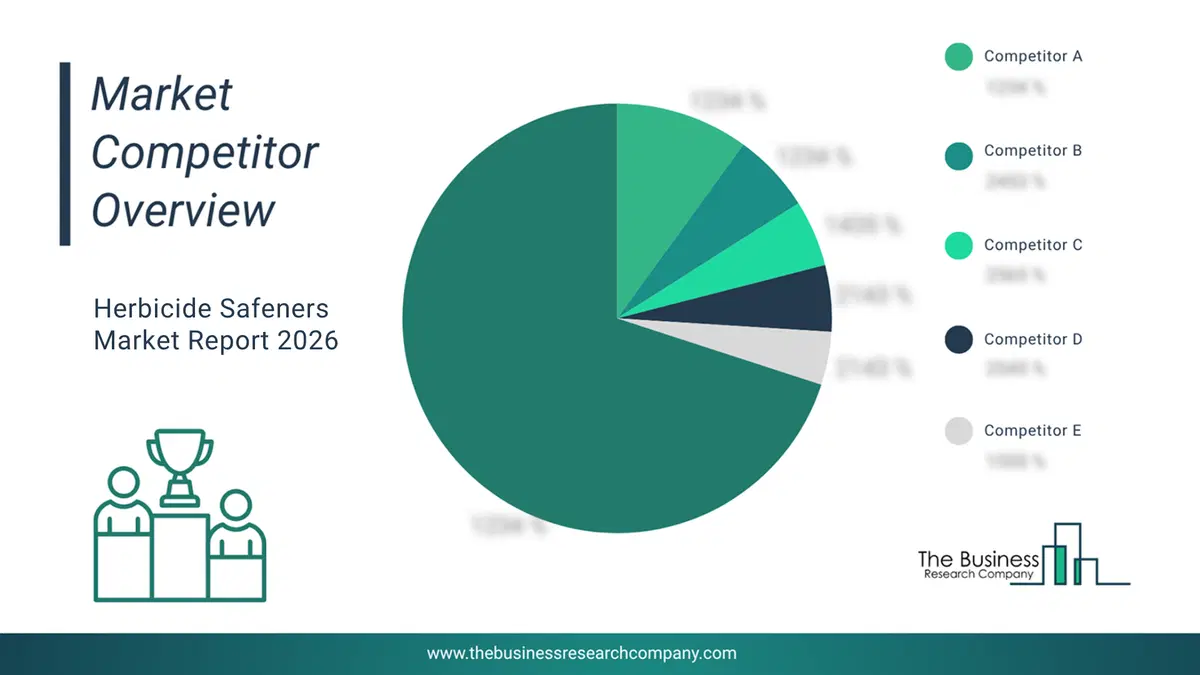
This chart is for illustrative purposes; the full report includes a detailed competitor analysis and comprehensive overview of the top 10 companies in the market.
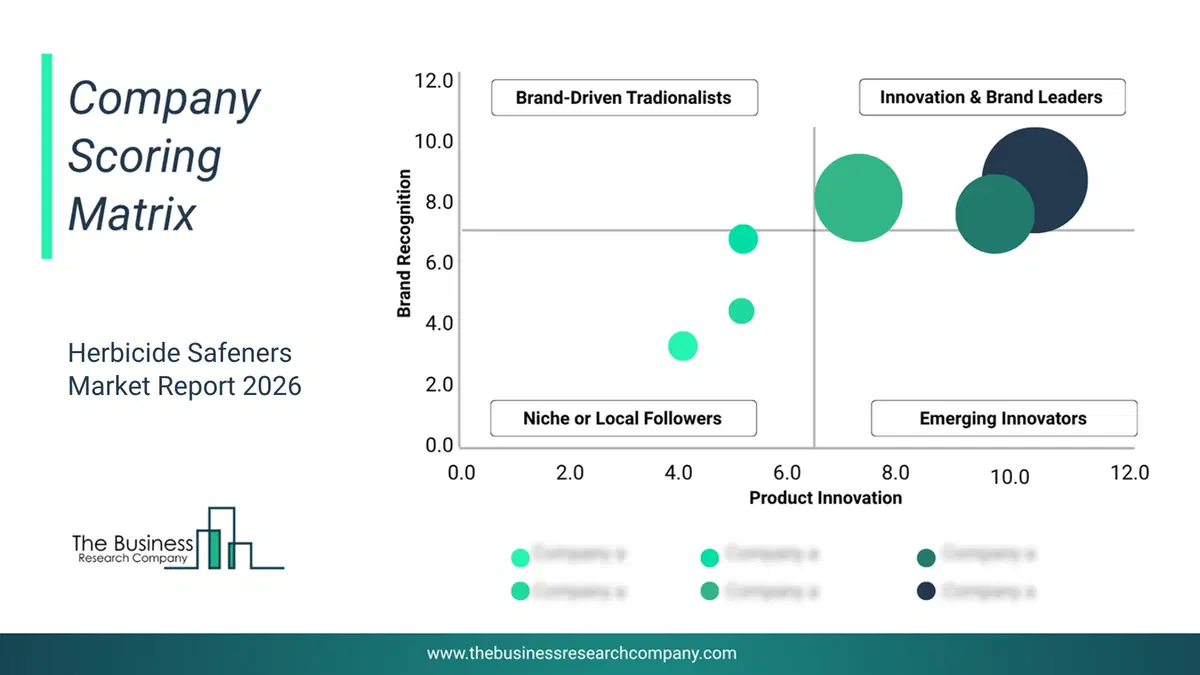
This chart maps companies by product innovation and brand strength, with bubble size indicating relative revenue, helping identify market leaders, challengers, and niche players. This is an illustrative chart; the full report provides a complete and accurate competitive analysis.
Global Herbicide Safeners Market Trends and Insights
Major companies operating in the herbicide safeners market are focused on developing innovative technologies such as herbicide technology. Herbicide technology refers to the scientific and technological methods and innovations applied to the development, formulation, and application of herbicides. For instance, in November 2023, Nufarm, a Canada-based agricultural chemical company, launched the ‘Duplosan’ technology. It is a power suit for cereal herbicides that enables maximum weed control in cereals. The technology is yielding favorable outcomes for a new pipeline of solutions, aiding farmers in addressing persistent weed challenges in cereal crops.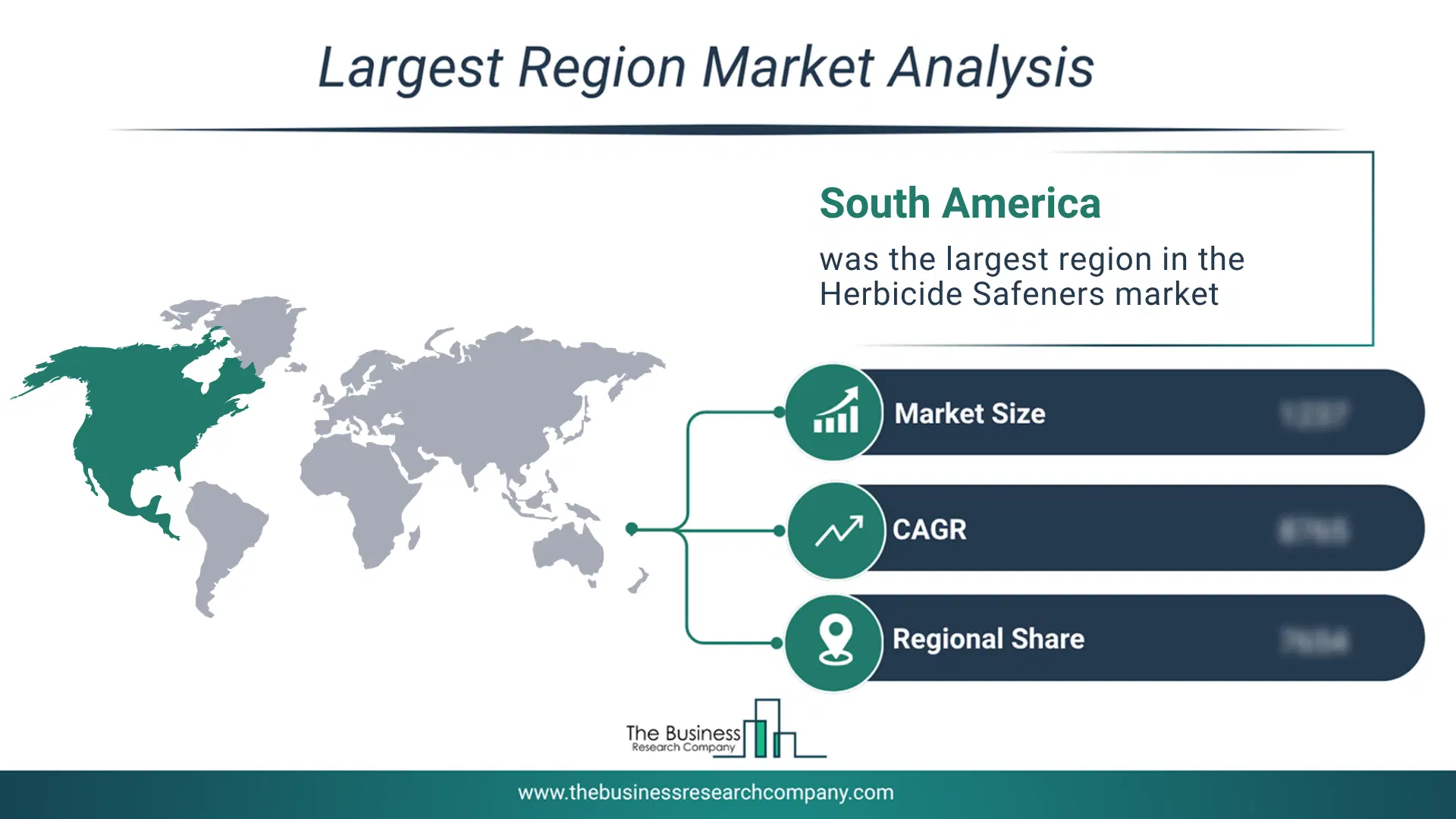
Regional Insights
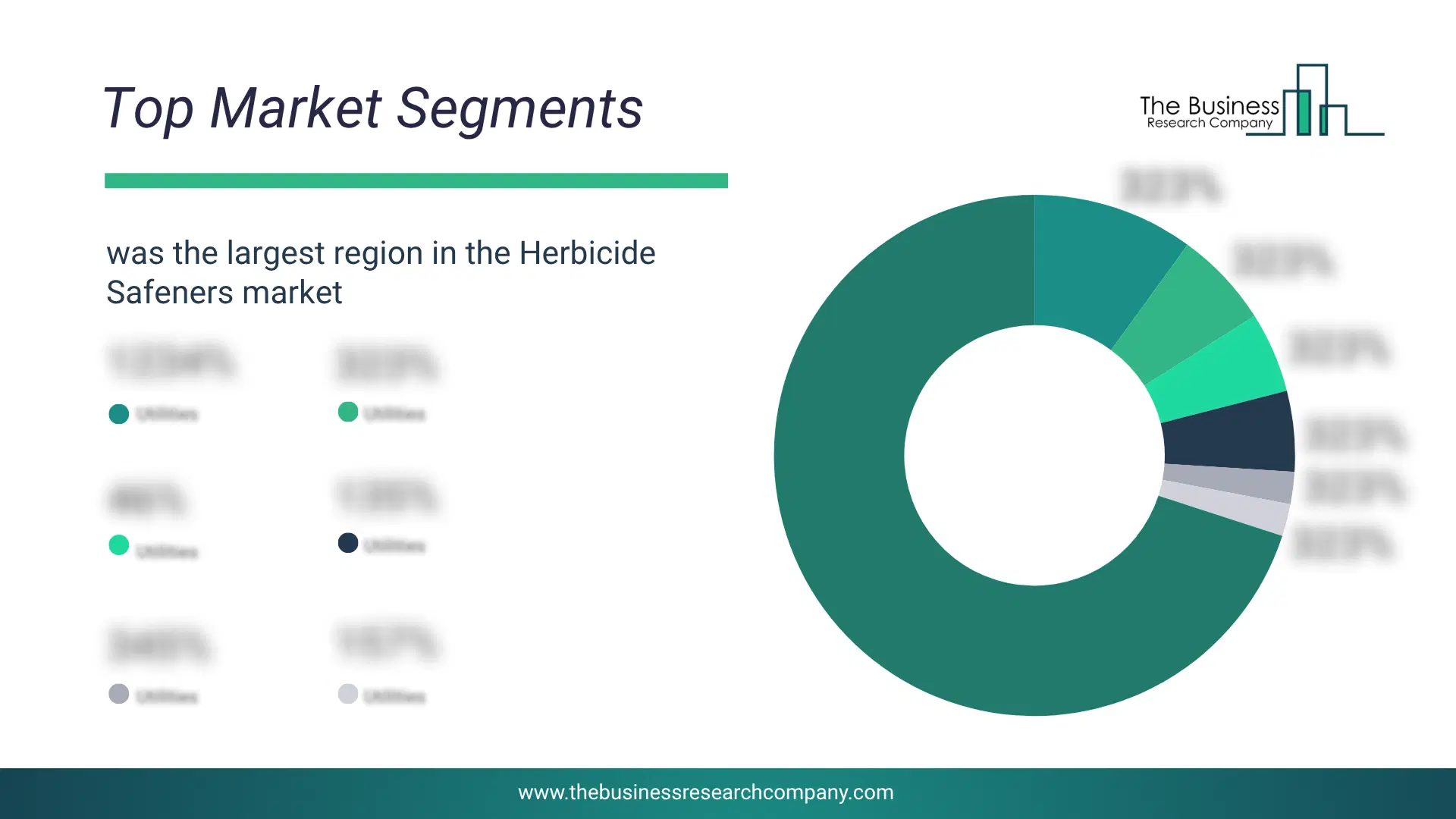
South America was the largest region in the herbicide safeners market in 2025. The regions covered in this market report are Asia-Pacific, South East Asia, Western Europe, Eastern Europe, North America, South America, Middle East, Africa The countries covered in this market report are Australia, Brazil, China, France, Germany, India, Indonesia, Japan, Taiwan, Russia, South Korea, UK, USA, Canada, Italy, SpainWhat Defines the Herbicide Safeners Market?
The herbicide safeners market consists of sales of cloquintocet-mexyl, isoxadifen, fluxofenim, adjuvants, and surfactants. Values in this market are ‘factory gate’ values, that is the value of goods sold by the manufacturers or creators of the goods, whether to other entities (including downstream manufacturers, wholesalers, distributors, and retailers) or directly to end customers. The value of goods in this market includes related services sold by the creators of the goods.How is Market Value Defined and Measured?
The market value is defined as the revenues that enterprises gain from the sale of goods and/or services within the specified market and geography through sales, grants, or donations in terms of the currency (in USD unless otherwise specified). The revenues for a specified geography are consumption values that are revenues generated by organizations in the specified geography within the market, irrespective of where they are produced. It does not include revenues from resales along the supply chain, either further along the supply chain or as part of other products.
This chart presents market attractiveness based on a quantitative evaluation of growth, competition, strategic alignment, and risk, offering a clear view of opportunity areas for decision-making. This chart is for illustrative purposes; the full report contains the complete analysis.

This chart highlights the Total Addressable Market (TAM) by estimating the maximum revenue opportunity using an assumption-driven approach, supporting strategic planning and opportunity sizing across markets. The chart is illustrative; the full report provides a more comprehensive analysis.
What Key Data and Analysis Are Included in the Herbicide Safeners Market Report 2026?
The herbicide safeners market research report is one of a series of new reports from The Business Research Company that provides market statistics, including industry global market size, regional shares, competitors with the market share, detailed market segments, market trends and opportunities, and any further data you may need to thrive in the herbicide safeners industry. The market research report delivers a complete perspective of everything you need, with an in-depth analysis of the current and future state of the industry.Herbicide Safeners Market Report Forecast Analysis
| Report Attribute | Details |
|---|---|
| Market Size Value In 2026 | $1.39 billion |
| Revenue Forecast In 2030 | $1.88 billion |
| Growth Rate | CAGR of 7.6% from 2026 to 2030 |
| Base Year For Estimation | 2025 |
| Actual Estimates/Historical Data | 2020-2025 |
| Forecast Period | 2026 - 2030 |
| Market Representation | Revenue in USD Billion and CAGR from 2026 to 2030 |
| Segments Covered | Type, Herbicide Selectivity, Crop, Application |
| Regional Scope | Asia-Pacific, Western Europe, Eastern Europe, North America, South America, Middle East, Africa |
| Country Scope | The countries covered in this market report are Australia, Brazil, China, France, Germany, India, Indonesia, Japan, Taiwan, Russia, South Korea, UK, USA, Canada, Italy, Spain |
| Key Companies Profiled | BASF SE, Bayer AG, Syngenta Group, Corteva, Inc., FMC Corporation, UPL Limited, ADAMA Agricultural Solutions Ltd., Nufarm Limited, Sumitomo Chemical Company, Limited, Nissan Chemical Corporation, Kumiai Chemical Industry Co., Ltd., Ishihara Sangyo Kaisha, Ltd., Albaugh, LLC, Sharda Cropchem Limited, Rotam CropSciences Ltd., Lier Chemical Co., Ltd., Jiangsu Yangnong Chemical Co., Ltd., Anhui Huaxing Chemical Industry Co., Ltd., Zhejiang Yongnong Chemical Co., Ltd., Sinon Corporation |
| Customization Scope | Request for Customization |
| Pricing And Purchase Options | Explore Purchase Options |