
Hibiscus Concentrate Drinks Market Report 2026
Global Outlook – By Ingredient Type (Organic, Conventional), By Form (Liquid, Powder), By Distribution Channel (Online Stores, Supermarkets Or Hypermarkets, Specialty Stores, Other Distribution Channels), By Application (Beverages, Nutritional Supplements, Pharmaceuticals, Cosmetics, Other Applications), By End-User (Household, Food Service, Industrial) – Market Size, Trends, Strategies, and Forecast to 2035
Hibiscus Concentrate Drinks Market Overview
• Hibiscus Concentrate Drinks market size has reached to $1.24 billion in 2025 • Expected to grow to $1.92 billion in 2030 at a compound annual growth rate (CAGR) of 9.1% • Growth Driver: Surge In Demand For Natural And Functional Beverages Fueling The Growth Of The Market Due To Increasing Consumer Preference For Clean-label, Health-focused Beverages • Market Trend: Advancements In Phytochemical-Based Functional Formulations Driving Innovation In Hibiscus Concentrate Drinks • North America was the largest region in 2025 and Asia-Pacific is the fastest growing region.What Is Covered Under Hibiscus Concentrate Drinks Market?
Hibiscus concentrate drinks are beverages made by extracting and concentrating the natural compounds, flavor, and color from hibiscus flowers. They are typically used as a base for preparing refreshing drinks, often diluted with water or other liquids before consumption. Hibiscus concentrate drinks are valued for their tart taste, vibrant red color, and natural plant-derived properties. The main ingredient types of hibiscus concentrate drinks include organic and conventional. Organic refer to beverages made from organically cultivated hibiscus extracts processed into concentrated formulations for flavor and nutritional benefits. These products are available in liquid and powder forms and are distributed through online stores, supermarkets or hypermarkets, specialty stores, and other distribution channels. The key applications of beverages, nutritional supplements, pharmaceuticals, cosmetics, and others, while the end-use includes household, food service, and industrial.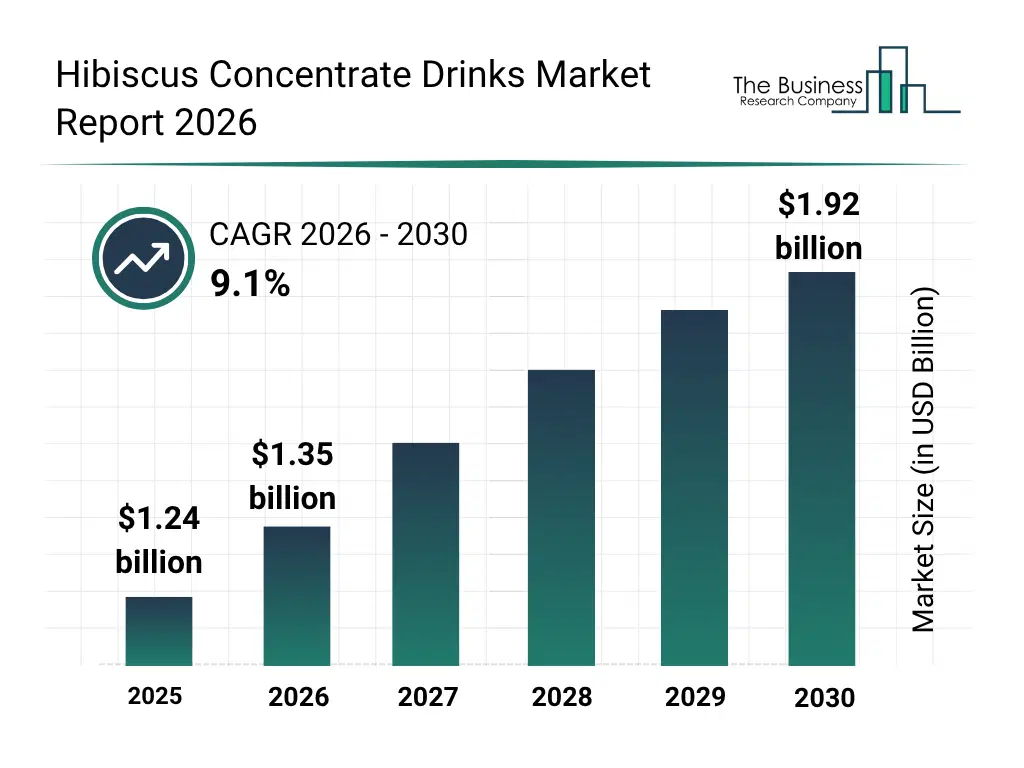
What Is The Hibiscus Concentrate Drinks Market Size and Share 2026?
The hibiscus concentrate drinks market size has grown strongly in recent years. It will grow from $1.24 billion in 2025 to $1.35 billion in 2026 at a compound annual growth rate (CAGR) of 8.9%. The growth in the historic period can be attributed to growing consumer preference for natural fruit and floral extracts, expansion of bottled beverage and ready-to-drink markets, increasing awareness of antioxidant-rich functional drinks, early adoption of herbal concentrates in food service channels, traditional use of hibiscus in herbal and ethnic beverages.What Is The Hibiscus Concentrate Drinks Market Growth Forecast?
The hibiscus concentrate drinks market size is expected to see strong growth in the next few years. It will grow to $1.92 billion in 2030 at a compound annual growth rate (CAGR) of 9.1%. The growth in the forecast period can be attributed to rising demand for functional wellness and immunity-boosting beverages, expansion of clean-label and organic beverage consumption trends, increasing innovation in plant-based nutraceutical drinks, growth of e-commerce and direct-to-consumer beverage brands, technological advancements in extraction and concentration processes. Major trends in the forecast period include cold-pressed hibiscus extraction for nutrient preservation, clean-label and no-added-sugar hibiscus concentrate formulations, functional antioxidant-rich beverage innovation with hibiscus bioactives, natural preservation and shelf-life extension using plant-derived acids, sustainable packaging adoption for concentrated beverage formats.
Global Hibiscus Concentrate Drinks Market Segmentation
1) By Ingredient Type: Organic, Conventional 2) By Form: Liquid, Powder 3) By Distribution Channel: Online Stores, Supermarkets Or Hypermarkets, Specialty Stores, Other Distribution Channels 4) By Application: Beverages, Nutritional Supplements, Pharmaceuticals, Cosmetics, Other Applications 5) By End-User: Household, Food Service, Industrial Subsegments: 1) By Organic: Cold Pressed Organic Concentrate, Raw Organic Concentrate, United States Department Of Agriculture Organic Concentrate, No Additive Organic Concentrate, Filtered Organic Concentrate 2) By Conventional: Pasteurized Conventional Concentrate, Sweetened Conventional Concentrate, Unsweetened Conventional Concentrate, Flavored Conventional Concentrate, Preservative Added Conventional ConcentrateWhat Are The Drivers Of The Hibiscus Concentrate Drinks Market?
The rising demand for natural and functional beverages is expected to propel the growth of the hibiscus concentrate drinks market going forward. Natural and functional beverages refer to drinks made with natural ingredients that are designed to provide added health or wellness benefits beyond basic hydration. The rising demand for natural and functional beverages is driven by growing health consciousness, as consumers increasingly prefer drinks made with clean-label ingredients that support overall wellness and reduce exposure to artificial additives. Hibiscus concentrate drinks support the natural and functional beverages market by offering plant-based, antioxidant-rich formulations that align with consumer demand for clean-label, wellness-oriented, and naturally functional drink options. For instance, according to the 2024 Plant-Based Foods State of the Marketplace Report by the Plant-Based Foods Industry Association (PBFIA), a US-based organization, several retail categories saw notable growth in 2024, including plant-based protein powders and beverages, which increased by 11% in value and 13% in volume, reaching $450 million. Therefore, the rising demand for natural and functional beverages is driving the growth of the hibiscus concentrate drinks industry. The increasing health consciousness among consumers is expected to propel the growth of the hibiscus concentrate drinks market going forward. Health consciousness among consumers refers to the growing awareness and proactive mindset of individuals toward maintaining and improving their physical well-being through informed dietary and lifestyle choices. Health consciousness among consumers is largely driven by the rising prevalence of chronic diseases such as diabetes, hypertension, and cardiovascular conditions, which has prompted people to actively seek preventive nutrition and shift away from sugar-laden beverages toward natural functional alternatives. As consumers become more mindful of what they consume, they increasingly turn to plant-based, antioxidant-rich beverages such as hibiscus concentrate drinks, which are perceived as natural remedies that support heart health, blood pressure management, and immune function. For instance, in June 2024, according to the International Food Information Council (IFIC), a US‑based nonprofit organization, the proportion of Americans following a specific diet or eating pattern over the past year remains high at 54%. Most people are looking to increase their protein intake, with interest climbing from 59% in 2022 to 67% in 2023 and reaching 71% in 2024. Additionally, roughly half of consumers aim to eat more fresh foods, which are widely considered the healthiest options. Therefore, increasing health consciousness among consumers is driving the growth of the hibiscus concentrate drinks industry.Key Players In The Global Hibiscus Concentrate Drinks Market
Major companies operating in the hibiscus concentrate drinks market are Archer Daniels Midland Company, Südzucker AG, Givaudan SA, Martin Bauer Group, Dilmah Ceylon Tea Company PLC, Alkaloid AD Skopje, Sunny Sky Products, Tractor Beverage Company, Teatulia Organic Teas, The Tea Planet, Wild Hibiscus Flower Company, Herbal Goodness, Flavours Avenue, Swa Artisanal Syrups, Hibisbloom, Mak Food Company, Karma Sugar Company, Aadhunik Ayurveda, Plants Med Laboratories Pvt. Ltd, Rena Beverages SolutionsGlobal Hibiscus Concentrate Drinks Market Trends and Insights
Major companies operating in the hibiscus concentrate drinks market are focusing on developing functional products such as phytochemical concentrate formulations to enhance bioactivity and functional efficacy. Phytochemical concentrate formulation refers to the scientifically controlled process of extracting, isolating, and standardizing bioactive compounds (phytochemicals) from plant sources and combining them into a stable, concentrated formulation. For instance, in November 2024, Treatt, a UK-based flavor and ingredient solutions company, introduced its Botanical Concentrates range designed for beverage applications. The range was developed to address key formulation challenges in natural beverage development, such as flavor instability, inconsistency in botanical extracts, and complex processing requirements. The botanical concentrates range includes standardized liquid extracts derived from ingredients such as chamomile, hibiscus, and turmeric, offering high flavor consistency, improved stability, and ease of integration into beverage systems. These concentrates are suitable for use in ready-to-drink teas, functional beverages, flavored waters, and other health-oriented drinks, enabling manufacturers to achieve clean-label positioning, reduced formulation complexity, and enhanced sensory performance across diverse beverage applications.Regional Outlook/Insights
North America was the largest region in the hibiscus concentrate drinks market in 2025. Asia-Pacific is expected to be the fastest-growing region in the forecast period. The regions covered in this market report are Asia-Pacific, South East Asia, Western Europe, Eastern Europe, North America, South America, Middle East, Africa. The countries covered in this market report are Australia, Brazil, China, France, Germany, India, Indonesia, Japan, Taiwan, Russia, South Korea, UK, USA, Canada, Italy, Spain.What Defines the Hibiscus Concentrate Drinks Market?
The hibiscus concentrates drinks market consists of sales of hibiscus infusion concentrate, hibiscus flavor concentrate, hibiscus liquid concentrate, and hibiscus powder extract. Values in this market are ‘factory gate’ values, that is, the value of goods sold by the manufacturers or creators of the goods, whether to other entities (including downstream manufacturers, wholesalers, distributors, and retailers) or directly to end customers. The value of goods in this market includes related services sold by the creators of the goods.How is Market Value Defined and Measured?
The market value is defined as the revenues that enterprises gain from the sale of goods and/or services within the specified market and geography through sales, grants, or donations in terms of the currency (in USD unless otherwise specified). The revenues for a specified geography are consumption values that are revenues generated by organizations in the specified geography within the market, irrespective of where they are produced. It does not include revenues from resales along the supply chain, either further along the supply chain or as part of other products.What Key Data and Analysis Are Included in the Hibiscus Concentrate Drinks Market Report 2026?
The hibiscus concentrate drinks market research report is one of a series of new reports from The Business Research Company that provides market statistics, including industry global market size, regional shares, competitors with the market share, detailed market segments, market trends and opportunities, and any further data you may need to thrive in the hibiscus concentrate drinks industry. The market research report delivers a complete perspective of everything you need, with an in-depth analysis of the current and future state of the industry.Hibiscus Concentrate Drinks Market Report Forecast Analysis
| Report Attribute | Details |
|---|---|
| Market Size Value In 2026 | $1.35 billion |
| Revenue Forecast In 2035 | $1.92 billion |
| Growth Rate | CAGR of 9.1% from 2026 to 2035 |
| Base Year For Estimation | 2025 |
| Actual Estimates/Historical Data | 2020-2025 |
| Forecast Period | 2026 - 2030 - 2035 |
| Market Representation | Revenue in USD Billion and CAGR from 2026 to 2035 |
| Segments Covered | Ingredient Type, Form, Distribution Channel, Application, End-User |
| Regional Scope | Asia-Pacific, Western Europe, Eastern Europe, North America, South America, Middle East, Africa |
| Country Scope | The countries covered in the report are Australia, Brazil, China, France, Germany, India, Indonesia, Japan, Taiwan, Russia, South Korea, UK, USA, Canada, Italy, Spain. |
| Key Companies Profiled | Archer Daniels Midland Company, Südzucker AG, Givaudan SA, Martin Bauer Group, Dilmah Ceylon Tea Company PLC, Alkaloid AD Skopje, Sunny Sky Products, Tractor Beverage Company, Teatulia Organic Teas, The Tea Planet, Wild Hibiscus Flower Company, Herbal Goodness, Flavours Avenue, Swa Artisanal Syrups, Hibisbloom, Mak Food Company, Karma Sugar Company, Aadhunik Ayurveda, Plants Med Laboratories Pvt. Ltd, Rena Beverages Solutions |
| Customization Scope | Request for Customization |
| Pricing And Purchase Options | Explore Purchase Options |