
High-Performance Electric Sports Cars Market Report 2026
Global Outlook – By Vehicle (Hypercars, Supercars, Sports Coupes), By Propulsion (Battery Electric Vehicles (BEVs), Plug-in Hybrid Electric Vehicles (PHEVs)), By Battery Capacity (60-100 kWh, 100-150 kWh, 150+ kWh), By End-User (Individual Buyers, Racing Teams, Other End User) – Market Size, Trends, Strategies, and Forecast to 2030
High-Performance Electric Sports Cars Market Overview
• High-Performance Electric Sports Cars market size has reached to $35.17 billion in 2025 • Expected to grow to $84.13 billion in 2030 at a compound annual growth rate (CAGR) of 19% • Growth Driver: Increasing Charging Infrastructure Fueling The Growth Of The Market Due To Rising Demand For Fast And Accessible EV Charging • Market Trend: Next-Generation Battery Technology Powers High-Performance Electric Sports Cars With Extended Range And Efficiency • North America was the largest region in 2025 and Asia-Pacific is the fastest growing region.What Is Covered Under High-Performance Electric Sports Cars Market?
High-performance electric sports cars are advanced battery-powered vehicles designed to deliver exceptional acceleration, speed, and handling, often rivaling or surpassing their gasoline-powered counterparts. These cars feature cutting-edge electric drivetrains, lightweight materials, and aerodynamic designs, enabling them to achieve impressive power outputs, rapid 0-60 mph times, and extended driving ranges while maintaining efficiency and sustainability. The main types of high-performance electric sports cars are hyper cars, supercars, sports coupes. Hyper cars are the pinnacle of automotive engineering, offering unparalleled performance, cutting-edge technology, and exclusivity. The various propulsion includes battery electric vehicles (bevs), plug-in hybrid electric vehicles (phevs) with battery capacity that include 60-100 kwh, 100-150 kwh, 150+ kwh. These are used by various end-users such as individual buyers, racing teams, others.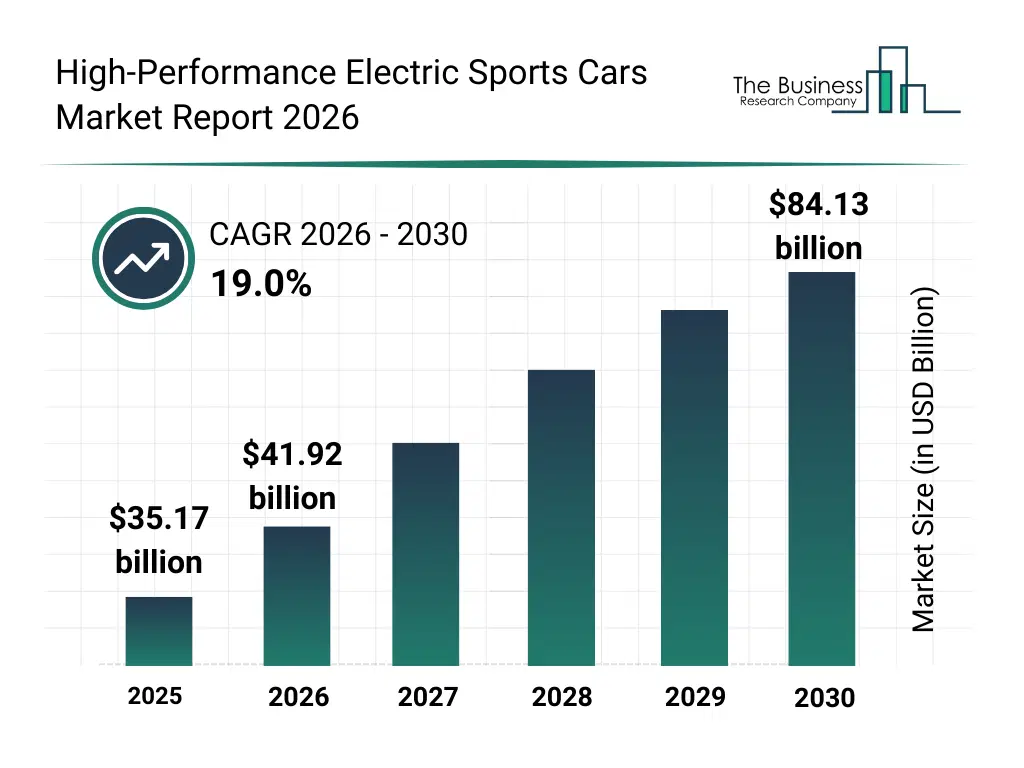
What Is The High-Performance Electric Sports Cars Market Size and Share 2026?
The high-performance electric sports cars market size has grown rapidly in recent years. It will grow from $35.17 billion in 2025 to $41.92 billion in 2026 at a compound annual growth rate (CAGR) of 19.2%. The growth in the historic period can be attributed to early EV performance prototypes, tightening emission norms, luxury vehicle electrification, advances in battery chemistry, growing consumer interest in sports cars.What Is The High-Performance Electric Sports Cars Market Growth Forecast?
The high-performance electric sports cars market size is expected to see rapid growth in the next few years. It will grow to $84.13 billion in 2030 at a compound annual growth rate (CAGR) of 19.0%. The growth in the forecast period can be attributed to solid state battery development, expansion of high power charging networks, rising demand for electric hypercars, declining battery costs, increasing sustainability driven purchases. Major trends in the forecast period include ultra fast acceleration capabilities, lightweight aerodynamic vehicle design, high capacity battery integration, performance focused electric powertrains, premium technology driven interiors.
Global High-Performance Electric Sports Cars Market Segmentation
1) By Vehicle: Hypercars, Supercars, Sports Coupes 2) By Propulsion: Battery Electric Vehicles (BEVs), Plug-in Hybrid Electric Vehicles (PHEVs) 3) By Battery Capacity: 60-100 kWh, 100-150 kWh, 150+ kWh 4) By End-User: Individual Buyers, Racing Teams, Other End User Subsegments: 1) By Hypercars: All-Electric Hypercars, Hybrid-Electric Hypercars, Limited-Edition Hypercars 2) By Supercars: All-Electric Supercars, Hybrid-Electric Supercars, Track-Focused Supercars 3) By Sports Coupes: All-Electric Sports Coupes, Hybrid-Electric Sports Coupes, Grand Touring Sports CoupesWhat Is The Driver Of The High-Performance Electric Sports Cars Market?
The increasing charging infrastructure is expected to propel the growth of the high-performance electric sports car market going forward. Charging infrastructure refers to the network of charging stations, equipment, and related systems that supply electricity to electric vehicles. The increasing charging infrastructure is rising as more people adopt electric vehicles, requiring accessible, fast, and efficient charging solutions to support daily commuting and long-distance travel. High-performance electric sports cars enhance charging infrastructure by increasing the need for high-speed charging stations, making them essential for long-distance travel. They drive innovation in battery technology by supporting ultra-fast charging capabilities, improving overall charging efficiency. For instance, in February 2024, according to the Brazilian Association of Electric Vehicles (ABVE), a Brazil-based government organization, Brazil significantly enhanced its electric vehicle infrastructure, with projections indicating that 2,500 new charging stations were installed by the end of 2024. This expansion brought the total number of operational charging stations in the country to approximately 6,800. Therefore, the increasing charging infrastructure is driving the growth of the high-performance electric sports car industry.Key Players In The Global High-Performance Electric Sports Cars Market
Major companies operating in the high-performance electric sports cars market report include Bayerische Motoren Werke AG, Mercedes-AMG, Porsche AG, NIO Inc., Ferrari N.V., Lamborghini S.p.A., Aston Martin Lagonda, McLaren Automotive, Lucid Motors, Lotus Cars, Koenigsegg Automotive AB, Karma Automotive, Genesis Motors, Aspark Owl, Apollo Automobil GmbH, Bugatti Automobiles S.A.S., Pininfarina Automobili, Audi AG, Czinger Vehicles, Zenvo Automotive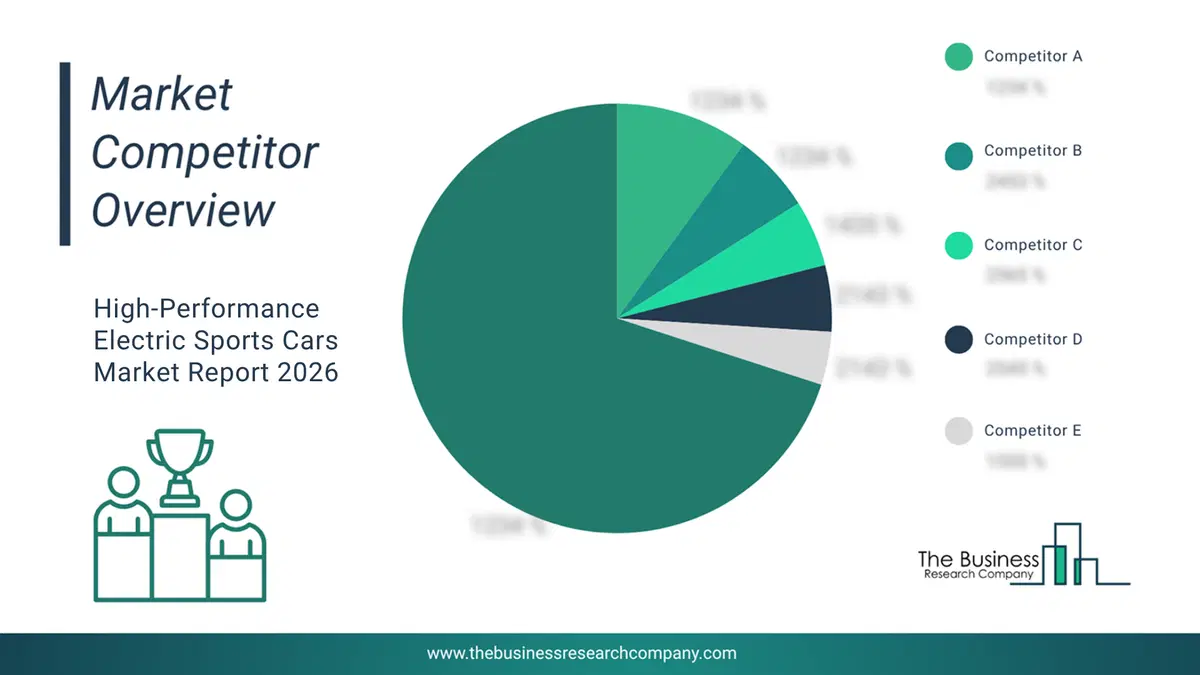
This chart is for illustrative purposes; the full report includes a detailed competitor analysis and comprehensive overview of the top 10 companies in the market.
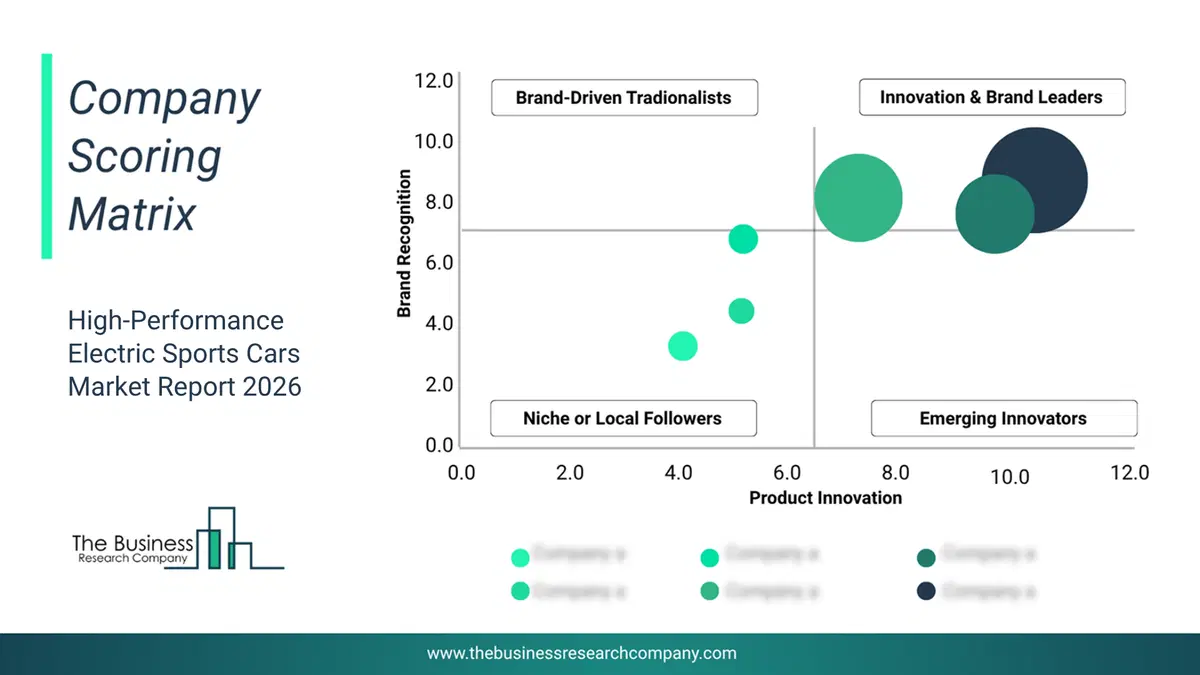
This chart maps companies by product innovation and brand strength, with bubble size indicating relative revenue, helping identify market leaders, challengers, and niche players. This is an illustrative chart; the full report provides a complete and accurate competitive analysis.
Global High-Performance Electric Sports Cars Market Trends and Insights
Major companies operating in the high-performance electric sports cars are focusing on advanced battery technologies such as next-generation high-energy-density batteries to enhance performance, extend driving range, and improve efficiency. Next-generation high-energy-density batteries are advanced energy storage systems that offer greater power capacity in a compact size, improving efficiency, range, and performance in electric vehicles and other applications. For instance, in October 2023, Toyota, a Japan-based automotive company, unveiled its first electric supercar, the FT-Se, at the Japan Mobility Show. This high-performance BEV features advanced high-energy-density batteries, a lightweight aerodynamic design, and enhanced handling, showcasing Toyota's vision for sustainable yet thrilling sports cars.What Are Latest Mergers And Acquisitions In The High-Performance Electric Sports Cars Market?
In November 2024, YASA Limited, an England-based electric motor company, partnered with Automobili Lamborghini to develop axial flux motors for the Temerario hybrid. With this partnership, YASA and Lamborghini strengthen their commitment to high-performance electric propulsion by equipping the hybrid V8 Temerario with next-generation axial flux motors. Automobili Lamborghini is an Italy-based automotive company that specializes in luxury, high-performance sports cars and supercars.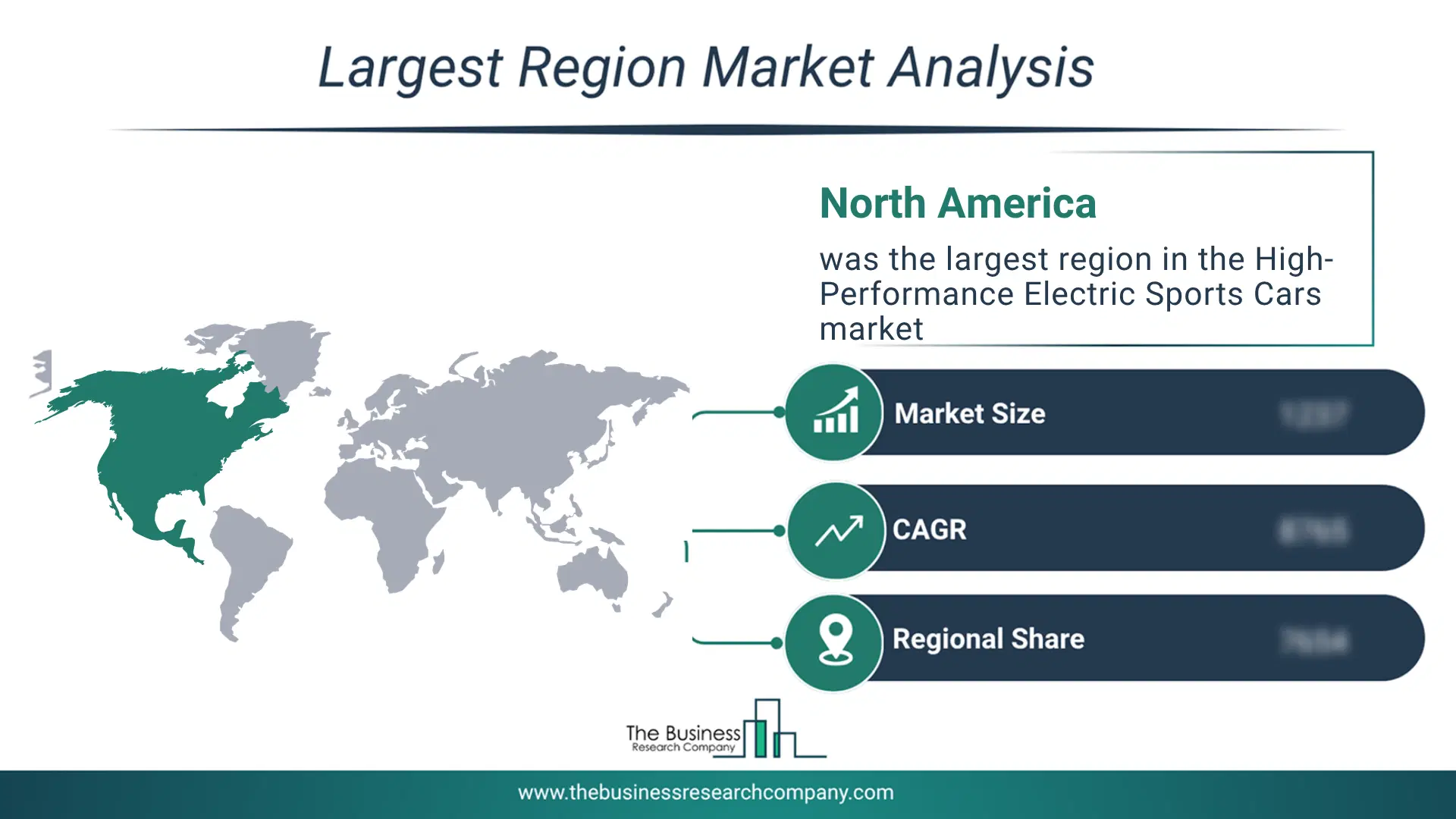
Regional Outlook
North America was the largest region in the high-performance electric sports cars market in 2025. Asia-Pacific is expected to be the fastest-growing region in the forecast period. The regions covered in this market report include Asia-Pacific, South East Asia, Western Europe, Eastern Europe, North America, South America, Middle East, Africa. The countries covered in this market report include Australia, Brazil, China, France, Germany, India, Indonesia, Japan, Taiwan, Russia, South Korea, UK, USA, Canada, Italy, SpainWhat Defines the High-Performance Electric Sports Cars Market?
The high-performance electric sports market consists of sales of luxury electric sports cars, all-wheel drive (AWD) electric sports cars, long-range electric sports cars, fast-charging electric sports cars, and track-focused electric sports cars. Values in this market are ‘factory gate’ values, that is, the value of goods sold by the manufacturers or creators of the goods, whether to other entities (including downstream manufacturers, wholesalers, distributors, and retailers) or directly to end customers. The value of goods in this market includes related services sold by the creators of the goods.How is Market Value Defined and Measured?
The market value is defined as the revenues that enterprises gain from the sale of goods and/or services within the specified market and geography through sales, grants, or donations in terms of the currency (in USD unless otherwise specified). The revenues for a specified geography are consumption values that are revenues generated by organizations in the specified geography within the market, irrespective of where they are produced. It does not include revenues from resales along the supply chain, either further along the supply chain or as part of other products.
This chart presents market attractiveness based on a quantitative evaluation of growth, competition, strategic alignment, and risk, offering a clear view of opportunity areas for decision-making. This chart is for illustrative purposes; the full report contains the complete analysis.

This chart highlights the Total Addressable Market (TAM) by estimating the maximum revenue opportunity using an assumption-driven approach, supporting strategic planning and opportunity sizing across markets. The chart is illustrative; the full report provides a more comprehensive analysis.
What Key Data and Analysis Are Included in the High-Performance Electric Sports Cars Market Report 2026?
The high-performance electric sports cars market research report is one of a series of new reports from The Business Research Company that provides market statistics, including industry global market size, regional shares, competitors with the market share, detailed market segments, market trends and opportunities, and any further data you may need to thrive in the high-performance electric sports cars industry. The market research report delivers a complete perspective of everything you need, with an in-depth analysis of the current and future state of the industry.High-Performance Electric Sports Cars Market Report Forecast Analysis
| Report Attribute | Details |
|---|---|
| Market Size Value In 2026 | $41.92 billion |
| Revenue Forecast In 2030 | $84.13 billion |
| Growth Rate | CAGR of 19.2% from 2026 to 2030 |
| Base Year For Estimation | 2025 |
| Actual Estimates/Historical Data | 2020-2025 |
| Forecast Period | 2026 - 2030 - 2030 |
| Market Representation | Revenue in USD Billion and CAGR from 2026 to 2030 |
| Segments Covered | Vehicle, Propulsion, Battery Capacity, End-User |
| Regional Scope | Asia-Pacific, Western Europe, Eastern Europe, North America, South America, Middle East, Africa |
| Country Scope | The countries covered in the report are Australia, Brazil, China, France, Germany, India, Indonesia, Japan, Taiwan, Russia, South Korea, UK, USA, Canada, Italy, Spain. |
| Key Companies Profiled | Bayerische Motoren Werke AG, Mercedes-AMG, Porsche AG, NIO Inc., Ferrari N.V., Lamborghini S.p.A., Aston Martin Lagonda, McLaren Automotive, Lucid Motors, Lotus Cars, Koenigsegg Automotive AB, Karma Automotive, Genesis Motors, Aspark Owl, Apollo Automobil GmbH, Bugatti Automobiles S.A.S., Pininfarina Automobili, Audi AG, Czinger Vehicles, Zenvo Automotive |
| Customization Scope | Request for Customization |
| Pricing And Purchase Options | Explore Purchase Options |