
High Speed Engine Global Market Opportunities And Strategies To 2035
By Speed (1,000 – 1,500 RPM, 1,500 – 1,800 RPM, Above 1,800 RPM), By Power Output (0.5-1 MW, 1-2 MW, 2-4 MW, Above 4 MW), By End User (Railway, Marine, Power Generation, Oil And Gas, Other End Users), And By Region, Opportunities And Strategies – Global Forecast To 2035
High Speed Engine Market Definition
High-speed engines are internal combustion engines designed to operate at high rotational speeds, typically above 1000 revolutions per minute (RPM). They are engineered with lightweight components, efficient fuel systems and advanced cooling mechanisms to deliver high power output while maintaining reliability and durability. The primary purpose of high speed engines is to provide efficient and compact power generation for applications requiring rapid response and high power density. The high speed engine market consists of sales by entities (organizations, sole traders and partnerships) of engines designed to operate at high rotational speeds. These engines are widely used in applications such as marine propulsion, power generation, rail locomotives, construction equipment and industrial machinery due to their high power density, compact size and quick load response. High speed engines are commonly powered by diesel, gas, or dual-fuel technologies and incorporate advanced systems such as turbocharging, electronic fuel injection and emission control technologies to improve efficiency and meet environmental regulations.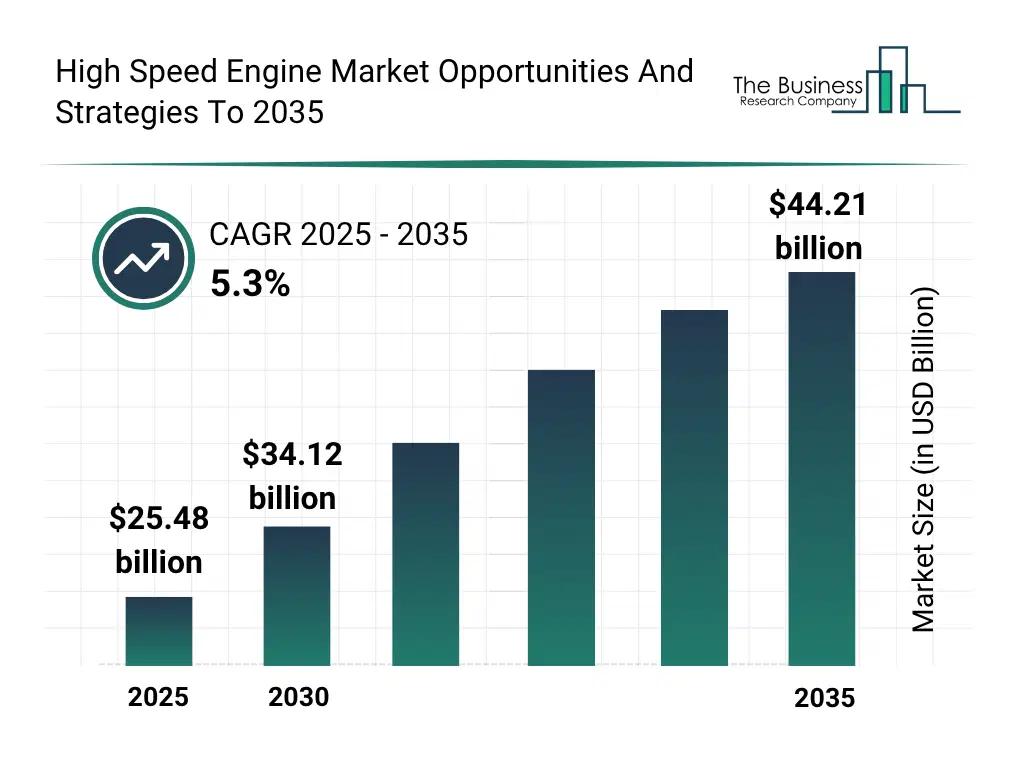
High Speed Engine Market Size
The global high speed engine market reached a value of nearly $25,476.9 million in 2025, having grown at a compound annual growth rate (CAGR) of 7.1% since 2020. The market is expected to grow from $25,476.9 million in 2025 to $34,121.6 million in 2030 at a rate of 6.0%. The market is then expected to grow at a CAGR of 5.3% from 2030 and reach $44,206.8 million in 2035. Growth in the historic period resulted from growth in marine tourism and recreational boating activities, expansion of global maritime freight transport, rising industrialization and demand for industrial machinery and equipment and expansion of distributed power generation systems. Factors that negatively affected growth in the historic period were stringent environmental emission regulations and volatility in fuel prices. Going forward, expansion of the oil and gas exploration sector, increasing demand for high energy generator system, increasing demand for off-grid power generation and expansion of port infrastructure and maritime logistics operations will drive the growth. Factors that could hinder the growth of the high speed engine market in the future include high initial capital investment, rising operational and maintenance costs and impact of trade war and tariffs.
High Speed Engine Market Segmentation
The high speed engine market is segmented by speed, by power output and by end user.
By Speed –
The high speed engine market is segmented by speed into:
By Power Output –
The high speed engine market is segmented by power output into:
By End User –
The high speed engine market is segmented by end user into:
By Geography - The high speed engine market is segmented by geography into:
By Speed –
The high speed engine market is segmented by speed into:
- a) 1,000 – 1,500 RPM
- b) 1,500 – 1,800 RPM
- c) Above 1,800 RPM
By Power Output –
The high speed engine market is segmented by power output into:
- a) 0.5-1 MW
- b) 1-2 MW
- c) 2-4 MW
- d) Above 4 MW
By End User –
The high speed engine market is segmented by end user into:
- a) Railway
- b) Marine
- c) Power Generation
- d) Oil And Gas
- e) Other End Users
By Geography - The high speed engine market is segmented by geography into:
- China
- India
- Japan
- Australia
- Taiwan
- South Korea
- Indonesia
- USA
- Canada
- Brazil
- France
- Germany
- UK
- Italy
- Spain
- Russia
-
o Asia Pacific
o Africa