

Higher Education Admissions Software Market Report 2026
Global Outlook – By Component (Software, Services ), By Type Of Institution (Public Universities, Private Universities, Community Colleges, Online Institutions, Career Or Technical Colleges ), By Enrollment Size (Small Institutions, Medium Institutions, Large Institutions, Very Large Institutions ), By Deployment Model (Cloud-Based Solutions, On-Premise Solutions, Hybrid Deployment Models ), By End User (Admission Offices, Academic Departments, Administrative Staff, Students And Applicants, Education Consultants) – Market Size, Trends, Strategies, and Forecast to 2030
Higher Education Admissions Software Market Overview
• Higher Education Admissions Software market size has reached to $1.54 billion in 2025 • Expected to grow to $2.58 billion in 2030 at a compound annual growth rate (CAGR) of 10.8% • Growth Driver: The Rising International Student Mobility Driving The Growth Of The Market Due To Increasing Demand For Globally Recognized Degrees • Market Trend: Advancements In Digital Application Document Management Platforms • North America was the largest region in 2025 and Asia-Pacific is the fastest growing region.What Is Covered Under Higher Education Admissions Software Market?
Higher education admissions software refers to digital platforms designed to streamline and automate the student admission process for colleges and universities, including application management, document verification, candidate evaluation, and enrollment activities. These solutions enable institutions to improve operational efficiency, enhance applicant experiences, and manage admissions workflows through centralized data management and analytics. The main components of higher education admissions software include software and services. Software refers to digital platforms that streamline and automate the application, evaluation, enrollment, and admissions processes of higher education institutions. These solutions are used by public universities, private universities, community colleges, online institutions, and career or technical colleges, and are adopted by small institutions, medium institutions, large institutions, and very large institutions. They are deployed through cloud-based solutions, on-premise solutions, and hybrid deployment models, serving end users including admission offices, academic departments, administrative staff, students and applicants, and education consultants.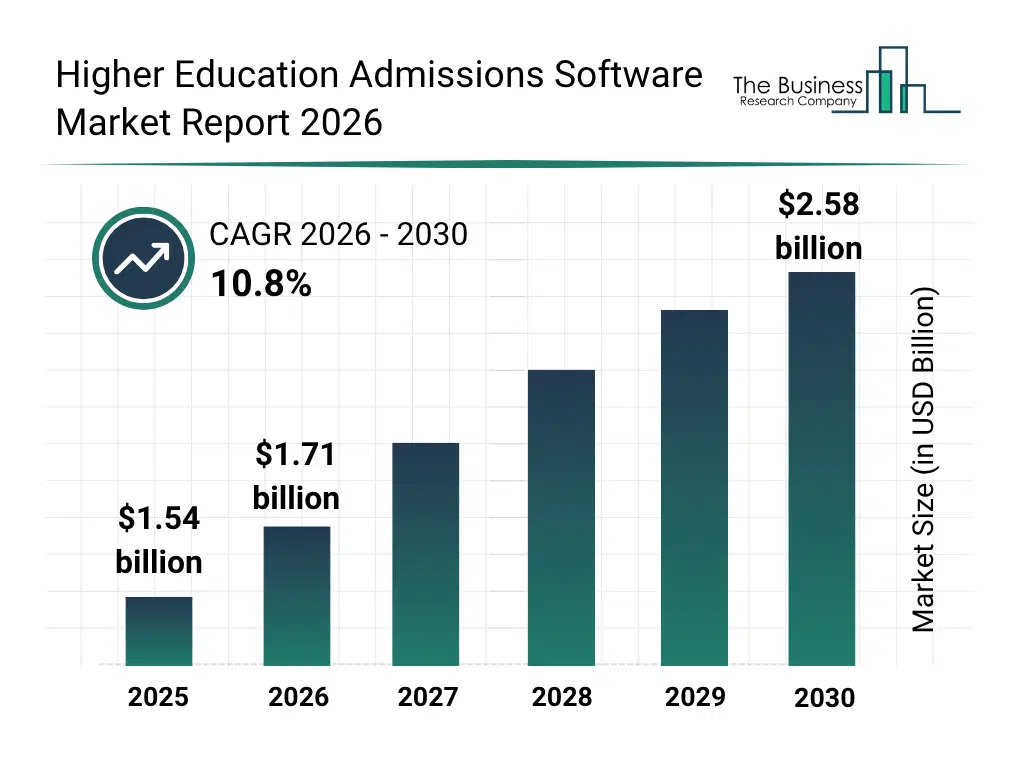
What Is The Higher Education Admissions Software Market Size and Share 2026?
The higher education admissions software market size has grown rapidly in recent years. It will grow from $1.54 billion in 2025 to $1.71 billion in 2026 at a compound annual growth rate (CAGR) of 11.3%. The growth in the historic period can be attributed to rising demand for streamlined admission workflows, increasing student application volumes, growing adoption of digital application platforms, increasing need for centralized applicant data, rising focus on improving admissions efficiency.What Is The Higher Education Admissions Software Market Growth Forecast?
The higher education admissions software market size is expected to see rapid growth in the next few years. It will grow to $2.58 billion in 2030 at a compound annual growth rate (CAGR) of 10.8%. The growth in the forecast period can be attributed to growing demand for personalized applicant engagement, increasing adoption of automated admissions decision support, rising need for real-time enrollment analytics, expanding adoption of integrated student information systems, growing emphasis on seamless digital enrollment experiences. Major trends in the forecast period include increasing adoption of automated application processing, growing use of centralized admissions data management, rising demand for digital document verification, increasing integration of applicant evaluation workflows, growing adoption of analytics-driven enrollment management.
Global Higher Education Admissions Software Market Segmentation
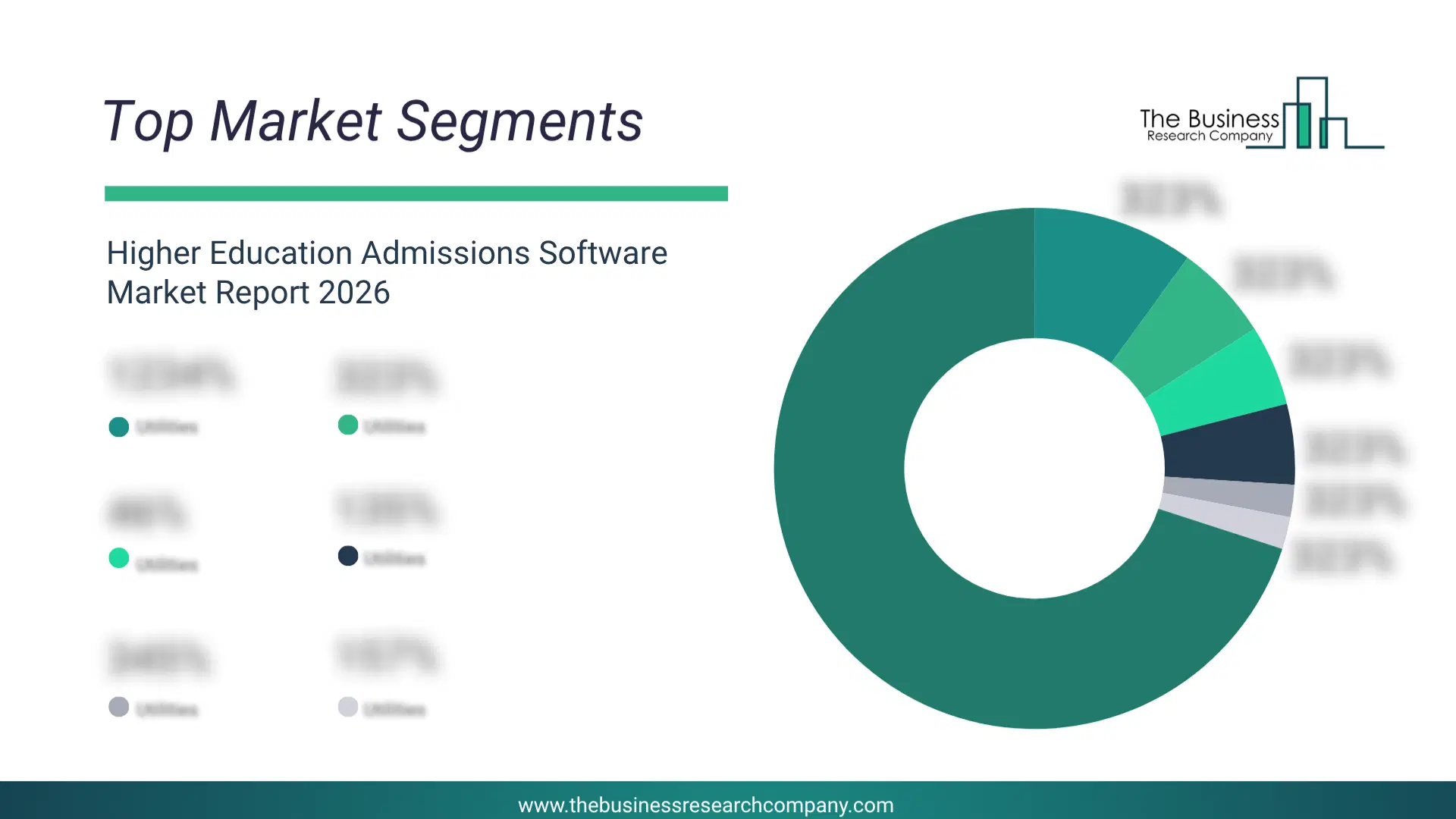
1) By Component: Software, Services 2) By Type Of Institution: Public Universities, Private Universities, Community Colleges, Online Institutions, Career Or Technical Colleges 3) By Enrollment Size: Small Institutions, Medium Institutions, Large Institutions, Very Large Institutions 4) By Deployment Model: Cloud-Based Solutions, On-Premise Solutions, Hybrid Deployment Models 5) By End User: Admission Offices, Academic Departments, Administrative Staff, Students And Applicants, Education Consultants Subsegments: 1) By Software: Application Management Software, Customer Relationship Management Software, Document Management Software, Enrollment Management Software, Analytics And Reporting Software, Communication And Engagement Software 2) By Services: Implementation Services, Consulting Services, Integration Services, Training And Support Services, Maintenance And Upgrade Services, Managed ServicesWhat Is The Driver Of The Higher Education Admissions Software Market?
The rising international student mobility is expected to propel the growth of the higher education admissions software market going forward. International student mobility refers to the movement of students across national borders to pursue education at foreign colleges, universities, or other educational institutions, enabling them to gain academic qualifications, international exposure, and cross-cultural learning experiences. Rising international student mobility is due to the increasing demand for globally recognized degrees, as students seek high-quality education, better career opportunities, and internationally valued qualifications that enhance their employability worldwide. Higher education admissions software enables international students to navigate the admissions process more efficiently through streamlined applications, document verification, communication, and enrollment workflows. For instance, in January 2024, according to ApplyBoard Inc., a Canada-based educational technology company in 2023, there were 6.4 million international students worldwide, maintaining the same count as in 2022. Therefore, the rising international student mobility is driving the growth of the higher education admissions software industry.Key Players In The Global Higher Education Admissions Software Market
Major companies operating in the higher education admissions software market are Microsoft Corporation, Oracle Corporation, Salesforce Inc., Adobe Inc., Workday Inc., Ellucian Company L.P., Blackbaud Inc., Technolutions Inc., Finalsite Holdings Inc., EducationDynamics LLC, Liaison International LLC, Faria Education Group Limited, LeadSquared Inc., Jenzabar Inc., Tribal Group plc, Anthology Inc., Unibuddy Ltd., Element451 Inc., Creatrix Campus Inc., DreamApply OÜ, EdVisorly Inc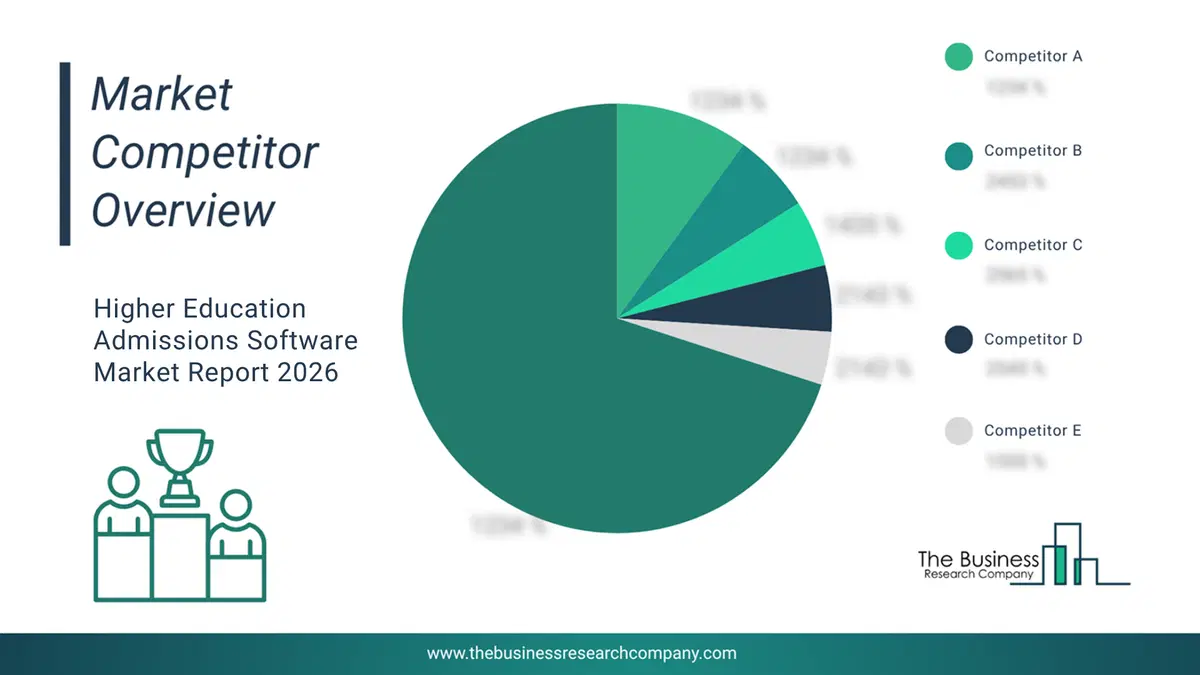
This chart is for illustrative purposes; the full report includes a detailed competitor analysis and comprehensive overview of the top 10 companies in the market.
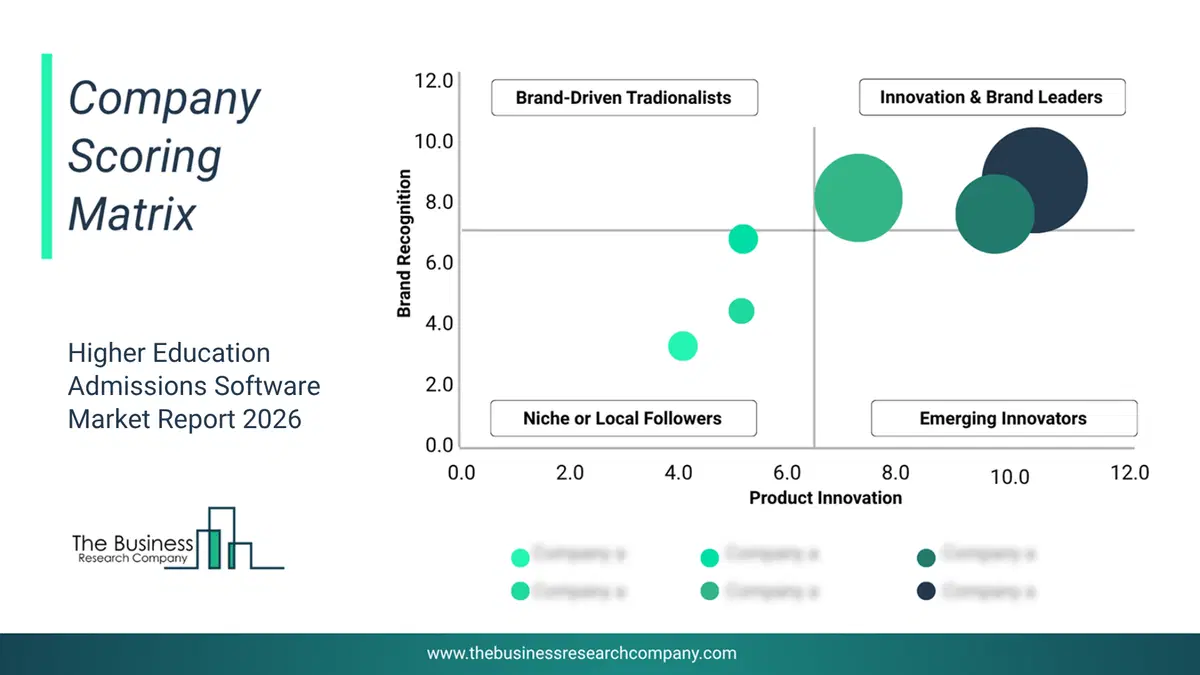
This chart maps companies by product innovation and brand strength, with bubble size indicating relative revenue, helping identify market leaders, challengers, and niche players. This is an illustrative chart; the full report provides a complete and accurate competitive analysis.
Global Higher Education Admissions Software Market Trends and Insights
Major companies operating in the higher education admissions software market are focusing on developing innovative platforms, such as application document management platforms, to enhance admissions efficiency, document security, and workflow automation across colleges and universities. An application document management platform is a cloud-based solution that enables institutions to securely receive, store, organize, track, and process student application documents through a centralized digital portal. For instance, in November 2023, Scribbles Software, LLC., a US-based education technology company, launched ScribForward, an innovative higher education admissions document management platform designed specifically for colleges and universities. ScribForward enables admissions offices to securely receive transcripts, letters of recommendation, and other application materials through an online portal while organizing and tracking documents throughout the admissions process. The platform includes automated email notifications for newly received documents, advanced filtering by status and submission date, document export capabilities, comprehensive audit trails, and role-based access controls to protect sensitive student information. It is available in both free and premium versions, allowing institutions of different sizes to streamline admissions workflows, improve operational efficiency, and reduce the risk of misplaced or delayed application documents.What Are Latest Mergers And Acquisitions In The Higher Education Admissions Software Market?
In June 2026, Acumen, part of Sannam S4 Group, an India-based education consulting and advisory company, acquired EduCorePro for an undisclosed amount. With this acquisition, Acumen aims to strengthen its AI-powered admissions capabilities and accelerate the digital transformation of global student enrolment services by integrating advanced automation, predictive analytics, and workflow intelligence into its platform. EduCorePro is an India-based company that provides AI-powered higher education admissions software for streamlining student recruitment, admissions, and application management.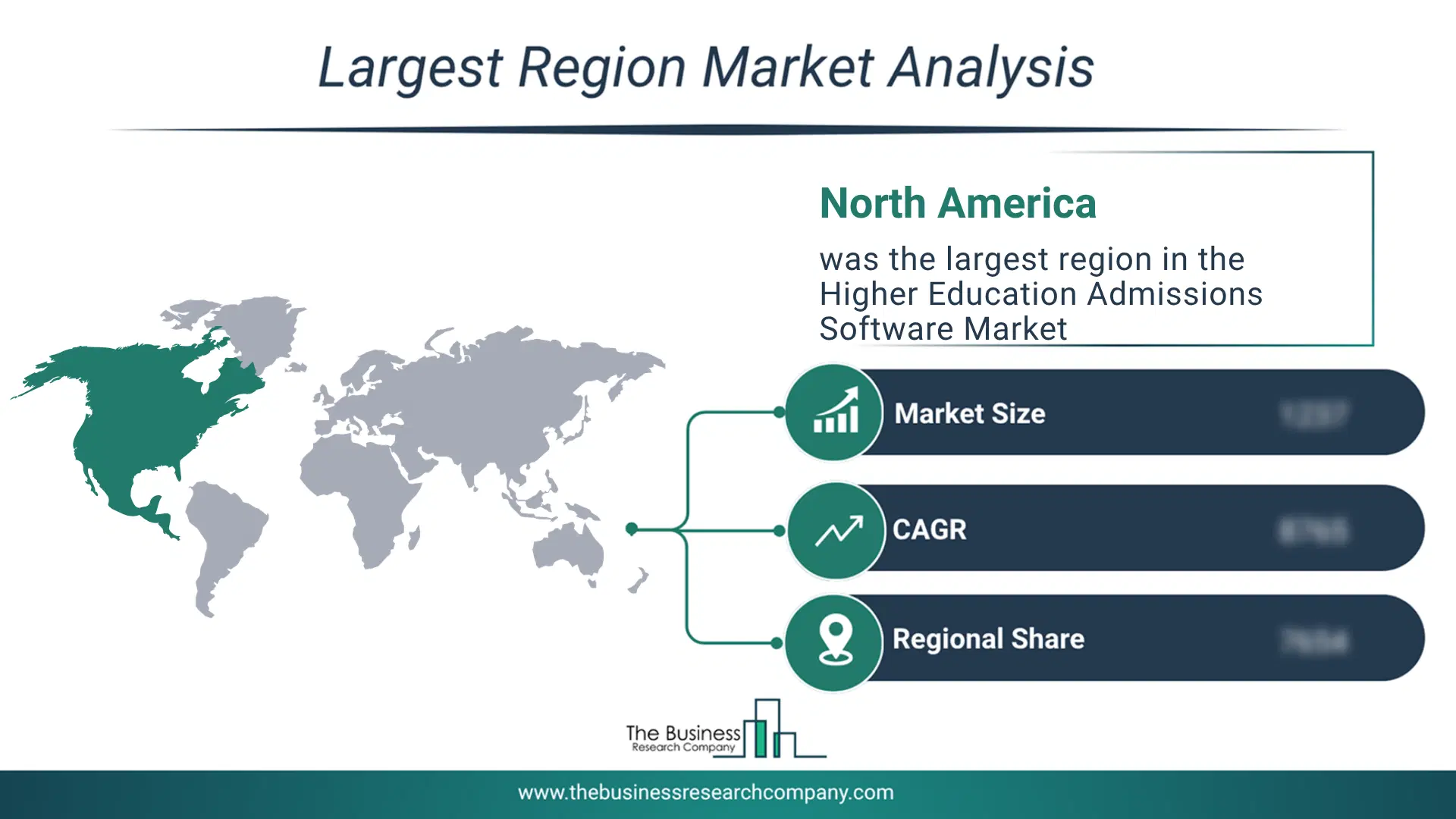
Regional Insights
North America was the largest region in the higher education admissions software market in 2025. Asia-Pacific is expected to be the fastest-growing region in the forecast period. The regions covered in this market report are Asia-Pacific, South East Asia, Western Europe, Eastern Europe, North America, South America, Middle East, Africa. The countries covered in this market report are Australia, Brazil, China, France, Germany, India, Indonesia, Japan, Taiwan, Russia, South Korea, UK, USA, Canada, Italy, Spain.What Defines the Higher Education Admissions Software Market?
The higher education admissions software market includes revenues earned by entities by providing services such as application management and processing service, student recruitment and enrollment management services, applicant tracking and evaluation services, document verification and compliance management services, and admissions analytics and reporting services. The market value includes the value of related goods sold by the service provider or included within the service offering. Only goods and services traded between entities or sold to end consumers are included.How is Market Value Defined and Measured?
The market value is defined as the revenues that enterprises gain from the sale of goods and/or services within the specified market and geography through sales, grants, or donations in terms of the currency (in USD unless otherwise specified). The revenues for a specified geography are consumption values that are revenues generated by organizations in the specified geography within the market, irrespective of where they are produced. It does not include revenues from resales along the supply chain, either further along the supply chain or as part of other products.
This chart presents market attractiveness based on a quantitative evaluation of growth, competition, strategic alignment, and risk, offering a clear view of opportunity areas for decision-making. This chart is for illustrative purposes; the full report contains the complete analysis.

This chart highlights the Total Addressable Market (TAM) by estimating the maximum revenue opportunity using an assumption-driven approach, supporting strategic planning and opportunity sizing across markets. The chart is illustrative; the full report provides a more comprehensive analysis.
What Key Data and Analysis Are Included in the Higher Education Admissions Software Market Report 2026?
The higher education admissions software market research report is one of a series of new reports from The Business Research Company that provides market statistics, including industry global market size, regional shares, competitors with the market share, detailed market segments, market trends and opportunities, and any further data you may need to thrive in the higher education admissions software industry. The market research report delivers a complete perspective of everything you need, with an in-depth analysis of the current and future state of the industry.Higher Education Admissions Software Market Report Forecast Analysis
| Report Attribute | Details |
|---|---|
| Market Size Value In 2026 | $1.71 billion |
| Revenue Forecast In 2030 | $2.58 billion |
| Growth Rate | CAGR of 10.8% from 2026 to 2030 |
| Base Year For Estimation | 2025 |
| Actual Estimates/Historical Data | 2020-2025 |
| Forecast Period | 2026 - 2030 |
| Market Representation | Revenue in USD Billion and CAGR from 2026 to 2030 |
| Segments Covered | Component, Type Of Institution, Enrollment Size, Deployment Model, End User |
| Regional Scope | Asia-Pacific, Western Europe, Eastern Europe, North America, South America, Middle East, Africa |
| Country Scope | The countries covered in the report are Australia, Brazil, China, France, Germany, India, Indonesia, Japan, Taiwan, Russia, South Korea, UK, USA, Canada, Italy, Spain. |
| Key Companies Profiled | Microsoft Corporation, Oracle Corporation, Salesforce Inc., Adobe Inc., Workday Inc., Ellucian Company L.P., Blackbaud Inc., Technolutions Inc., Finalsite Holdings Inc., EducationDynamics LLC, Liaison International LLC, Faria Education Group Limited, LeadSquared Inc., Jenzabar Inc., Tribal Group plc, Anthology Inc., Unibuddy Ltd., Element451 Inc., Creatrix Campus Inc., DreamApply OÜ, EdVisorly Inc |
| Customization Scope | Request for Customization |
| Pricing And Purchase Options | Explore Purchase Options |