
Highway Driving Assist Market Report 2026
Global Outlook – By Component (Camera, Radar, Global Positioning System (GPS), Navigation System Map Database), By Operational Techniques (Automatic Emergency Braking (AEB), Pedestrian Automatic Emergency Braking (PAEB), Rear Automatic Braking, Blind Spot Intervention), By Function (Adaptive Cruise Control, Lane Keeping Assist, Lane Centering Assist, Collision Avoidance Assist), By Vehicle Type (Mid Segment, Luxury), By Application (Automotive Original Equipment Manufacturers (OEMs), Fleet Operators, Transportation Services, Individual Consumers) – Market Size, Trends, Strategies, and Forecast to 2030
Highway Driving Assist Market Overview
• Highway Driving Assist market size has reached to $5.39 billion in 2025 • Expected to grow to $13.09 billion in 2030 at a compound annual growth rate (CAGR) of 19% • Growth Driver: Autonomous Vehicles in Driving the Growth of the Highway Driving Assist Market • Market Trend: Next-Generation Highway Driving Assist Enhances Autonomy And Safety • North America was the largest region in 2025 and Asia-Pacific is the fastest growing region.What Is Covered Under Highway Driving Assist Market?
Highway driving assist is a level 2 advanced driving assistance system (ADAS), designed for limited-access highways. This system integrates adaptive cruise control with stop-and-go functionality, vehicle distance maintenance technology, lane-centering assistance, GPS data, and route information from the navigation system. The main components in highway driving assist market are camera, radar, global positioning system (GPS), and navigation system map database. Cameras in highway driving assist systems are key components for collecting visual data from the surrounding environment. The operational techniques includes automatic emergency braking (AEB), pedestrian automatic emergency braking (PAEB), rear automatic braking, and blind spot intervention. The multiple function includes are adaptive cruise control, lane keeping assist, lane centering assist, and collision avoidance assist for mid segment, luxury vehicles. The different applications include automotive original equipment manufacturers (OEMs), fleet operators, transportation services, and individual consumers.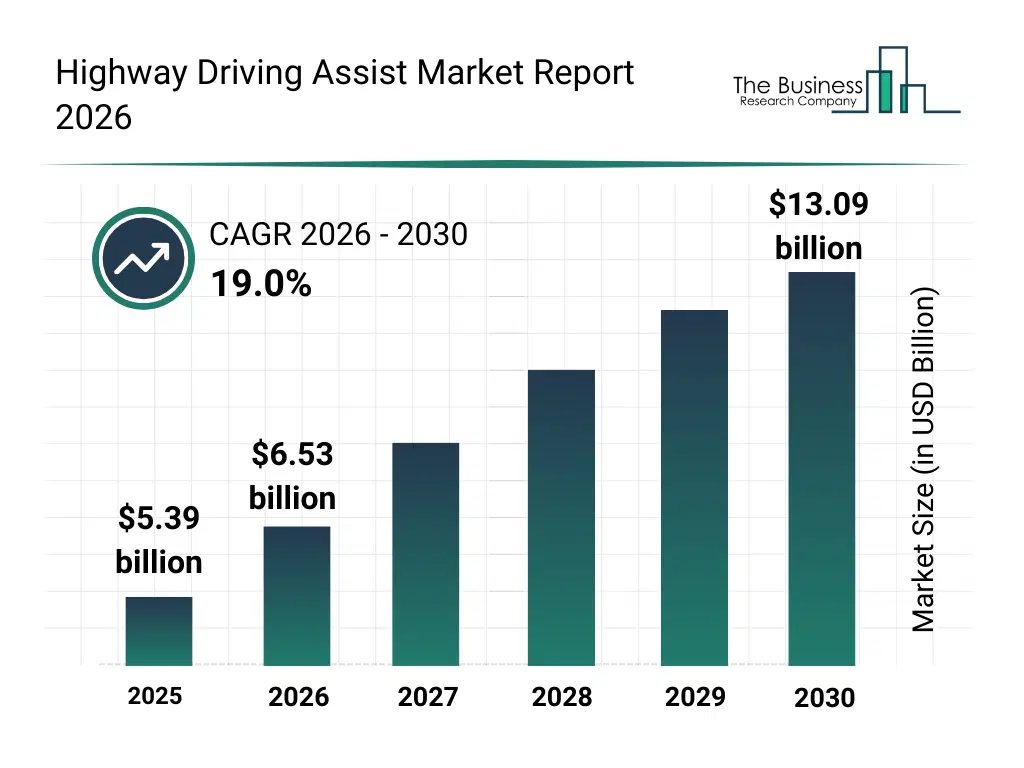
What Is The Highway Driving Assist Market Size and Share 2026?
The highway driving assist market size has grown exponentially in recent years. It will grow from $5.39 billion in 2025 to $6.53 billion in 2026 at a compound annual growth rate (CAGR) of 21.1%. The growth in the historic period can be attributed to increase in highway accidents, early adas adoption, demand for driving comfort, regulatory safety mandates, advancements in radar and camera systems.What Is The Highway Driving Assist Market Growth Forecast?
The highway driving assist market size is expected to see rapid growth in the next few years. It will grow to $13.09 billion in 2030 at a compound annual growth rate (CAGR) of 19.0%. The growth in the forecast period can be attributed to transition toward higher autonomy levels, growth in connected vehicles, rising luxury vehicle penetration, continuous sensor cost reduction, consumer focus on safety features. Major trends in the forecast period include integration of adaptive cruise control, lane centering assistance adoption, real time gps and map data usage, enhanced sensor fusion systems, rising level 2 adas deployment.
Global Highway Driving Assist Market Segmentation
1) By Component: Camera, Radar, Global Positioning System (GPS), Navigation System Map Database 2) By Operational Techniques: Automatic Emergency Braking (AEB), Pedestrian Automatic Emergency Braking (PAEB), Rear Automatic Braking, Blind Spot Intervention 3) By Function: Adaptive Cruise Control, Lane Keeping Assist, Lane Centering Assist, Collision Avoidance Assist 4) By Vehicle Type: Mid Segment, Luxury 5) By Application: Automotive Original Equipment Manufacturers (OEMs), Fleet Operators, Transportation Services, Individual Consumers Subsegments: 1) By Camera: Front Camera, Rearview Camera, Surround View Camera 2) By Radar: Long-Range Radar, Short-Range Radar, Medium-Range Radar 3) By Global Positioning System (Gps): Standalone Gps Units, Integrated Gps Modules 4) By Navigation System Map Database: 2d Map Databases, 3d Map Databases, Real-Time Map Update DatabasesWhat Is The Driver Of The Highway Driving Assist Market?
The increasing number of autonomous vehicles is expected to propel the growth of the highway driving assist market going forward. Autonomous vehicles are self-driving cars that employ advanced sensor technologies, computer systems, and artificial intelligence to operate and navigate without constant human intervention or monitoring. Autonomous vehicles have increased demand due to advancements in artificial intelligence and sensor technology, along with substantial investment and support from private companies and governments to enhance safety and efficiency in transportation. Highway driving assist helps autonomous vehicles by providing additional safety and redundancy measures, improving navigation and decision-making capabilities, and strengthening overall driving efficiency. For instance, in January 2025, according to Tesla, a US-based electric vehicle manufacturing company, in Q4 2024, total production reached 459,445 vehicles with 495,570 deliveries, while full-year 2024 production totaled 1,773,443 vehicles with 1,789,226 deliveries, all equipped with Level 2 autonomous driving features. Therefore, the increasing number of autonomous vehicles is driving the highway driving assist industry.Global Highway Driving Assist Market Trends and Insights
Major companies operating in the highway driving assist market are focusing on innovation in automotive safety, such as hands-off level 2 Driving to enable drivers to remove their hands from the wheel while the system maintains speed, lane position, and assists with motorway navigation. Hands-Off Level 2 Driving refers to a semi-autonomous feature where the vehicle controls both steering and speed simultaneously, with the driver remaining alert and able to intervene at any time. For instance, in November 2025, Bayerische Motoren Werke AG (BMW), a Germany-based automotive manufacturing comapny, received international approval under UN Regulation No. 171 for its Motorway Assistant system. This approval certifies that the system can safely provide hands-off driving on highways at speeds up to 130 km/h, including intelligent lane changes, motorway interchanges, and exit slip roads, with driver monitoring and symbiotic steering and braking. By combining advanced sensors, AI-driven assistance, and driver observation, BMW’s Hands-Off Level 2 Driving sets a new benchmark for semi-autonomous highway driving, ensuring both comfort and safety.Key Players In The Global Highway Driving Assist Market
Major companies operating in the highway driving assist market report include Toyota Motor Corporation, Honda Motor Co. Ltd., Robert Bosch GmbH, Hitachi Ltd., DENSO Corporation, ZF Friedrichshafen AG, Qualcomm Technologies Inc., Continental AG, Magna International Inc., Aisin Corporation, Valeo SA, Texas Instruments Incorporated, Aptiv, Analog Devices Inc., Renesas Electronics Corporation, Autoliv, ON Semiconductor Corporation, HARMAN International, HELLA GmbH & Co. KGaA, Visteon Corporation, AVL, Veoneer, Mobileye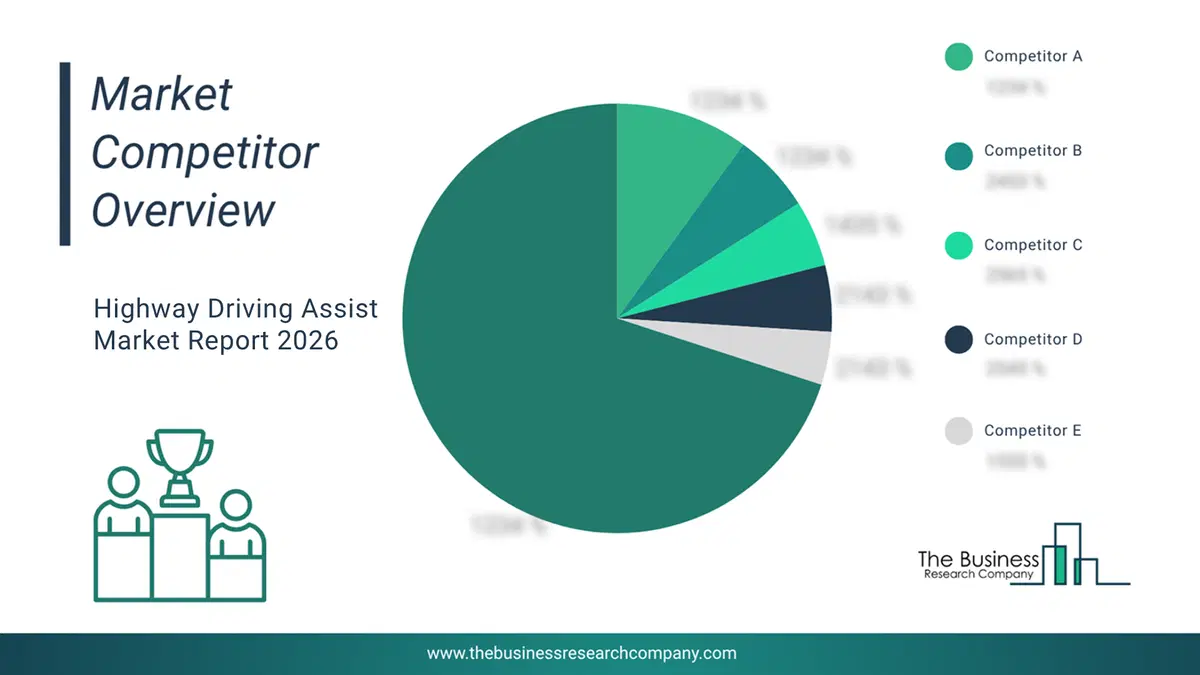
This chart is for illustrative purposes; the full report includes a detailed competitor analysis and comprehensive overview of the top 10 companies in the market.
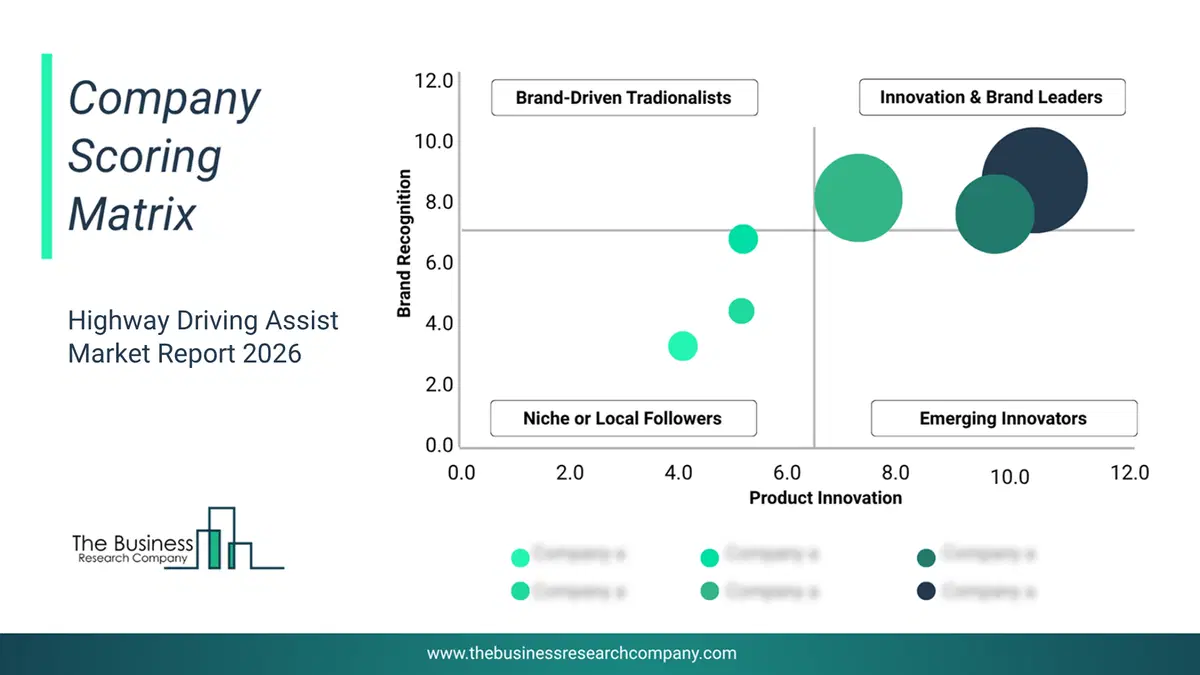
This chart maps companies by product innovation and brand strength, with bubble size indicating relative revenue, helping identify market leaders, challengers, and niche players. This is an illustrative chart; the full report provides a complete and accurate competitive analysis.
What Are Latest Mergers And Acquisitions In The Highway Driving Assist Market?
In June 2023, Magna International, a Canada-based mobility technology company, acquired the active safety business of Veoneer for US 1.525 billion. With this acquisition, Magna strengthened its position in the fast-growing automotive safety and highway driving assistance sector by expanding its portfolio of sensors, perception software and integrated driver assistance systems. Veoneer, Inc. is a Sweden based automotive technology company known for developing advanced driver assistance, restraint control systems and technologies that improve vehicle safety and automated driving performance.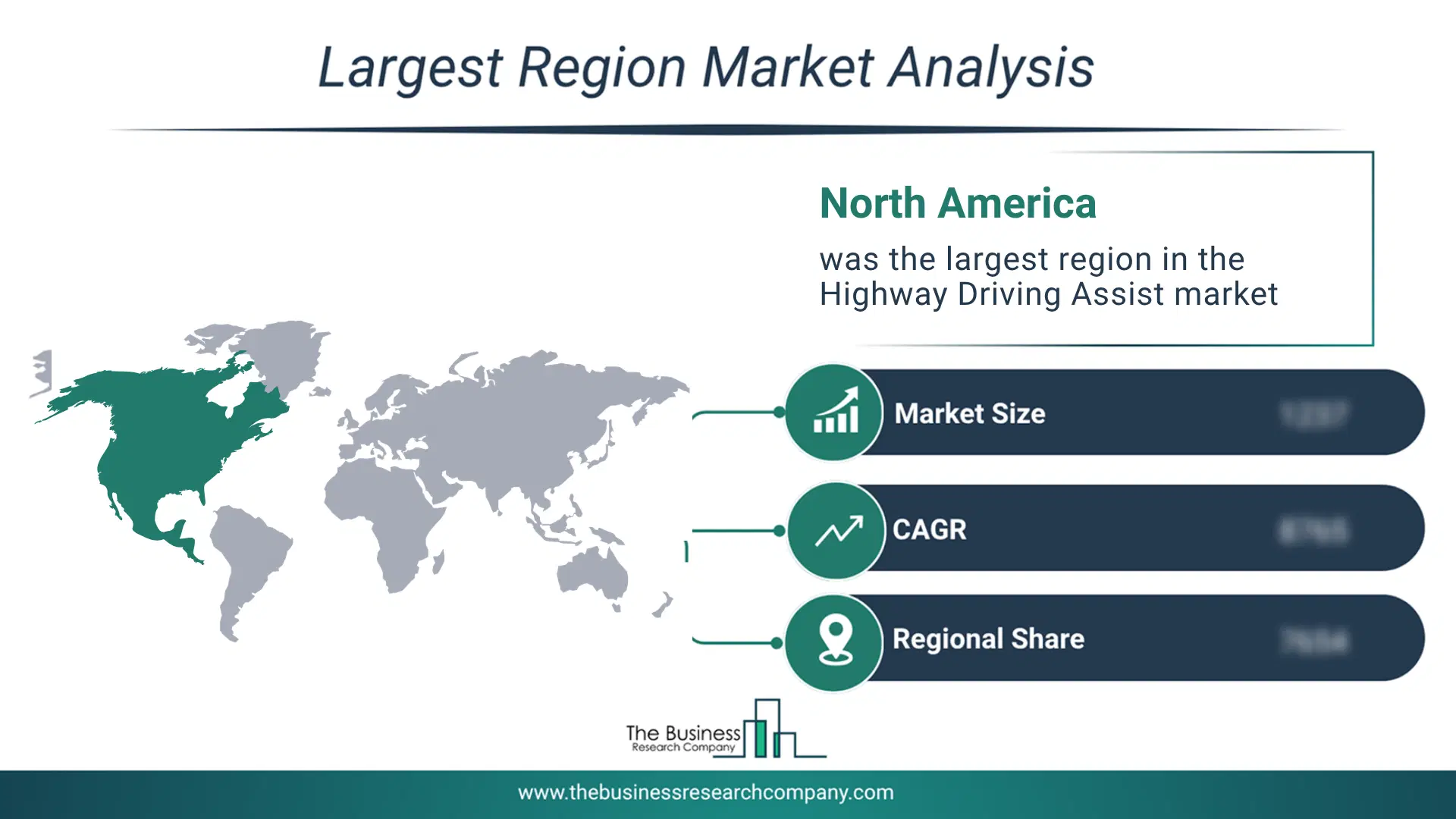
Regional Outlook
North America was the largest region in the highway driving assist market in 2025. Asia-Pacific is expected to be the fastest-growing region in the forecast period. The regions covered in this market report include Asia-Pacific, South East Asia, Western Europe, Eastern Europe, North America, South America, Middle East, Africa. The countries covered in this market report include Australia, Brazil, China, France, Germany, India, Indonesia, Japan, Taiwan, Russia, South Korea, UK, USA, Canada, Italy, SpainWhat Defines the Highway Driving Assist Market?
The highway driving assist market consists of revenues earned by entities by providing services such as adaptive cruise control, lane-keeping assistance, automatic emergency braking, and traffic jam assist. The market value includes the value of related goods sold by the service provider or included within the service offering. The highway driving assist market also includes sales of sensors, such as cameras, radars, and LiDAR, control units, actuators, such as steering and braking systems. Values in this market are ‘factory gate’ values, that is the value of goods sold by the manufacturers or creators of the goods, whether to other entities (including downstream manufacturers, wholesalers, distributors and retailers) or directly to end customers. The value of goods in this market includes related services sold by the creators of the goods.How is Market Value Defined and Measured?
The market value is defined as the revenues that enterprises gain from the sale of goods and/or services within the specified market and geography through sales, grants, or donations in terms of the currency (in USD unless otherwise specified). The revenues for a specified geography are consumption values that are revenues generated by organizations in the specified geography within the market, irrespective of where they are produced. It does not include revenues from resales along the supply chain, either further along the supply chain or as part of other products.
This chart presents market attractiveness based on a quantitative evaluation of growth, competition, strategic alignment, and risk, offering a clear view of opportunity areas for decision-making. This chart is for illustrative purposes; the full report contains the complete analysis.

This chart highlights the Total Addressable Market (TAM) by estimating the maximum revenue opportunity using an assumption-driven approach, supporting strategic planning and opportunity sizing across markets. The chart is illustrative; the full report provides a more comprehensive analysis.
What Key Data and Analysis Are Included in the Highway Driving Assist Market Report 2026?
The highway driving assist market research report is one of a series of new reports from The Business Research Company that provides market statistics, including industry global market size, regional shares, competitors with the market share, detailed market segments, market trends and opportunities, and any further data you may need to thrive in the highway driving assist industry. The market research report delivers a complete perspective of everything you need, with an in-depth analysis of the current and future state of the industry.Highway Driving Assist Market Report Forecast Analysis
| Report Attribute | Details |
|---|---|
| Market Size Value In 2026 | $6.53 billion |
| Revenue Forecast In 2030 | $13.09 billion |
| Growth Rate | CAGR of 21.1% from 2026 to 2030 |
| Base Year For Estimation | 2025 |
| Actual Estimates/Historical Data | 2020-2025 |
| Forecast Period | 2026 - 2030 - 2030 |
| Market Representation | Revenue in USD Billion and CAGR from 2026 to 2030 |
| Segments Covered | Component, Operational Techniques, Function, Vehicle Type, Application |
| Regional Scope | Asia-Pacific, Western Europe, Eastern Europe, North America, South America, Middle East, Africa |
| Country Scope | The countries covered in the report are Australia, Brazil, China, France, Germany, India, Indonesia, Japan, Taiwan, Russia, South Korea, UK, USA, Canada, Italy, Spain. |
| Key Companies Profiled | Toyota Motor Corporation, Honda Motor Co. Ltd., Robert Bosch GmbH, Hitachi Ltd., DENSO Corporation, ZF Friedrichshafen AG, Qualcomm Technologies Inc., Continental AG, Magna International Inc., Aisin Corporation, Valeo SA, Texas Instruments Incorporated, Aptiv, Analog Devices Inc., Renesas Electronics Corporation, Autoliv, ON Semiconductor Corporation, HARMAN International, HELLA GmbH & Co. KGaA, Visteon Corporation, AVL, Veoneer, Mobileye |
| Customization Scope | Request for Customization |
| Pricing And Purchase Options | Explore Purchase Options |