
Hollow-Core Fiber Market Report 2026
Global Outlook – By Type Of Fiber (Photonic Bandgap Fibers, Anti-Resonant Fibers, Other Specialized Hollow-Core Fibers), By Material (Silica, Polymer, Other Materials), By Manufacturing Process (Extrusion Process, Draw Tower Process, Lasing And Sintering Methods, Other Advanced Manufacturing Techniques), By End-User (Telecom And Information Technology (IT), Healthcare, Manufacturing, Aerospace And Defense, Other End-Users) – Market Size, Trends, Strategies, and Forecast to 2030
Hollow-Core Fiber Market Overview
• Hollow-Core Fiber market size has reached to $1.23 billion in 2025 • Expected to grow to $2.6 billion in 2030 at a compound annual growth rate (CAGR) of 16.1% • Growth Driver: Increasing Demand For High-Speed Internet Connectivity Fueling The Market Growth Due To Digital Transformation Requirements • Market Trend: Innovative Anti-Resonant Fibers Revolutionize Long-Distance Optical Networks • Asia-Pacific was the largest region in 2025.What Is Covered Under Hollow-Core Fiber Market?
A hollow-core fiber is a type of optical fiber in which light is guided primarily through a hollow, air-filled core instead of a solid glass core. It significantly reduces light absorption and scattering, resulting in lower transmission losses and the ability to carry high-bandwidth signals over long distances. They are employed in advanced optical communication, high-precision sensing, and ultrafast signal transmission applications due to their efficient light guidance and minimal signal distortion. The main types of hollow-core fiber are photonic bandgap fibers, anti-resonant fibers, and other specialized hollow-core fibers. Photonic bandgap fibers are specialized optical fibers with a periodic structure that guides light through a hollow core, enabling low-loss, high-power, and high-performance transmission. They are made using materials such as silica, polymer, and other materials, and manufactured through processes including extrusion, draw tower, lasing and sintering methods, and other advanced techniques. They are used by end-users including telecom and information technology (IT), healthcare, manufacturing, aerospace and defense, and other organizations.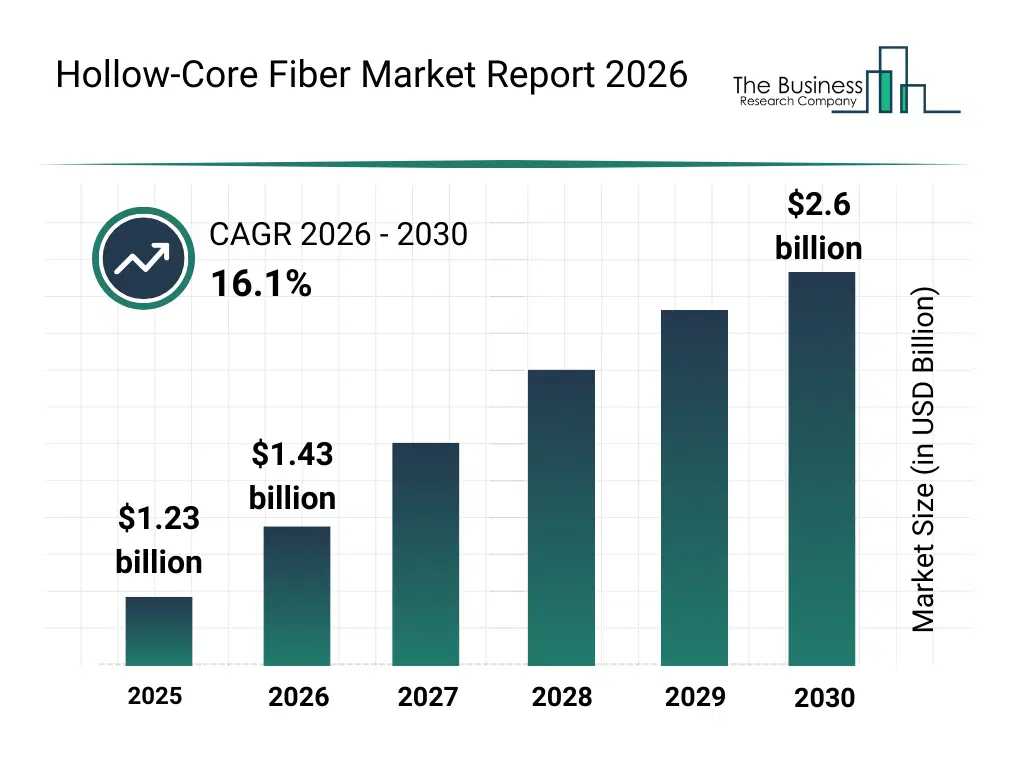
What Is The Hollow-Core Fiber Market Size and Share 2026?
The hollow-core fiber market size has grown rapidly in recent years. It will grow from $1.23 billion in 2025 to $1.43 billion in 2026 at a compound annual growth rate (CAGR) of 16.4%. The growth in the historic period can be attributed to reliance on traditional solid-core fibers, high transmission losses, limited long-distance bandwidth, signal distortion in conventional fibers, low adoption in precision sensing.What Is The Hollow-Core Fiber Market Growth Forecast?
The hollow-core fiber market size is expected to see rapid growth in the next few years. It will grow to $2.6 billion in 2030 at a compound annual growth rate (CAGR) of 16.1%. The growth in the forecast period can be attributed to rising demand for high-speed optical communication, adoption in aerospace and defense, growth in healthcare and manufacturing sensing applications, expansion of long-distance telecommunication networks, development of low-loss and high-power hollow-core fibers. Major trends in the forecast period include ultra-low loss transmission, high-bandwidth long-distance communication, advanced optical sensing applications, ultrafast signal transmission, precision signal guidance.
Global Hollow-Core Fiber Market Segmentation
1) By Type Of Fiber: Photonic Bandgap Fibers, Anti-Resonant Fibers, Other Specialized Hollow-Core Fibers 2) By Material: Silica, Polymer, Other Materials 3) By Manufacturing Process: Extrusion Process, Draw Tower Process, Lasing And Sintering Methods, Other Advanced Manufacturing Techniques 4) By End-User: Telecom And Information Technology (IT), Healthcare, Manufacturing, Aerospace And Defense, Other End-Users Subsegments: 1) By Photonic Bandgap Fibers: Bragg Fibers, Kagome Fibers, Tube Lattice Fibers, Hollow-Core Photonic Crystal Fibers 2) By Anti-Resonant Fibers: Single-Ring Anti-Resonant Fibers, Nested-Ring Anti-Resonant Fibers, Negative Curvature Fibers, Tube Lattice Anti-Resonant Fibers 3) By Other Specialized Hollow-Core Fibers: Low-Loss Hollow-Core Fibers, High-Power Transmission Fibers, Dispersion-Managed Hollow-Core Fibers, Custom Geometry Hollow-Core FibersWhat Is The Driver Of The Hollow-Core Fiber Market?
The increasing demand for high-speed internet connectivity is expected to propel the growth of the hollow-core fiber market going forward. High-speed internet connectivity refers to broadband services that provide fast data transmission capabilities enabling seamless digital communication and data transfer. The demand for high-speed internet is rising due to accelerated digital transformation across industries, as remote work, cloud computing, and streaming services require robust bandwidth infrastructure to support growing data consumption needs. Hollow-core fiber supports high-speed internet connectivity by utilizing air-filled cores that allow light signals to travel faster with significantly reduced latency and signal losses compared to conventional solid-core fibers, thereby providing the ultra-fast, low-latency infrastructure essential for demanding high-bandwidth applications and next-generation telecommunications networks. For instance, in November 2024, according to the UK Parliament's House of Commons Library, a UK-based government administration, as of January 2024, gigabit-capable broadband covered 78% of UK premises, up from 72% in January 2023, 64% in January 2022. Therefore, the increasing demand for high-speed internet connectivity is driving the growth of the hollow-core fiber industry.Key Players In The Global Hollow-Core Fiber Market
Major companies operating in the hollow-core fiber market are Microsoft Corporation, Hamamatsu Photonics K.K., Heraeus Covantics GmbH, Prysmian Group, Furukawa Electric Co. Ltd., Hengtong Group Co. Ltd., HUBER+SUHNER AG, Thorlabs Inc., Relativity Networks Inc., YSL Photonics Co. Ltd., Lingxian Technology, GLOphotonics SAS, Guiding Photonics Inc., Yangtze Optical Electronic Co. Ltd. (YOEC), Photonics Bretagne, NKT Photonics A/S, art photonics GmbH, Few-cycle Inc., Linfiber Technology (Nantong) Co. Ltd., IRflex Corporation.
This chart is for illustrative purposes; the full report includes a detailed competitor analysis and comprehensive overview of the top 10 companies in the market.
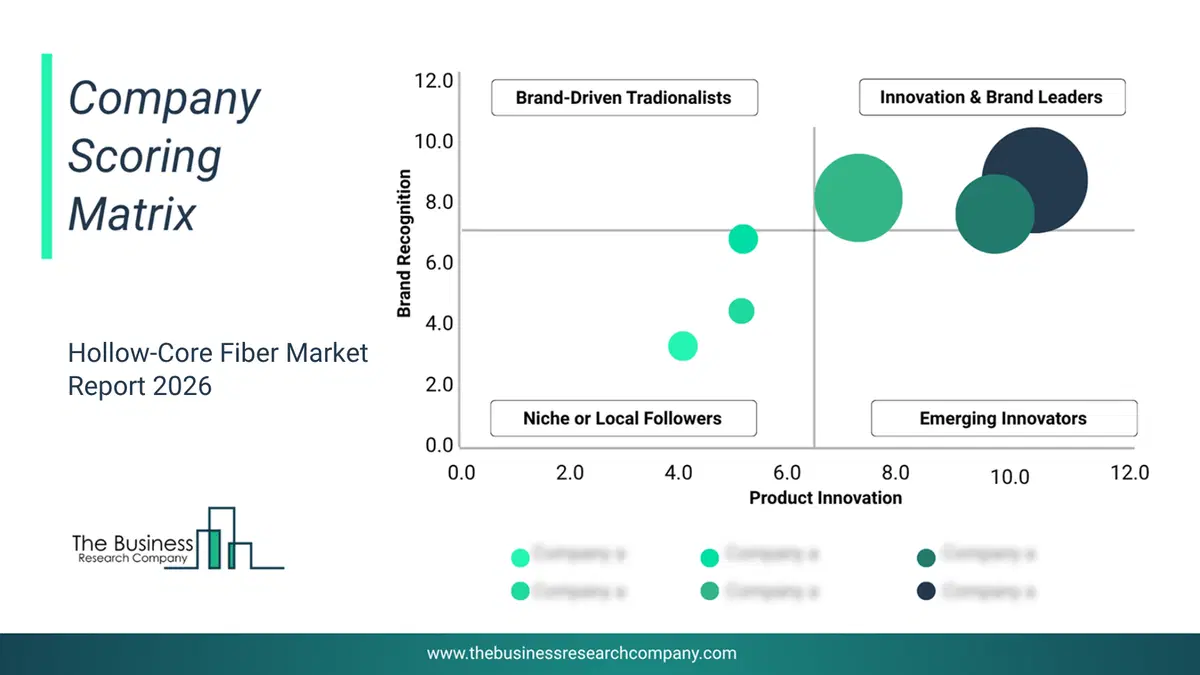
This chart maps companies by product innovation and brand strength, with bubble size indicating relative revenue, helping identify market leaders, challengers, and niche players. This is an illustrative chart; the full report provides a complete and accurate competitive analysis.
Global Hollow-Core Fiber Market Trends and Insights
Major companies operating in the hollow-core fiber market are focusing on developing innovative solutions such as low-loss anti-resonant hollow-core fibers to enable ultra-fast, low-latency, and high-capacity optical networks. Low-loss anti-resonant hollow-core fibers (AR-HCFs) are optical fibers with a hollow core that guides light through air rather than solid glass, minimizing scattering and absorption, which helps reduce signal loss, lower latency, minimize dispersion, and enable higher-power, long-distance, high-speed data transmission. For instance, in September 2024, Linfiber Technology (Nantong) Co., Ltd., a China-based company, launched its LinearCore hollow-core fiber cable, featuring an innovative anti-resonant hollow-core fiber (AR-HCF) structure with a loss of 0.5 dB/km in the C+L band. The cable provides approximately 30% lower latency compared to standard silica glass fibers and supports ultra-high-capacity transmission, enabling more efficient long-distance, high-speed data transfer with minimal signal degradation. LinearCore also incorporates advanced connector and splicing technologies, including SMF28-HCF connectors and HCF-HCF splicing techniques, ensuring low connection loss (<0.3 dB) and reliable field deployment. Its design allows higher input power, reduces the need for repeaters and amplifiers, and simplifies optical dispersion and nonlinear compensation, leading to lower energy consumption and overall system cost.What Are Latest Mergers And Acquisitions In The Hollow-Core Fiber Market?
In January 2023, Microsoft, a U.S.-based provider of software, cloud computing, and technology solutions, acquired Lumenisity Limited for an undisclosed amount. With this acquisition, Microsoft aims to enhance its technological capabilities in advanced fiber optic solutions, supporting high-speed data transmission and next-generation network infrastructure. Lumenisity Limited is a U.K.-based telecommunications company that provides hollow-core fiber (HCF) with a proprietary design offering multiple advantages over traditional solid-core fiber.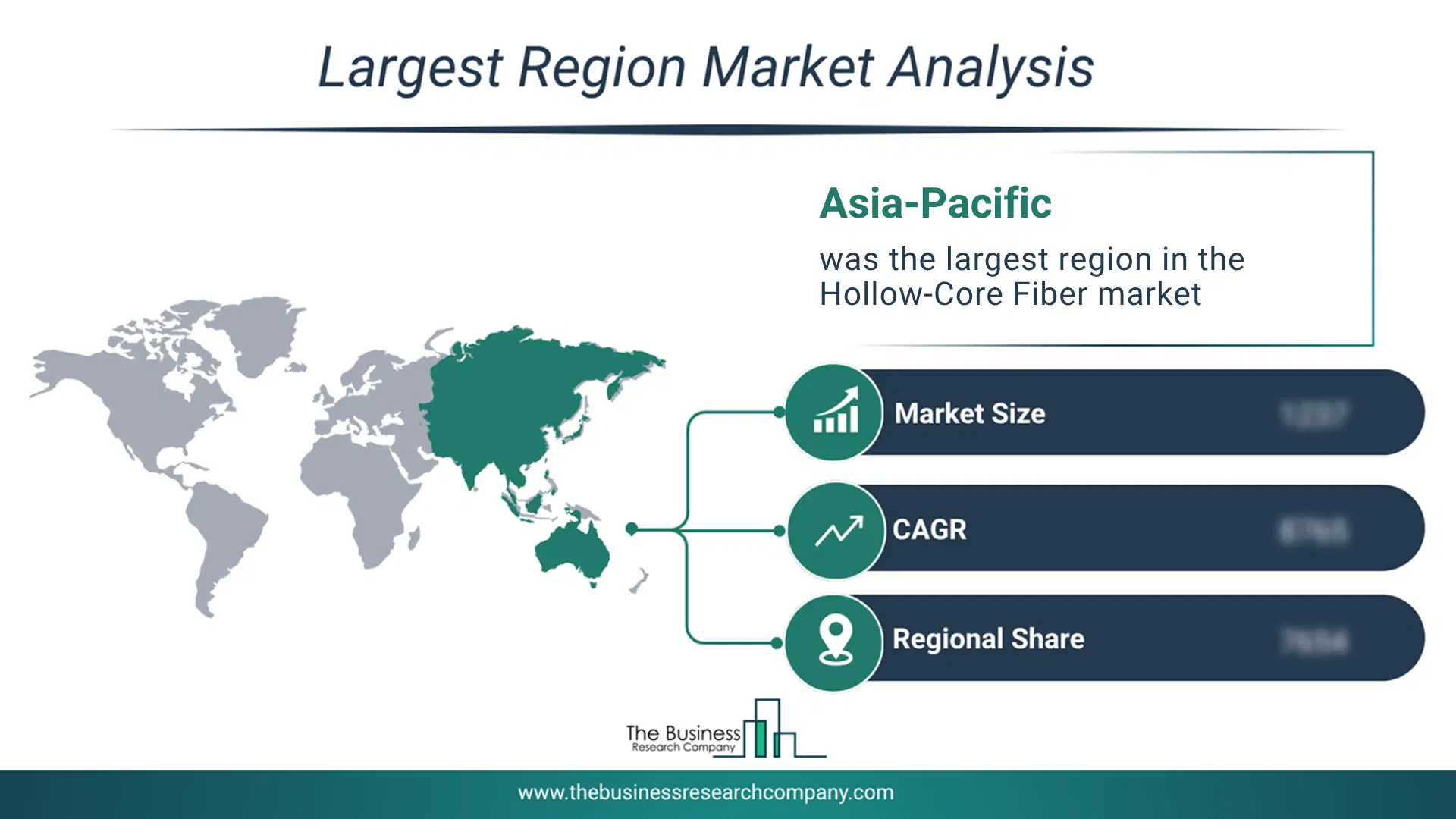
Regional Insights
Asia-Pacific was the largest region in the hollow-core fiber market in 2025, and it is expected to be the fastest-growing region in the forecast period. The regions covered in this market report are Asia-Pacific, South East Asia, Western Europe, Eastern Europe, North America, South America, Middle East, Africa. The countries covered in this market report are Australia, Brazil, China, France, Germany, India, Indonesia, Japan, Taiwan, Russia, South Korea, UK, USA, Canada, Italy, Spain.What Defines the Hollow-Core Fiber Market?
The hollow-core fiber market consists of sales of kagome fibers, chalcogenide glass hollow-core fibers, and fused silica hollow-core fibers. Values in this market are ‘factory gate’ values, that is the value of goods sold by the manufacturers or creators of the goods, whether to other entities (including downstream manufacturers, wholesalers, distributors and retailers) or directly to end customers. The value of goods in this market includes related services sold by the creators of the goods.How is Market Value Defined and Measured?
The market value is defined as the revenues that enterprises gain from the sale of goods and/or services within the specified market and geography through sales, grants, or donations in terms of the currency (in USD unless otherwise specified). The revenues for a specified geography are consumption values that are revenues generated by organizations in the specified geography within the market, irrespective of where they are produced. It does not include revenues from resales along the supply chain, either further along the supply chain or as part of other products.
This chart presents market attractiveness based on a quantitative evaluation of growth, competition, strategic alignment, and risk, offering a clear view of opportunity areas for decision-making. This chart is for illustrative purposes; the full report contains the complete analysis.

This chart highlights the Total Addressable Market (TAM) by estimating the maximum revenue opportunity using an assumption-driven approach, supporting strategic planning and opportunity sizing across markets. The chart is illustrative; the full report provides a more comprehensive analysis.
What Key Data and Analysis Are Included in the Hollow-Core Fiber Market Report 2026?
The hollow-core fiber market research report is one of a series of new reports from The Business Research Company that provides market statistics, including industry global market size, regional shares, competitors with the market share, detailed market segments, market trends and opportunities, and any further data you may need to thrive in the hollow-core fiber industry. The market research report delivers a complete perspective of everything you need, with an in-depth analysis of the current and future state of the industry.Hollow-Core Fiber Market Report Forecast Analysis
| Report Attribute | Details |
|---|---|
| Market Size Value In 2026 | $1.43 billion |
| Revenue Forecast In 2030 | $2.6 billion |
| Growth Rate | CAGR of 16.1% from 2026 to 2030 |
| Base Year For Estimation | 2025 |
| Actual Estimates/Historical Data | 2020-2025 |
| Forecast Period | 2026 - 2030 |
| Market Representation | Revenue in USD Billion and CAGR from 2026 to 2030 |
| Segments Covered | Type Of Fiber, Material, Manufacturing Process, End-User |
| Regional Scope | Asia-Pacific, Western Europe, Eastern Europe, North America, South America, Middle East, Africa |
| Country Scope | The Countries Covered In This Market Report Are Australia, Brazil, China, France, Germany, India, Indonesia, Japan, Taiwan, Russia, South Korea, Uk, Usa, Canada, Italy, Spain. |
| Key Companies Profiled | Microsoft Corporation, Hamamatsu Photonics K.K., Heraeus Covantics GmbH, Prysmian Group, Furukawa Electric Co. Ltd., Hengtong Group Co. Ltd., HUBER+SUHNER AG, Thorlabs Inc., Relativity Networks Inc., YSL Photonics Co. Ltd., Lingxian Technology, GLOphotonics SAS, Guiding Photonics Inc., Yangtze Optical Electronic Co. Ltd. (YOEC), Photonics Bretagne, NKT Photonics A/S, art photonics GmbH, Few-cycle Inc., Linfiber Technology (Nantong) Co. Ltd., IRflex Corporation. |
| Customization Scope | Request for Customization |
| Pricing And Purchase Options | Explore Purchase Options |