

Home Bedding Market Report 2026
Global Outlook – By Type (Mattress, Bed Linen, Pillows, Blankets), By Distribution (Offline, Online), By Application (Personal, Hotel, Other Applications) – Market Size, Trends, Strategies, and Forecast to 2030
Home Bedding Market Overview
• Home Bedding market size has reached to $100.34 billion in 2025 • Expected to grow to $163.31 billion in 2030 at a compound annual growth rate (CAGR) of 10.2% • Growth Driver: The Surging Demand In The Hospitality Sector Drives Expansion Of The Home Bedding Market • Market Trend: Innovative Customizable Bedding Solutions Transforming the Home Bedding Market • Asia-Pacific was the largest region and fastest growing region.Market Gains By 2030 – Top Opportunities By Segment
Market Gain identifies the most promising market opportunities by highlighting the segments or products expected to generate the highest incremental revenue growth over the next five years.
What Is Covered Under Home Bedding Market?
Home bedding refers to a flat or fitted bed sheet that covers the mattress and is typically included with a bedding set to provide aesthetic appeal and comfort for people living in homes. Home beddings are washable materials that are placed above the bed for comfort, beauty, warmth, and hygiene. Home beddings are also known as bedclothes or bed linen. The main types of home bedding are mattress, bed linen, pillows, blankets, and others. The mattress is a big cushion for supporting the reclining body, used as or on a bed, and comprised of a quilted or similarly secured case, usually of thick cloth, stuffed with cotton, foam rubber, and other materials. The various applications of home bedding are personal, hotel, and others. Home bedding products are mainly distributed through online and offline channels.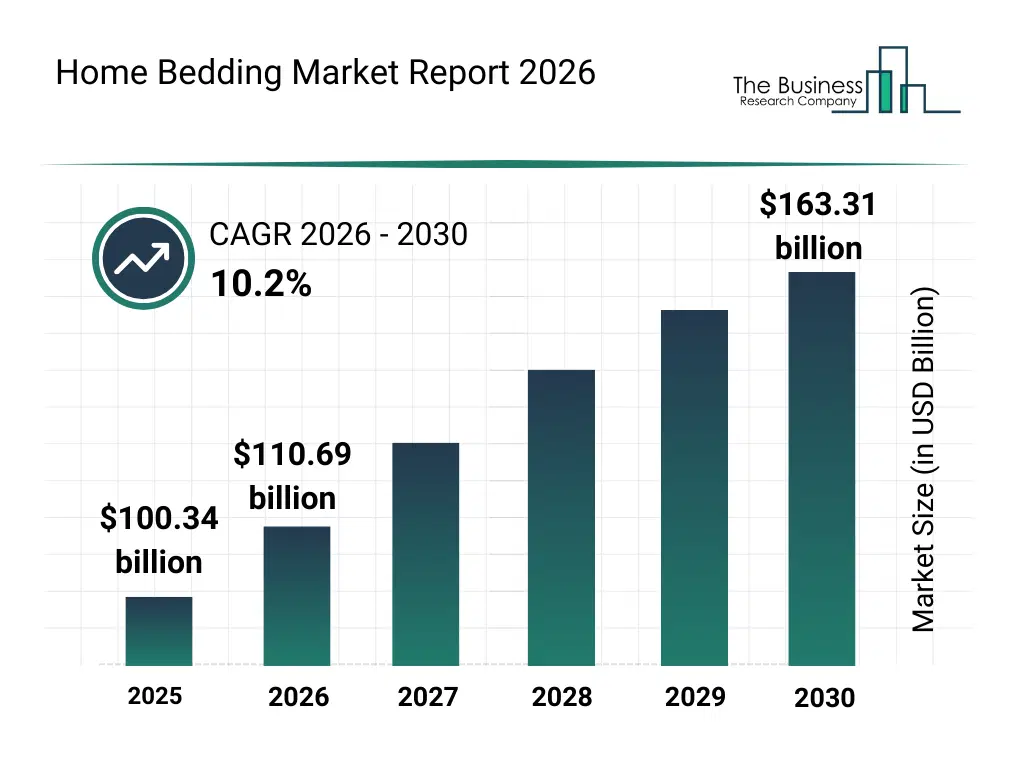
What Is The Home Bedding Market Size and Share 2026?
The home bedding market size has grown rapidly in recent years. It will grow from $100.34 billion in 2025 to $110.69 billion in 2026 at a compound annual growth rate (CAGR) of 10.3%. The growth in the historic period can be attributed to rising urban household formation, increasing disposable income levels, expansion of organized home textile retail, growing hotel and hospitality demand, wider availability of machine-washable bedding products.What Is The Home Bedding Market Growth Forecast?
The home bedding market size is expected to see rapid growth in the next few years. It will grow to $163.31 billion in 2030 at a compound annual growth rate (CAGR) of 10.2%. The growth in the forecast period can be attributed to increasing consumer focus on sleep quality, rising demand for eco-friendly home textiles, growth of direct-to-consumer bedding brands, expansion of online home furnishing platforms, increasing premiumization of home bedding products. Major trends in the forecast period include increasing demand for sustainable and organic bedding materials, rising preference for premium and designer bed linen, growing adoption of online bedding purchases, expansion of customizable bedding options, enhanced focus on sleep comfort and wellness.
Global Home Bedding Market Segmentation
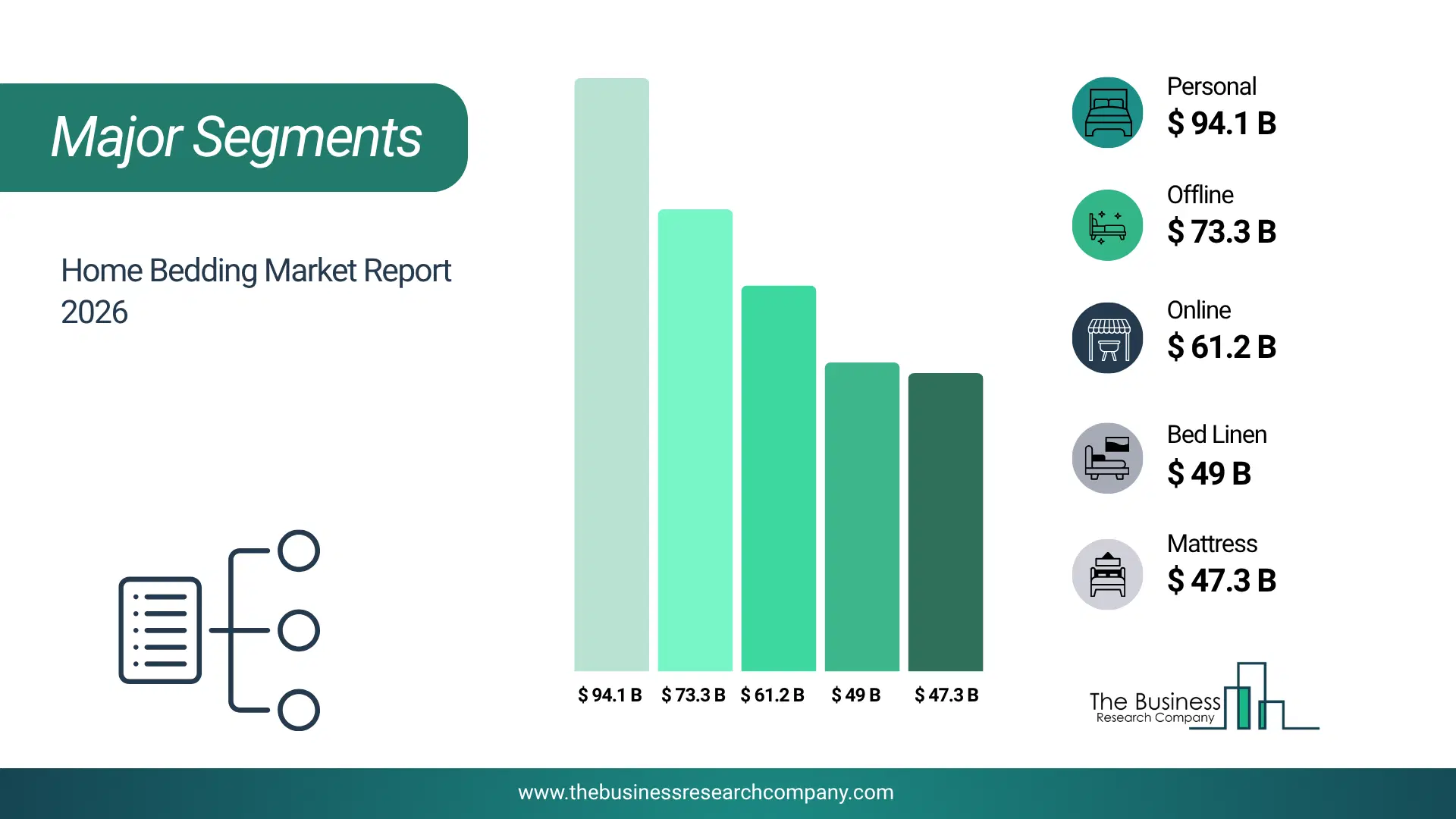
1) By Type: Mattress, Bed Linen, Pillows, Blankets 2) By Distribution: Offline, Online 3) By Application: Personal, Hotel, Other Applications Subsegments: 1) By Mattress: Innerspring Mattresses, Memory Foam Mattresses, Latex Mattresses, Hybrid Mattresses, Adjustable Mattresses 2) By Bed Linen: Bed Sheets (Fitted And Flat), Duvet Covers, Bed Skirts, Mattress Protectors 3) By Pillows: Standard Pillows, Memory Foam Pillows, Down Or Feather Pillows, Synthetic Pillows, Specialty Pillows 4) By Blankets: Comforters, Duvets, Quilts, Throws, Weighted Blankets The top segments in the home bedding market will be: • Personal will reach $94123.27 Million by 2030. • Offline will reach $73309.19 Million by 2030. • Bed Linen will reach $48993.26 Million by 2030. • Online will reach $61267.72 Million by 2030. • Mattress will reach $47292.21 Million by 2030.What Is The Driver Of The Home Bedding Market?
The growing demand in the hospitality industry is expected to propel the growth of the home bedding market going forward. The hospitality industry refers to the sector of the economy focused on providing services to people like food, lodging, and other types of assistance. Home bedding is used in the hospitality industry to provide the overall comfort of guests during their stay with soft, clean, and well-maintained bedding, such as sheets, pillowcases, duvets, and pillows. For instance, in February 2023, according to the National Restaurant Association, a US-based restaurant industry business association, there were $997 billion in industry sales and 15.5 million in industry employment in 2023. Therefore, the expansion of the hospitality industry is driving the growth of the home bedding industry.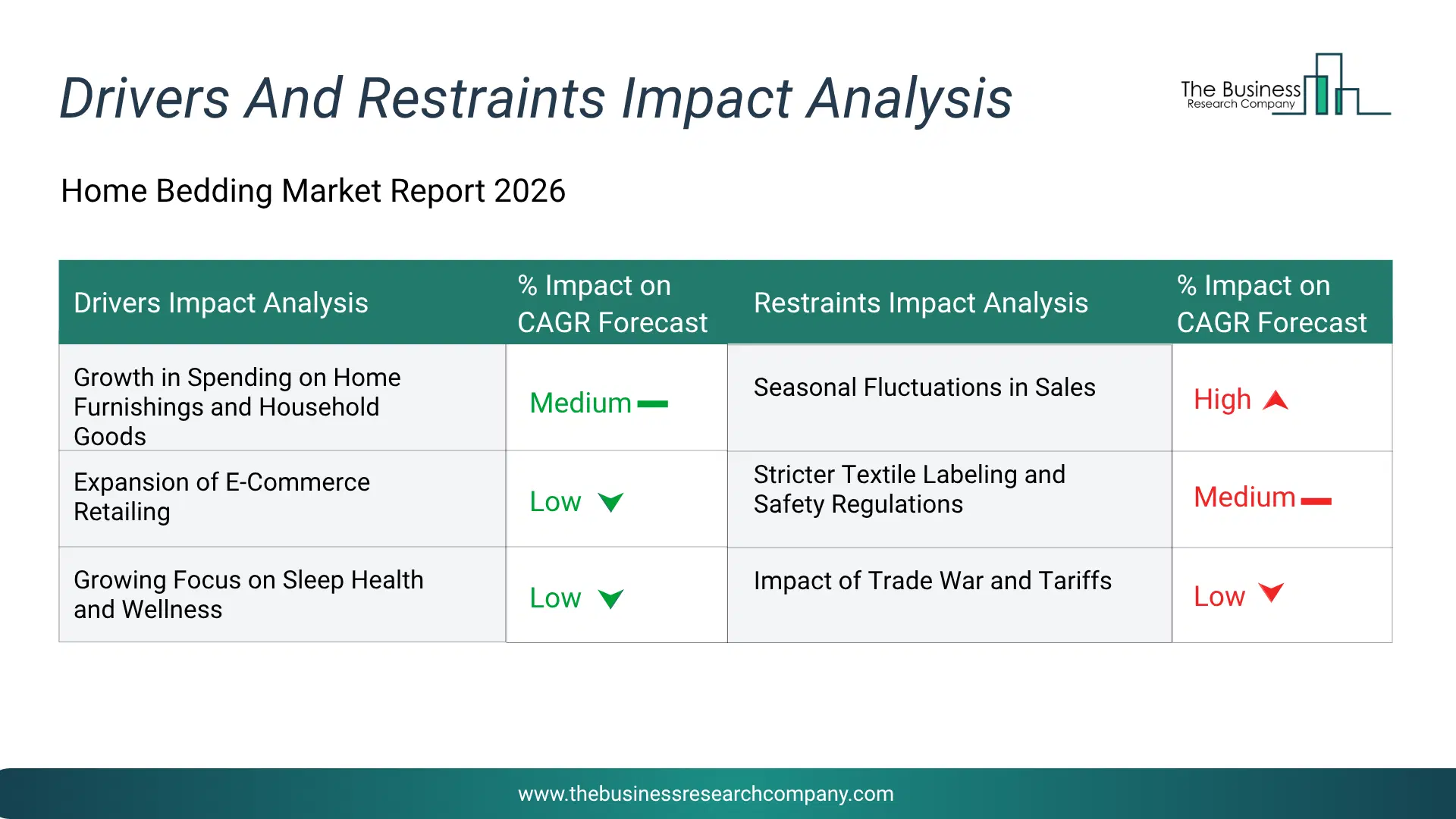
Infographic Chart Showing Key Market Drivers Analysis And Restraints For Home Bedding Market
The chart presents an impact analysis of key drivers and restraints, quantifying their relative influence on the market's growth rate and helping assess the balance between growth enablers and limiting factors. This chart offers a high-level perspective; the full report contains more detailed insights.
How Will The Drivers Impact Growth In The Global Home Bedding Market?
• Growth in Spending on Home Furnishings and Household Goods (Medium) – During the forecast period, the growth in spending on home furnishings and household goods will become a key driver of growth in the home bedding market by 2030. rising household expenditure on items such as mattresses, bed linens, pillows, quilts and decorative bedding enhances overall demand as consumers increasingly prioritize home comfort, interior aesthetics and functional upgrades. higher spending levels also reflect stronger discretionary income and shifting lifestyle preferences toward improved sleep environments and home enhancement. moreover, increased investment in furnishing and home-related goods supports frequent replacement cycles and encourages consumers to purchase premium or multi-functional bedding products. as households continue to allocate a larger portion of their budgets toward home improvement and comfort-driven purchases, the demand for high-quality bedding products is expected to increase, thereby driving the growth of the home bedding market. as a result, the growth in spending on home furnishings and household goods growth is anticipated to contributing to a 1.3% annual growth in the market. • Expansion of E-Commerce Retailing (Low) – During the forecast period, the expansion of e-commerce retailing will emerge as a major factor driving the expansion of the home bedding market by 2030. as more consumers shift toward online shopping for convenience, variety and competitive pricing, demand is increasing for mattresses, bed linens, pillows and other bedding products sold via digital storefronts and marketplaces. e-commerce platforms enable buyers to browse a wide range of bedding options, compare reviews and order products that are delivered directly to their doorstep, making purchases easier and more accessible than traditional brick-and-mortar retail. moreover, the growth of online retail lowers barriers for emerging bedding brands to reach consumers globally, supports frequent product launches and seasonal promotions and enhances market reach beyond local geographies. consequently, the expansion of e-commerce retailing growth is projected to contributing to a 1.0% annual growth in the market. • Growing Focus on Sleep Health and Wellness (Low) – During the forecast period, the growing focus on sleep health and wellness efforts as a major factor driving the expansion of the home bedding market by 2030. increasing awareness of sleep quality, sleep disorders and the importance of restorative rest is driving consumers to invest in higher-quality mattresses, pillows, bedding and sleep accessories that promote better sleep hygiene and comfort. as more people prioritize wellness and holistic health, demand will rise for bedding designed to optimize sleep, including ergonomic mattresses, supportive pillows, breathable sheets and bedding tailored to improve rest quality. moreover, this shift toward sleep-focused living encourages repeated replacements and upgrades, as consumers seek to refine their sleep environment for optimal health benefits. consequently, growing focus on sleep health and wellness growth is projected to contributing to a 0.8% annual growth in the market. • Increasing Awareness of Ergonomic and Orthopedic Bedding (Low) – During the forecast period, increasing awareness of ergonomic and orthopedic bedding will propel the growth of the home bedding market. As consumers become more conscious of posture, spinal alignment and long-term musculoskeletal health, demand is rising for mattresses, pillows and bedding accessories specifically designed to provide targeted support and pressure relief. Ergonomic and orthopedic bedding solutions help address issues such as back pain, joint discomfort and poor sleep posture, making them increasingly attractive to health-focused buyers. Moreover, growing adoption of wellness-oriented lifestyles encourages consumers to invest in higher-quality bedding products that improve sleep comfort and prevent physical strain, contributing to more frequent upgrades and a shift toward premium product categories. The increasing awareness of ergonomic and orthopedic bedding growth contribution during the forecast period in 2025 is 0.5%.How Will The Restraints Impact Growth In The Global Home Bedding Market?
• Seasonal Fluctuations in Sales (Medium) – During the forecast period, seasonal fluctuations in online holiday spending are expected to restrict the growth of the home bedding market during the forecast period. online sales tend to spike sharply during holiday seasons, such as the thanksgiving–cyber monday period in the us and then drop off significantly during off-season months, creating unstable demand cycles for bedding manufacturers and retailers. this volatility means inventory planning, production scheduling and demand forecasting become more challenging and companies may face overstock or under-stock situations outside peak periods. from a market-dynamics standpoint, these swings increase operational risks, constrain steady revenue growth and force producers to rely heavily on promotional periods rather than stable year-round demand. as a result, many bedding brands may underinvest in design innovation or expansion, or compress their product launch timelines to align with peak shopping periods, which could hamper consistent market growth and long-term stability. growth affected by seasonal fluctuations in sales during the forecast period in 2025 is -2.2%. • Stricter Textile Labeling and Safety Regulations (Low) – During the forecast period, stricter textile labeling and safety regulations are restricting the growth of the home bedding market during the forecast period. these regulations require more detailed disclosure of fabric composition, chemical treatments and potential hazards, increasing compliance costs for manufacturers and slowing down product development cycles. they also limit the use of certain chemicals, such as pfas used for stain-, water- and oil-resistant finishes, which traditionally helped enhance the performance of bedding products. from a regulatory standpoint, these measures aim to improve consumer safety and align with growing environmental and health concerns related to textile chemicals. as a result, many bedding manufacturers are reformulating products, discontinuing treated fabrics, or shifting to alternative materials that may be more expensive or less efficient, particularly in categories such as stain-resistant sheets, water-repellent mattress protectors and performance bedding. this shift is gradually reducing the availability of chemically treated bedding products, particularly in markets where safety compliance, ingredient transparency and eco-conscious materials are major purchasing factors. growth affected by stricter textile labeling and safety regulations during the forecast period in 2025 is -2.0%. • Impact of Trade War and Tariffs (Low) – During the forecast period, stricter trade tariffs on bedding imports are restricting the growth of the home bedding market during the forecast period. bedding components and finished products such as down pillows, featherbed shells, cotton pillow-casings and silk or knit-fabric bedding that were previously imported under tariff exemptions are now facing substantial import duty increases, which raises costs for manufacturers and importers. these tariff changes increase production and sourcing costs, reduce the price competitiveness of imported bedding products and limit the availability of lower-cost bedding lines for consumers. as a result, many bedding retailers and brands are expected to reduce their reliance on imported bedding components, postpone product launches, or pass on cost increases to consumers, particularly in markets where affordability, variety and import-based supply are major purchasing factors. growth affected by trade war and tariffs across regions during the forecast period in 2025 is -0.2%.Key Players In The Global Home Bedding Market
Major companies operating in the home bedding market are Ashley Sleep, Birch Lane LLC, Frette North America Inc., Serta Simmons Bedding LLC, WestPoint Home LLC, Celine Linen Inc., Casper Sleep Inc., The Bombay Dyeing & Mfg. Co. Ltd., Pacific Coast Feather Company, American Textile Company, D'Décor Home Fabrics Pvt. Ltd., Downlite LLC, Boll & Branch LLC, Hollander Sleep Products LLC, Avocado Green Brands LLC, Amerisleep LLC, Peacock Alley Inc., DreamCloud Holdings LLC, Beautyrest, Cuddledown Inc., SFERRA Fine Linens LLC, Beaumont & Brown Limited, Sampedro Group, Portico New York Inc., Bellino Fine Linens Inc., Allswell Home LLC, Bedsure Designs Inc., Benjamin Franklin Mattress Company, Crane & Canopy Inc., Buffy Inc.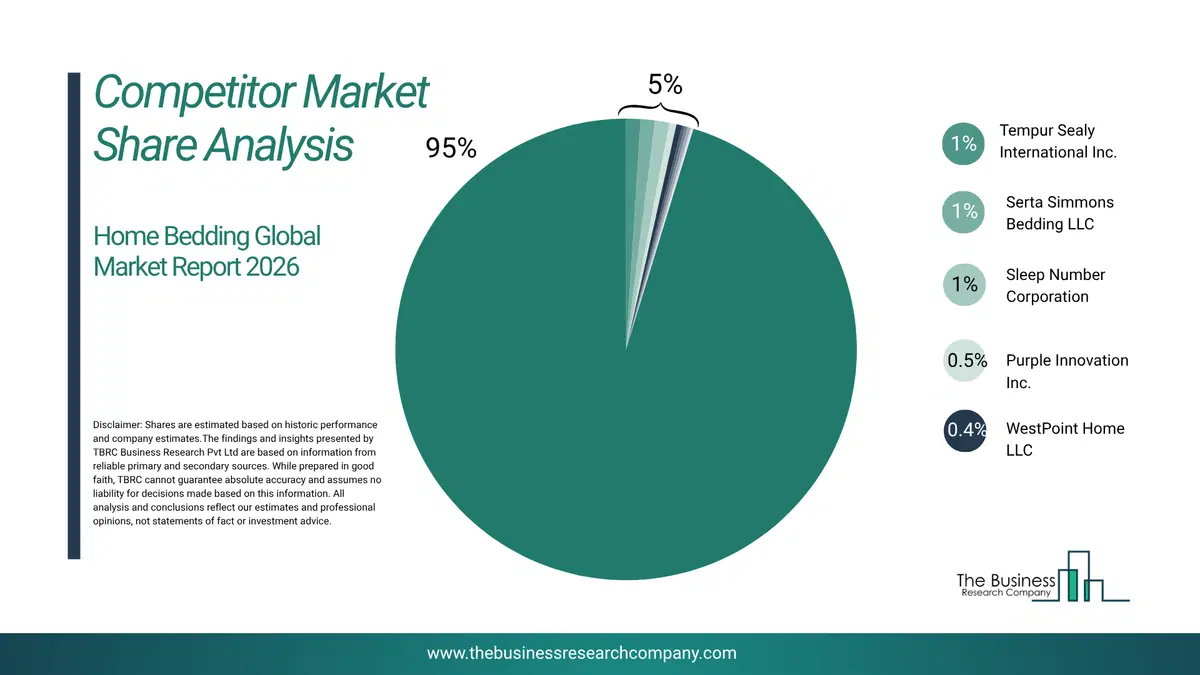
This chart is for illustrative purposes; the full report includes a detailed competitor analysis and comprehensive overview of the top 10 companies in the market.
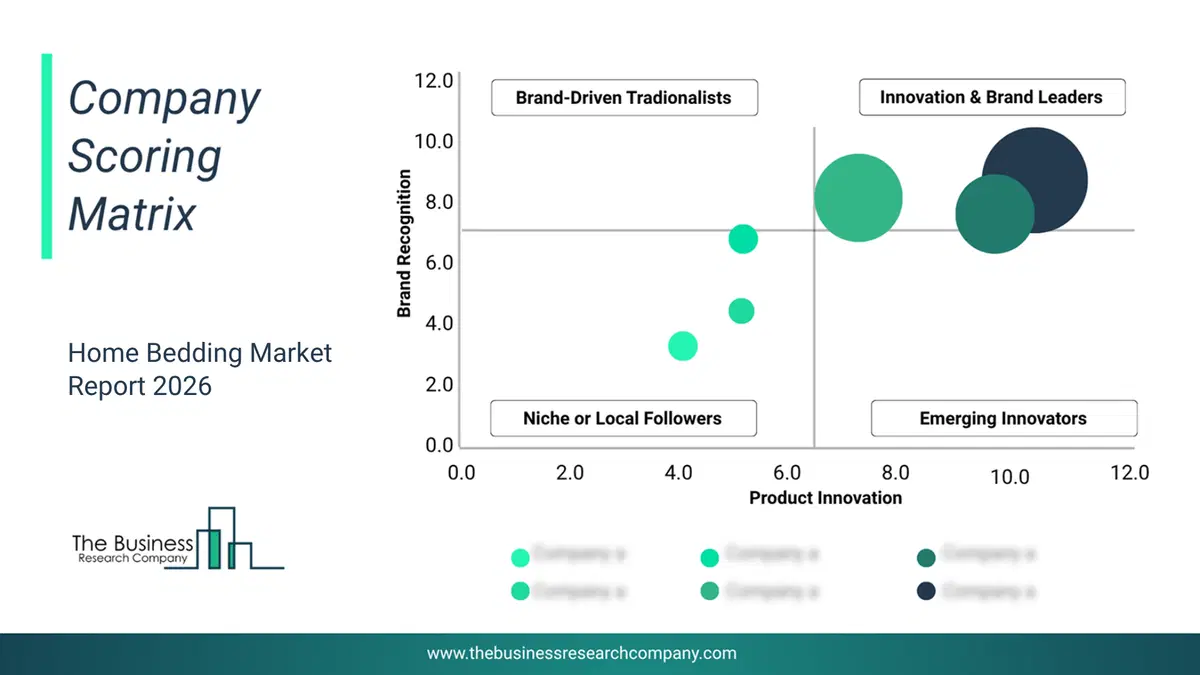
This chart maps companies by product innovation and brand strength, with bubble size indicating relative revenue, helping identify market leaders, challengers, and niche players. This is an illustrative chart; the full report provides a complete and accurate competitive analysis.
Global Home Bedding Market Trends and Insights
Major companies operating in the home bedding sector are focused on developing customizable mattresses and bed linens to strengthen their position. Customizable mattresses and bed linens refer to bedding products that can be tailored to meet individual preferences and needs. For instance, in August 2023, Bedsure, a US-based home goods manufacturer, launched the Breescape Cooling Series, designed to enhance sleep quality with innovative cooling technology. This revolutionary series features breathable materials that actively wick away moisture and regulate temperature, ensuring a comfortable sleep environment. The Breescape Cooling Series includes various bedding products such as sheets, duvet covers, and comforters, all engineered to provide optimal cooling and comfort for a restful night’s sleep. This launch emphasizes Bedsure's commitment to enhancing the sleep experience through advanced fabric technology. Therefore, the introduction of innovative products like the Breescape Cooling Series is likely to drive significant growth in the home bedding market.What Are Latest Mergers And Acquisitions In The Home Bedding Market?
In March 2024, Ashley Furniture, a US-based furniture manufacturing company, acquired Resident for an undisclosed amount. This strategic deal is expected to enhance Ashley's product offerings and expand its presence in the competitive home decor sector. The acquisition marks a pivotal moment for Ashley as it seeks to capitalize on the growing demand for innovative and stylish furniture solutions. Resident is a US-based manufacturer of household products intended to specialize in the home goods space.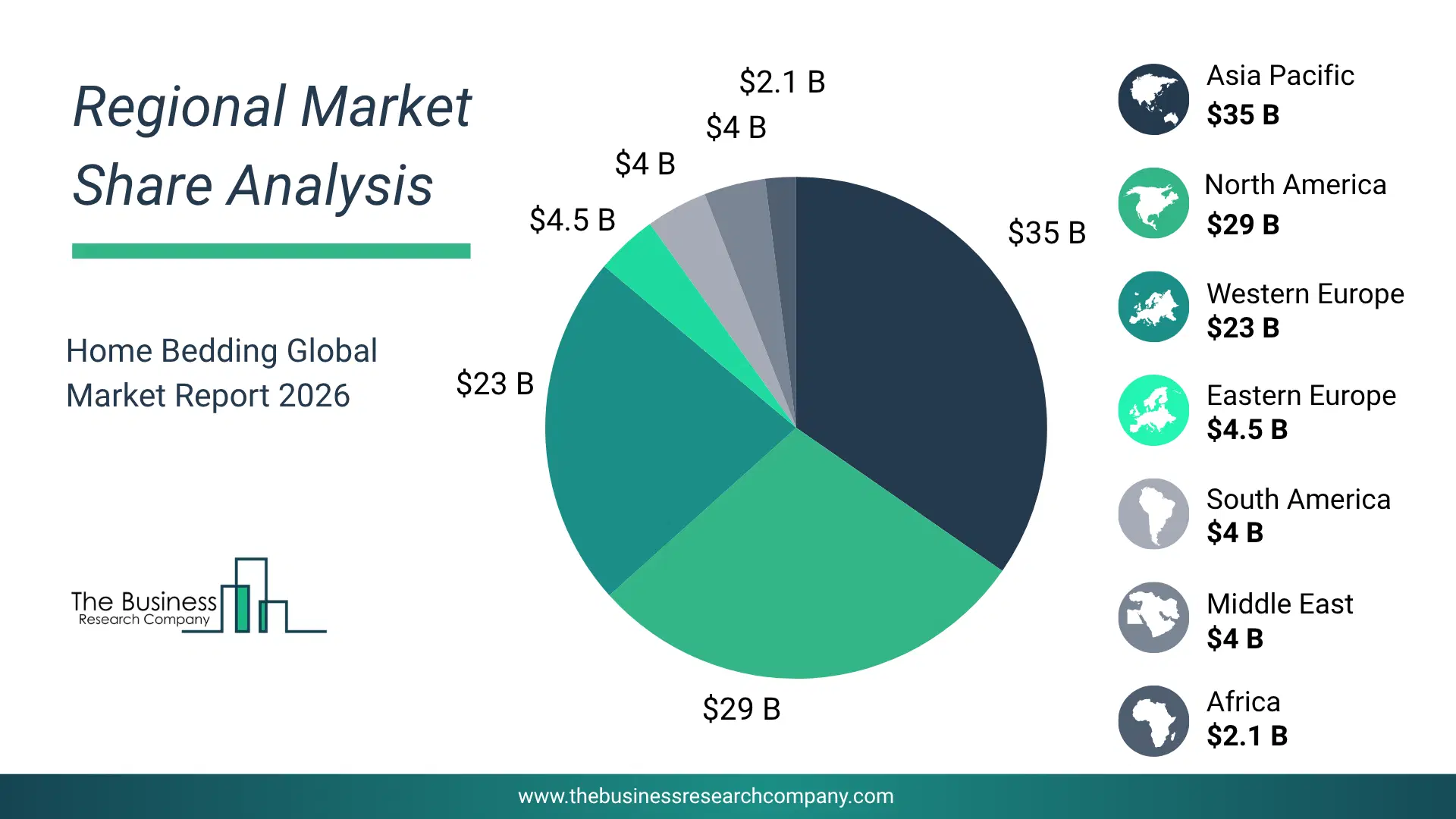
Regional Outlook
Asia-Pacific was the largest region in the home bedding market in 2025. Asia-Pacific is also expected to be the fastest-growing region in the forecast period. The regions covered in this market report are Asia-Pacific, South East Asia, Western Europe, Eastern Europe, North America, South America, Middle East, Africa. The countries covered in this market report are Australia, Brazil, China, France, Germany, India, Indonesia, Japan, Taiwan, Russia, South Korea, UK, USA, Canada, Italy, Spain.What Defines the Home Bedding Market?
The home bedding market consists of sales of rugs, sheets, duvets, quilts, and comforters, including fitted sheets, flat sheets, pillowcases, comforters, shams, quilts, and bed skirts. Values in this market are ‘factory gate’ values, that is the value of goods sold by the manufacturers or creators of the goods, whether to other entities (including downstream manufacturers, wholesalers, distributors and retailers) or directly to end customers. The value of goods in this market includes related services sold by the creators of the goods.How is Market Value Defined and Measured?
The market value is defined as the revenues that enterprises gain from the sale of goods and/or services within the specified market and geography through sales, grants, or donations in terms of the currency (in USD unless otherwise specified). The revenues for a specified geography are consumption values that are revenues generated by organizations in the specified geography within the market, irrespective of where they are produced. It does not include revenues from resales along the supply chain, either further along the supply chain or as part of other products.
This chart presents market attractiveness based on a quantitative evaluation of growth, competition, strategic alignment, and risk, offering a clear view of opportunity areas for decision-making. This chart is for illustrative purposes; the full report contains the complete analysis.

This chart highlights the Total Addressable Market (TAM) by estimating the maximum revenue opportunity using an assumption-driven approach, supporting strategic planning and opportunity sizing across markets. The chart is illustrative; the full report provides a more comprehensive analysis.
What Key Data and Analysis Are Included in the Home Bedding Market Report 2026?
The home bedding market research report is one of a series of new reports from The Business Research Company that provides market statistics, including Market Report 2026?global market size, regional shares, competitors with the market share, detailed market segments, market trends and opportunities, and any further data you may need to thrive in the home bedding Market Report 2026? The market research report delivers a complete perspective of everything you need, with an in-depth analysis of the current and future state of the Market Report 2026?Home Bedding Market Report Forecast Analysis
| Report Attribute | Details |
|---|---|
| Market Size Value In 2026 | $110.69 billion |
| Revenue Forecast In 2030 | $163.31 billion |
| Growth Rate | CAGR of 10.3% from 2026 to 2030 |
| Base Year For Estimation | 2025 |
| Actual Estimates/Historical Data | 2020-2025 |
| Forecast Period | 2026 - 2030 - 2035 |
| Market Representation | Revenue in USD Billion and CAGR from 2026 to 2030 |
| Segments Covered | Type, Distribution, Application |
| Regional Scope | Asia-Pacific, Western Europe, Eastern Europe, North America, South America, Middle East, Africa |
| Country Scope | The countries covered in the report are Australia, Brazil, China, France, Germany, India, Indonesia, Japan, Taiwan, Russia, South Korea, UK, USA, Canada, Italy, Spain. |
| Key Companies Profiled | Ashley Sleep, Birch Lane LLC, Frette North America Inc., Serta Simmons Bedding LLC, WestPoint Home LLC, Celine Linen Inc., Casper Sleep Inc., The Bombay Dyeing & Mfg. Co. Ltd., Pacific Coast Feather Company, American Textile Company, D'Décor Home Fabrics Pvt. Ltd., Downlite LLC, Boll & Branch LLC, Hollander Sleep Products LLC, Avocado Green Brands LLC, Amerisleep LLC, Peacock Alley Inc., DreamCloud Holdings LLC, Beautyrest, Cuddledown Inc., SFERRA Fine Linens LLC, Beaumont & Brown Limited, Sampedro Group, Portico New York Inc., Bellino Fine Linens Inc., Allswell Home LLC, Bedsure Designs Inc., Benjamin Franklin Mattress Company, Crane & Canopy Inc., Buffy Inc. |
| Customization Scope | Request for Customization |
| Pricing And Purchase Options | Explore Purchase Options |