
Home Infusion Therapy Devices Market Report 2026
Global Outlook – By Device Type (Infusion Pumps, Intravenous Sets, Needles And Cannulas, Syringe Pumps, Infusion Accessories), By Therapeutic Area (Oncology, Infectious Diseases, Diabetes, Other Therapeutic Areas), By Route Of Administration (Intravenous Infusion, Subcutaneous Infusion, Epidural Infusion, Other Routes Of Administration), By Distribution Channel (Online Distribution, Pharmacies, Healthcare Institutions, Direct Sales), By End User (Patients, Healthcare Providers, Home Healthcare Agencies, Pharmaceutical Companies) – Market Size, Trends, Strategies, and Forecast to 2030
Home Infusion Therapy Devices Market Overview
• Home Infusion Therapy Devices market size has reached to $10.86 billion in 2025 • Expected to grow to $17.83 billion in 2030 at a compound annual growth rate (CAGR) of 10.3% • Growth Driver: Expansion Of Telehealth And Remote Patient Monitoring Driving The Market Growth Due To Increasing Demand For Home-Based Healthcare Solutions • Market Trend: Innovation In Connected Ambulatory Infusion Platforms Strengthens Remote Patient Monitoring • Asia-Pacific was the largest region and fastest growing region.What Is Covered Under Home Infusion Therapy Devices Market?
Home infusion therapy devices refer to medical devices designed to administer fluids, medications, nutrients, and other therapeutic solutions directly into a patient's body in a home-based setting. These devices are engineered to deliver controlled, accurate, and safe therapy, enabling long-term treatment outside of hospitals while improving patient convenience, treatment continuity, and healthcare efficiency. The main device types of home infusion therapy devices include infusion pumps, intravenous sets, needles and cannulas, syringe pumps, and infusion accessories. Infusion pumps refer to medical devices that deliver fluids, medications, nutrients, or other therapeutic substances into the body at controlled rates during home-based treatment. These devices are used across therapeutic areas including oncology, infectious diseases, diabetes, and other therapeutic areas, and support intravenous infusion, subcutaneous infusion, epidural infusion, and other routes of administration. They are distributed through online distribution, pharmacies, healthcare institutions, and direct sales, and are used by end users including patients, healthcare providers, home healthcare agencies, and pharmaceutical companies.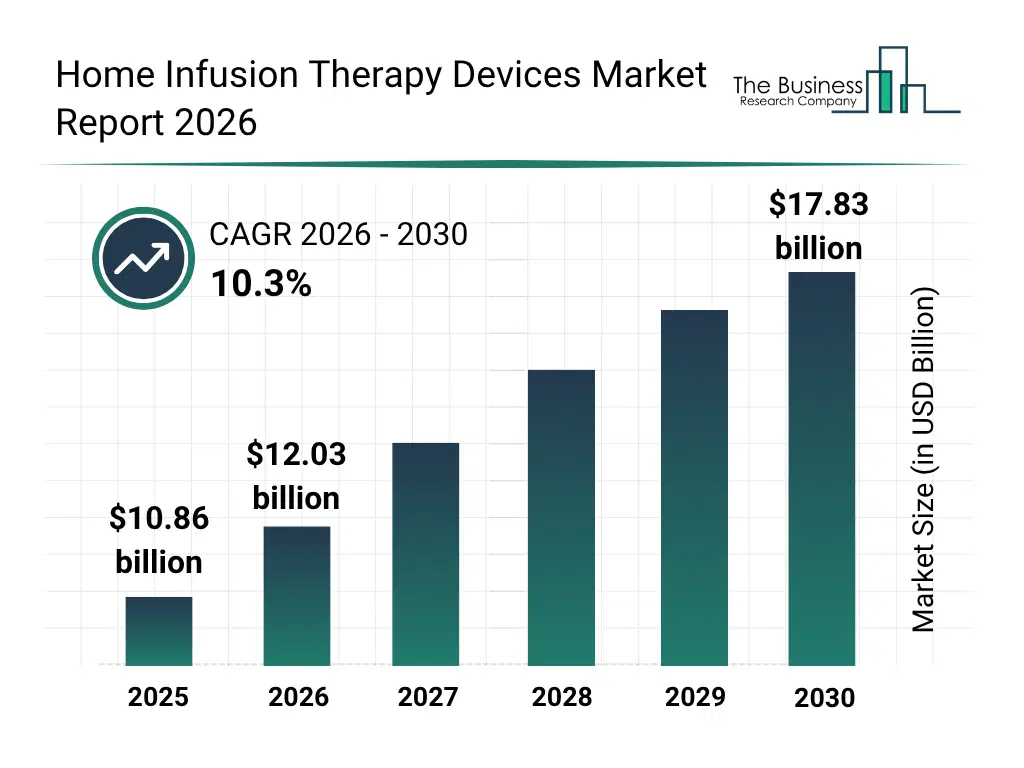
What Is The Home Infusion Therapy Devices Market Size and Share 2026?
The home infusion therapy devices market size has grown rapidly in recent years. It will grow from $10.86 billion in 2025 to $12.03 billion in 2026 at a compound annual growth rate (CAGR) of 10.8%. The growth in the historic period can be attributed to rising prevalence of chronic diseases, increasing demand for home healthcare, growing geriatric population, rising hospital discharge rates, increasing need for long-term infusion therapies.What Is The Home Infusion Therapy Devices Market Growth Forecast?
The home infusion therapy devices market size is expected to see rapid growth in the next few years. It will grow to $17.83 billion in 2030 at a compound annual growth rate (CAGR) of 10.3%. The growth in the forecast period can be attributed to expansion of home-based healthcare services, increasing adoption of remote patient monitoring, growing demand for personalized drug delivery, rising healthcare expenditure, increasing shift toward decentralized care. Major trends in the forecast period include increasing adoption of portable infusion devices, growing demand for ambulatory infusion pumps, rising preference for disposable infusion devices, increasing demand for home-based intravenous therapy, greater focus on safe and accurate drug delivery.
Global Home Infusion Therapy Devices Market Segmentation
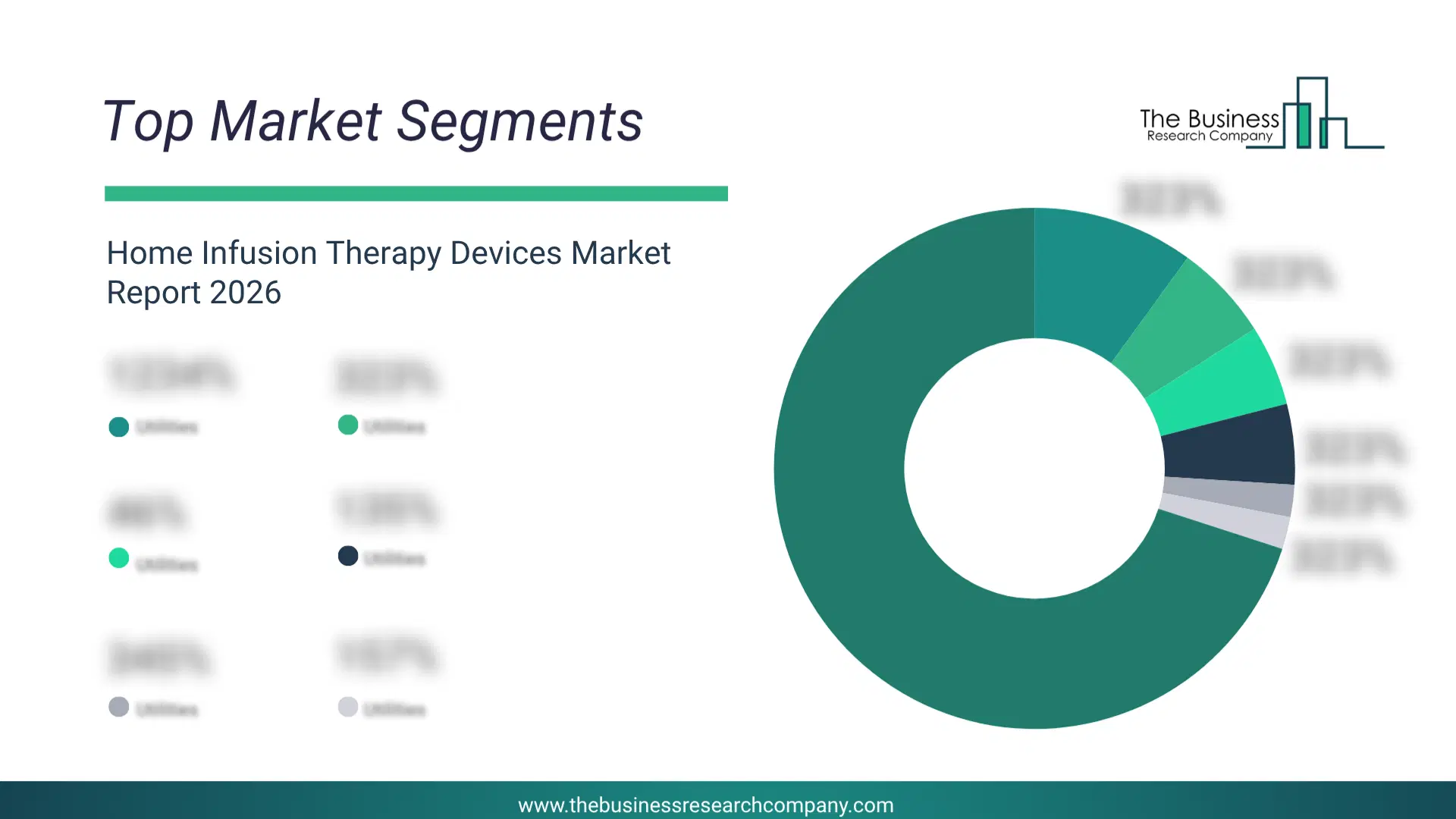
1) By Device Type: Infusion Pumps, Intravenous Sets, Needles And Cannulas, Syringe Pumps, Infusion Accessories 2) By Therapeutic Area: Oncology, Infectious Diseases, Diabetes, Other Therapeutic Areas 3) By Route Of Administration: Intravenous Infusion, Subcutaneous Infusion, Epidural Infusion, Other Routes Of Administration 4) By Distribution Channel: Online Distribution, Pharmacies, Healthcare Institutions, Direct Sales 5) By End User: Patients, Healthcare Providers, Home Healthcare Agencies, Pharmaceutical Companies Subsegments: 1) By Infusion Pumps: Volumetric Infusion Pumps, Elastomeric Infusion Pumps, Ambulatory Infusion Pumps, Patient Controlled Infusion Pumps, Disposable Infusion Pumps 2) By Intravenous Sets: Primary Intravenous Sets, Secondary Intravenous Sets, Blood Administration Sets, Micro Drip Intravenous Sets, Extension Intravenous Sets 3) By Needles And Cannulas: Intravenous Catheters, Butterfly Needles, Safety Needles, Peripheral Cannulas, Central Venous Catheters 4) By Syringe Pumps: Single Channel Syringe Pumps, Multi Channel Syringe Pumps, Portable Syringe Pumps, Programmable Syringe Pumps, Disposable Syringe Pumps 5) By Infusion Accessories: Infusion Tubing, Infusion Connectors, Infusion Filters, Infusion Stands, Infusion Monitoring DevicesWhat Are The Drivers Of The Home Infusion Therapy Devices Market?
The expansion of telehealth and remote patient monitoring is expected to propel the growth of the home infusion therapy devices market going forward. Telehealth and remote patient monitoring refer to the use of digital technologies, connected devices, and virtual healthcare platforms to monitor patients’ health conditions and provide medical care remotely. The adoption of telehealth and remote patient monitoring is rising due to the increasing need for convenient, cost-effective, and patient-centered healthcare solutions that reduce hospital visits and support continuous disease management. Telehealth and remote patient monitoring support the use of home infusion therapy devices by enabling healthcare providers to remotely track infusion progress, monitor patient responses, and provide timely interventions, improving the safety, efficiency, and accessibility of home-based infusion treatments. For instance, in April 2023, according to FAIR Health Inc., a US-based non-profit organization, national telehealth use increased by 7.3%, rising from 5.5% of medical claim lines in December 2022 to 5.9% in January 2023. Therefore, the expansion of telehealth and remote patient monitoring is driving the growth of the home infusion therapy devices industry. The growth of the aging population is expected to propel the growth of the home infusion therapy devices market going forward. The aging population refers to the increasing proportion of elderly individuals within the total population, who often require continuous medical care and management of chronic conditions. The aging population is rising due to increasing life expectancy, as advancements in healthcare and medical treatments have enabled people to live longer, leading to a growing elderly population worldwide. Elderly individuals support the adoption of home infusion therapy devices by increasing the demand for convenient, cost-effective, and patient-friendly treatment options that enable them to receive intravenous therapies, such as antibiotics, nutrition, and medications, in the comfort of their homes. For instance, in November 2025, according to the Organization for Economic Co-operation and Development (OECD), a France-based intergovernmental organization, the share of people aged 65 and over across OECD countries increased to 18.5% in 2023, while the number of individuals aged 65 and above exceeded 252 million in 2023, representing an increase of over 10 million older adults within two years. Therefore, the growth of the aging population is driving the growth of the home infusion therapy devices industry.Key Players In The Global Home Infusion Therapy Devices Market
Major companies operating in the home infusion therapy devices market are Medtronic plc, Becton Dickinson and Company, Baxter International Inc., Cardinal Health Inc., B. Braun SE, Fresenius Kabi AG, Terumo Corporation, ICU Medical Inc., Shenzhen Mindray Bio-Medical Electronics Co. Ltd., Insulet Corporation, Teleflex Incorporated, F. Hoffmann-La Roche Ltd, Nipro Corporation, Moog Inc., Tandem Diabetes Care Inc., Avanos Medical Inc., InfuSystem Holdings Inc., Vygon SAS, Argon Medical Devices Inc., JMS Co. Ltd., Eitan Medical Ltd., SOOIL Development Co. Ltd., Micrel Medical Devices S.A., Ace Medical Co. Ltd.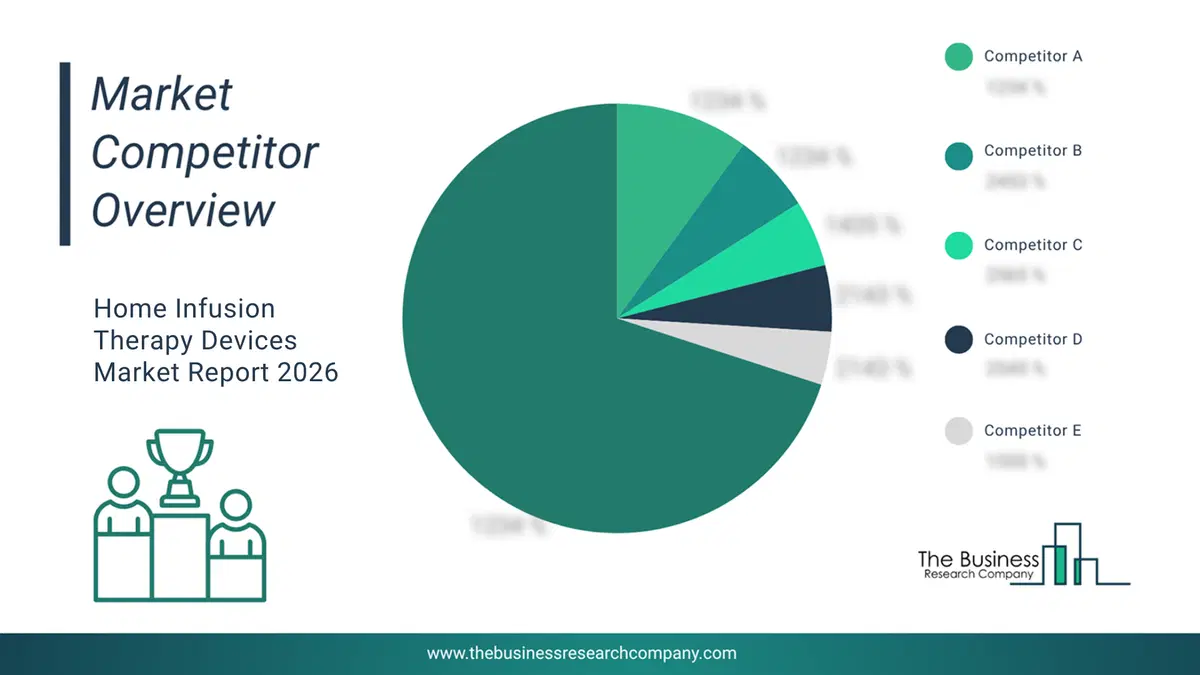
This chart is for illustrative purposes; the full report includes a detailed competitor analysis and comprehensive overview of the top 10 companies in the market.
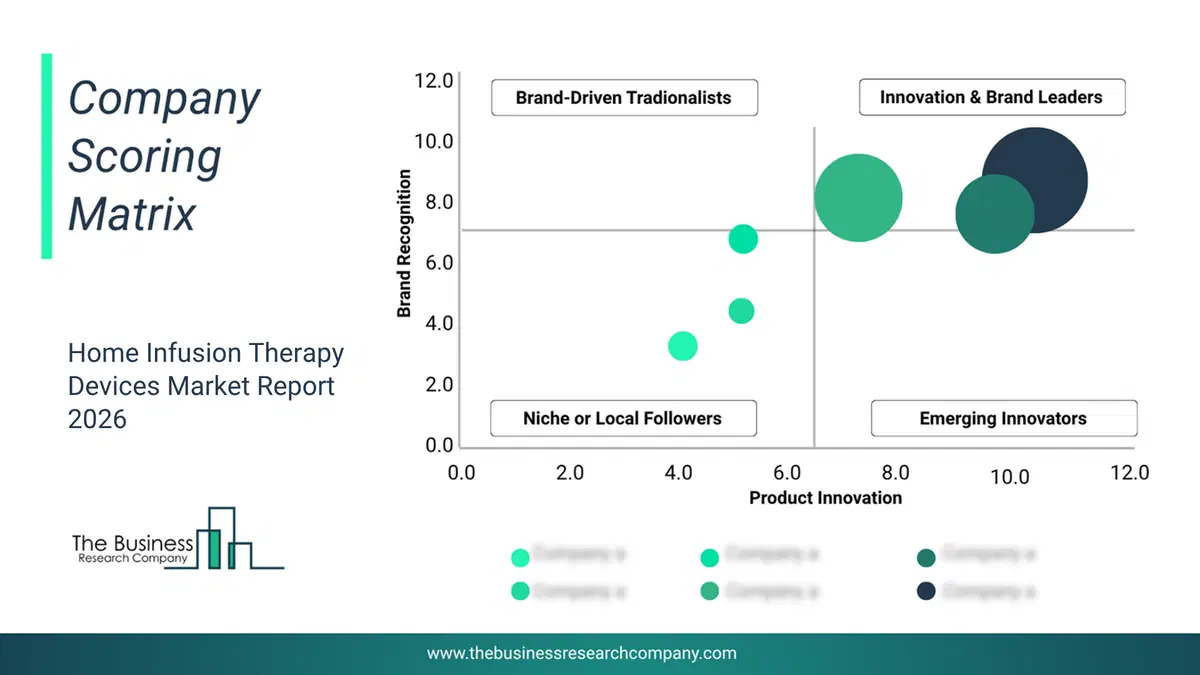
This chart maps companies by product innovation and brand strength, with bubble size indicating relative revenue, helping identify market leaders, challengers, and niche players. This is an illustrative chart; the full report provides a complete and accurate competitive analysis.
Global Home Infusion Therapy Devices Market Trends and Insights
Major companies operating in the home infusion therapy devices market are focusing on developing innovative solutions such as, connected ambulatory infusion platforms to enhance remote patient monitoring, treatment accuracy, patient safety, and home-based care. Connected ambulatory infusion platforms are portable infusion systems that combine programmable drug delivery with wireless connectivity, enabling healthcare providers to remotely monitor infusion therapy, optimize treatment management, and improve patient adherence compared with conventional standalone infusion pumps. For instance, in April 2023, Eitan Medical Ltd., an Israel-based medical device company, launched the Avoset Infusion Platform, an innovative connected multi-therapy ambulatory infusion system designed for post-acute care and specialty infusion therapy. The platform features compact and simplified technology with remote monitoring capabilities that enable clinicians to track infusion treatment data in real time, improving patient safety and user experience. It is designed to support therapies requiring secure medication reservoirs, extended battery life, and low flow rates, while complementing the company's Sapphire infusion portfolio. The MDR-certified system enables patients to receive infusion therapy safely and conveniently at home, supporting the growing transition toward connected, patient-centric home healthcare.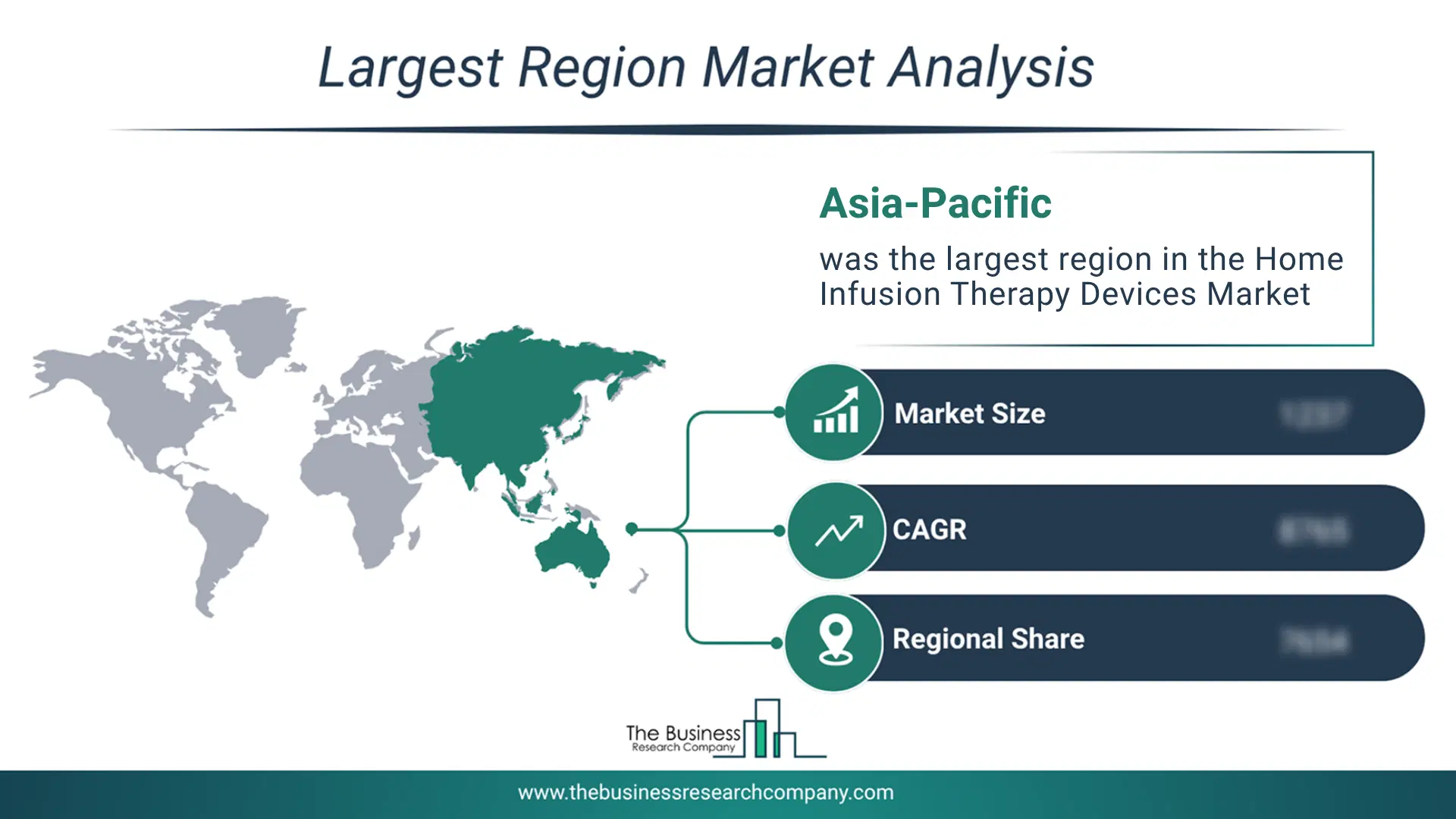
Regional Insights
Asia-Pacific was the largest region in the home infusion therapy devices market in 2025. Asia-Pacific is expected to be the fastest-growing region in the forecast period. The regions covered in this market report are Asia-Pacific, South East Asia, Western Europe, Eastern Europe, North America, South America, Middle East, Africa. The countries covered in this market report are Australia, Brazil, China, France, Germany, India, Indonesia, Japan, Taiwan, Russia, South Korea, UK, USA, Canada, Italy, Spain.What Defines the Home Infusion Therapy Devices Market?
The home infusion therapy devices market consists of sales of ambulatory infusion systems, elastomeric infusion systems, enteral feeding systems, vascular access devices, infusion administration equipment, drug delivery systems, infusion monitoring equipment, disposable infusion components, and home infusion kits. Values in this market are ‘factory gate’ values, that is, the value of goods sold by the manufacturers or creators of the goods, whether to other entities (including downstream manufacturers, wholesalers, distributors, and retailers) or directly to end customers. The value of goods in this market includes related services sold by the creators of the goods.How is Market Value Defined and Measured?
The market value is defined as the revenues that enterprises gain from the sale of goods and/or services within the specified market and geography through sales, grants, or donations in terms of the currency (in USD unless otherwise specified). The revenues for a specified geography are consumption values that are revenues generated by organizations in the specified geography within the market, irrespective of where they are produced. It does not include revenues from resales along the supply chain, either further along the supply chain or as part of other products.
This chart presents market attractiveness based on a quantitative evaluation of growth, competition, strategic alignment, and risk, offering a clear view of opportunity areas for decision-making. This chart is for illustrative purposes; the full report contains the complete analysis.

This chart highlights the Total Addressable Market (TAM) by estimating the maximum revenue opportunity using an assumption-driven approach, supporting strategic planning and opportunity sizing across markets. The chart is illustrative; the full report provides a more comprehensive analysis.
What Key Data and Analysis Are Included in the Home Infusion Therapy Devices Market Report 2026?
The home infusion therapy devices market research report is one of a series of new reports from The Business Research Company that provides market statistics, including industry global market size, regional shares, competitors with the market share, detailed market segments, market trends and opportunities, and any further data you may need to thrive in the home infusion therapy devices industry. The market research report delivers a complete perspective of everything you need, with an in-depth analysis of the current and future state of the industry.Home Infusion Therapy Devices Market Report Forecast Analysis
| Report Attribute | Details |
|---|---|
| Market Size Value In 2026 | $12.03 billion |
| Revenue Forecast In 2030 | $17.83 billion |
| Growth Rate | CAGR of 10.3% from 2026 to 2030 |
| Base Year For Estimation | 2025 |
| Actual Estimates/Historical Data | 2020-2025 |
| Forecast Period | 2026 - 2030 |
| Market Representation | Revenue in USD Billion and CAGR from 2026 to 2030 |
| Segments Covered | Device Type, Therapeutic Area, Route Of Administration, Distribution Channel, End User |
| Regional Scope | Asia-Pacific, Western Europe, Eastern Europe, North America, South America, Middle East, Africa |
| Country Scope | The countries covered in the report are Australia, Brazil, China, France, Germany, India, Indonesia, Japan, Taiwan, Russia, South Korea, UK, USA, Canada, Italy, Spain. |
| Key Companies Profiled | Medtronic plc, Becton Dickinson and Company, Baxter International Inc., Cardinal Health Inc., B. Braun SE, Fresenius Kabi AG, Terumo Corporation, ICU Medical Inc., Shenzhen Mindray Bio-Medical Electronics Co. Ltd., Insulet Corporation, Teleflex Incorporated, F. Hoffmann-La Roche Ltd, Nipro Corporation, Moog Inc., Tandem Diabetes Care Inc., Avanos Medical Inc., InfuSystem Holdings Inc., Vygon SAS, Argon Medical Devices Inc., JMS Co. Ltd., Eitan Medical Ltd., SOOIL Development Co. Ltd., Micrel Medical Devices S.A., Ace Medical Co. Ltd. |
| Customization Scope | Request for Customization |
| Pricing And Purchase Options | Explore Purchase Options |