
Home Medical Alert Systems Market Report 2026
Global Outlook – By Type (Personal Emergency Response Systems (PERS), Wearable Alert Systems, Smartphone Based Alert Systems, In Home Alert Systems), By Service Model (Subscription Based Services, One Time Purchase Models, Bundled Services, Pay-As-You-Go Services), By Applications (Home Based Use, Nursing Home, Assisted Living Facilities, Hospices, Other Applications), By Distribution Channel (Online Retailers, Medical Equipment Stores, Direct Sales, Healthcare Facilities), By End User (Seniors, Disabled Individuals, Patients With Chronic Conditions, Other End Users) – Market Size, Trends, Strategies, and Forecast to 2030
Home Medical Alert Systems Market Overview
• Home Medical Alert Systems market size has reached to $4.4 billion in 2025 • Expected to grow to $7.65 billion in 2030 at a compound annual growth rate (CAGR) of 11.6% • Growth Driver: Increasing Penetration Of Mobile Networks Fueling The Growth Of The Market Due To Rising Demand For Convenient Health Management • Market Trend: Advancements In Home Medical Alert Systems Driving Enhanced Safety And Real-Time Monitoring • North America was the largest region in 2025 and Asia-Pacific is the fastest growing region.What Is Covered Under Home Medical Alert Systems Market?
Home medical alert systems are devices designed to help individuals, especially the elderly or those with medical conditions, quickly get help in emergencies. These systems typically include wearable alarms or pendants that connect to a monitoring center via phone or the internet. When activated, they alert emergency responders or caregivers. They provide safety, independence, and peace of mind for users and their families. The main types of home medical alert systems include personal emergency response systems (PERS), wearable alert systems, smartphone-based alert systems, and in-home alert systems. Personal emergency response systems (PERS) refer to electronic devices that allow individuals, especially seniors or those with medical conditions, to quickly call for help in emergencies. There are service models that include subscription-based services, one-time purchase models, bundled services, and pay-as-you-go services. Applications include home-based use, nursing homes, assisted living facilities, hospices, and others, while the distribution channels are online retailers, medical equipment stores, direct sales, and healthcare facilities. The key end users are seniors, disabled individuals, patients with chronic conditions, and others.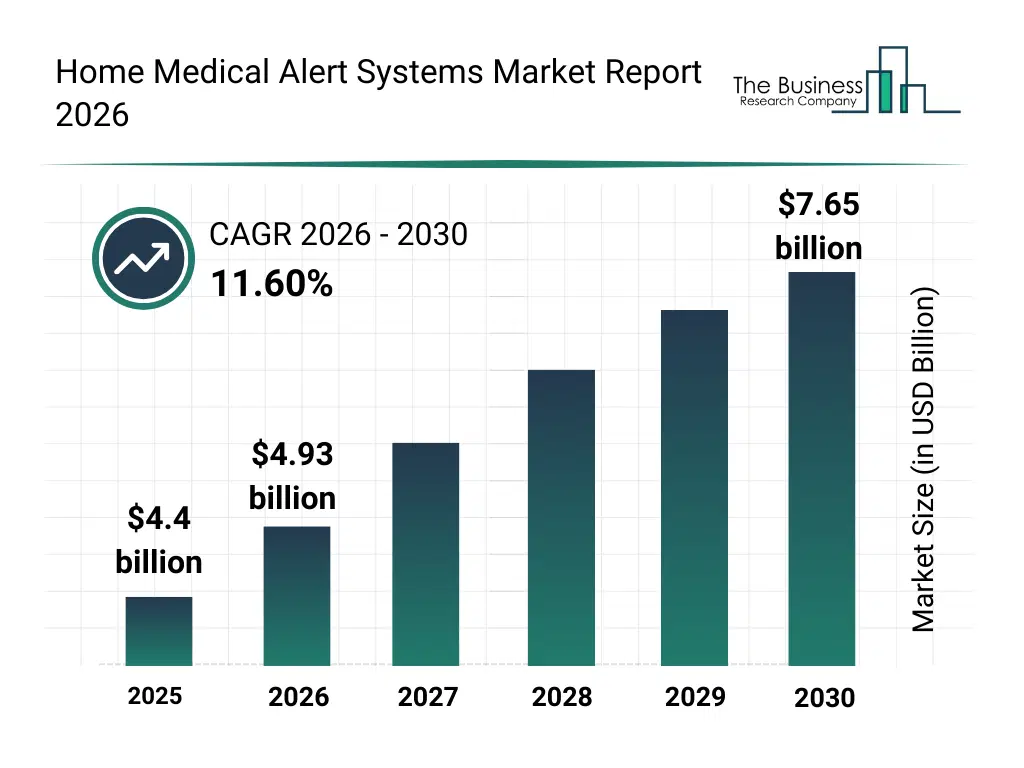
What Is The Home Medical Alert Systems Market Size and Share 2026?
The home medical alert systems market size has grown rapidly in recent years. It will grow from $4.4 billion in 2025 to $4.93 billion in 2026 at a compound annual growth rate (CAGR) of 11.9%. The growth in the historic period can be attributed to increasing elderly population, reliance on landline-based pers systems, limited mobile connectivity in early years, growing awareness of in-home safety, development of basic emergency pendant devices.What Is The Home Medical Alert Systems Market Growth Forecast?
The home medical alert systems market size is expected to see rapid growth in the next few years. It will grow to $7.65 billion in 2030 at a compound annual growth rate (CAGR) of 11.6%. The growth in the forecast period can be attributed to rising adoption of smartphone-based and ai-powered alert apps, integration with smart home ecosystems, increasing chronic disease prevalence, advancements in wearable technology, expansion of assisted living and nursing home facilities. Major trends in the forecast period include growing adoption of wearable medical alert devices, integration with telehealth and remote monitoring services, rising demand for gps and fall detection features, expansion of subscription-based and pay-as-you-go service models, enhanced focus on user-friendly interfaces and accessibility.
Global Home Medical Alert Systems Market Segmentation
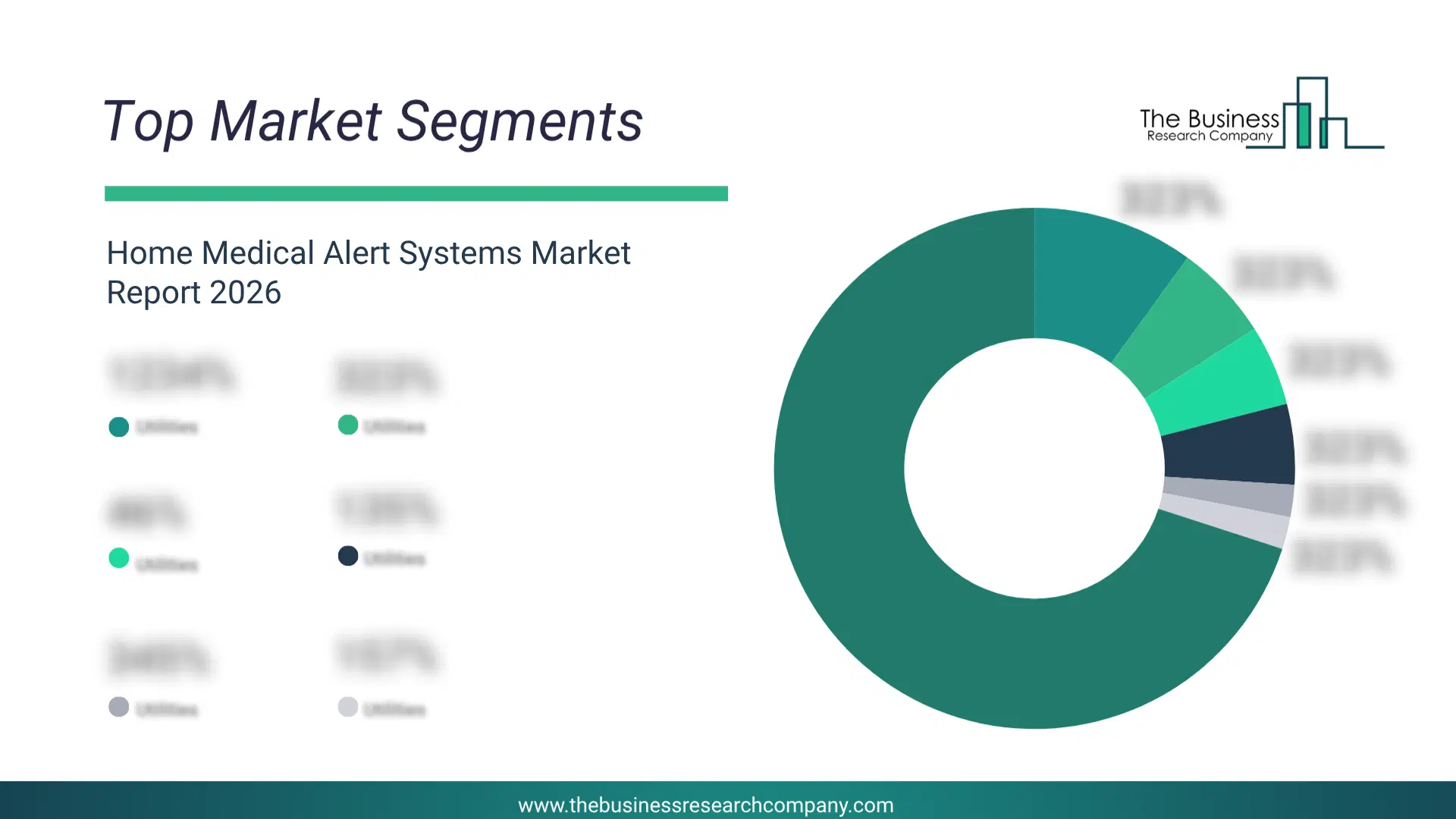
1) By Type: Personal Emergency Response Systems (PERS), Wearable Alert Systems, Smartphone Based Alert Systems, In Home Alert Systems 2) By Service Model: Subscription Based Services, One Time Purchase Models, Bundled Services, Pay-As-You-Go Services 3) By Applications: Home Based Use, Nursing Home, Assisted Living Facilities, Hospices, Other Applications 4) By Distribution Channel: Online Retailers, Medical Equipment Stores, Direct Sales, Healthcare Facilities 5) By End User: Seniors, Disabled Individuals, Patients With Chronic Conditions, Other End Users Subsegments: 1) By Personal Emergency Response Systems (PERS): Landline-Based PERS, Cellular-Based PERS, GPS-Enabled PERS, Two-Way Voice Communication PERS, Fall Detection-Integrated PERS 2) By Wearable Alert Systems: Medical Alert Smartwatches, Emergency Pendant Alarms, Wristband Alert Devices, Necklace Alert Devices, Clip-On Wearable Sensors 3) By Smartphone-Based Alert Systems: Dedicated Medical Alert Apps, Hybrid Smartphone + Wearable Systems, AI-Powered Emergency Response Apps, Family-Connected Alert Apps, GPS Location Tracking Apps 4) By In-Home Alert Systems: Wall-Mounted Emergency Buttons, Bedside Alert Systems, Voice-Activated Home Assistants, Motion-Sensor Based Alarms, Smart Home-Integrated Medical AlertsWhat Is The Driver Of The Home Medical Alert Systems Market?
The increasing penetration of mobile networks is expected to propel the growth of the home medical alert systems market going forward. Mobile networks are wireless communication systems that connect mobile devices to the internet and telephone services using radio waves. The penetration of mobile networks is increasing due to the growing demand for internet access in both urban and rural areas. Home medical alert systems often rely on mobile connectivity to function, encouraging more network installations in residential areas. For instance, in February 2025, the GSM Association, a UK-based global organization of mobile operators and companies, reported that there were 5.8 billion unique mobile subscribers globally, representing a 71% penetration rate. This number is expected to grow to 6.5 billion by 2030. Therefore, the increasing penetration of mobile networks is driving the growth of the home medical alert systems industry.Key Players In The Global Home Medical Alert Systems Market
Major companies operating in the home medical alert systems market are ADT Inc., Connect America LLC, Lifeline Systems Pvt. Ltd., LifeStation Inc., Medical Guardian LLC, LifeFone Inc., AlertOne Services LLC, Life Alert Emergency Response Inc., Rescue Alert of California, MyNotifi by MedHab Inc., Bay Alarm Medical, SafeGuardian LLC, LifeCall Medical Alert Systems, Senior Safety Medical Alert, AlertCare Medical Alert Systems, LifeSignals Group Inc., LogicMark Inc., ResponseNow Medical Alert Systems, Rescue Touch LLC, Vital Alert Communication Inc.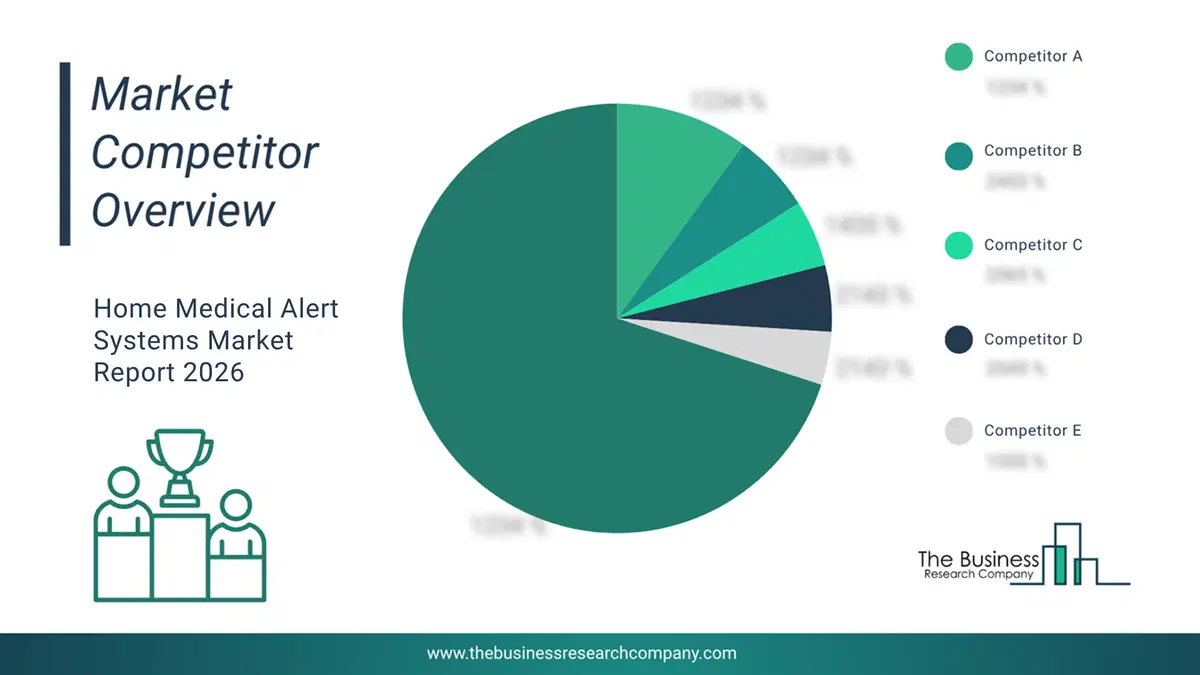
This chart is for illustrative purposes; the full report includes a detailed competitor analysis and comprehensive overview of the top 10 companies in the market.
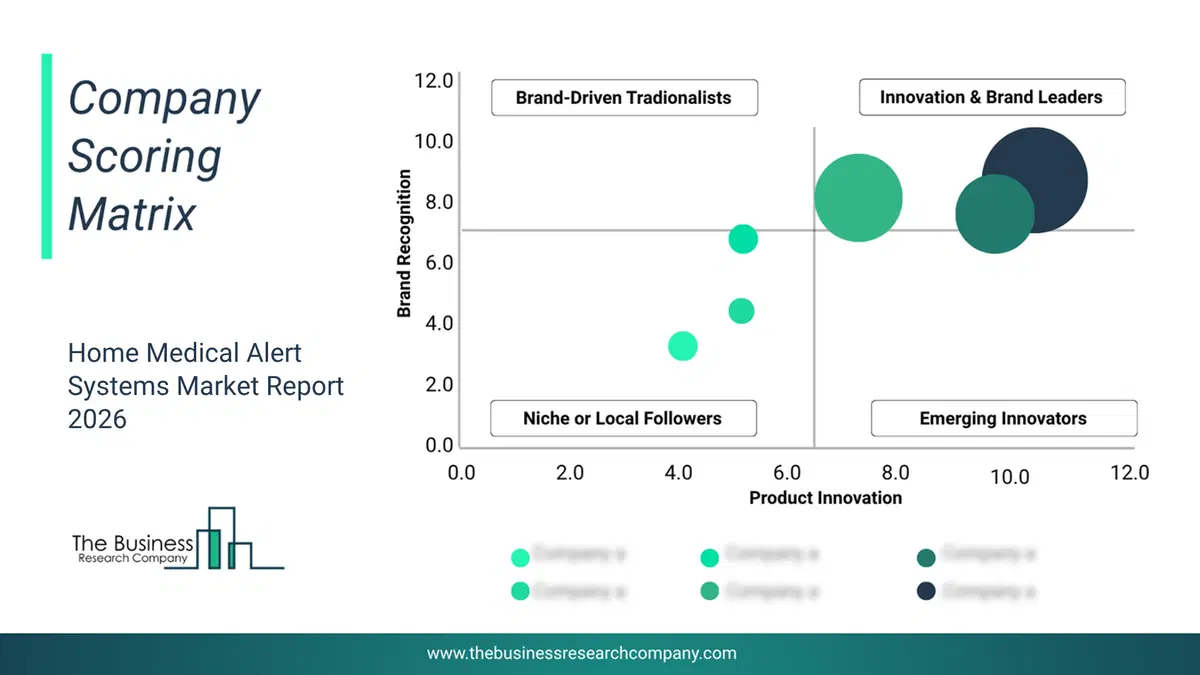
This chart maps companies by product innovation and brand strength, with bubble size indicating relative revenue, helping identify market leaders, challengers, and niche players. This is an illustrative chart; the full report provides a complete and accurate competitive analysis.
Global Home Medical Alert Systems Market Trends and Insights
Major companies operating in the home medical alert systems market are focusing on advanced technology such as artificial intelligence (AI)-powered fall detection to provide faster emergency response, greater user safety, and more personalized health monitoring. AI-powered fall detection refers to the use of artificial intelligence algorithms in devices to accurately identify and alert caregivers of falls in real-time, improving emergency response and reducing false alarms. For instance, in November 2024, LogicMark, a US-based company specializing in medical alert systems, launched the Freedom Alert Max, an advanced home medical alert device. This innovative system integrates AI-powered fall detection, GPS tracking, and emergency video calling in a single device. It features seamless connectivity with mobile applications and 24/7 US-based professional monitoring. Freedom Alert Max enhances user safety and independence for seniors and vulnerable individuals.What Are Latest Mergers And Acquisitions In The Home Medical Alert Systems Market?
In May 2024, Medical Guardian, a US-based healthcare technology company, acquired MobileHelp for an undisclosed amount. This acquisition aims to broaden Medical Guardian’s footprint in the connected health and aging-in-place markets, combining MobileHelp’s strength in mobile and wearable alert solutions with Medical Guardian’s innovation in 24/7 monitoring services. MobileHelp is a US-based healthcare technology company specializing in mobile personal emergency response systems (mPERS).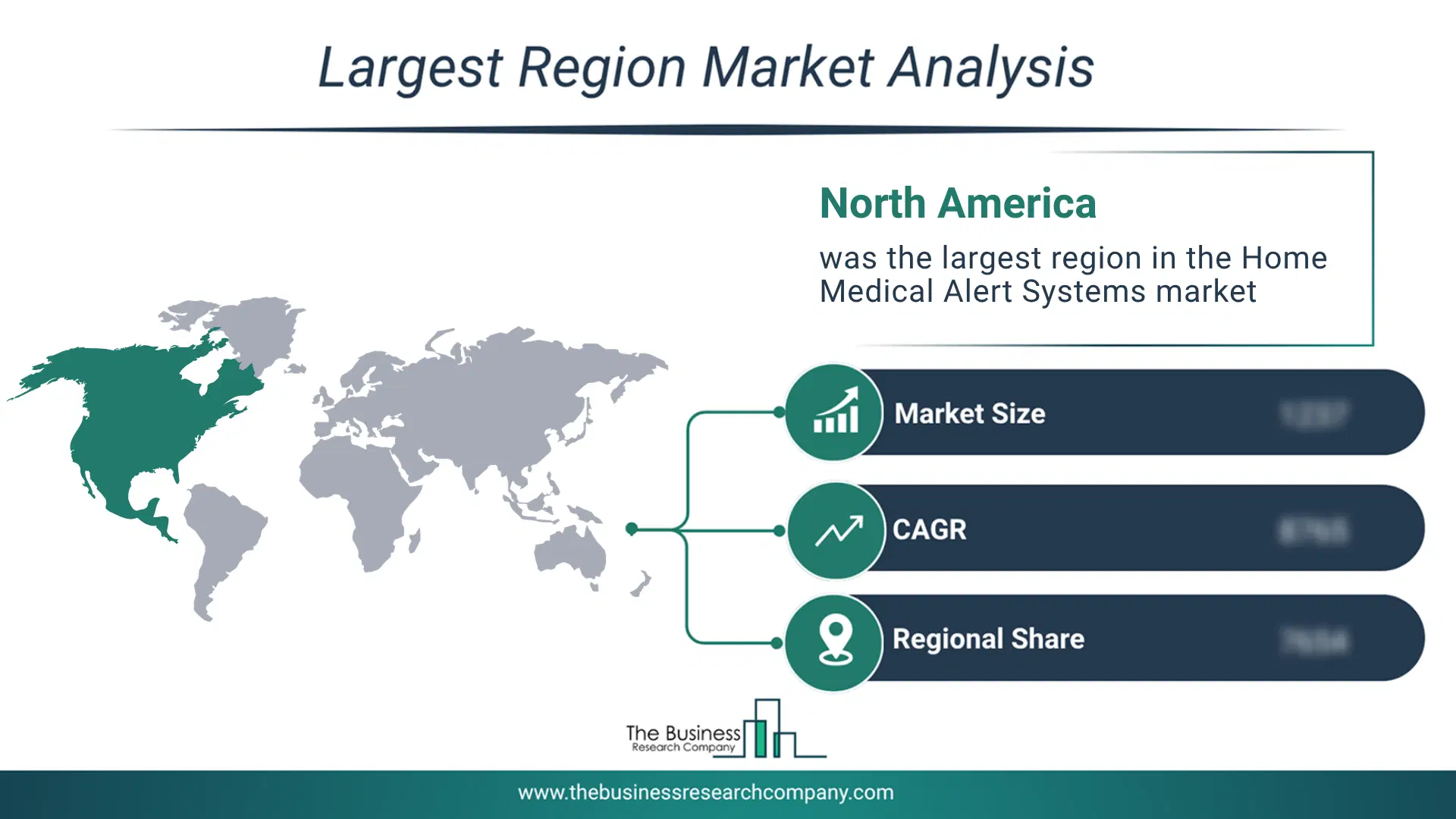
Regional Outlook
North America was the largest region in the home medical alert systems market in 2025. Asia-Pacific is expected to be the fastest-growing region in the forecast period. The regions covered in this market report are Asia-Pacific, South East Asia, Western Europe, Eastern Europe, North America, South America, Middle East, Africa. The countries covered in this market report are Australia, Brazil, China, France, Germany, India, Indonesia, Japan, Taiwan, Russia, South Korea, UK, USA, Canada, Italy, SpainWhat Defines the Home Medical Alert Systems Market?
The home medical alert systems market consists of revenues earned by entities by providing services such as emergency response services, fall detection, and health monitoring services. The market value includes the value of related goods sold by the service provider or included within the service offering. The home medical alert systems market also includes sales of classic in-home alert systems, fall detection systems, and smart home medical alert systems. Values in this market are ‘factory gate’ values, that is, the value of goods sold by the manufacturers or creators of the goods, whether to other entities (including downstream manufacturers, wholesalers, distributors, and retailers) or directly to end customers. The value of goods in this market includes related services sold by the creators of the goods.How is Market Value Defined and Measured?
The market value is defined as the revenues that enterprises gain from the sale of goods and/or services within the specified market and geography through sales, grants, or donations in terms of the currency (in USD unless otherwise specified). The revenues for a specified geography are consumption values that are revenues generated by organizations in the specified geography within the market, irrespective of where they are produced. It does not include revenues from resales along the supply chain, either further along the supply chain or as part of other products.
This chart presents market attractiveness based on a quantitative evaluation of growth, competition, strategic alignment, and risk, offering a clear view of opportunity areas for decision-making. This chart is for illustrative purposes; the full report contains the complete analysis.

This chart highlights the Total Addressable Market (TAM) by estimating the maximum revenue opportunity using an assumption-driven approach, supporting strategic planning and opportunity sizing across markets. The chart is illustrative; the full report provides a more comprehensive analysis.
What Key Data and Analysis Are Included in the Home Medical Alert Systems Market Report 2026?
The home medical alert systems market research report is one of a series of new reports from The Business Research Company that provides market statistics, including industry global market size, regional shares, competitors with the market share, detailed market segments, market trends and opportunities, and any further data you may need to thrive in the home medical alert systems industry. The market research report delivers a complete perspective of everything you need, with an in-depth analysis of the current and future state of the industry.Home Medical Alert Systems Market Report Forecast Analysis
| Report Attribute | Details |
|---|---|
| Market Size Value In 2026 | $4.93 billion |
| Revenue Forecast In 2030 | $7.65 billion |
| Growth Rate | CAGR of 11.6% from 2026 to 2030 |
| Base Year For Estimation | 2025 |
| Actual Estimates/Historical Data | 2020-2025 |
| Forecast Period | 2026 - 2030 |
| Market Representation | Revenue in USD Billion and CAGR from 2026 to 2030 |
| Segments Covered | Type, Service Model, Applications, Distribution Channel, End User |
| Regional Scope | Asia-Pacific, Western Europe, Eastern Europe, North America, South America, Middle East, Africa |
| Country Scope | The countries covered in the report are Australia, Brazil, China, France, Germany, India, Indonesia, Japan, Taiwan, Russia, South Korea, UK, USA, Canada, Italy, Spain. |
| Key Companies Profiled | ADT Inc., Connect America LLC, Lifeline Systems Pvt. Ltd., LifeStation Inc., Medical Guardian LLC, LifeFone Inc., AlertOne Services LLC, Life Alert Emergency Response Inc., Rescue Alert of California, MyNotifi by MedHab Inc., Bay Alarm Medical, SafeGuardian LLC, LifeCall Medical Alert Systems, Senior Safety Medical Alert, AlertCare Medical Alert Systems, LifeSignals Group Inc., LogicMark Inc., ResponseNow Medical Alert Systems, Rescue Touch LLC, Vital Alert Communication Inc. |
| Customization Scope | Request for Customization |
| Pricing And Purchase Options | Explore Purchase Options |