
Home Use Wi-Fi Router Market Report 2026
Global Outlook – By Type (Speed And Capacity, Wi-Fi Standards), By Technology (Dual-Band And Tri-Band Routers, Mesh Wi-Fi Systems), By Application (Gaming Routers, Streaming Routers, General-Use Routers) – Market Size, Trends, Strategies, and Forecast to 2030
Home Use Wi-Fi Router Market Overview
• Home Use Wi-Fi Router market size has reached to $4.65 billion in 2025 • Expected to grow to $6.76 billion in 2030 at a compound annual growth rate (CAGR) of 7.8% • Growth Driver: Growing Internet Penetration Fueling The Home Use Wi-Fi Router Market Growth • Market Trend: AI-Powered Solutions Revolutionize Connectivity • North America was the largest region in 2025.What Is Covered Under Home Use Wi-Fi Router Market?
A home-use wireless fidelity (Wi-Fi) router is a networking device designed for residential environments to provide wireless internet connectivity to multiple devices within a household. It serves as a central hub for distributing internet access from the broadband connection provided by an internet service provider (ISP) to various devices such as smartphones, tablets, laptops, and more. The main types of home use Wi-Fi routers include speed and capacity and wireless fidelity (Wi-Fi) standards. Speed and capacity refer to the ability of the router to transfer data at a certain rate and handle multiple connections simultaneously. These provide various technologies, such as dual-band and tri-band routers and mesh wireless fidelity (Wi-Fi) systems for various applications, including gaming routers, streaming routers, and general-use routers.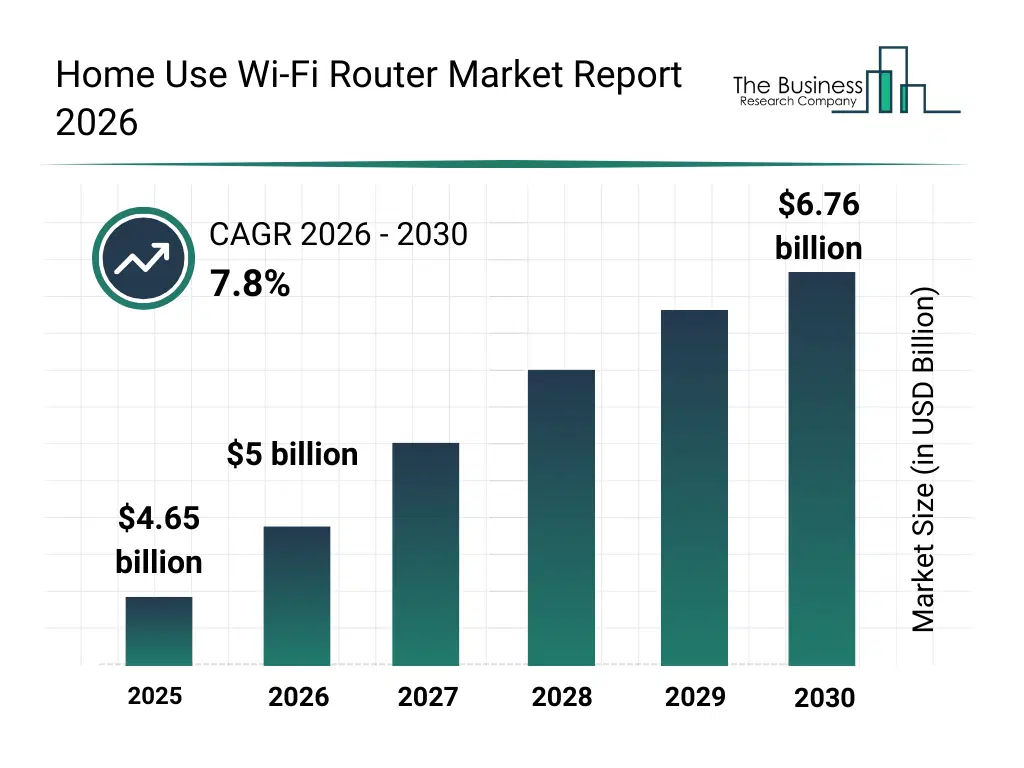
What Is The Home Use Wi-Fi Router Market Size and Share 2026?
The home use wi-fi router market size has grown strongly in recent years. It will grow from $4.65 billion in 2025 to $5 billion in 2026 at a compound annual growth rate (CAGR) of 7.5%. The growth in the historic period can be attributed to increase in home internet penetration, growth of smart home devices, rise of online entertainment consumption, expansion of broadband infrastructure, affordability of wireless routers.What Is The Home Use Wi-Fi Router Market Growth Forecast?
The home use wi-fi router market size is expected to see strong growth in the next few years. It will grow to $6.76 billion in 2030 at a compound annual growth rate (CAGR) of 7.8%. The growth in the forecast period can be attributed to remote work and online learning demand, adoption of wi-fi 7 standards, rising gaming and streaming usage, increasing connected devices per household, demand for secure home networks. Major trends in the forecast period include adoption of wi-fi 6 and wi-fi 6e, growth of mesh wi-fi systems, enhanced network security features, high-speed multi-band connectivity, easy self-installation and management.
Global Home Use Wi-Fi Router Market Segmentation
1) By Type: Speed And Capacity, Wi-Fi Standards 2) By Technology: Dual-Band And Tri-Band Routers, Mesh Wi-Fi Systems 3) By Application: Gaming Routers, Streaming Routers, General-Use Routers Subsegments: 1) By Speed And Capacity: Low-Speed Wi-Fi Routers (Up To 100 Mbps), Medium-Speed Wi-Fi Routers (100 Mbps To 1 Gbps), High-Speed Wi-Fi Routers (Above 1 Gbps), Multi-band Wi-Fi Routers 2) By Wi-Fi Standards: Wi-Fi 4 (802.11n), Wi-Fi 5 (802.11ac), Wi-Fi 6 (802.11ax), Wi-Fi 6E (Extended), Wi-Fi 7 (802.11be, upcoming)What Is The Driver Of The Home Use Wi-Fi Router Market?
The growing internet penetration is expected to propel the growth of the home Wi-Fi router market going forward. Internet penetration refers to the percentage of the population within a specific geographical area with Internet access. Internet penetration is due to communication, e-commerce, entertainment, remote work and education, social media and networking, and digital transformation. Home-use Wi-Fi routers significantly contribute to the growth of internet penetration by providing convenient, affordable, and reliable connectivity options for households, thereby facilitating increased internet usage among individuals and families. For instance, in September 2023, according to the International Telecommunication Union, a Switzerland-based United Nations agency for information and communication technologies, 67% of the world’s population, or 5.4 billion people, were currently using the Internet, compared to 5.3 billion people (66% of the world’s population) in 2022. Therefore, the growing internet penetration is driving the growth of the home Wi-Fi router market.Key Players In The Global Home Use Wi-Fi Router Market
Major companies operating in the home use wi-fi router market are Google LLC; Samsung Electronics Co. Ltd.; Huawei Technologies Co. Ltd.; ASUSTeK Computer Inc.; Motorola Solutions Inc.; TP-Link Corporation Limited; Ubiquiti Networks Inc.; Netgear Inc.; D-Link Corporation; ASRock Inc.; ZyXEL Communications Corporation; MikroTik; Edimax Technology Co. Ltd.; Billion Electric Co. Ltd.; Shenzhen Tenda Technology Co. Ltd.; Linksys Holdings Inc.; Securifi Inc.; EnGenius Technologies Inc.; Keenetic Limited; Open Mesh Inc.; Gryphon Online Safety Inc.; MERCUSYS Technologies Co. Ltd.; ARRIS International plc; Dell Technologies Inc.; Cisco Systems Inc.
This chart is for illustrative purposes; the full report includes a detailed competitor analysis and comprehensive overview of the top 10 companies in the market.
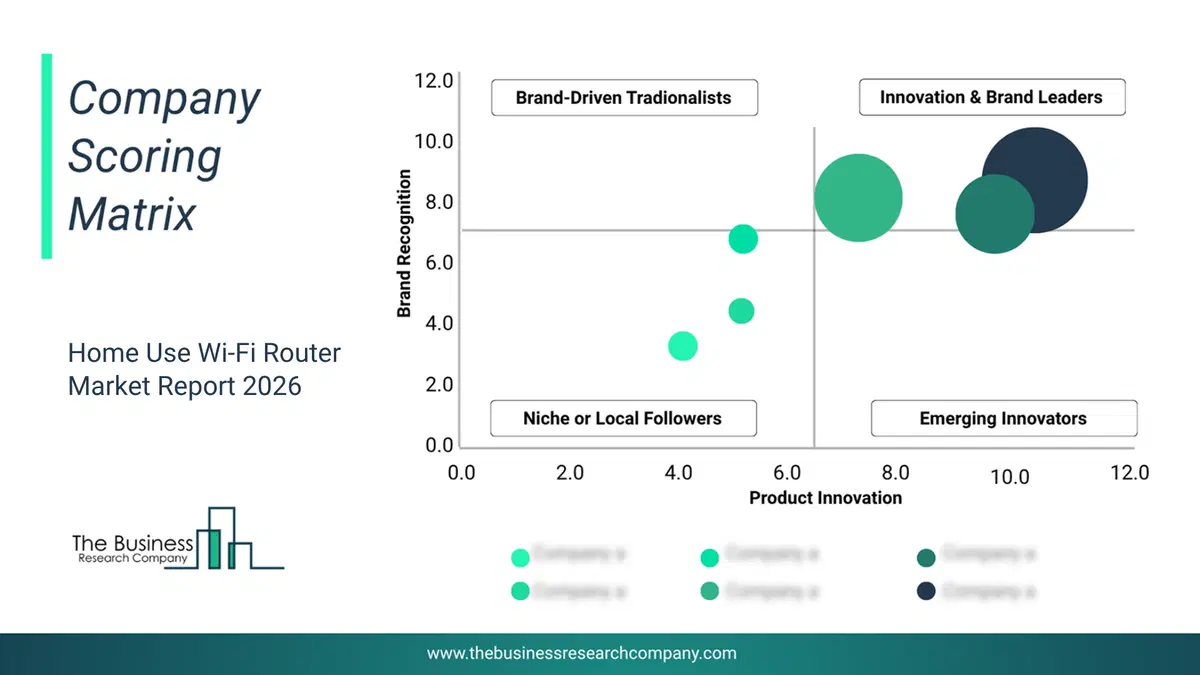
This chart maps companies by product innovation and brand strength, with bubble size indicating relative revenue, helping identify market leaders, challengers, and niche players. This is an illustrative chart; the full report provides a complete and accurate competitive analysis.
Global Home Use Wi-Fi Router Market Trends and Insights
Major companies operating in the home-use Wi-Fi router market are focused on developing advanced products, such as the AQUILA PRO AI series, to capture a larger market share and meet consumers' evolving needs. AQUILA PRO AI is a Wi-Fi 6 smart home gateway or Wi-Fi 6 smart mesh router that leverages machine learning algorithms to analyze real-time network traffic patterns, device usage, and environmental factors. This allows for dynamic optimization of the Wi-Fi network, ensuring optimal performance and coverage throughout the home. For instance, in March 2023, D-Link Systems Inc., a China-based networking hardware and telecom equipment manufacturer, launched the AQUILA PRO AI series, created to improve the connectivity and stability of smart home networks. This series consists of six models, such as the MS78, MS60, MS30, M60, M30, and E30, each with unique characteristics to fulfill the different needs of customers. The series is designed to make it easier to set up smart home systems by providing easy software that helps users enroll in Matter-compliant goods and allows for remote control and management of smart home devices.What Are Latest Mergers And Acquisitions In The Home Use Wi-Fi Router Market?
In January 2023, Semtech Corporation, a US-based semiconductor company, acquired Sierra Wireless for $1.2 billion. This acquisition aims to design a comprehensive Internet of Things (IoT) infrastructure that blends the ultra-low power benefits of LoRa with the more extensive bandwidth capabilities of cellular technology. The deal provides a uniquely differentiated IoT platform that caters to the growing demands of the Wi-Fi router market. Sierra Wireless is a Canada-based communications equipment company that offers routers for home use, including 5G, LTE, and Wi-Fi routers.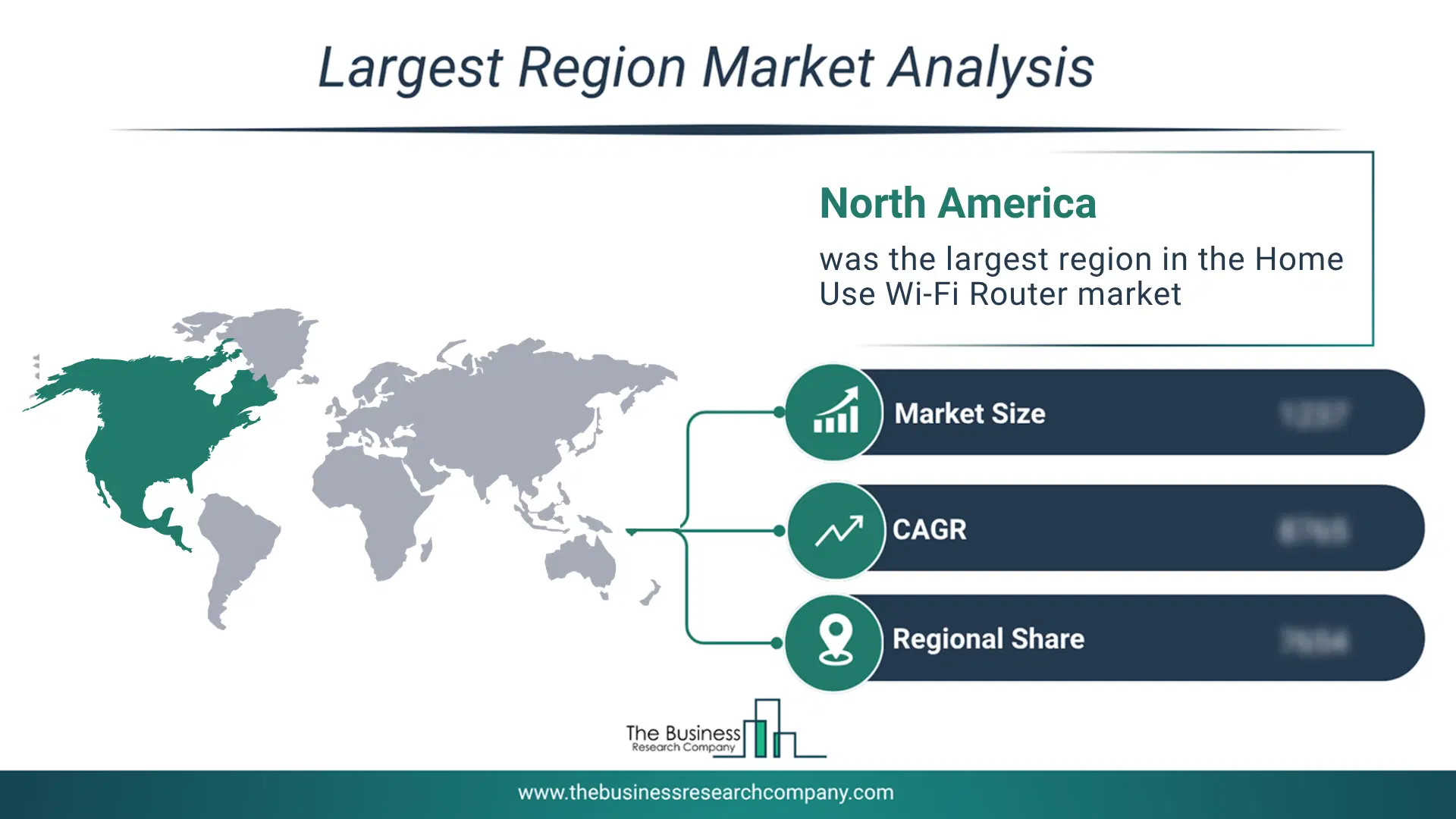
Regional Insights
North America was the largest region in the home use Wi-Fi router market in 2025. The regions covered in this market report are Asia-Pacific, South East Asia, Western Europe, Eastern Europe, North America, South America, Middle East, Africa. The countries covered in this market report are Australia, Brazil, China, France, Germany, India, Indonesia, Japan, Taiwan, Russia, South Korea, UK, USA, Canada, Italy, SpainWhat Defines the Home Use Wi-Fi Router Market?
The home use Wi-Fi router market consists of sales of single-band routers, dual-band routers, smart routers and modem-router combo units. Values in this market are ‘factory gate’ values, that is the value of goods sold by the manufacturers or creators of the goods, whether to other entities (including downstream manufacturers, wholesalers, distributors, and retailers) or directly to end customers. The value of goods in this market includes related services sold by the creators of the goods.How is Market Value Defined and Measured?
The market value is defined as the revenues that enterprises gain from the sale of goods and/or services within the specified market and geography through sales, grants, or donations in terms of the currency (in USD unless otherwise specified). The revenues for a specified geography are consumption values that are revenues generated by organizations in the specified geography within the market, irrespective of where they are produced. It does not include revenues from resales along the supply chain, either further along the supply chain or as part of other products.
This chart presents market attractiveness based on a quantitative evaluation of growth, competition, strategic alignment, and risk, offering a clear view of opportunity areas for decision-making. This chart is for illustrative purposes; the full report contains the complete analysis.

This chart highlights the Total Addressable Market (TAM) by estimating the maximum revenue opportunity using an assumption-driven approach, supporting strategic planning and opportunity sizing across markets. The chart is illustrative; the full report provides a more comprehensive analysis.
What Key Data and Analysis Are Included in the Home Use Wi-Fi Router Market Report 2026?
The home use wi-fi router market research report is one of a series of new reports from The Business Research Company that provides market statistics, including industry global market size, regional shares, competitors with the market share, detailed market segments, market trends and opportunities, and any further data you may need to thrive in the home use wi-fi router industry. The market research report delivers a complete perspective of everything you need, with an in-depth analysis of the current and future state of the industry.Home Use Wi-Fi Router Market Report Forecast Analysis
| Report Attribute | Details |
|---|---|
| Market Size Value In 2026 | $5 billion |
| Revenue Forecast In 2030 | $6.76 billion |
| Growth Rate | CAGR of 7.8% from 2026 to 2030 |
| Base Year For Estimation | 2025 |
| Actual Estimates/Historical Data | 2020-2025 |
| Forecast Period | 2026 - 2030 |
| Market Representation | Revenue in USD Billion and CAGR from 2026 to 2030 |
| Segments Covered | Type, Technology, Application |
| Regional Scope | Asia-Pacific, Western Europe, Eastern Europe, North America, South America, Middle East, Africa |
| Country Scope | The Countries Covered In This Market Report Are Australia, Brazil, China, France, Germany, India, Indonesia, Japan, Taiwan, Russia, South Korea, Uk, Usa, Canada, Italy, Spain. |
| Key Companies Profiled | Google LLC, Samsung Electronics Co. Ltd., Huawei Technologies Co. Ltd., ASUSTeK Computer Inc., Motorola Solutions Inc., TP-Link Corporation Limited, Ubiquiti Networks Inc., Netgear Inc., D-Link Corporation, ASRock Inc., ZyXEL Communications Corporation, MikroTik, Edimax Technology Co. Ltd., Billion Electric Co. Ltd., Shenzhen Tenda Technology Co. Ltd., Linksys Holdings Inc., Securifi Inc., EnGenius Technologies Inc., Keenetic Limited, Open Mesh Inc., Gryphon Online Safety Inc., MERCUSYS Technologies Co. Ltd., ARRIS International plc, Dell Technologies Inc., Cisco Systems Inc. |
| Customization Scope | Request for Customization |
| Pricing And Purchase Options | Explore Purchase Options |