
Hormonal Intrauterine Devices (IUDs) Market Report 2026
Global Outlook – By Type (13 Milligram Hormonal Intrauterine Devices, 19 Milligram Hormonal Intrauterine Devices, 52 Milligram Hormonal Intrauterine Devices), By Device Design (Framed Intrauterine Devices, Frameless Intrauterine Devices), By Hormone Type (Levonorgestrel Releasing Intrauterine Devices, Progesterone Releasing Intrauterine Devices), By Application (Age 20-24, Age 25-34, Age 35-44, Other Applications) – Market Size, Trends, Strategies, and Forecast to 2030
Hormonal Intrauterine Devices (IUDs) Market Overview
• Hormonal Intrauterine Devices (IUDs) market size has reached to $2.87 billion in 2025 • Expected to grow to $4.74 billion in 2030 at a compound annual growth rate (CAGR) of 10.5% • Growth Driver: Rising Unwanted Pregnancies Fuel Growth In The Hormonal IUD Market • Market Trend: Development Of Advanced Levonorgestrel Iuds Enhancing Contraceptive And Therapeutic Benefits • North America was the largest region in 2025 and Asia-Pacific is the fastest growing region.What Is Covered Under Hormonal Intrauterine Devices (IUDs) Market?
Hormonal intrauterine devices (IUDs) are small, T-shaped plastic devices inserted into the uterus that release progestin, a synthetic hormone. They prevent pregnancy by thickening cervical mucus to block sperm, thinning the uterine lining to hinder implantation, and sometimes suppressing ovulation. They can also reduce menstrual bleeding and cramping and may even stop periods altogether. The main types of hormonal intrauterine devices (IUDs) are 13 milligram hormonal intrauterine devices, 19 milligram hormonal intrauterine devices, and 52 milligram hormonal intrauterine devices. 13-milligram hormonal IUDs, releasing a small dose of hormones for up to 3 years, are increasingly popular among women seeking low-dose, long-acting contraceptive options. The device design such as framed intrauterine devices and frameless intrauterine devices with different hormone types, including levonorgestrel-releasing intrauterine devices and progesterone-releasing intrauterine devices for various applications such as ages 20-24, 25-34, 35-44, and other applications.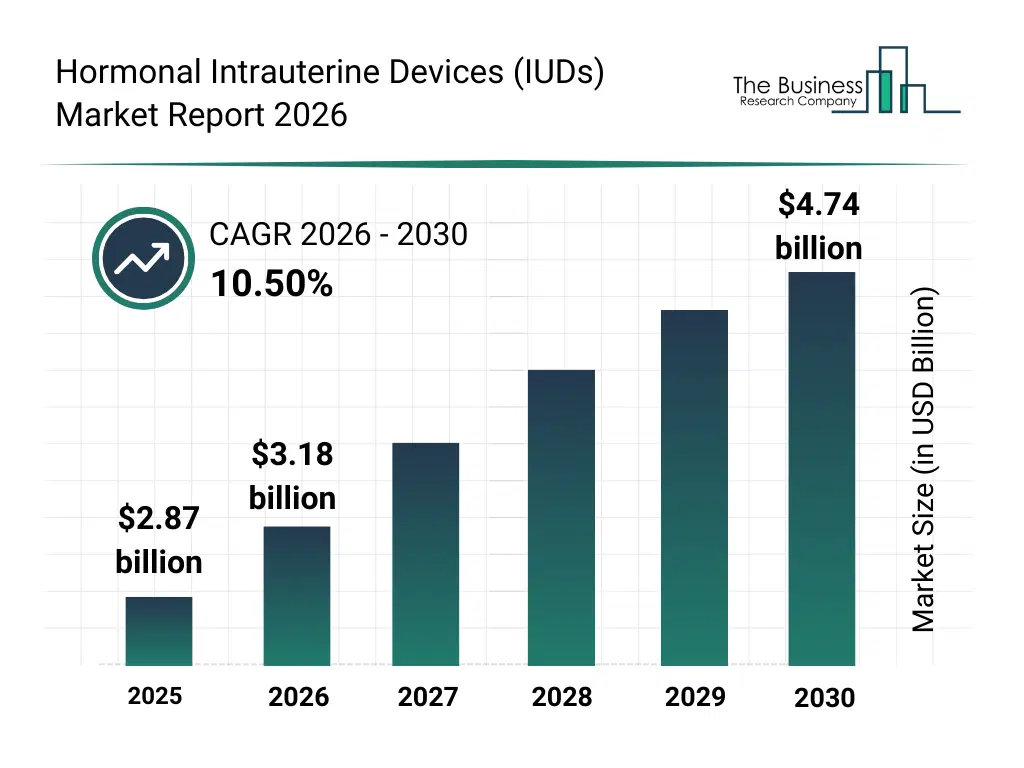
What Is The Hormonal Intrauterine Devices (IUDs) Market Size and Share 2026?
The hormonal intrauterine devices (iuds) market size has grown rapidly in recent years. It will grow from $2.87 billion in 2025 to $3.18 billion in 2026 at a compound annual growth rate (CAGR) of 10.6%. The growth in the historic period can be attributed to increasing awareness of family planning options, expansion of women’s reproductive healthcare programs, rising preference for long-term contraception, availability of hormone-based devices, support from public health initiatives.What Is The Hormonal Intrauterine Devices (IUDs) Market Growth Forecast?
The hormonal intrauterine devices (iuds) market size is expected to see rapid growth in the next few years. It will grow to $4.74 billion in 2030 at a compound annual growth rate (CAGR) of 10.5%. The growth in the forecast period can be attributed to increasing demand for non-surgical contraceptive solutions, rising focus on menstrual health management, expansion of access in emerging markets, growing investments in women’s health technologies, increasing innovation in hormone delivery systems. Major trends in the forecast period include increasing adoption of low-dose hormonal iuds, rising demand for long-acting reversible contraceptives, growing preference for frameless device designs, expansion of therapeutic iud applications, enhanced focus on patient comfort and safety.

Global Hormonal Intrauterine Devices (IUDs) Market Segmentation
1) By Type: 13 Milligram Hormonal Intrauterine Devices, 19 Milligram Hormonal Intrauterine Devices, 52 Milligram Hormonal Intrauterine Devices 2) By Device Design: Framed Intrauterine Devices, Frameless Intrauterine Devices 3) By Hormone Type: Levonorgestrel Releasing Intrauterine Devices, Progesterone Releasing Intrauterine Devices 4) By Application: Age 20-24, Age 25-34, Age 35-44, Other Applications Subsegments: 1) By 13 Milligram Hormonal Intrauterine Devices: Low-Dose 13 Mg IUDs, Specialty 13 Mg IUDs For Specific Conditions 2) By 19 Milligram Hormonal Intrauterine Devices: Low-Dose 19 Mg IUDs, Specialty 19 Mg IUDs For Specific Conditions 3) By 52 Milligram Hormonal Intrauterine Devices: Standard 52 Mg IUDs, Extended-Release 52 Mg IUDs, Specialty 52 Mg IUDs For Heavy Menstrual Bleeding Or EndometriosisWhat Is The Driver Of The Hormonal Intrauterine Devices (IUDs) Market?
The increase in unwanted pregnancies is expected to propel the growth of the hormonal intrauterine devices market going forward. Unwanted pregnancies refer to pregnancies that are not planned or desired at the time of conception. These pregnancies can occur for various reasons, including contraceptive failure, lack of access to birth control, incorrect use of contraception, or sexual violence. Limited access to effective contraception increases the risk of unwanted pregnancies by reducing individuals' control over their reproductive choices. Hormonal IUDs are highly effective at preventing pregnancy, with a failure rate of less than 1%. They provide long-term protection (3 to 7 years, depending on the type) and are a reliable option for those seeking to avoid unwanted pregnancies. For instance, in July 2025, according to the Society for Family Planning, a US-based professional organization, the number of abortions rose to 1.14 million in 2024, compared with 1.05 million recorded in 2023. Therefore, the increase in unwanted pregnancies is driving the growth of the hormonal intrauterine devices market.Key Players In The Global Hormonal Intrauterine Devices (IUDs) Market
Major companies operating in the hormonal intrauterine devices (iuds) market are Bayer AG, Organon & Companies, Gedeon Richter Plc, Meril Life Science Pvt Ltd., Teva UK Limited, Medicines360, HLL Lifecare Limited, Pregna International Ltd., DKT WomanCare Global, SMB Corporation of India, Oy Leiras, OCON Healthcare, Bayer Healthcare Pharmaceuticals, CooperSurgical Inc., Mithra Pharmaceuticals, Shanghai Dahua Medical Apparatus Co. Ltd., Beijing Zizhu Pharmaceutical Co. Ltd., Shanghai Jiansheng Medical Devices Co. Ltd., Zhejiang Xianju Pharmaceutical Co. Ltd., Shanghai Chuangling Medical Devices Co. Ltd.
This chart is for illustrative purposes; the full report includes a detailed competitor analysis and comprehensive overview of the top 10 companies in the market.

This chart maps companies by product innovation and brand strength, with bubble size indicating relative revenue, helping identify market leaders, challengers, and niche players. This is an illustrative chart; the full report provides a complete and accurate competitive analysis.
Global Hormonal Intrauterine Devices (IUDs) Market Trends and Insights
Major companies operating in the hormonal intrauterine devices market are focusing on developing advanced solutions, such as levonorgestrel intrauterine devices (IUDs), to reduce menstrual bleeding and cramps. Levonorgestrel intrauterine devices (IUDs) are long-term birth control options inserted into the uterus that slowly release the hormone levonorgestrel to stop pregnancy. For instance, in October 2024, Medicines360, a US-based nonprofit organization, launched Avibela, a 52 mg levonorgestrel intrauterine device (IUD) in Zambia. It serves two key purposes, offering up to eight years of pregnancy prevention and up to five years of relief from heavy menstrual bleeding. Its contraceptive effect comes from its ability to make cervical mucus denser, preventing sperm from reaching the uterus. For heavy bleeding, it works by thinning the uterine lining, which helps reduce menstrual flow.What Are Latest Mergers And Acquisitions In The Hormonal Intrauterine Devices (IUDs) Market?
In January 2024, Medicines360, a US-based pharmaceutical organization that manufactures hormonal intrauterine devices (IUDs), partnered with DKT WomanCare Global to expand the availability and accessibility of the affordable hormonal IUD Avibela by increasing awareness and extending market reach, particularly in underserved regions, aimed at improving global sexual and reproductive health; DKT WomanCare Global is a France-based company focused on enhancing the availability, accessibility, and affordability of sexual and reproductive health products for women.
Regional Outlook
North America was the largest region in the hormonal intrauterine devices (IUDs) market in 2025. Asia-Pacific is expected to be the fastest-growing region in the forecast period. The regions covered in this market report are Asia-Pacific, South East Asia, Western Europe, Eastern Europe, North America, South America, Middle East, Africa. The countries covered in this market report are Australia, Brazil, China, France, Germany, India, Indonesia, Japan, Taiwan, Russia, South Korea, UK, USA, Canada, Italy, SpainWhat Defines the Hormonal Intrauterine Devices (IUDs) Market?
The hormonal intrauterine devices (IUDs) market consists of sales of hormone reservoir, strings, and insertion or removal instruments. Values in this market are ‘factory gate’ values, that is the value of goods sold by the manufacturers or creators of the goods, whether to other entities (including downstream manufacturers, wholesalers, distributors, and retailers) or directly to end customers. The value of goods in this market includes related services sold by the creators of the goods.How is Market Value Defined and Measured?
The market value is defined as the revenues that enterprises gain from the sale of goods and/or services within the specified market and geography through sales, grants, or donations in terms of the currency (in USD unless otherwise specified). The revenues for a specified geography are consumption values that are revenues generated by organizations in the specified geography within the market, irrespective of where they are produced. It does not include revenues from resales along the supply chain, either further along the supply chain or as part of other products.
This chart presents market attractiveness based on a quantitative evaluation of growth, competition, strategic alignment, and risk, offering a clear view of opportunity areas for decision-making. This chart is for illustrative purposes; the full report contains the complete analysis.

This chart highlights the Total Addressable Market (TAM) by estimating the maximum revenue opportunity using an assumption-driven approach, supporting strategic planning and opportunity sizing across markets. The chart is illustrative; the full report provides a more comprehensive analysis.
What Key Data and Analysis Are Included in the Hormonal Intrauterine Devices (IUDs) Market Report 2026?
The hormonal intrauterine devices (iuds) market research report is one of a series of new reports from The Business Research Company that provides market statistics, including industry global market size, regional shares, competitors with the market share, detailed market segments, market trends and opportunities, and any further data you may need to thrive in the hormonal intrauterine devices (iuds) industry. The market research report delivers a complete perspective of everything you need, with an in-depth analysis of the current and future state of the industry.Hormonal Intrauterine Devices (IUDs) Market Report Forecast Analysis
| Report Attribute | Details |
|---|---|
| Market Size Value In 2026 | $3.18 billion |
| Revenue Forecast In 2030 | $4.74 billion |
| Growth Rate | CAGR of 10.5% from 2026 to 2030 |
| Base Year For Estimation | 2025 |
| Actual Estimates/Historical Data | 2020-2025 |
| Forecast Period | 2026 - 2030 |
| Market Representation | Revenue in USD Billion and CAGR from 2026 to 2030 |
| Segments Covered | Type, Device Design, Hormone Type, Application |
| Regional Scope | Asia-Pacific, Western Europe, Eastern Europe, North America, South America, Middle East, Africa |
| Country Scope | The countries covered in the report are Australia, Brazil, China, France, Germany, India, Indonesia, Japan, Taiwan, Russia, South Korea, UK, USA, Canada, Italy, Spain. |
| Key Companies Profiled | Bayer AG, Organon & Companies, Gedeon Richter Plc, Meril Life Science Pvt Ltd., Teva UK Limited, Medicines360, HLL Lifecare Limited, Pregna International Ltd., DKT WomanCare Global, SMB Corporation of India, Oy Leiras, OCON Healthcare, Bayer Healthcare Pharmaceuticals, CooperSurgical Inc., Mithra Pharmaceuticals, Shanghai Dahua Medical Apparatus Co. Ltd., Beijing Zizhu Pharmaceutical Co. Ltd., Shanghai Jiansheng Medical Devices Co. Ltd., Zhejiang Xianju Pharmaceutical Co. Ltd., Shanghai Chuangling Medical Devices Co. Ltd. |
| Customization Scope | Request for Customization |
| Pricing And Purchase Options | Explore Purchase Options |