
Hotel Digital Market Report 2026
Global Outlook – By Component (Software, Hardware, Services), By Deployment Mode (On Premises, Cloud), By Purpose Of Travel (Leisure Travelers, Business Travelers, Event Attendees, Group Travelers, Solo Travelers), By Application (Booking Management, Guest Experience Enhancement, Revenue Management, Marketing And Advertising, Other Applications), By End User (Luxury Hotels, Budget Hotels, Boutique Hotels, Other End Users) – Market Size, Trends, Strategies, and Forecast to 2030
Hotel Digital Market Overview
• Hotel Digital market size has reached to $19.03 billion in 2025 • Expected to grow to $32.03 billion in 2030 at a compound annual growth rate (CAGR) of 11% • Growth Driver: Rise In Business Travel Fuelling The Growth Of The Market Due To Increasing Online Bookings And Digital Engagement • Market Trend: Eco-Friendly Digital Compendium Enhances Guest Experience And Streamlines Hotel Operations • North America was the largest region in 2025 and Asia-Pacific is the fastest growing region.Market Gains By 2030 – Top Opportunities By Segment
Market Gain identifies the most promising market opportunities by highlighting the segments or products expected to generate the highest incremental revenue growth over the next five years.
What Is Covered Under Hotel Digital Market?
Hotel digital refers to the integration of technology into hotel operations to streamline management, enhance guest experiences, and optimize service efficiency. It involves using digital tools for reservations, check-ins, room management, and personalized services. This approach leverages data and automation to improve overall operational performance and customer satisfaction. The main components of hotel digital are software, hardware, and services. Hotel digital software refers to technology platforms and applications designed to automate, manage, and enhance hotel operations and guest experiences through digital solutions. The various deployment modes involved are on-premises and cloud for leisure travellers, business travellers, event attendees, group travellers, and solo travellers. The various application involved are booking management, guest experience enhancement, revenue management, marketing and advertising, and others for luxury hotels, budget hotels, boutique hotels, and others.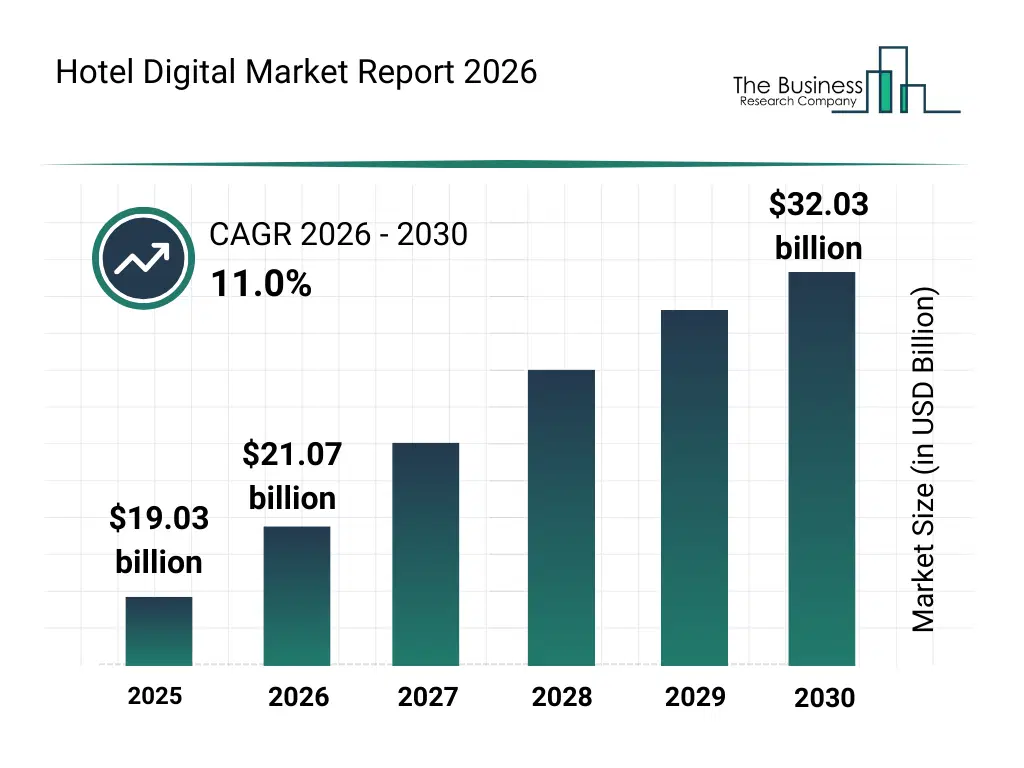
What Is The Hotel Digital Market Size and Share 2026?
The hotel digital market size has grown rapidly in recent years. It will grow from $19.03 billion in 2025 to $21.07 billion in 2026 at a compound annual growth rate (CAGR) of 10.7%. The growth in the historic period can be attributed to growth of online hotel bookings, adoption of property management systems, expansion of global hotel chains, rising competition among hotels, increasing guest expectations.What Is The Hotel Digital Market Growth Forecast?
The hotel digital market size is expected to see rapid growth in the next few years. It will grow to $32.03 billion in 2030 at a compound annual growth rate (CAGR) of 11.0%. The growth in the forecast period can be attributed to increasing demand for contactless services, growth of cloud based hotel software, adoption of AI driven personalization, expansion of smart hotel investments, focus on operational efficiency. Major trends in the forecast period include digital check in and check out adoption, personalized guest experience platforms, smart room and connected hotel infrastructure, data driven revenue management systems, integrated omnichannel hotel operations.
Global Hotel Digital Market Segmentation
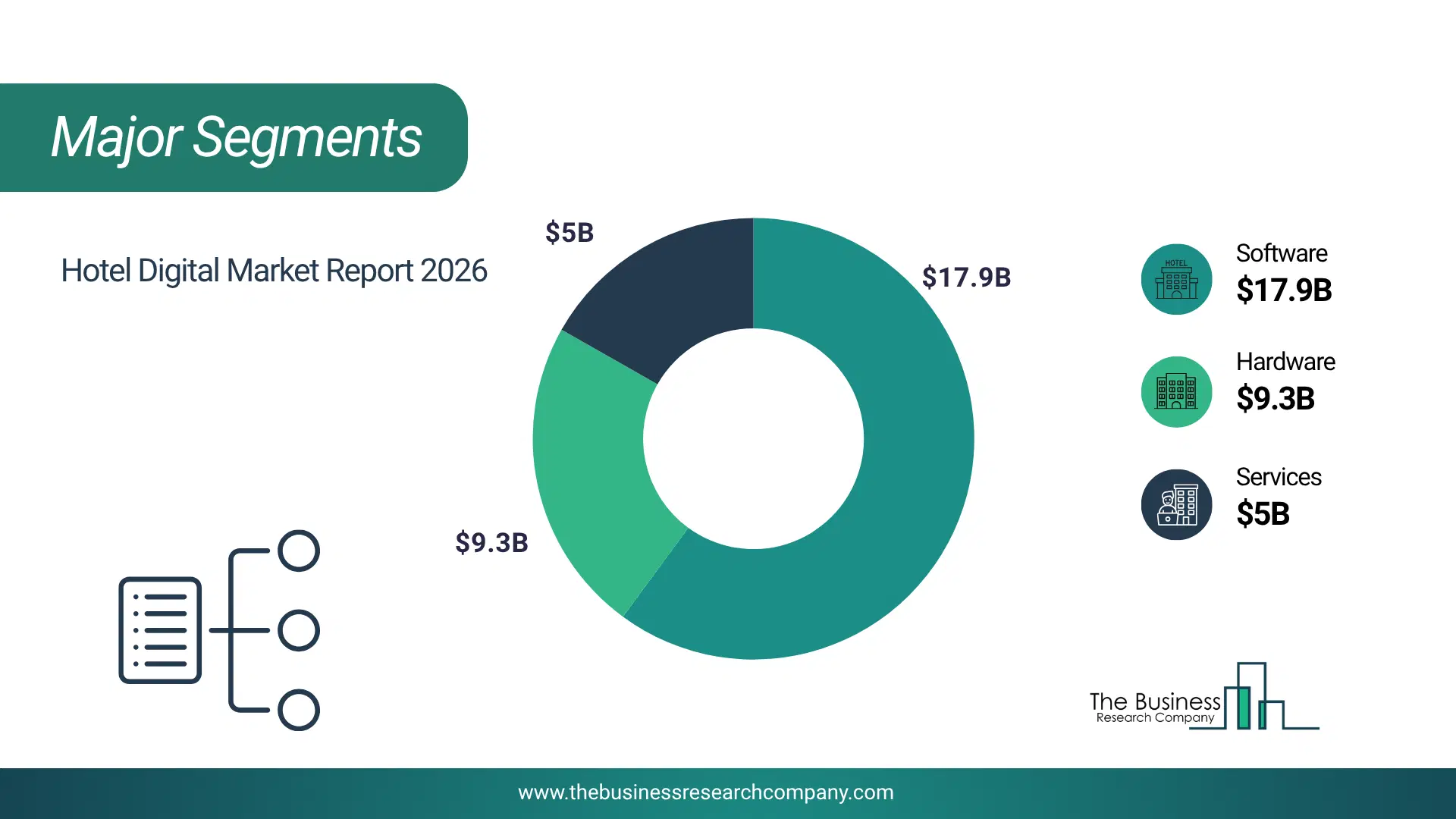
1) By Component: Software, Hardware, Services 2) By Deployment Mode: On Premises, Cloud 3) By Purpose Of Travel: Leisure Travelers, Business Travelers, Event Attendees, Group Travelers, Solo Travelers 4) By Application: Booking Management, Guest Experience Enhancement, Revenue Management, Marketing And Advertising, Other Applications 5) By End User: Luxury Hotels, Budget Hotels, Boutique Hotels, Other End Users Subsegments: 1) By Software: Property Management Software, Booking Management Software, Revenue Management Software, Customer Relationship Management Software, Marketing Automation Software, Analytics And Reporting Software 2) By Hardware: Self Check In Kiosks, Digital Key And Access Systems, In Room Entertainment Devices, Point Of Sale Terminals, Smart Room Sensors And Controls 3) By Services: Consulting And Implementation Services, Training And Support Services, Maintenance And Managed Services, Digital Marketing And Promotion Services, Data Management And Analytics Services The top segments in the hotel digital market will be: • Software will reach $17.84 billion by 2030. • Hardware will reach $9.25 billion by 2030. • Services will reach $4.94 billion by 2030.What Is The Driver Of The Hotel Digital Market?
The rise in business travel is expected to propel the growth of the hotel digital market going forward. Business travel refers to trips taken for work-related purposes, such as meetings, conferences, or company operations, rather than for leisure. Business travel is rising due to the expansion of global trade and international business activities, as companies increasingly send employees abroad for meetings, conferences, and client engagements to strengthen partnerships and drive growth. Business travel benefits hotel digital by increasing online bookings, as travelers frequently use hotel websites and apps to search, compare, and reserve accommodations, enhancing the hotel’s digital visibility and engagement. For instance, in October 2024, according to the World Travel and Tourism Council, a UK-based forum for the travel and tourism industry, business travel spending in the U.S. was anticipated to reach US$472 billion, while in China, the second-largest business travel market globally, expenditures were expected to climb to around US$211 billion. Therefore, the rise in business travel is driving the growth of the hotel digital industry.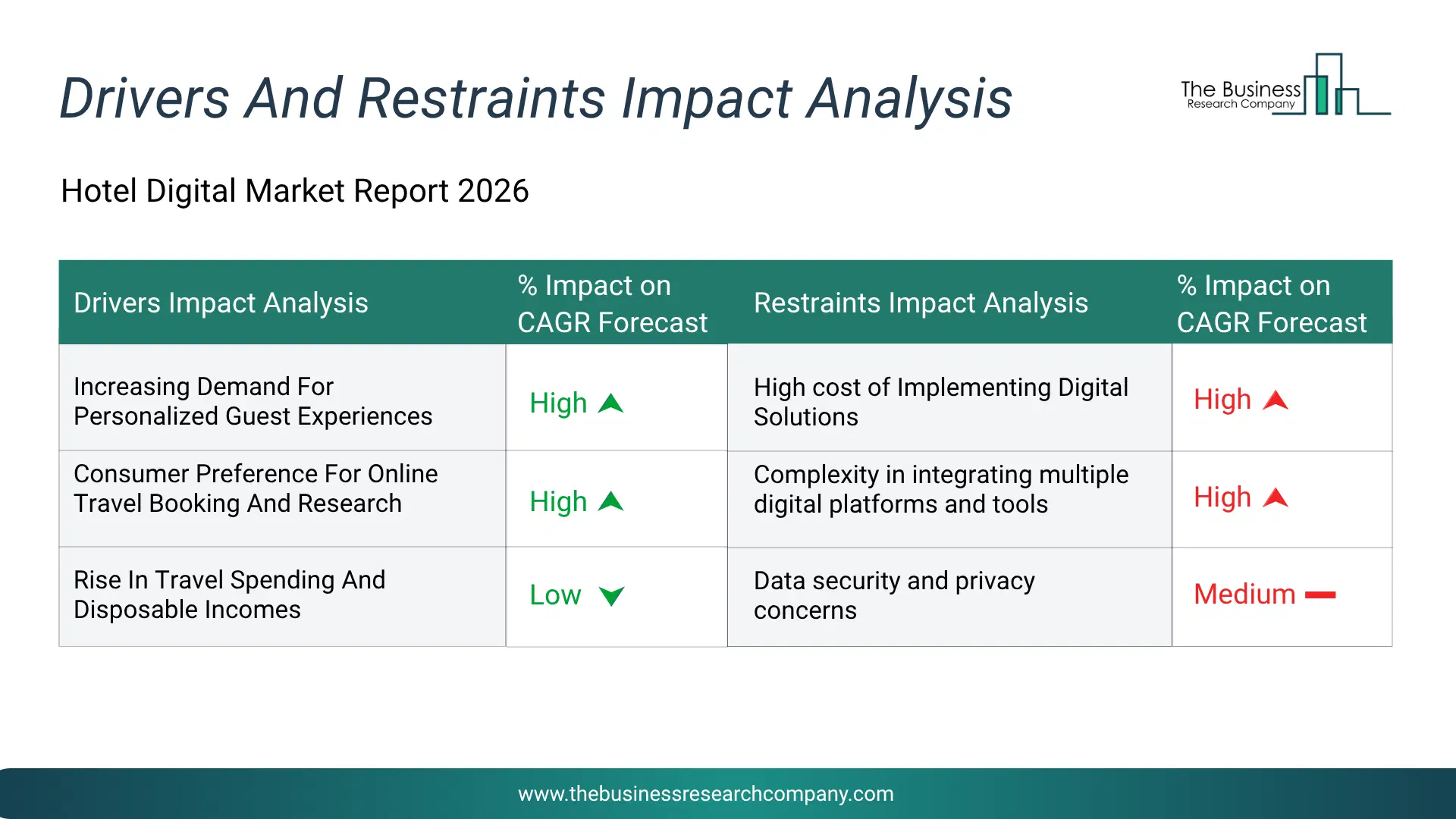
Infographic Chart Showing Key Market Drivers Analysis And Restraints For Hotel Digital Market
The chart presents an impact analysis of key drivers and restraints, quantifying their relative influence on the market's growth rate and helping assess the balance between growth enablers and limiting factors. This chart offers a high-level perspective; the full report contains more detailed insights.
How Will The Drivers Impact Growth In The Global Hotel Digital Market?
• Increasing Demand For Personalized Guest Experiences (High) – During the forecast period, the increasing demand for personalized guest experiences is expected to become a key growth driver for the hotel digital market by 2030. Hotels are increasingly implementing digital technologies such as ai-powered chatbots, mobile applications, and advanced analytics to offer tailored recommendations and services. Personalization improves guest satisfaction, fostering loyalty and repeat visits. Digital platforms also facilitate real-time feedback and service optimization, enhancing overall guest engagement. This heightened focus on personalization is prompting greater investment in digital transformation initiatives. • Consumer Preference For Online Travel Booking And Research (High) – During the forecast period, the growing preference for online travel booking and research is expected to emerge as a major factor driving the expansion of the hotel digital market by 2030. Travelers are increasingly using websites, mobile apps, and comparison platforms to conveniently plan and reserve accommodations. This transition reduces reliance on traditional travel intermediaries and encourages hotels to strengthen their digital capabilities. Online platforms enable hotels to display promotions, guest reviews, and virtual experiences that influence booking decisions. With rising digital engagement, hotels are investing in streamlined booking systems and targeted digital marketing strategies to capture online demand. • Rise In Travel Spending And Disposable Incomes (Low) – During the forecast period, the rise in travel spending and disposable incomes is expected to act as a key growth catalyst for the hotel digital market by 2030. Increasing consumer spending on travel is driving demand for premium, technology-enhanced hospitality services. As travelers allocate higher budgets, they seek convenient booking processes, contactless services, and personalized digital experiences. Greater purchasing power supports the adoption of mobile applications, loyalty programs, and smart in-room technologies. This development is encouraging hotels to invest in advanced digital platforms to attract and retain higher-value guests.How Will The Restraints Impact Growth In The Global Hotel Digital Market?
• High cost of Implementing Digital Solutions (High) – During the forecast period, the high cost of implementing digital solutions acts as a major restraint for the hotel digital market. Small and mid-sized hotels often struggle with the large upfront investments required for advanced technologies. Expenses related to system integration, staff training, and ongoing maintenance further add to the burden. These costs can slow down digital adoption, especially in price-sensitive markets. As a result, many hotels delay or limit their digital transformation despite rising customer expectations. • Complexity in integrating multiple digital platforms and tools (High) – During the forecast period, the complexity of integrating multiple digital platforms and tools creates a major barrier for the hotel digital market. Hotels often use different systems for booking, payments, customer management, and marketing, which may not seamlessly connect. Poor integration can lead to data silos, operational inefficiencies, and inconsistent guest experiences. Managing these fragmented technologies also requires skilled staff and additional resources. This challenge slows down digital adoption and reduces the overall effectiveness of digital investments. • Data security and privacy concerns (Medium) – During the forecast period, the data security and privacy concerns act as a significant restraint for the hotel digital market. Hotels collect sensitive guest information such as payment details and personal preferences, making them vulnerable to cyberattacks. Any breach can damage brand reputation and reduce customer trust in digital services. Compliance with strict data protection regulations also adds to operational challenges and costs. These risks make some hotels hesitant to fully embrace advanced digital solutions.Key Players In The Global Hotel Digital Market
Major companies operating in the hotel digital market are YOTEL Limited, Henn-na Hotel, The Sinclair, The Venetian Resort Las Vegas, Ace Hotel Group, Aloft Hotels, Eccleston Square Hotel, Hotel 1000, LXR Hotels & Resorts, The Peninsula Hotels, Four Seasons Hotels and Resorts, Radisson Blu, InterContinental Hotels Group (IHG), Hyatt Hotels Corporation, MGM Resorts International, Virgin Hotels, Generator Hostels, Motto by Hilton, Nobu Hotels, SBE Hotels, The Ritz-Carlton, EDITION Hotels, The Langham, Aman Resorts, Six Senses Hotels, Shangri-La Hotels, Belmond Hotels, The Beverly Hills Hotel, The Plaza Hotel, The Ned London, Kimpton Hotels & Restaurants, Ginger Hotels, CitizenM Tower of London, Hotel Silken Puerta América, M Social Singapore, Park Hotel Tokyo, LEVA Hotel, Hub by Premier Inn London Westminster, Aria Resort & Casino Las Vegas, Hotel Monville Montreal, Clarion Hotel Sign Stockholm, Hotel Jen Orchardgateway Singapore, NH Collection Madrid Eurobuilding, Kameha Grand Zurich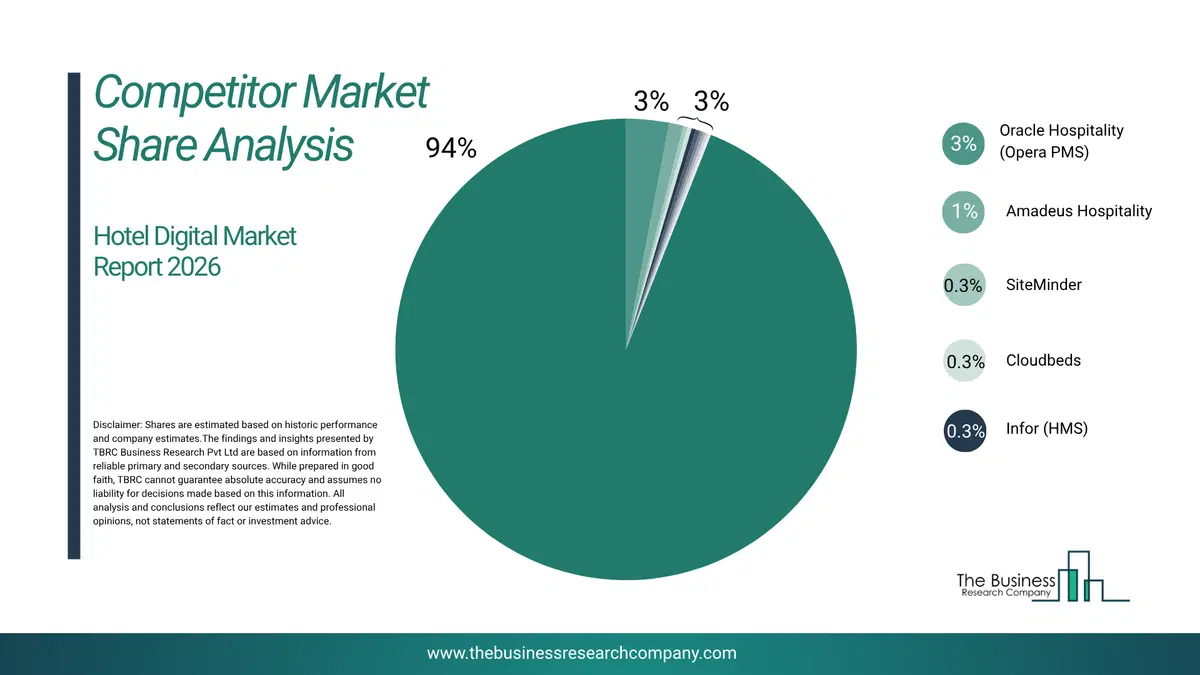
This chart is for illustrative purposes; the full report includes a detailed competitor analysis and comprehensive overview of the top 10 companies in the market.
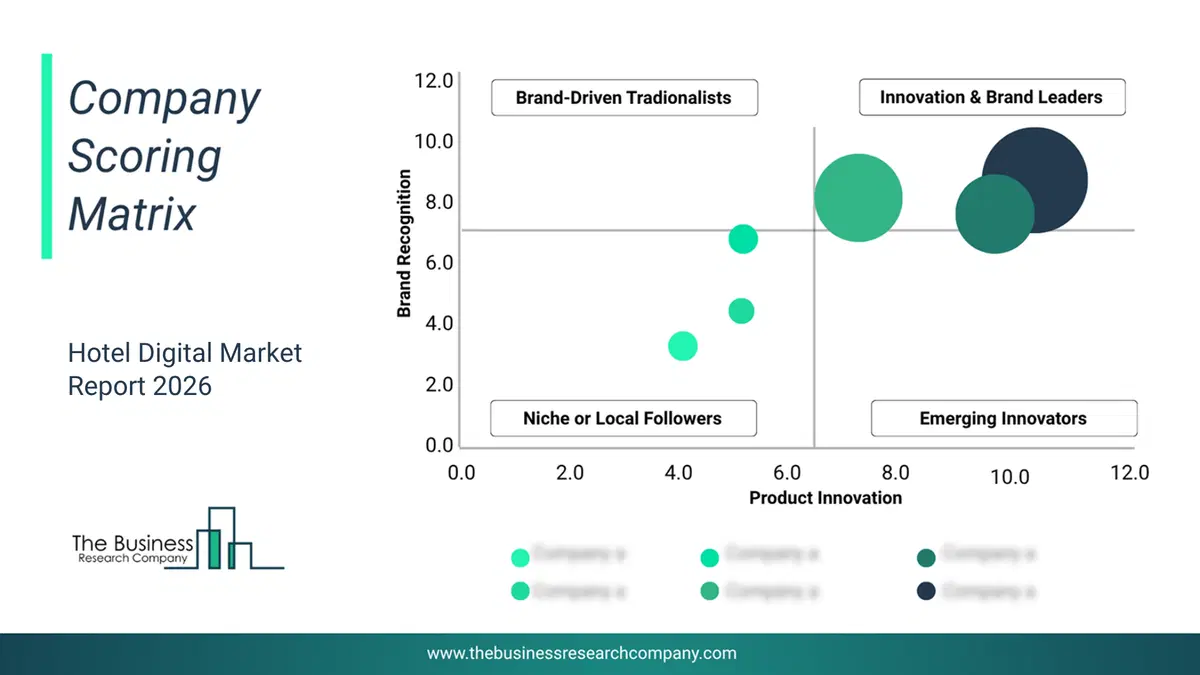
This chart maps companies by product innovation and brand strength, with bubble size indicating relative revenue, helping identify market leaders, challengers, and niche players. This is an illustrative chart; the full report provides a complete and accurate competitive analysis.
Global Hotel Digital Market Trends and Insights
Major companies operating in the hotel digital market are focusing on developing advanced solutions, such as eco-friendly digital solutions, to replace traditional paper compendiums. An eco-friendly solution refers to a sustainable practice or technology that reduces environmental impact by conserving resources, cutting pollution, and supporting ecological balance. For instance, in October 2024, Canary Technologies, a US-based software company, launched a Digital Compendium into its award-winning Guest Management Platform. This innovation replaces traditional printed compendiums by providing hotel information and amenities directly to guests through a web-based platform without the need for any app download. It delivers real-time updates on hotel services, facilities, and nearby attractions while allowing hoteliers to easily customize content with images, menus, and branding without incurring additional printing costs. Integrated with Canary’s guest management solutions, such as mobile check-in, dynamic upselling, guest messaging, and smart check-out, it offers a seamless digital experience. The digital compendium improves guest satisfaction, simplifies hotel operations, and helps drive additional revenue.What Are Latest Mergers And Acquisitions In The Hotel Digital Market?
In January 2024, IBS Software Services Private Limited, an India-based software company, acquired Above Property Services for $90 million. With this acquisition, IBS Software aims to strengthen its leadership in the hospitality technology sector by offering a unified, cloud-based platform that enhances hotel operations and guest experiences worldwide. Above Property Service LLC is a US-based company that provides digital solutions for hotels.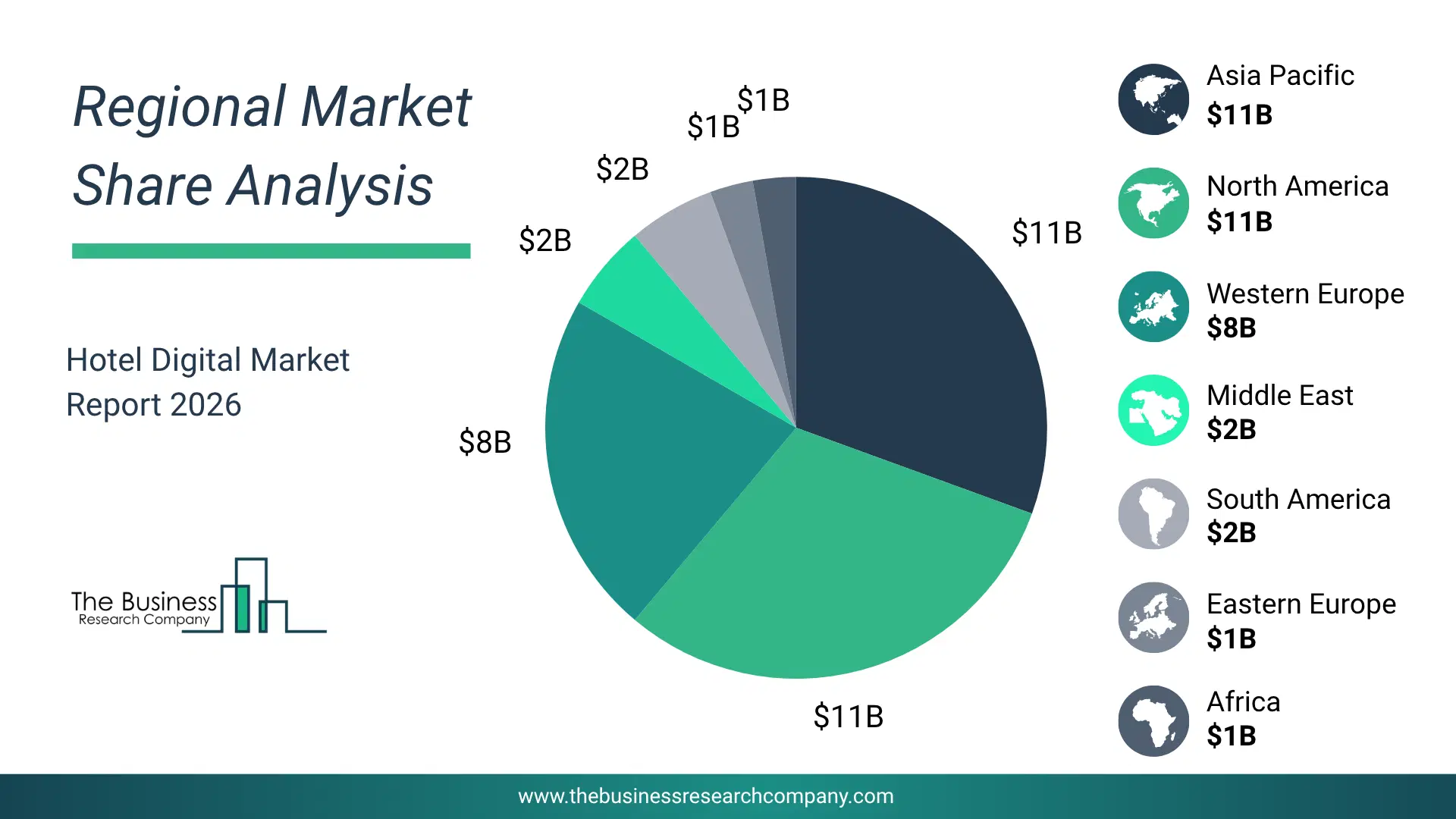
Regional Outlook
North America was the largest region in the hotel digital market in 2025. Asia-Pacific is expected to be the fastest-growing region in the forecast period. The regions covered in this market report are Asia-Pacific, South East Asia, Western Europe, Eastern Europe, North America, South America, Middle East, Africa. The countries covered in this market report are Australia, Brazil, China, France, Germany, India, Indonesia, Japan, Taiwan, Russia, South Korea, UK, USA, Canada, Italy, SpainWhat Defines the Hotel Digital Market?
The hotel digital market consists of revenues earned by entities by providing services such as online booking management, property management system, guest relationship management and digital check-in and check-out. The market value includes the value of related goods sold by the service provider or included within the service offering. The hotel digital market also includes of sales of hotel management software, online booking platforms, and digital signage and displays, computers and servers. Values in this market are ‘factory gate’ values, that is the value of goods sold by the manufacturers or creators of the goods, whether to other entities (including downstream manufacturers, wholesalers, distributors and retailers) or directly to end customers. The value of goods in this market includes related services sold by the creators of the goods.How is Market Value Defined and Measured?
The market value is defined as the revenues that enterprises gain from the sale of goods and/or services within the specified market and geography through sales, grants, or donations in terms of the currency (in USD unless otherwise specified). The revenues for a specified geography are consumption values that are revenues generated by organizations in the specified geography within the market, irrespective of where they are produced. It does not include revenues from resales along the supply chain, either further along the supply chain or as part of other products.
This chart presents market attractiveness based on a quantitative evaluation of growth, competition, strategic alignment, and risk, offering a clear view of opportunity areas for decision-making. This chart is for illustrative purposes; the full report contains the complete analysis.

This chart highlights the Total Addressable Market (TAM) by estimating the maximum revenue opportunity using an assumption-driven approach, supporting strategic planning and opportunity sizing across markets. The chart is illustrative; the full report provides a more comprehensive analysis.
What Key Data and Analysis Are Included in the Hotel Digital Market Report 2026?
The hotel digital market research report is one of a series of new reports from The Business Research Company that provides market statistics, including industry global market size, regional shares, competitors with the market share, detailed market segments, market trends and opportunities, and any further data you may need to thrive in the hotel digital industry. The market research report delivers a complete perspective of everything you need, with an in-depth analysis of the current and future state of the industry.Hotel Digital Market Report Forecast Analysis
| Report Attribute | Details |
|---|---|
| Market Size Value In 2026 | $21.07 billion |
| Revenue Forecast In 2030 | $32.03 billion |
| Growth Rate | CAGR of 11% from 2026 to 2030 |
| Base Year For Estimation | 2025 |
| Actual Estimates/Historical Data | 2020-2025 |
| Forecast Period | 2026 - 2030 |
| Market Representation | Revenue in USD Billion and CAGR from 2026 to 2030 |
| Segments Covered | Component, Deployment Mode, Purpose Of Travel, Application, End User |
| Regional Scope | Asia-Pacific, Western Europe, Eastern Europe, North America, South America, Middle East, Africa |
| Country Scope | The countries covered in the report are Australia, Brazil, China, France, Germany, India, ... |
| Key Companies Profiled | YOTEL Limited, Henn-na Hotel, The Sinclair, The Venetian Resort Las Vegas, Ace Hotel Group, Aloft Hotels, Eccleston Square Hotel, Hotel 1000, LXR Hotels & Resorts, The Peninsula Hotels, Four Seasons Hotels and Resorts, Radisson Blu, InterContinental Hotels Group (IHG), Hyatt Hotels Corporation, MGM Resorts International, Virgin Hotels, Generator Hostels, Motto by Hilton, Nobu Hotels, SBE Hotels, The Ritz-Carlton, EDITION Hotels, The Langham, Aman Resorts, Six Senses Hotels, Shangri-La Hotels, Belmond Hotels, The Beverly Hills Hotel, The Plaza Hotel, The Ned London, Kimpton Hotels & Restaurants, Ginger Hotels, CitizenM Tower of London, Hotel Silken Puerta América, M Social Singapore, Park Hotel Tokyo, LEVA Hotel, Hub by Premier Inn London Westminster, Aria Resort & Casino Las Vegas, Hotel Monville Montreal, Clarion Hotel Sign Stockholm, Hotel Jen Orchardgateway Singapore, NH Collection Madrid Eurobuilding, Kameha Grand Zurich |
| Customization Scope | Request for Customization |
| Pricing And Purchase Options | Explore Purchase Options |