

Contact Us
  Search
The Business Research Company Logo
House Dust Mite Allergy Market 2025
Published :May 2025
Pages :331
Format :PDF
Delivery Time :2-3 Business Days
Why 2-3 days? We update the report with the latest data and news before delivery. Let us know if you need us to expedite.
Report Price :$4,490.00

House Dust Mite Allergy Market 2025

By Product Type (Tablets, Nasal Drops, Injectable), By Treatment Type (Medication, Nasal Irrigation, Other Types), By Diagnosis (Skin Prick Test (SPT), Specific Immunoglobulin E (IgE) And Blood Test, Other Diagnostics), By Dosage Forms (Solid, Liquid), By End Users (Hospitals, Homecare, Specialty Clinics, Other End Users), And By Region, Opportunities And Strategies – Global Forecast To 2035
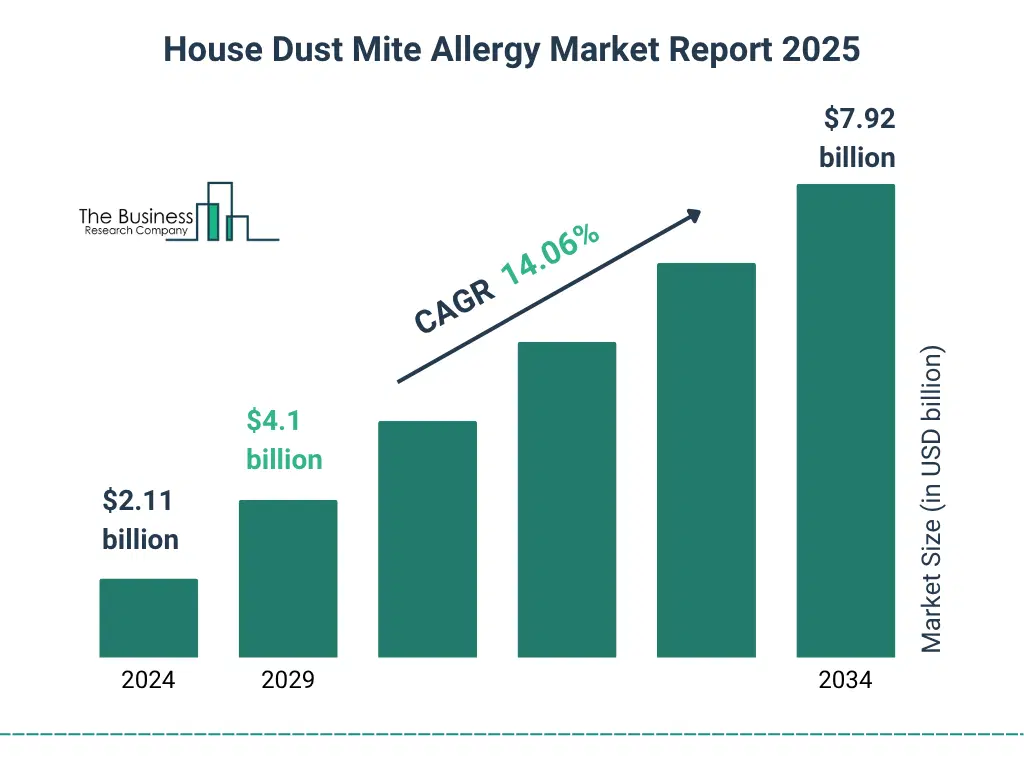
House Dust Mite Allergy Market Size and growth rate 2025 to 2029: Graph

House Dust Mite Allergy Market Definition

House dust mite allergy, also known as dust mite allergy or dust allergy, is an allergic reaction triggered by the proteins found in the feces, body parts and secretions of dust mites. Dust mites are microscopic arthropods that thrive in indoor environments, particularly in warm, humid conditions. They are commonly found in bedding, upholstered furniture, carpets, curtains and other soft furnishings where they feed on dead skin cells shed by humans and pets. The house dust mite allergy market consists of sales, by entities (organizations, sole traders and partnerships), of house dust mite allergy treatment products designed to either reduce exposure to allergens or to treat the symptoms and underlying immune response.
Research Expert

Book your 30 minutes free consultation with our research experts

House Dust Mite Allergy Market Size

The global house dust mite allergy market reached a value of nearly $2,112.79 million in 2024, having grown at a compound annual growth rate (CAGR) of 9.31% since 2019. The market is expected to grow from $2,112.79 million in 2024 to $4,101.79 million in 2029 at a rate of 14.19%. The market is then expected to grow at a CAGR of 14.06% from 2029 and reach $7,918.07 million in 2034. Growth in the historic period resulted from rising healthcare expenditures, increased pet ownership, rising asthma prevalence and growing demand for prescription-based drugs. Factors that negatively affected growth in the historic period were the discontinuation of drug trials and high cost of allergen immunotherapy. Going forward, rising air pollution levels, increasing prevalence of allergic diseases, changing climate patterns and favorable government initiatives will drive growth. Factor that could hinder the growth of the house dust mite allergy market in the future include were regulatory compliance and delays and adverse effects of treatments.

House Dust Mite Allergy Market Drivers

The key drivers of the house dust mite allergy market include: Rising Air Pollution Levels During the forecast period, the rising air pollution levels are expected to propel the growth of the house dust mite allergy market. Air pollution, especially particulate matter (PM2.5 and PM10), can increase allergens by attaching to dust particles, which are carried indoors and mix with dust mites and their waste. In highly polluted areas, people often keep windows closed to block out outdoor contaminants, leading to a buildup of allergens indoors. Poor ventilation and rising humidity further promote dust mite growth. Additionally, air conditioning and heating systems, if not regularly cleaned or fitted with effective filters, circulate both pollutants and allergens, worsening allergy symptoms. The rising air pollution growth contribution during the forecast period in 2024 is 1.50%.

House Dust Mite Allergy Market Restraints

The key restraints on the house dust mite allergy market include: Regulatory Compliance And Delays During the forecast period, regulatory compliance and delays are expected to restrict the growth of the house dust mite allergy market. Regulatory bodies and national health agencies enforce strict approval standards for allergy treatments, ensuring safety and efficacy but often causing delays in market entry. The approval process, including clinical trials and safety evaluations, can hinder market growth, especially for smaller companies facing high costs. Additionally, shifting regulations may require manufacturers to adapt their products, increasing expenses and potentially delaying the introduction of new therapies. These challenges can discourage investment in innovation and limit access to new treatments. Growth affected by regulatory compliance and delays during the forecast period in 2024 is -1.61%.

Need data on a specific region in this market?

Opportunities And Recommendations In The House Dust Mite Allergy Market

Opportunities – The top opportunities in the house dust mite allergy market segmented by product type will arise in the tablets segment, which will gain $1,504.93 million of global annual sales by 2029. The top opportunities in the house dust mite allergy market segmented by treatment type will arise in the medication segment, which will gain $1,457.98 million of global annual sales by 2029. The top opportunities in the house dust mite allergy market segmented by diagnosis will arise in the skin prick test (SPT) segment, which will gain $1,142.06 million of global annual sales by 2029. The top opportunities in the house dust mite allergy market segmented by dosage forms will arise in the solid segment, which will gain $1,504.93 million of global annual sales by 2029. The top opportunities in the house dust mite allergy market segmented by end users will arise in the homecare segment, which will gain $1,344.26 million of global annual sales by 2029 The house dust mite allergy market size will gain the most in the USA at $596.30 million. Recommendations- To take advantage of the opportunities, The Business Research Company recommends the house dust mite allergy to focus on expanding age-specific therapies to improve access and adherence, focus on developing targeted therapies to modulate immune responses, focus on advancing allergy testing with AI and precision diagnostics, focus on expanding regulatory approvals for immunotherapy tablets, focus on expanding tablet offerings for house dust mite allergy, focus on expanding medication offerings for house dust mite allergy, focus on enhancing diagnostic offerings for house dust mite allergy, focus on solid dosage forms to drive market growth, expand in emerging markets, focus on expanding strategic partnerships to enhance distribution channels, focus on competitive and value-based pricing, focus on targeted digital campaigns, focus on educating and engaging consumers and focus on expanding in the homecare market.
Chat with us