
Human Activity Recognition Market Report 2026
Global Outlook – By Component (Hardware, Software, Services), By Technology (Wearable Sensors, Vision-Based, Smartphone-Based, Other Technologies), By Application (Healthcare, Sports And Fitness, Smart Home, Security And Surveillance, Industrial, Other Applications) – Market Size, Trends, Strategies, and Forecast to 2030
Human Activity Recognition Market Overview
• Human Activity Recognition market size has reached to $7.74 billion in 2025 • Expected to grow to $17.76 billion in 2030 at a compound annual growth rate (CAGR) of 18% • Growth Driver: Increasing Adoption Of Smart Devices Fueling The Growth Of The Market Amid Rising Digital Integration • Market Trend: Integration Of Sensing Technology To Improve Real-Time Activity Monitoring • North America was the largest region in 2025 and Asia-Pacific is the fastest growing region.What Is Covered Under Human Activity Recognition Market?
Human Activity Recognition (HAR) is the process of automatically identifying and classifying the physical activities or movements performed by a person using data collected from various sensors such as accelerometers, gyroscopes, cameras, or wearable devices. It involves analyzing these sensor signals through machine learning or deep learning techniques to recognize actions such as walking, running, sitting, or standing. HAR plays a crucial role in many fields, including healthcare, fitness tracking, smart homes, and human-computer interaction, by enabling systems to understand and respond to human behavior intelligently. The main components of human activity recognition are hardware, software, and services. Human activity recognition (HAR) hardware refers to the physical devices and sensors used to detect, collect, and process data about human movements, behaviors, or actions in real-time. The main technologies involved are wearable sensors, vision-based, smartphone-based, and other technologies used for Healthcare, Sports And Fitness, Smart Home, Security And Surveillance, Industrial, and other applications.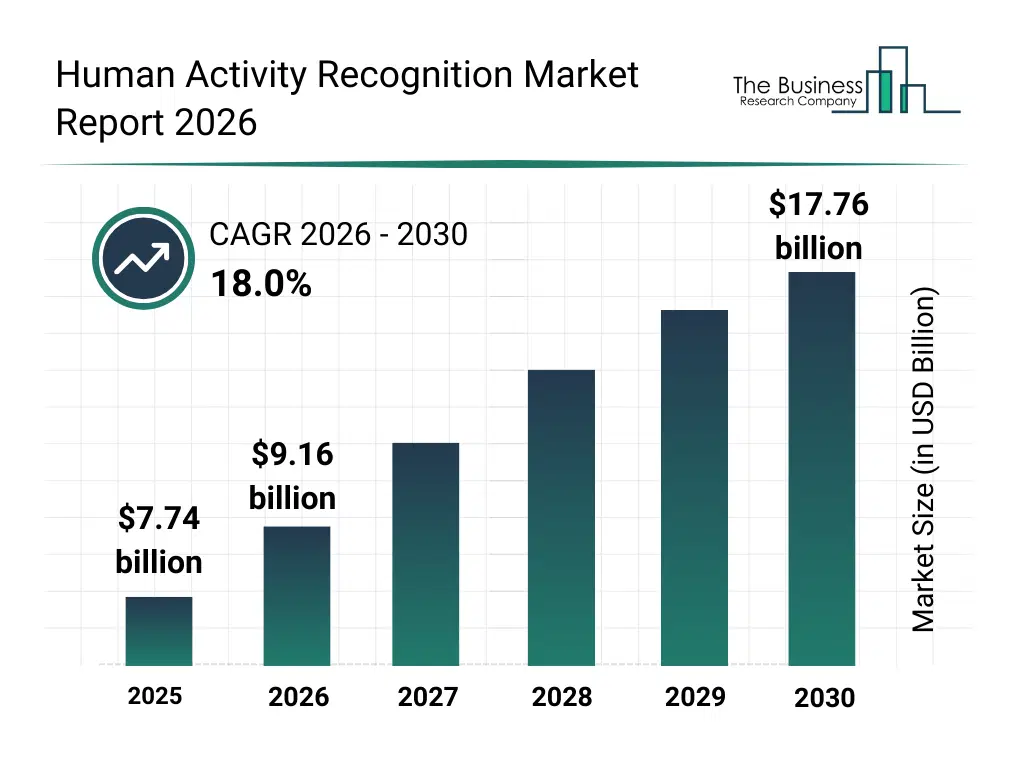
What Is The Human Activity Recognition Market Size and Share 2026?
The human activity recognition market size has grown rapidly in recent years. It will grow from $7.74 billion in 2025 to $9.16 billion in 2026 at a compound annual growth rate (CAGR) of 18.3%. The growth in the historic period can be attributed to growth of wearable device adoption, advances in smartphone sensors, demand for remote patient monitoring, increasing sports analytics usage, improvements in edge AI inference.What Is The Human Activity Recognition Market Growth Forecast?
The human activity recognition market size is expected to see rapid growth in the next few years. It will grow to $17.76 billion in 2030 at a compound annual growth rate (CAGR) of 18.0%. The growth in the forecast period can be attributed to AI-driven preventive healthcare, smart home context awareness, industrial safety monitoring expansion, privacy-preserving on-device analytics, multimodal har with vision and wearables. Major trends in the forecast period include multimodal sensor fusion for activity detection, on-device activity recognition models, privacy-preserving har analytics, real-time fall detection and alerts, context-aware personalization for wearables.
Global Human Activity Recognition Market Segmentation
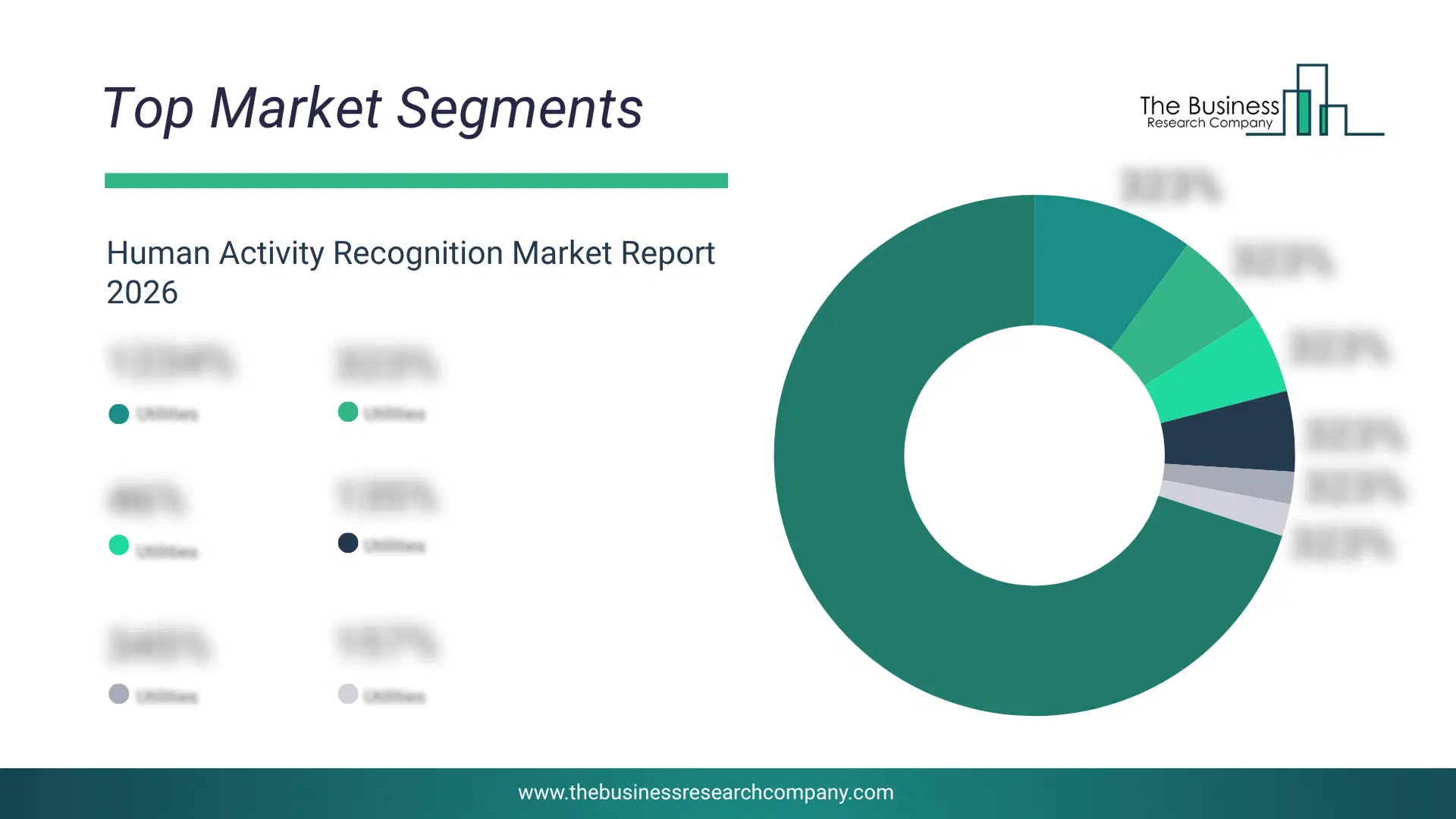
1) By Component: Hardware, Software, Services 2) By Technology: Wearable Sensors, Vision-Based, Smartphone-Based, Other Technologies 3) By Application: Healthcare, Sports And Fitness, Smart Home, Security And Surveillance, Industrial, Other Applications Subsegments: 1) By Hardware: Sensors, Cameras, Processor Units, Power Management Units, Memory Devices 2) By Software: Data Management Software, Signal Processing Software, Real-Time Monitoring Software, Machine Learning Software, Predictive Analytics Software 3) By Services: Consulting Services, Integration And Deployment Services, Support And Maintenance Services, Training And Education Services, Managed ServicesWhat Is The Driver Of The Human Activity Recognition Market?
The increasing adoption of smart devices is expected to support the growth of the human activity recognition (HAR) market going forward. Smart devices are internet-connected electronic systems, such as smartphones, wearables, and smart home appliances that collect and analyze data to perform tasks intelligently and efficiently. Their adoption is rising as consumers seek greater convenience, personalization, and efficiency through interconnected digital ecosystems. The growing use of smart devices generates continuous motion and behavioral data, which enhance the accuracy and application of human activity recognition technologies. For instance, in August 2025, according to Eurostat, the statistical office of the European Union, about 70.9% of people in the European Union used internet-connected or smart devices in 2024, with the highest share recorded in the Netherlands at 94.8%, illustrating strong regional adoption trends. Therefore, the increasing adoption of smart devices is driving the growth of the human activity recognition industry.Key Players In The Global Human Activity Recognition Market
Major companies operating in the human activity recognition market are Apple Inc., Google LLC, Microsoft Corporation, Samsung Electronics Co. Ltd., Huawei Technologies Co. Ltd., Robert Bosch GmbH, Sony Corporation, Intel Corporation, Xiaomi Corporation, Qualcomm Technologies Inc., NEC Corporation, Nokia Corporation, STMicroelectronics N.V., NXP Semiconductors N.V., Hangzhou Hikvision Digital Technology Co. Ltd., Garmin Ltd., Polar Electro Oy, Oura Health Oy, Whoop Inc., Movella Holdings Inc.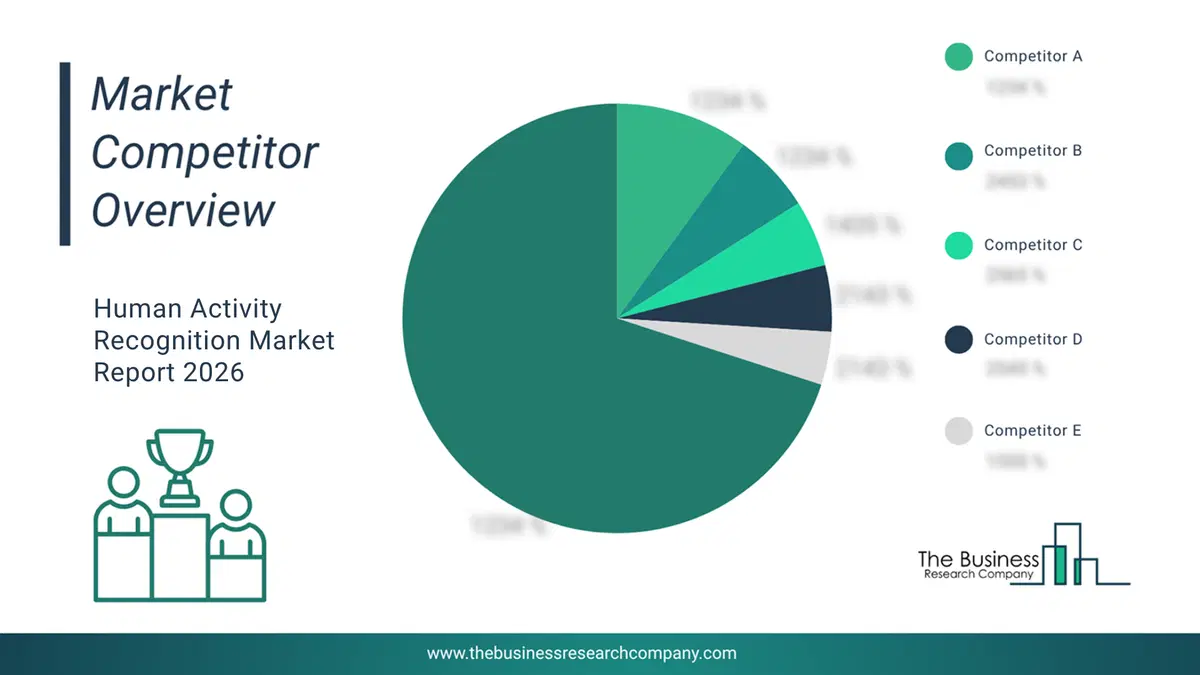
This chart is for illustrative purposes; the full report includes a detailed competitor analysis and comprehensive overview of the top 10 companies in the market.
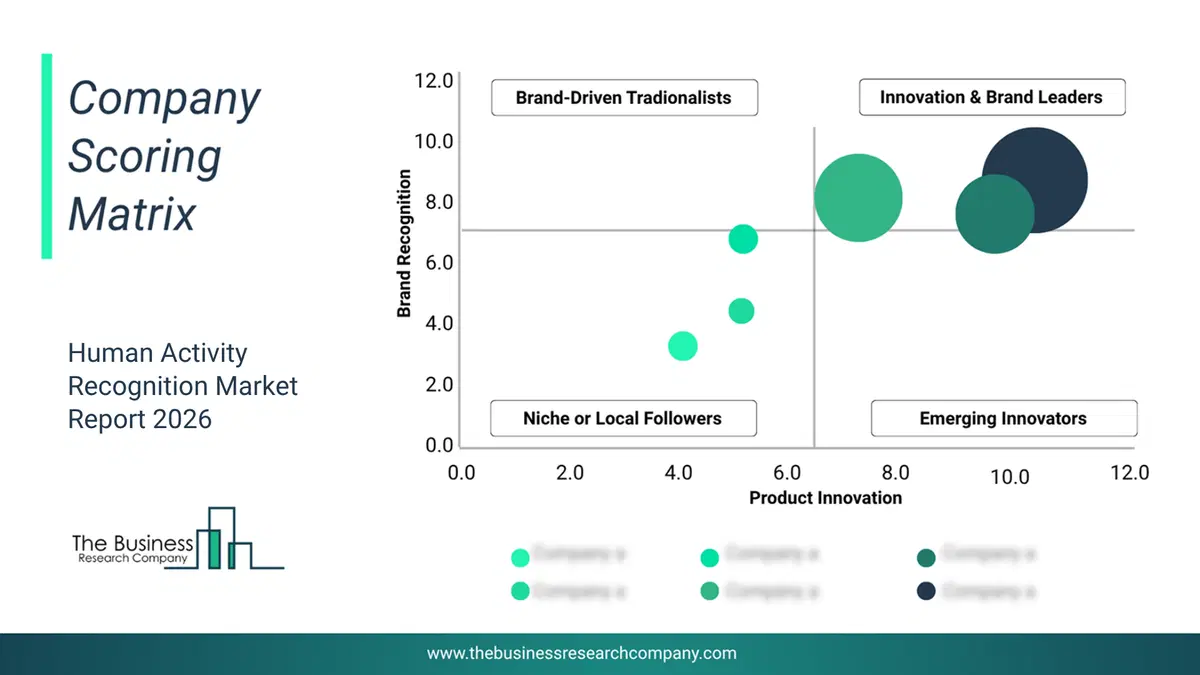
This chart maps companies by product innovation and brand strength, with bubble size indicating relative revenue, helping identify market leaders, challengers, and niche players. This is an illustrative chart; the full report provides a complete and accurate competitive analysis.
Global Human Activity Recognition Market Trends and Insights
Major companies operating in the human activity recognition market are focusing on technological advancements in sensing technologies to enhance real-time activity monitoring, motion detection, and behavioral analysis. Sensing technologies use combinations of motion, physiological, and environmental sensors, such as accelerometers, gyroscopes, temperature sensors, and heart-rate monitors to capture and interpret human movement patterns. These systems enable automatic activity recognition, personalized health insights, and continuous physiological tracking. For instance, in October 2024, Oura Health Oy, a Finland-based wearable technology company specializing in health and activity monitoring, launched the Oura Ring 4, a smart sensing device designed to detect and classify user activities while monitoring sleep, stress, and overall wellness. The product features an upgraded 3D accelerometer and gyroscope for motion tracking, enhanced smart sensing algorithms for improved signal accuracy, and automatic detection across more than 40 activity types. The Oura Ring 4 demonstrates how advancements in sensing technologies improve activity recognition accuracy, user comfort, and health insight personalization.What Are Latest Mergers And Acquisitions In The Human Activity Recognition Market?
In February 2024, ActiGraph, a US-based provider of wearable digital health technologies and medical-grade activity monitoring solutions, partnered with Cambridge Cognition to enhance assessment capabilities in central nervous system (CNS) clinical trials. Through this collaboration, ActiGraph aims to advance human activity recognition and digital biomarker development by integrating continuous actigraphy-based motion sensing with cognitive and speech assessments to generate more objective clinical insights. Cambridge Cognition is a UK-based digital health company that specializes in cognitive assessment technologies and digital biomarkers for brain health.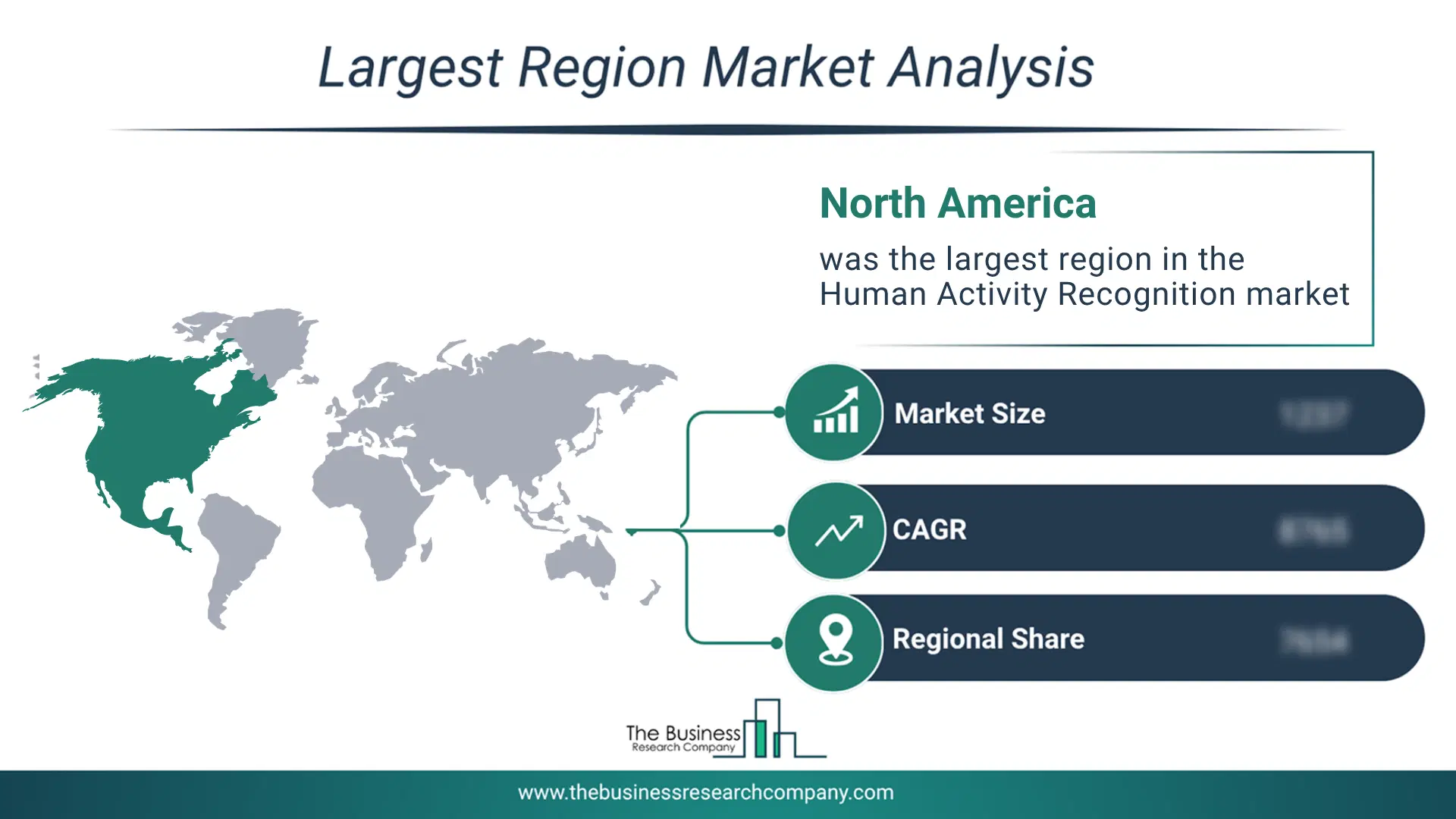
Regional Insights
North America was the largest region in the human activity recognition market in 2025. Asia-Pacific is expected to be the fastest-growing region in the forecast period. The regions covered in this market report are Asia-Pacific, South East Asia, Western Europe, Eastern Europe, North America, South America, Middle East, Africa. The countries covered in this market report are Australia, Brazil, China, France, Germany, India, Indonesia, Japan, Taiwan, Russia, South Korea, UK, USA, Canada, Italy, Spain.What Defines the Human Activity Recognition Market?
The human activity recognition market consists of revenues earned by entities by providing services such as data annotation services, algorithm development services, cloud integration services, system customization services, model training services, and performance optimization services. The market value includes the value of related goods sold by the service provider or included within the service offering. The human activity recognition market also includes sales of smart wearable bands, motion tracking systems, gesture recognition devices, depth sensing cameras, environmental monitoring units, and edge computing modules. Values in this market are ‘factory gate’ values, that is the value of goods sold by the manufacturers or creators of the goods, whether to other entities (including downstream manufacturers, wholesalers, distributors and retailers) or directly to end customers. The value of goods in this market includes related services sold by the creators of the goods.How is Market Value Defined and Measured?
The market value is defined as the revenues that enterprises gain from the sale of goods and/or services within the specified market and geography through sales, grants, or donations in terms of the currency (in USD unless otherwise specified). The revenues for a specified geography are consumption values that are revenues generated by organizations in the specified geography within the market, irrespective of where they are produced. It does not include revenues from resales along the supply chain, either further along the supply chain or as part of other products.
This chart presents market attractiveness based on a quantitative evaluation of growth, competition, strategic alignment, and risk, offering a clear view of opportunity areas for decision-making. This chart is for illustrative purposes; the full report contains the complete analysis.

This chart highlights the Total Addressable Market (TAM) by estimating the maximum revenue opportunity using an assumption-driven approach, supporting strategic planning and opportunity sizing across markets. The chart is illustrative; the full report provides a more comprehensive analysis.
What Key Data and Analysis Are Included in the Human Activity Recognition Market Report 2026?
The human activity recognition market research report is one of a series of new reports from The Business Research Company that provides market statistics, including industry global market size, regional shares, competitors with the market share, detailed market segments, market trends and opportunities, and any further data you may need to thrive in the human activity recognition industry. The market research report delivers a complete perspective of everything you need, with an in-depth analysis of the current and future state of the industry.Human Activity Recognition Market Report Forecast Analysis
| Report Attribute | Details |
|---|---|
| Market Size Value In 2026 | $9.16 billion |
| Revenue Forecast In 2030 | $17.76 billion |
| Growth Rate | CAGR of 18% from 2026 to 2030 |
| Base Year For Estimation | 2025 |
| Actual Estimates/Historical Data | 2020-2025 |
| Forecast Period | 2026 - 2030 |
| Market Representation | Revenue in USD Billion and CAGR from 2026 to 2030 |
| Segments Covered | Component, Technology, Application |
| Regional Scope | Asia-Pacific, Western Europe, Eastern Europe, North America, South America, Middle East, Africa |
| Country Scope | The Countries Covered In This Market Report Are Australia, Brazil, China, France, Germany, India, Indonesia, Japan, Taiwan, Russia, South Korea, Uk, Usa, Canada, Italy, Spain. |
| Key Companies Profiled | Apple Inc., Google LLC, Microsoft Corporation, Samsung Electronics Co. Ltd., Huawei Technologies Co. Ltd., Robert Bosch GmbH, Sony Corporation, Intel Corporation, Xiaomi Corporation, Qualcomm Technologies Inc., NEC Corporation, Nokia Corporation, STMicroelectronics N.V., NXP Semiconductors N.V., Hangzhou Hikvision Digital Technology Co. Ltd., Garmin Ltd., Polar Electro Oy, Oura Health Oy, Whoop Inc., Movella Holdings Inc. |
| Customization Scope | Request for Customization |
| Pricing And Purchase Options | Explore Purchase Options |