
Human Centric Lighting Global Market Opportunities And Strategies To 2035
By Component (Sensors, Drivers, Microprocessors And Microcontrollers, Switches And Dimmers, Transmitters And Receivers), By Installation Type (New Installations, Retrofit Installations), By Application (Wholesale And Retail, Enterprises And Data Centers, Residential, Educational Institutions, Healthcare, Industrial, Hospitality), And By Region, Opportunities And Strategies – Global Forecast To 2035
Human Centric Lighting Market Definition
Human centric lighting refers to lighting systems designed to support human health, well-being and productivity by aligning artificial light with natural human circadian rhythms. These systems adjust lighting parameters such as intensity, color temperature and timing to mimic natural daylight patterns throughout the day. The human centric lighting market consists of revenues generated by entities (organizations, sole traders and partnerships) by providing lighting systems and related components that are designed to align artificial lighting with human biological rhythms.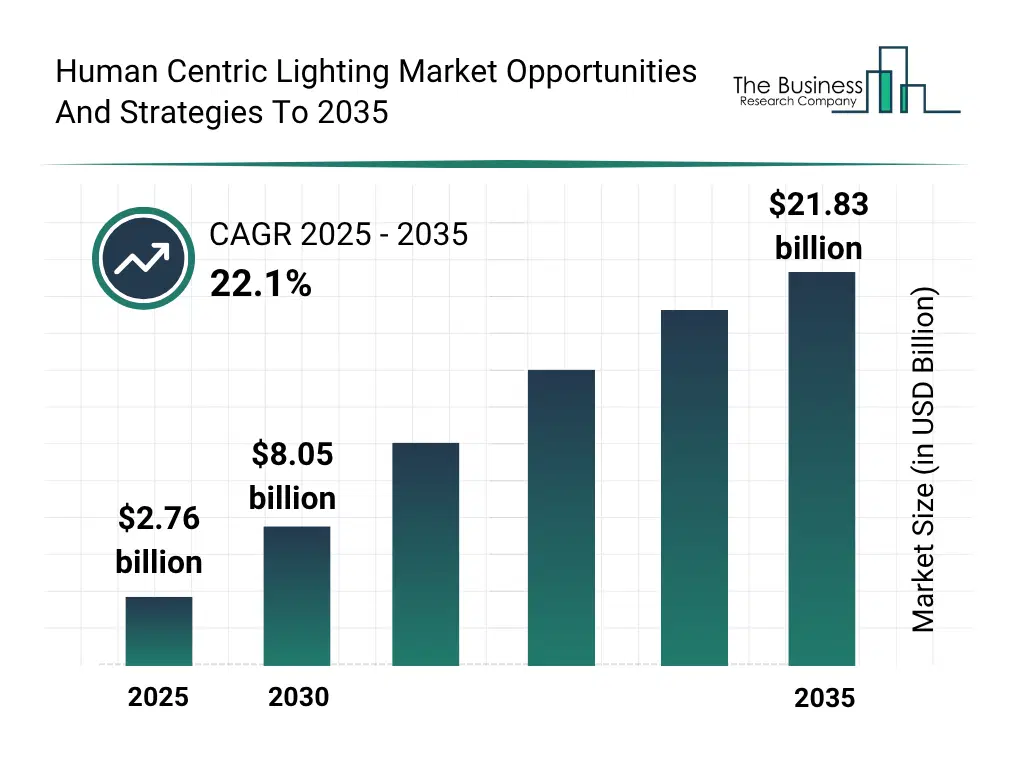
Human Centric Lighting Market Size
The global human centric lighting market reached a value of nearly $2,760.4 million in 2025, having grown at a compound annual growth rate (CAGR) of 25.5% since 2020. The market is expected to grow from $2,760.4 million in 2025 to $8,051.4 million in 2030 at a rate of 23.9%. The market is then expected to grow at a CAGR of 22.1% from 2030 and reach $21,832.2 million in 2035. Growth in the historic period resulted from growth in smart city projects, increasing adoption in healthcare and elderly care facilities, growing commercial construction activities and expansion of commercial office spaces and co-working environments. Factors that negatively affected growth in the historic period were high initial investment cost and high maintenance and calibration requirements. Going forward, adoption of net-zero energy building concepts, growing awareness of health and well-being benefits of lighting, supportive government regulations for energy-efficient lighting systems and growth in smart home adoption will drive the growth. Factors that could hinder the growth of the human centric lighting market in the future include lack of standardization, limited awareness among end users and trade war and tariffs.
Human Centric Lighting Market Segmentation
The human centric lighting market is segmented by component, by installation type and by application.
By Component –
The human centric lighting market is segmented by component into:
By Installation Type –
The human centric lighting market is segmented by installation type into:
By Application –
The human centric lighting market is segmented by application into:
By Geography - The human centric lighting market is segmented by geography into:
By Component –
The human centric lighting market is segmented by component into:
- a) Sensors
- b) Drivers
- c) Microprocessors And Microcontrollers
- d) Switches And Dimmers
- e) Transmitters And Receivers
By Installation Type –
The human centric lighting market is segmented by installation type into:
- a) New Installations
- b) Retrofit Installations
By Application –
The human centric lighting market is segmented by application into:
- a) Wholesale And Retail
- b) Enterprises And Data Centers
- c) Residential
- d) Educational Institutions
- e) Healthcare
- f) Industrial
- g) Hospitality
By Geography - The human centric lighting market is segmented by geography into:
- China
- India
- Japan
- Australia
- Taiwan
- South Korea
- Indonesia
- USA
- Canada
- Brazil
- France
- Germany
- UK
- Italy
- Spain
- Russia
-
o Asia Pacific
o Africa