
Human-Machine Interface (HMI) Sensors In Wearables Market Report 2026
Global Outlook – By Sensor Type ( Touch Sensors, Motion Sensors, Biometric Sensors, Voice And Audio Sensors, Environmental Sensors, Other Sensor Types), By Device Type ( Smartwatches And Fitness Bands, Smart Glasses Or Augmented Reality (AR) Glasses, Smart Clothing, Smart Rings Or Wristbands, Hearables Or Earbuds, Head-Mounted Displays (HMDs), Other Device Types), By Application ( Health And Fitness Monitoring, Gesture And Motion Control, Communication And Voice Interaction, Ambient Sensing And Personalization, Gaming And Immersive Experience, Other Applications), By End Use ( Consumer Electronics, Healthcare, Enterprise And Industrial Applications, Other End Uses) – Market Size, Trends, Strategies, and Forecast to 2030
Human-Machine Interface (HMI) Sensors In Wearables Market Overview
• Human-Machine Interface (HMI) Sensors In Wearables market size has reached to $4.29 billion in 2025 • Expected to grow to $9.72 billion in 2030 at a compound annual growth rate (CAGR) of 17.7% • Growth Driver: Rising Smartphone Penetration Fueling The Growth Of The Market Due To Increasing Internet Accessibility And Demand For Mobile Digital Services • Market Trend: AI-Powered Health Sensing Platforms Enhance Accuracy And User Experience • North America was the largest region in 2025 and Asia-Pacific is the fastest growing region.What Is Covered Under Human-Machine Interface (HMI) Sensors In Wearables Market?
Human-machine interface (HMI) sensors in wearables are advanced electronic devices embedded in wearable technologies that detect and interpret user inputs such as touch, motion, or physiological signals to enable interaction with digital systems. They facilitate seamless communication between the user and the device, enhancing usability, control, and real-time feedback in applications that require precise human-system interaction and contextual awareness. The main sensor types of human-machine interface (HMI) sensors in wearables are touch sensors, motion sensors, biometric sensors, voice and audio sensors, environmental sensors, and others. Touch sensors are input devices that detect and respond to physical contact or touch gestures, enabling intuitive user interaction with wearable devices. These are utilized in various device types, including smartwatches and fitness bands, smart glasses or augmented reality (AR) glasses, smart clothing, smart rings or wristbands, hearables or earbuds, head-mounted displays (HMDs), and others, which are used in applications such as health and fitness monitoring, gesture and motion control, communication and voice interaction, ambient sensing and personalization, gaming and immersive experience, and others, serving end users such as consumer electronics, healthcare, enterprise and industrial applications, and others.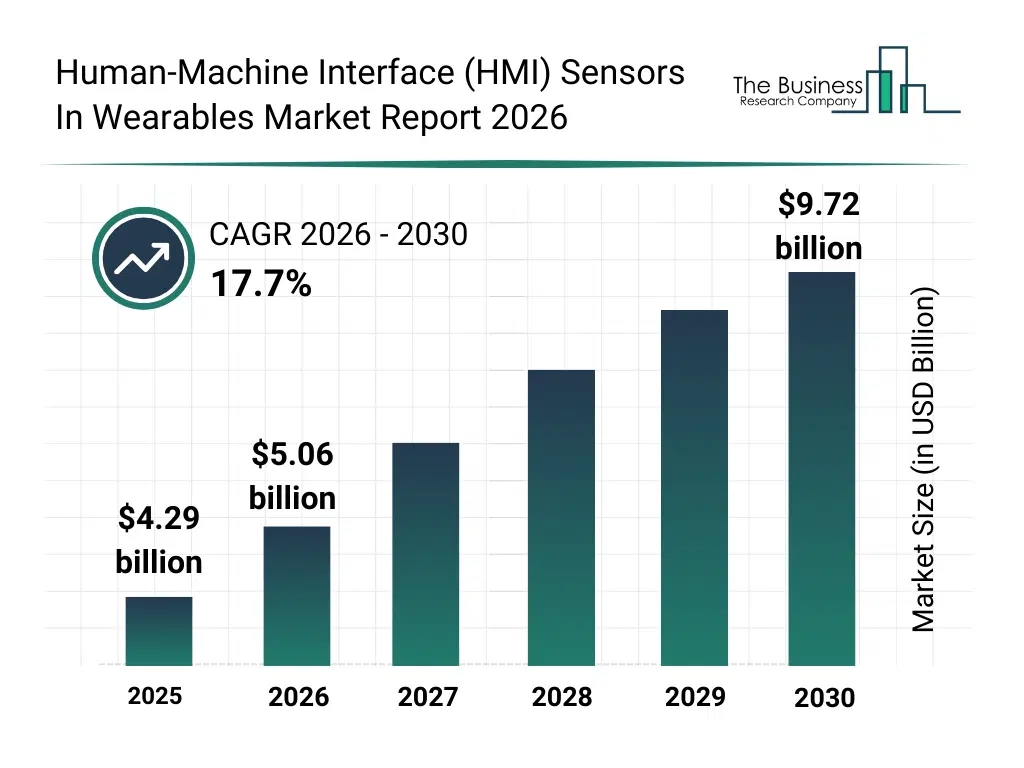
What Is The Human-Machine Interface (HMI) Sensors In Wearables Market Size 2026 And Growth Rate?
The human-machine interface (hmi) sensors in wearables market size has grown rapidly in recent years. It will grow from $4.29 billion in 2025 to $5.06 billion in 2026 at a compound annual growth rate (CAGR) of 17.9%. The growth in the historic period can be attributed to increasing adoption of wearable devices, advancements in sensor technologies, growing consumer awareness for health monitoring, early integration of hmi in smart devices, rise in fitness and sports applications.What Is The Human-Machine Interface (HMI) Sensors In Wearables Market Growth Forecast?
The human-machine interface (hmi) sensors in wearables market size is expected to see rapid growth in the next few years. It will grow to $9.72 billion in 2030 at a compound annual growth rate (CAGR) of 17.7%. The growth in the forecast period can be attributed to emergence of personalized healthcare solutions, integration of AI and ml in wearables, expansion of smart enterprise applications, development of next-gen immersive experiences, increasing demand for remote patient monitoring. Major trends in the forecast period include wearable sensor miniaturization, real-time biometric analytics, context-aware interaction, advanced haptic feedback, edge computing for wearables.
Global Human-Machine Interface (HMI) Sensors In Wearables Market Segmentation
1) By Sensor Type: Touch Sensors, Motion Sensors, Biometric Sensors, Voice And Audio Sensors, Environmental Sensors, Other Sensor Types 2) By Device Type: Smartwatches And Fitness Bands, Smart Glasses Or Augmented Reality (AR) Glasses, Smart Clothing, Smart Rings Or Wristbands, Hearables Or Earbuds, Head-Mounted Displays (HMDs), Other Device Types 3) By Application: Health And Fitness Monitoring, Gesture And Motion Control, Communication And Voice Interaction, Ambient Sensing And Personalization, Gaming And Immersive Experience, Other Applications 4) By End Use: Consumer Electronics, Healthcare, Enterprise And Industrial Applications, Other End Uses Subsegments: 1) By Touch Sensors: Capacitive Touch Sensors, Resistive Touch Sensors, Infrared Touch Sensors, Optical Touch Sensors, Surface Acoustic Wave Touch Sensors 2) By Motion Sensors: Accelerometers, Gyroscopes, Magnetometers, Inertial Measurement Units, Proximity Sensors 3) By Biometric Sensors: Fingerprint Sensors, Heart Rate Sensors, Electrocardiogram Sensors, Blood Oxygen Sensors, Facial Recognition Sensors, Skin Temperature Sensors 4) By Voice And Audio Sensors: Microphones, Voice Recognition Sensors, Acoustic Sensors, Bone Conduction Sensors 5) By Environmental Sensors: Temperature Sensors, Humidity Sensors, Pressure Sensors, Gas Sensors, Light Sensors, Ultraviolet Sensors 6) By Other Sensor Types: Haptic Feedback Sensors, Electromyography Sensors, Electroencephalography Sensors, Galvanic Skin Response Sensors, Force Sensors, Flex SensorsWhat Is The Driver Of The Human-Machine Interface (HMI) Sensors In Wearables Market?
The rising smartphone penetration is expected to propel the growth of the human-machine interface (HMI) sensors in wearables market going forward. Smartphone penetration refers to the percentage of a population that owns or regularly uses a smartphone within a specific region or market. Increasing smartphone penetration rates are due to increasing internet accessibility, affordable devices, and growing demand for mobile digital services. Human-Machine Interface (HMI) sensors in wearables enhance smartphones by enabling intuitive and seamless user interactions, such as gesture control, touchless commands, and real-time physiological monitoring. They improve user experience by providing faster response, personalised feedback, and smarter device control, making smartphone usage more convenient and engaging. For instance, in October 2023, according to the GSM Association, a UK-based non-profit organization, nearly 4.3 billion people (53% of the global population) were using their own smartphones to access the internet, and approximately 80% of mobile internet users are now using 4G or 5G smartphones, reflecting an increase of 330 million people from 2022 to 2023. Therefore, the rising smartphone penetration is driving the growth of the human-machine interface (HMI) sensors in wearables industry.Key Players In The Global Human-Machine Interface (HMI) Sensors In Wearables Market
Major companies operating in the human-machine interface (hmi) sensors in wearables market are Apple Inc., Samsung Electronics Co. Ltd., Qualcomm Technologies Inc., Broadcom Inc., Texas Instruments Incorporated, TDK Corporation, STMicroelectronics N.V., Infineon Technologies AG, NXP Semiconductors NV, Analog Devices Inc., Microchip Technology Inc., Omron Corporation, Ams-OSRAM AG, Garmin Ltd., Qorvo Inc., ROHM Co. Ltd., Synaptics Incorporated, Goodix Technology Co. Ltd., Sensirion AG, Bosch Sensortec GmbH, Valencell Inc., Interlink Electronics Inc., Ultrasense Systems Inc.
This chart is for illustrative purposes; the full report includes a detailed competitor analysis and comprehensive overview of the top 10 companies in the market.
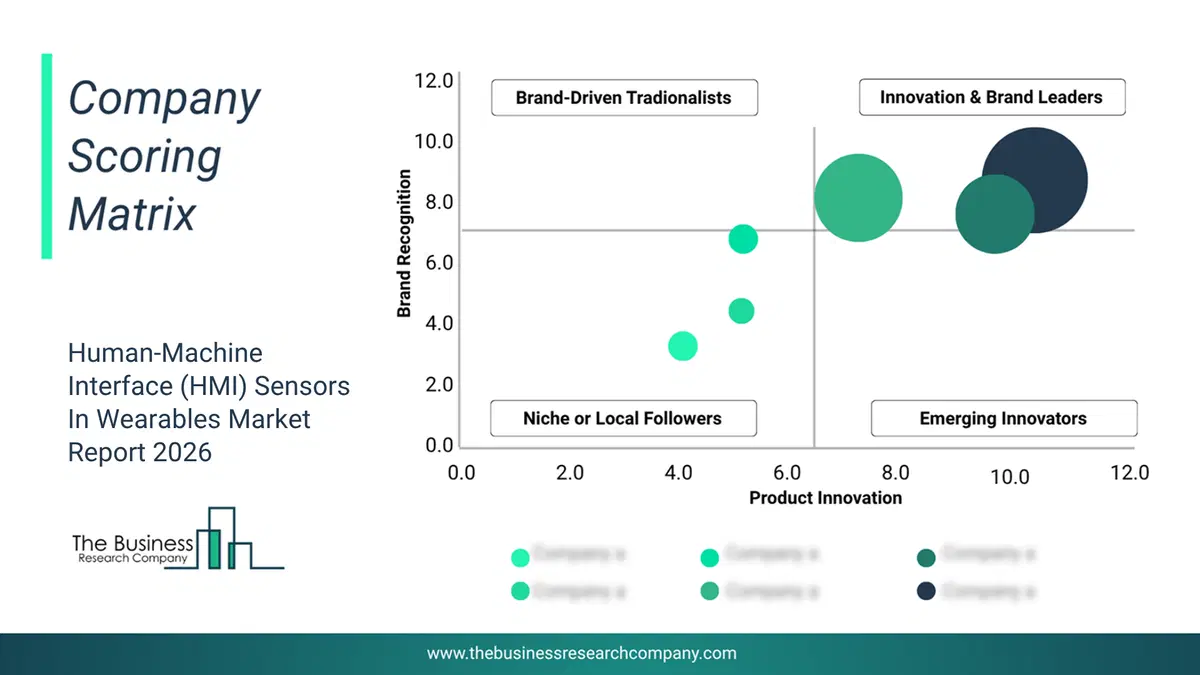
This chart maps companies by product innovation and brand strength, with bubble size indicating relative revenue, helping identify market leaders, challengers, and niche players. This is an illustrative chart; the full report provides a complete and accurate competitive analysis.
Global Human-Machine Interface (HMI) Sensors In Wearables Market Trends and Insights
Major companies operating in the human-machine interface (HMI) sensors in wearables market are focusing on developing advanced systems, such as AI-powered health sensing platforms, to boost accuracy, enhance user experience, and provide comprehensive health monitoring. An artificial intelligence (AI)-powered health sensing platform refers to an integrated hardware and software platform in wearables that uses artificial intelligence to process multiple health signals simultaneously, transforming raw sensor data into actionable health insights. For instance, in August 2024, Huawei Technologies Co., Ltd., a China-based provider of consumer electronics and information and communications technology solutions, launched the HUAWEI TruSense System. This system incorporates a multi-sensor architecture capable of monitoring more than sixty health and fitness indicators across several body systems, including assessments of emotional well-being derived from heart rate and nervous system data. It is distinguished by its certified accuracy, adaptability to varying user conditions, and openness to ecosystem collaboration, positioning it as a significant advancement in digital health and wearable technology.What Are Latest Mergers And Acquisitions In The Human-Machine Interface (HMI) Sensors In Wearables Market?
In March 2023, FundamentalVR, a UK-based medical technology company, partnered with Haply Robotics Inc. to transform traditional surgical training methods through virtual reality (VR). Through this partnership, FundamentalVR aims to enhance its HapticVR platform by integrating Haply Robotics’ advanced haptic technology to improve the realism, portability, and effectiveness of virtual surgical training. Haply Robotics Inc. is a Canada-based technology company that designs and manufactures precision haptic devices, such as force-feedback controllers and tactile interfaces, for human-machine interface (HMI) applications in wearables, robotics, medical simulation and immersive environments.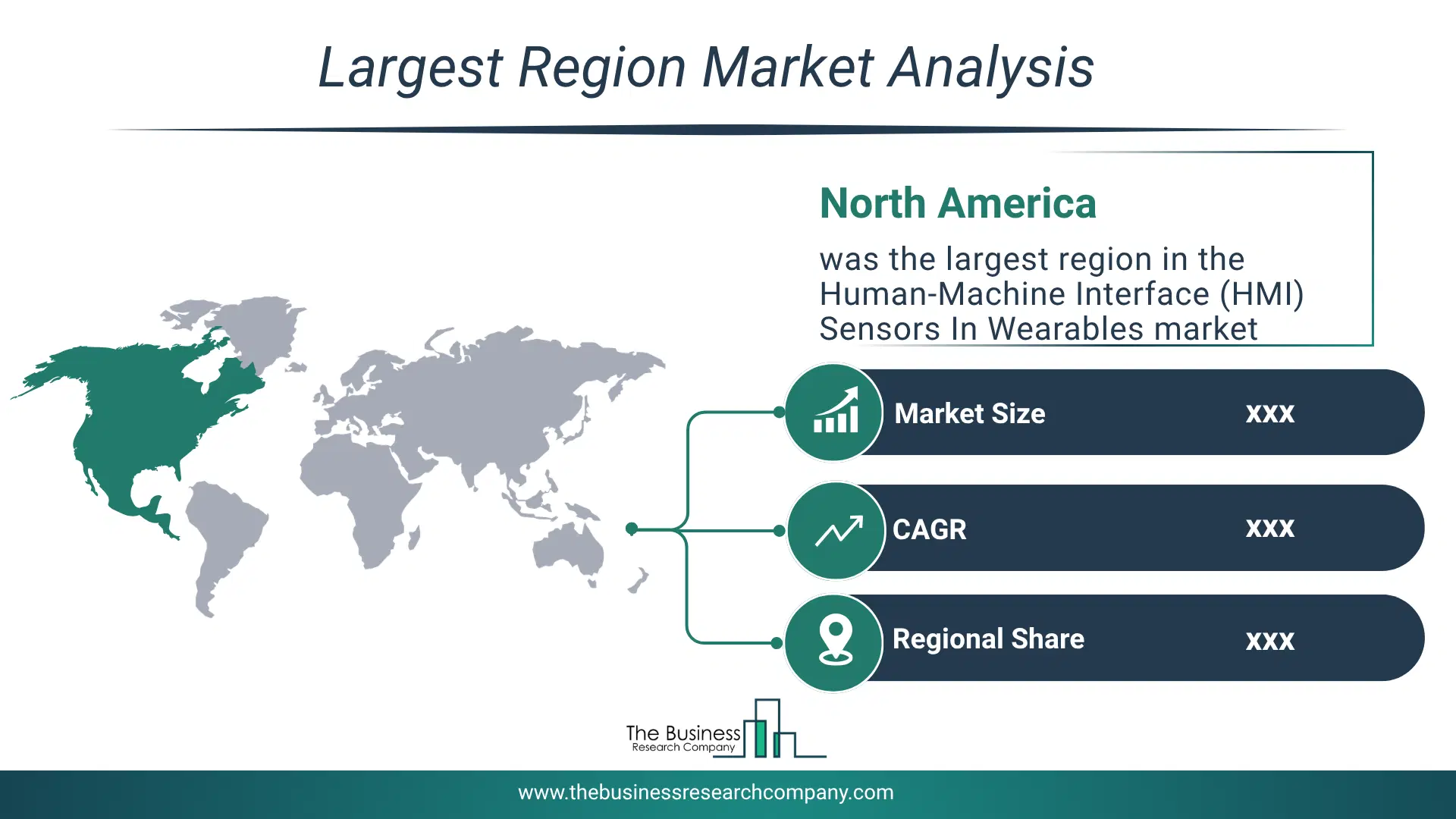
Regional Outlook
North America was the largest region in the human-machine interface (HMI) sensors in wearables market in 2025. Asia-Pacific is expected to be the fastest-growing region in the forecast period. The regions covered in this market report are Asia-Pacific, South East Asia, Western Europe, Eastern Europe, North America, South America, Middle East, Africa. The countries covered in this market report are Australia, Brazil, China, France, Germany, India, Indonesia, Japan, Taiwan, Russia, South Korea, UK, USA, Canada, Italy, Spain.What Defines the Human-Machine Interface (HMI) Sensors In Wearables Market?
The human-machine interface (HMI) sensors in wearables market consists of revenues earned by entities by providing services such as gesture control, voice command, touchless navigation, biometric authentication, and health monitoring. The market value includes the value of related goods sold by the service provider or included within the service offering. The human-machine interface (HMI) sensors in the wearables market also includes sales of optical sensors, biosensors, pressure sensors, and gesture recognition modules. Values in this market are ‘factory gate’ values, that is the value of goods sold by the manufacturers or creators of the goods, whether to other entities (including downstream manufacturers, wholesalers, distributors and retailers) or directly to end customers. The value of goods in this market includes related services sold by the creators of the goods.How is Market Value Defined and Measured?
The market value is defined as the revenues that enterprises gain from the sale of goods and/or services within the specified market and geography through sales, grants, or donations in terms of the currency (in USD unless otherwise specified). The revenues for a specified geography are consumption values that are revenues generated by organizations in the specified geography within the market, irrespective of where they are produced. It does not include revenues from resales along the supply chain, either further along the supply chain or as part of other products.
This chart presents market attractiveness based on a quantitative evaluation of growth, competition, strategic alignment, and risk, offering a clear view of opportunity areas for decision-making. This chart is for illustrative purposes; the full report contains the complete analysis.

This chart highlights the Total Addressable Market (TAM) by estimating the maximum revenue opportunity using an assumption-driven approach, supporting strategic planning and opportunity sizing across markets. The chart is illustrative; the full report provides a more comprehensive analysis.
What Key Data and Analysis Are Included in the Human-Machine Interface (HMI) Sensors In Wearables Market Report 2026?
The human-machine interface (hmi) sensors in wearables market research report is one of a series of new reports from The Business Research Company that provides market statistics, including industry global market size, regional shares, competitors with the market share, detailed market segments, market trends and opportunities, and any further data you may need to thrive in the human-machine interface (hmi) sensors in wearables industry. The market research report delivers a complete perspective of everything you need, with an in-depth analysis of the current and future state of the industry.Human-Machine Interface (HMI) Sensors In Wearables Market Report Forecast Analysis
| Report Attribute | Details |
|---|---|
| Market Size Value In 2026 | $5.06 billion |
| Revenue Forecast In 2030 | $9.72 billion |
| Growth Rate | CAGR of 17.7% from 2026 to 2030 |
| Base Year For Estimation | 2025 |
| Actual Estimates/Historical Data | 2020-2025 |
| Forecast Period | 2026 - 2030 |
| Market Representation | Revenue in USD Billion and CAGR from 2026 to 2030 |
| Segments Covered | Sensor Type, Device Type, Application, End Use |
| Regional Scope | Asia-Pacific, Western Europe, Eastern Europe, North America, South America, Middle East, Africa |
| Country Scope | The countries covered in the report are Australia, Brazil, China, France, Germany, India, Indonesia, Japan, Taiwan, Russia, South Korea, UK, USA, Canada, Italy, Spain. |
| Key Companies Profiled | Apple Inc., Samsung Electronics Co. Ltd., Qualcomm Technologies Inc., Broadcom Inc., Texas Instruments Incorporated, TDK Corporation, STMicroelectronics N.V., Infineon Technologies AG, NXP Semiconductors NV, Analog Devices Inc., Microchip Technology Inc., Omron Corporation, Ams-OSRAM AG, Garmin Ltd., Qorvo Inc., ROHM Co. Ltd., Synaptics Incorporated, Goodix Technology Co. Ltd., Sensirion AG, Bosch Sensortec GmbH, Valencell Inc., Interlink Electronics Inc., Ultrasense Systems Inc. |
| Customization Scope | Request for Customization |
| Pricing And Purchase Options | Explore Purchase Options |