
HVAC System Market Report 2026
Global Outlook – By Product (Heating, Ventilation, Cooling), By Implementation Type (New Construction, Retrofit), By Application (Commercial, Residential, Industrial) – Market Size, Trends, Strategies, and Forecast to 2030
HVAC System Market Overview
• HVAC System market size has reached to $189.81 billion in 2025 • Expected to grow to $260.58 billion in 2030 at a compound annual growth rate (CAGR) of 6.6% • Growth Driver: Construction Boom Driving Growth Of HVAC System Market • Market Trend: Emergence Of Dual Fuel Systems In HVAC • Asia-Pacific was the largest region in 2025.Market Gains By 2030 – Top Opportunities By Segment
Market Gain identifies the most promising market opportunities by highlighting the segments or products expected to generate the highest incremental revenue growth over the next five years.
What Is Covered Under HVAC System Market?
A heating, ventilation, and air conditioning (HVAC) system is a building mechanical system that provides thermal comfort for occupants along with indoor air quality. It is used to provide comfort by controlling temperature, humidity, and airflow in residential, commercial, and industrial buildings. The main types of HVAC systems are heating, ventilation, and cooling. Heating involves the use of various technologies to control the temperature, humidity, and purity of the air in an HVAC system. The various implementation types include new construction and retrofit and are used in commercial, residential, and industrial applications.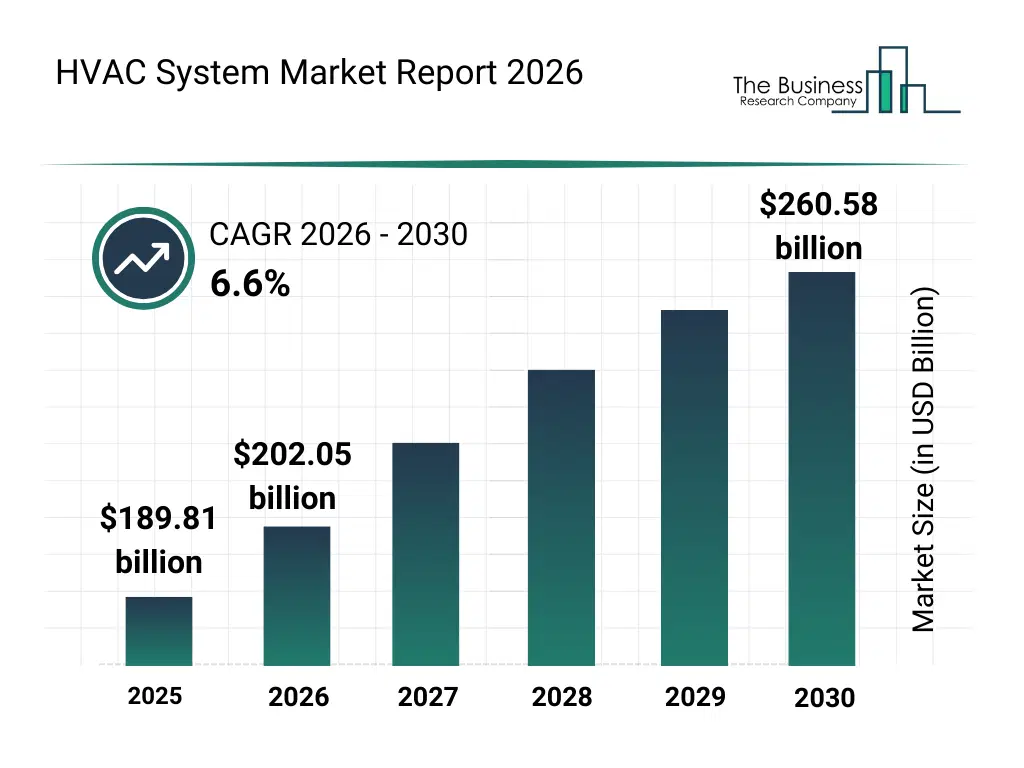
What Is The HVAC System Market Size and Share 2026?
The hvac system market size has grown strongly in recent years. It will grow from $189.81 billion in 2025 to $202.05 billion in 2026 at a compound annual growth rate (CAGR) of 6.5%. The growth in the historic period can be attributed to expansion of commercial construction, residential urbanization, conventional hvac installations, rising cooling demand, building comfort requirements.What Is The HVAC System Market Growth Forecast?
The hvac system market size is expected to see strong growth in the next few years. It will grow to $260.58 billion in 2030 at a compound annual growth rate (CAGR) of 6.6%. The growth in the forecast period can be attributed to smart city initiatives, net zero building targets, energy efficiency regulations, growth of green buildings, digital building management systems. Major trends in the forecast period include increasing adoption of smart hvac systems, growth of retrofit and replacement projects, focus on indoor air quality enhancement, integration of energy recovery technologies, demand for climate adaptive buildings.
Global HVAC System Market Segmentation
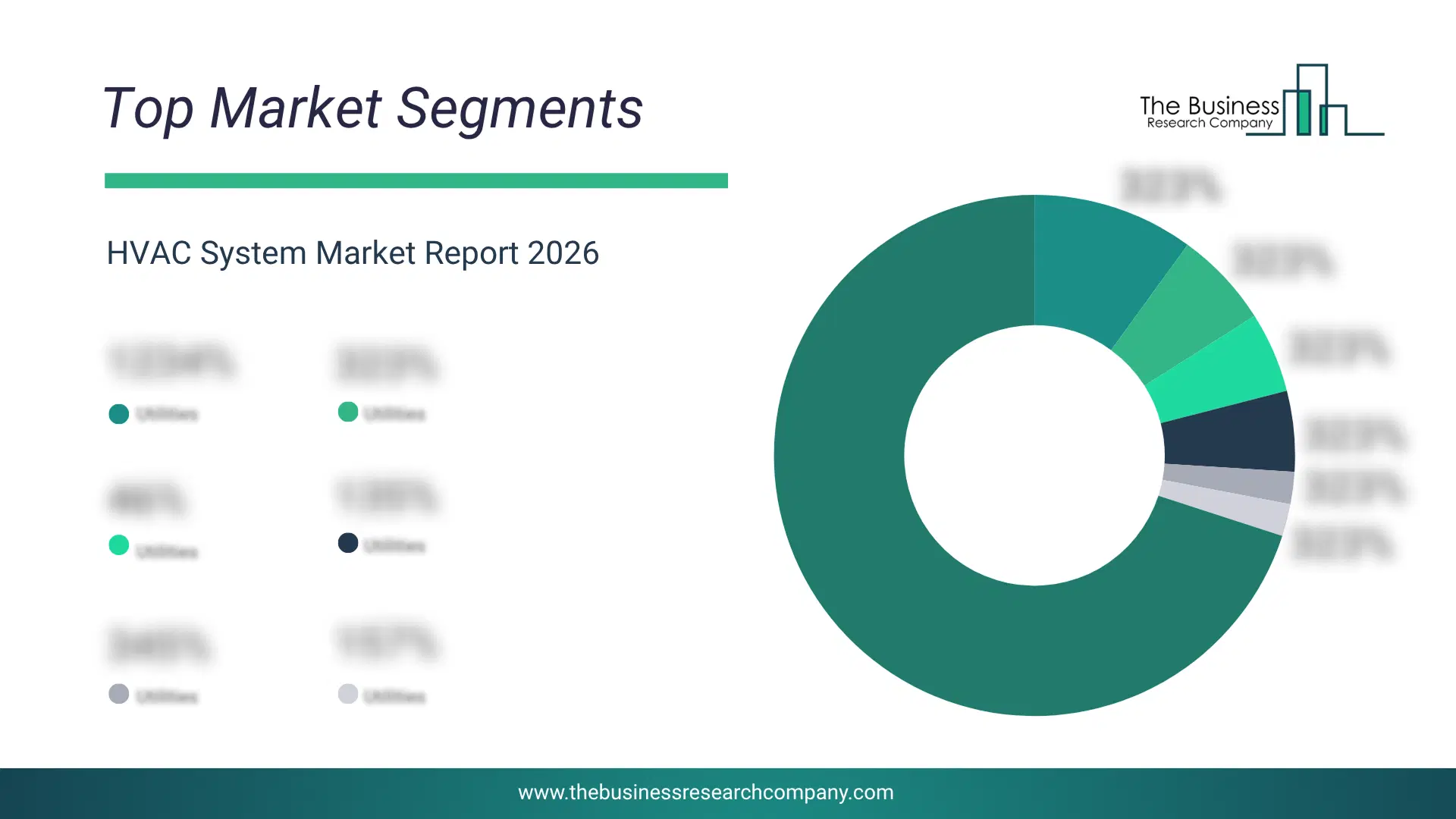
1) By Product: Heating, Ventilation, Cooling 2) By Implementation Type: New Construction, Retrofit 3) By Application: Commercial, Residential, Industrial Subsegments: 1) By Heating: Furnaces, Heat Pumps, Boilers, Radiant Heating Systems, Electric Heaters 2) By Ventilation: Exhaust Fans, Air Handling Units (AHUs), Energy Recovery Ventilators (ERVs), Demand-Controlled Ventilation Systems, Ductless Ventilation Systems 3) By Cooling: Air Conditioners, Chillers, Cooling Towers, Evaporative Coolers The top segments in the hvac system market will be: • Cooling will reach $116.11 Billion by 2030. • Heating will reach $94.14 Billion by 2030. • Ventilation will reach $46.76 Billion by 2030.What Is The Driver Of The HVAC System Market?
The surge in construction activities in the commercial and residential sectors is expected to propel the growth of the HVAC system market going forward. Residential and non-residential (including commercial, industrial, and other) infrastructure are part of the construction sector. A heating, ventilation, and air conditioning (HVAC) system is a building mechanical system that provides thermal comfort for occupants accompanied by indoor air quality and is more frequently used in diverse types of buildings, including industrial, commercial, residential, and institutional buildings. For instance, in March 2024, according to Atradius, a Netherlands-based insurance company that provides trade credit insurance, surety and collections services, global construction output is projected to rise by 2.0% in 2024, an increase from 3.7% in 2023. Growth in advanced economies is anticipated to be 1.8%, while in emerging markets, it is expected to see a 2.2% increase in building activity. Non-residential output and civil engineering are forecasted to grow by 2.8% and 4.4%, respectively, this year. In 2025, global construction is predicted to grow by 1.8%. Residential construction output is expected to rebound by 2.4% due to improving economic conditions and the effects of looser monetary policies. Therefore, the surge in construction activities in the commercial and residential sectors is driving the growth of the HVAC system industry.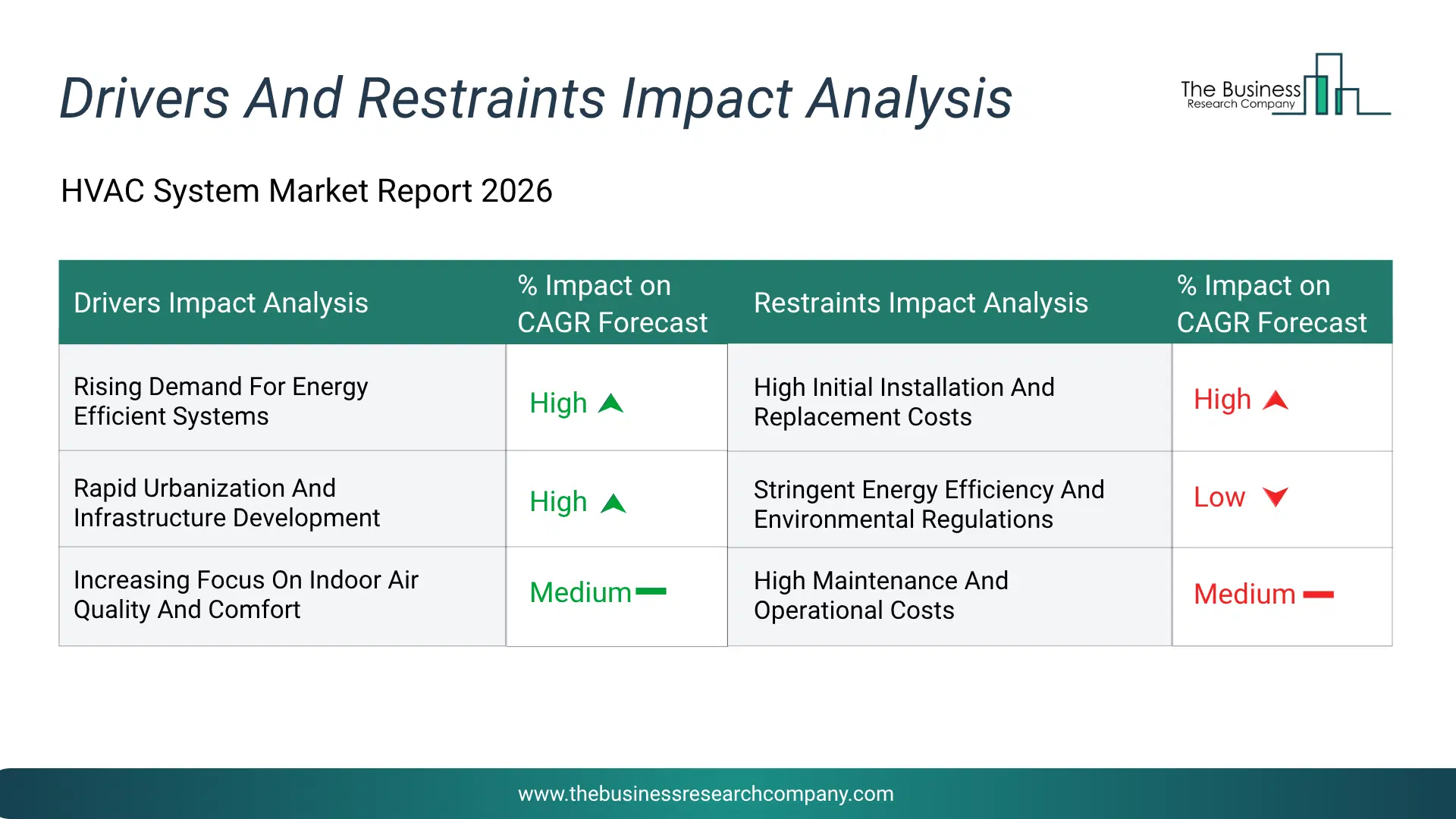
Infographic Chart Showing Key Market Drivers Analysis And Restraints For Hvac System Market
The chart presents an impact analysis of key drivers and restraints, quantifying their relative influence on the market's growth rate and helping assess the balance between growth enablers and limiting factors. This chart offers a high-level perspective; the full report contains more detailed insights.
How Will The Drivers Impact Growth In The Global HVAC System Market?
• Rising Demand For Energy Efficient Systems (High) – During the forecast period, the rising demand for energy efficient systems is expected to become a key growth driver for the HVAC system market by 2030. Building owners and facility managers are increasingly adopting high-efficiency HVAC solutions to reduce operational costs and optimize energy consumption. Advanced technologies such as variable refrigerant flow systems, smart thermostats, and inverter-based equipment are improving system performance while lowering electricity usage. Regulatory frameworks promoting energy conservation and carbon reduction are further encouraging investment in modern HVAC installations. This transition toward energy-efficient climate control solutions is reinforcing steady market expansion. • Rapid Urbanization And Infrastructure Development (High) – During the forecast period, the rapid urbanization and infrastructure development is expected to emerge as a major factor driving the expansion of the HVAC system market by 2030. Increasing construction of residential complexes, commercial buildings, transportation hubs, and mixed-use developments is creating substantial demand for heating, ventilation, and cooling equipment. Growing investments in smart cities and modern urban infrastructure are accelerating the deployment of advanced HVAC technologies designed for large-scale facilities. Expanding economic activity in emerging markets is also supporting new building projects requiring sophisticated climate management systems. • Increasing Focus On Indoor Air Quality And Comfort (Medium) – During the forecast period, the increasing focus on indoor air quality and comfort is expected to act as a key growth catalyst for the HVAC system market by 2030. Occupants across residential, commercial, and institutional environments are placing greater emphasis on healthy indoor spaces with improved air circulation and contaminant control. HVAC manufacturers are responding by integrating advanced filtration, humidity management, and air purification technologies into their systems. Growing awareness of workplace productivity, occupant well-being, and environmental health standards is further strengthening demand for enhanced ventilation solutions.How Will The Restraints Impact Growth In The Global HVAC System Market?
• High Initial Installation And Replacement Costs (High) – During the forecast period, the high initial installation and replacement costs act as a significant restraint for the HVAC system market by increasing the financial burden on end users, especially in residential and small commercial segments. Advanced systems such as VRF units, chillers, and energy-efficient heat pumps require substantial upfront investment, which discourages adoption despite long-term savings. Additionally, retrofitting or replacing existing systems in older buildings further adds to capital expenditure. These high costs slow down purchasing decisions and extend replacement cycles. As a result, market growth is restrained due to affordability concerns and delayed investments. • Stringent Energy Efficiency And Environmental Regulations (High) – During the forecast period, the stringent energy efficiency and environmental regulations act as a restraint by imposing compliance requirements that increase manufacturing and operational complexity. HVAC manufacturers must invest heavily in R&D to meet evolving standards related to refrigerants, emissions, and energy consumption. These regulations can lead to higher product prices, making systems less accessible in price-sensitive markets. Additionally, frequent regulatory updates create uncertainty and delay product launches. This regulatory pressure limits market expansion and challenges smaller players with limited resources. • High Maintenance And Operational Costs (Medium) – During the forecast period, the high maintenance and operational costs act as a restraint by increasing the total cost of ownership for HVAC systems over their lifecycle. Regular servicing, energy consumption, and repair expenses place a continuous financial burden on users, particularly in large-scale commercial and industrial applications. Inefficient or aging systems further escalate energy bills, discouraging prolonged usage or upgrades. These ongoing costs reduce customer willingness to invest in advanced HVAC solutions. Consequently, market growth is impacted as users seek cost-effective or alternative cooling and heating solutions.Key Players In The Global HVAC System Market
Major companies operating in the hvac system market are Daikin Industries Ltd., Johnson Controls International, Carrier Global Corporation, Trane Technologies PLC, LG Electronics, AAON Heating and Cooling Products, Addison HVAC, Allied Commercial, Danfoss AS, Emerson Electric Co., Honeywell International Inc., Mitsubishi Electric Corporation, Nortek Air Management, Samsung Group, Midea Group, Electrolux AB, Toshiba Corporation, York International Corporation, Nortek Global HVAC, Rheem Manufacturing Company, Goodman Manufacturing Company, Lennox International Inc., SPX Corporation, Standex International Corporation, CSW Industrials Inc., EMCOR Group Inc., Ingersoll-Rand plc (Ireland), Watts Water Technologies Inc.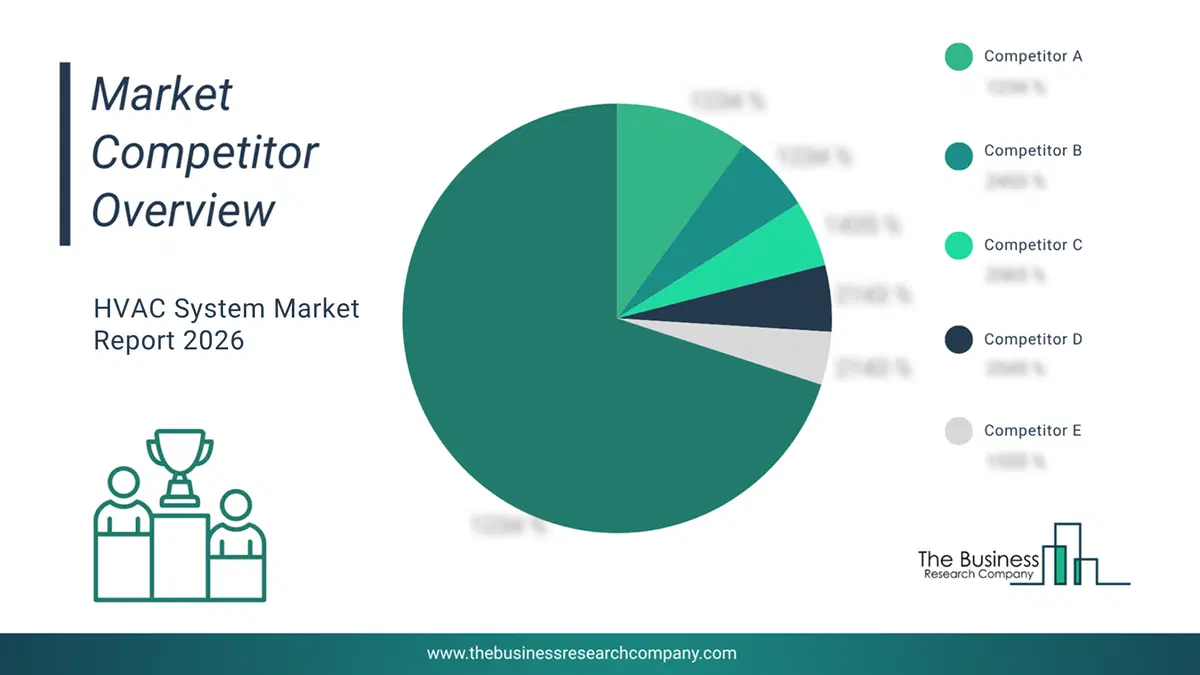
This chart is for illustrative purposes; the full report includes a detailed competitor analysis and comprehensive overview of the top 10 companies in the market.
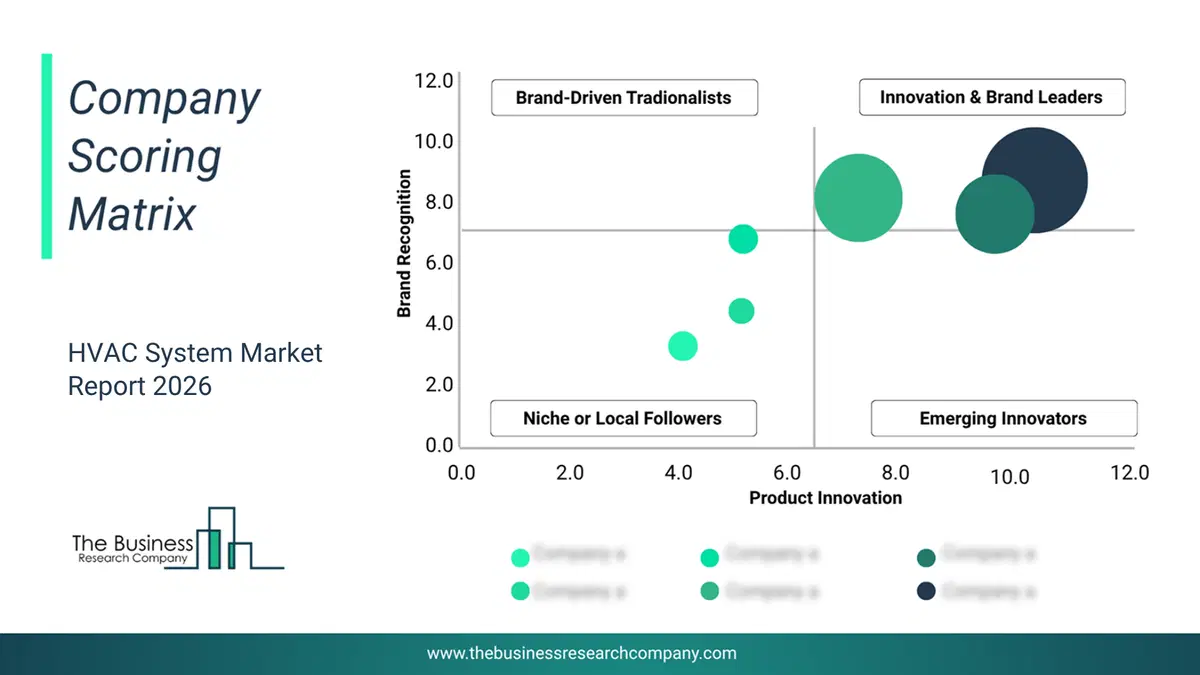
This chart maps companies by product innovation and brand strength, with bubble size indicating relative revenue, helping identify market leaders, challengers, and niche players. This is an illustrative chart; the full report provides a complete and accurate competitive analysis.
Global HVAC System Market Trends and Insights
Major companies operating in the HVAC system market are increasing their focus on introducing advanced heating and cooling solutions, such as the dual fuel system, to gain a competitive edge in the market. A dual fuel system in HVAC (Heating, Ventilation, and Air Conditioning) refers to a heating system that utilizes two different fuel sources, typically natural gas and electricity, allowing for automatic switching between the two based on factors like outdoor temperature and cost efficiency to optimize energy use and enhance heating performance. For instance, in September 2023, Johnson Controls-Hitachi Air Conditioning, a Hong Kong-based air conditioning manufacturer, launched the Hitachi Air365 Hybrid dual fuel system. The Hitachi Air365 Hybrid dual fuel system is an advanced heating and cooling solution that seamlessly integrates both gas and electric technologies for efficient and flexible climate control in residential and commercial settings. The system features an electric Hitachi Mini VRF heat pump as the primary heating and cooling source and an innovative dual-fuel module that attaches to a home's new or existing gas furnace.What Are Latest Mergers And Acquisitions In The HVAC System Market?
In May 2023, Daikin Applied, a US-based HVAC solutions company, acquired Carroll Air Systems for an undisclosed amount. The acquisition is expected to help Daikin Applied expand its HVAC product offerings. Aldridge Carroll Air Systems is a US-based company that specializes in providing heating, ventilation, and air-conditioning (HVAC) systems and services for commercial, industrial, and institutional facilities.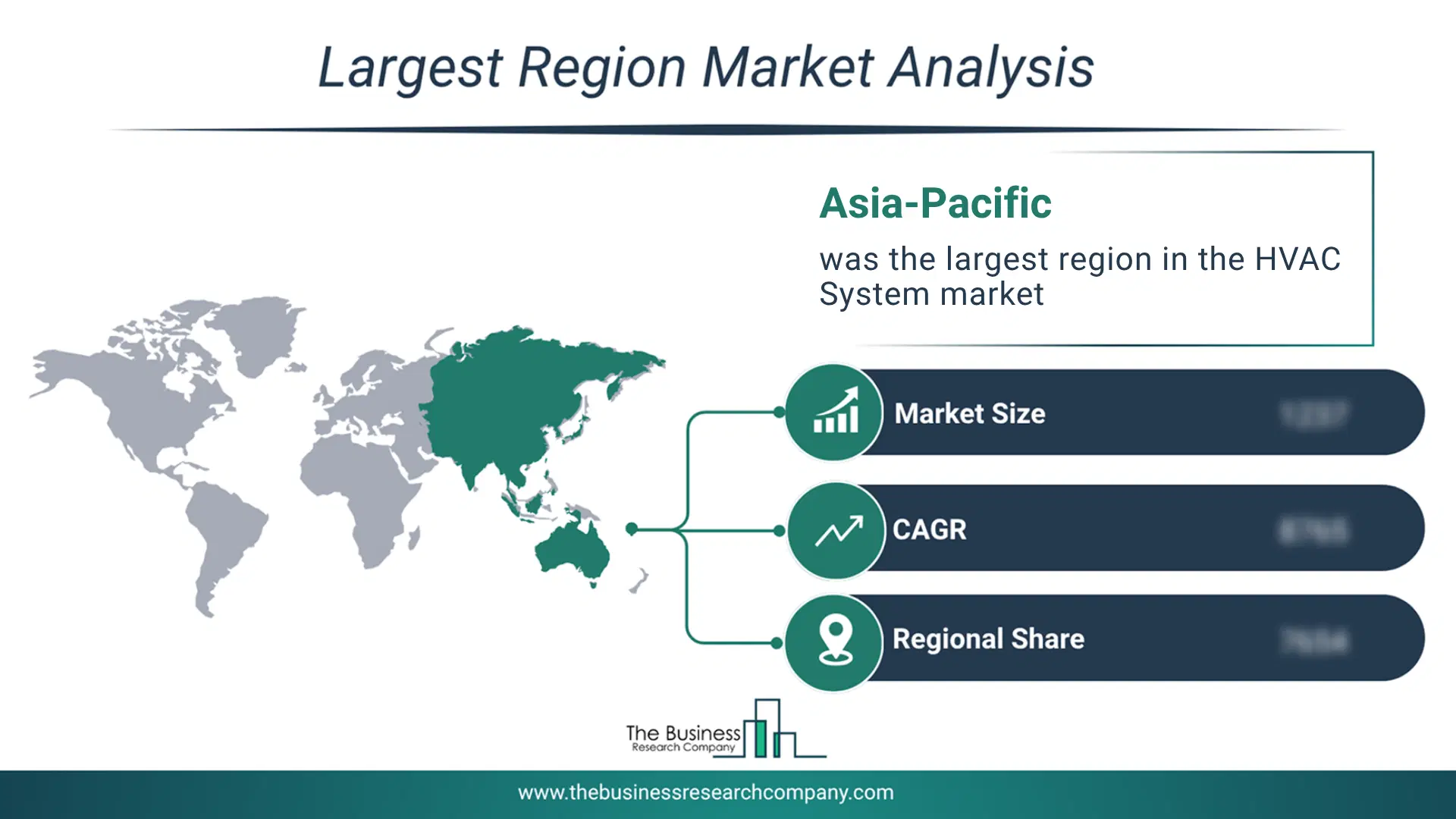
Regional Outlook
Asia-Pacific was the largest region in the HVAC system market in 2025. The regions covered in this market report are Asia-Pacific, South East Asia, Western Europe, Eastern Europe, North America, South America, Middle East, Africa The countries covered in this market report are Australia, Brazil, China, France, Germany, India, Indonesia, Japan, Taiwan, Russia, South Korea, UK, USA, Canada, Italy, Spain.What Defines the HVAC System Market?
The HVAC system market consists of sales of heat pumps, furnaces, unitary heaters, boilers, single splits, variable refrigerant flow (VRF) systems, chillers, room air conditioners, and other types. Values in this market are ‘factory gate’ values, that is, the value of goods sold by the manufacturers or creators of the goods, whether to other entities (including downstream manufacturers, wholesalers, distributors, and retailers) or directly to end customers. The value of goods in this market includes related services sold by the creators of the goods.How is Market Value Defined and Measured?
The market value is defined as the revenues that enterprises gain from the sale of goods and/or services within the specified market and geography through sales, grants, or donations in terms of the currency (in USD unless otherwise specified). The revenues for a specified geography are consumption values that are revenues generated by organizations in the specified geography within the market, irrespective of where they are produced. It does not include revenues from resales along the supply chain, either further along the supply chain or as part of other products.
This chart presents market attractiveness based on a quantitative evaluation of growth, competition, strategic alignment, and risk, offering a clear view of opportunity areas for decision-making. This chart is for illustrative purposes; the full report contains the complete analysis.

This chart highlights the Total Addressable Market (TAM) by estimating the maximum revenue opportunity using an assumption-driven approach, supporting strategic planning and opportunity sizing across markets. The chart is illustrative; the full report provides a more comprehensive analysis.
What Key Data and Analysis Are Included in the HVAC System Market Report 2026?
The hvac system market research report is one of a series of new reports from The Business Research Company that provides market statistics, including industry global market size, regional shares, competitors with the market share, detailed market segments, market trends and opportunities, and any further data you may need to thrive in the hvac system industry. The market research report delivers a complete perspective of everything you need, with an in-depth analysis of the current and future state of the industry.HVAC System Market Report Forecast Analysis
| Report Attribute | Details |
|---|---|
| Market Size Value In 2026 | $202.05 billion |
| Revenue Forecast In 2030 | $260.58 billion |
| Growth Rate | CAGR of 6.5% from 2026 to 2030 |
| Base Year For Estimation | 2025 |
| Actual Estimates/Historical Data | 2020-2025 |
| Forecast Period | 2026 - 2030 |
| Market Representation | Revenue in USD Billion and CAGR from 2026 to 2030 |
| Segments Covered | Product, Implementation Type, Application |
| Regional Scope | Asia-Pacific, Western Europe, Eastern Europe, North America, South America, Middle East, Africa |
| Country Scope | The countries covered in the report are Australia, Brazil, China, France, Germany, India, Indonesia, Japan, Taiwan, Russia, South Korea, UK, USA, Canada, Italy, Spain. |
| Key Companies Profiled | Daikin Industries Ltd., Johnson Controls International, Carrier Global Corporation, Trane Technologies PLC, LG Electronics, AAON Heating and Cooling Products, Addison HVAC, Allied Commercial, Danfoss AS, Emerson Electric Co., Honeywell International Inc., Mitsubishi Electric Corporation, Nortek Air Management, Samsung Group, Midea Group, Electrolux AB, Toshiba Corporation, York International Corporation, Nortek Global HVAC, Rheem Manufacturing Company, Goodman Manufacturing Company, Lennox International Inc., SPX Corporation, Standex International Corporation, CSW Industrials Inc., EMCOR Group Inc., Ingersoll-Rand plc (Ireland), Watts Water Technologies Inc. |
| Customization Scope | Request for Customization |
| Pricing And Purchase Options | Explore Purchase Options |