
Hybrid Additive Manufacturing Machines Market Report 2026
Global Outlook – By Component (Hardware, Software, Services), By Technology Type (Directed Energy Deposition (DED), Binder Jetting, Material Extrusion, Material Jetting, Powder Bed Fusion (PBF) ), By Machine Size (Desktop, Industrial, Large-Format, Portable, Customized Solutions), By Application (Repair, Production, Prototype), By End-Use Industry (Aerospace And Defense, Automotive, Medical And Dental, Energy And Power, Industrial Machinery, Electronics) – Market Size, Trends, Strategies, and Forecast to 2030
Hybrid Additive Manufacturing Machines Market Overview
• Hybrid Additive Manufacturing Machines market size has reached to $2.37 billion in 2025 • Expected to grow to $5.45 billion in 2030 at a compound annual growth rate (CAGR) of 18.1% • Growth Driver: Rising Adoption Of Industry 4.0 And Smart Factories Fueling The Growth Of The Market Due To Increasing Demand For Flexible, Digitally Integrated Manufacturing Systems • Market Trend: Advancing Manufacturing Systems To Enhance Metal Production Quality, Efficiency, And Industrial Scalability • North America was the largest region in 2025 and Asia-Pacific is the fastest growing region.What Is Covered Under Hybrid Additive Manufacturing Machines Market?
Hybrid additive manufacturing machines are advanced production systems that combine additive manufacturing (3d printing) technologies with traditional subtractive manufacturing methods, enabling the fabrication of complex, high-precision components. These machines allow layer-by-layer material deposition while integrating machining, milling, or finishing processes within the same platform, delivering enhanced accuracy, reduced lead times, and increased design flexibility. The main product types of hybrid additive manufacturing machines include infrared spark detectors, ultraviolet (UV) spark detectors, and other product types. Infrared spark detectors are devices that use infrared radiation to identify sparks or flames in industrial processes, helping prevent fire hazards. Different installation types include duct-mounted systems, conveyor-mounted systems, pneumatic transport systems, and standalone units. Multiple detection methods include point detection, line detection, area detection, and volumetric detection. Various sensor types are infra-red sensor type, ultraviolet bulb sensor type, multi-spectrum sensors, flame ionization sensors, and other sensor types, and they are used by several end-users such as the wood processing industry, pulp and paper industry, metal processing industry, food industry, textile industry, chemical industry, and others.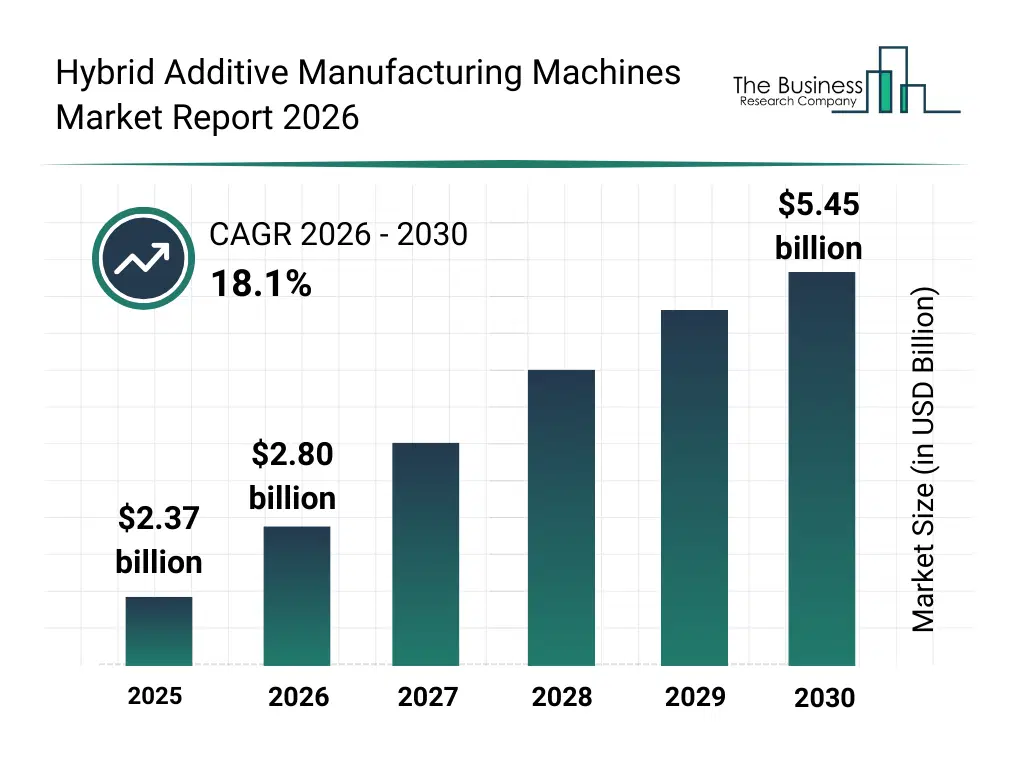
What Is The Hybrid Additive Manufacturing Machines Market Size and Share 2026?
The hybrid additive manufacturing machines market size has grown rapidly in recent years. It will grow from $2.37 billion in 2025 to $2.80 billion in 2026 at a compound annual growth rate (CAGR) of 18.4%. The growth in the historic period can be attributed to increasing adoption of additive manufacturing in aerospace, growing demand for rapid prototyping, rising need for lightweight components, expansion of precision engineering applications, and increasing investments in research and development for metal 3D printing.What Is The Hybrid Additive Manufacturing Machines Market Growth Forecast?
The hybrid additive manufacturing machines market size is expected to see rapid growth in the next few years. It will grow to $5.45 billion in 2030 at a compound annual growth rate (CAGR) of 18.1%. The growth in the forecast period can be attributed to growing integration of additive and subtractive processes, increasing demand in automotive and medical sectors, rising focus on smart factories and automation, expansion of multi-material manufacturing, and increasing adoption of internet of things (IoT)-enabled manufacturing systems. Major trends in the forecast period include advancements in hybrid machine technology, innovation in laser and electron beam additive systems, development of real-time monitoring and quality control, research and development in material efficiency, and expansion of artificial intelligence (AI) and predictive maintenance integration.
Global Hybrid Additive Manufacturing Machines Market Segmentation
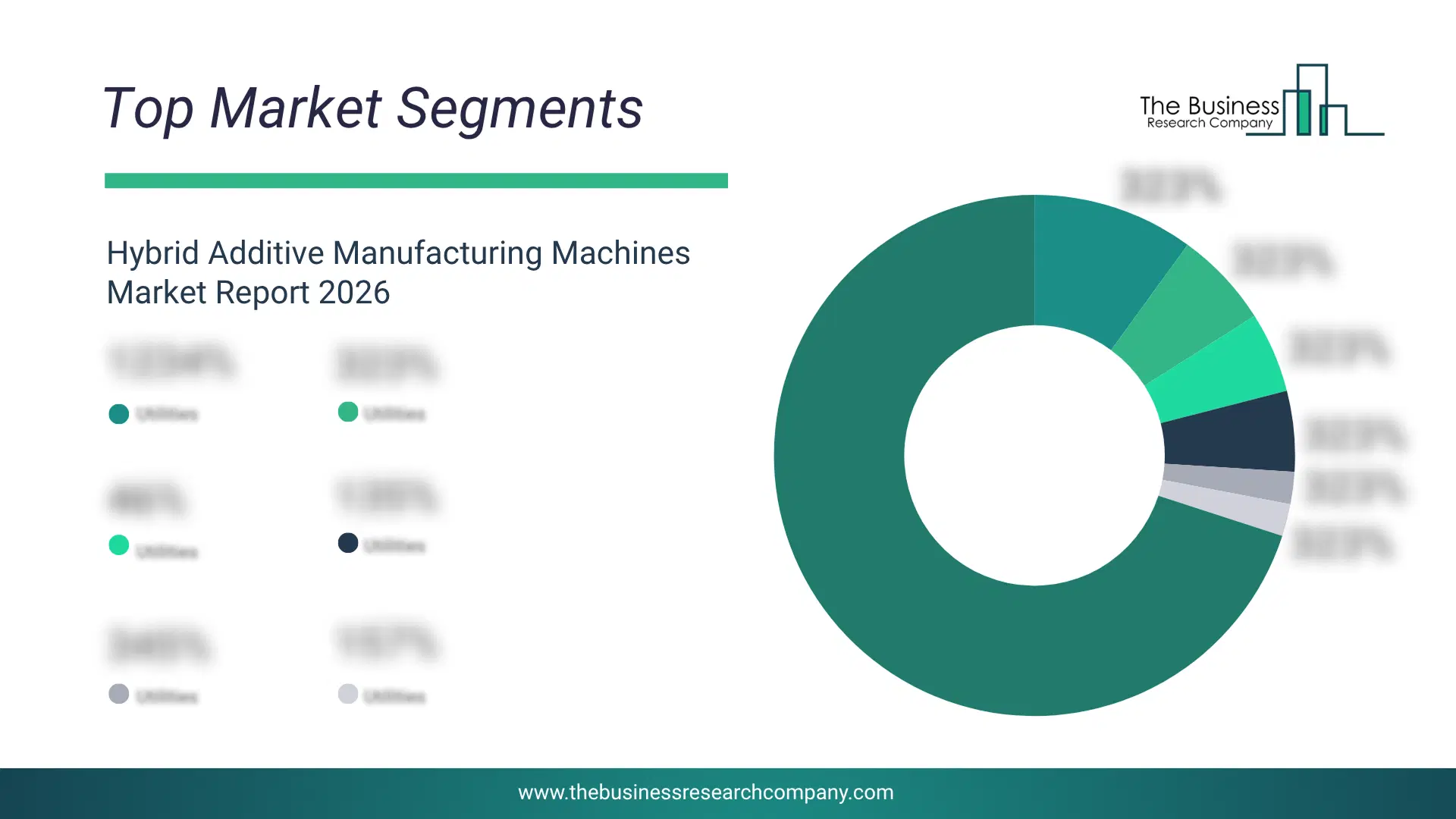
1) By Component: Hardware, Software, Services 2) By Technology Type: Directed Energy Deposition (DED), Binder Jetting, Material Extrusion, Material Jetting, Powder Bed Fusion (PBF) 3) By Machine Size: Desktop, Industrial, Large-Format, Portable, Customized Solutions 4) By Application: Repair, Production, Prototype 5) By End-Use Industry: Aerospace And Defense, Automotive, Medical And Dental, Energy And Power, Industrial Machinery, Electronics Subsegments: 1) By Hardware: Laser Processing Units, Electron Beam Units, Milling And Machining Modules, Material Handling Systems, Control Panels 2) By Software: Design And Modeling Software, Machine Control Software, Simulation And Analysis Software, Process Monitoring Software, Data Management Software 3) By Services: Installation Services, Maintenance And Repair Services, Training And Support Services, Consulting Services, Upgrades And Retrofitting ServicesWhat Is The Driver Of The Hybrid Additive Manufacturing Machines Market?
The rising adoption of Industry 4.0 and smart factories is expected to propel the growth of the hybrid additive manufacturing machines market going forward. Industry 4.0 and smart factories refer to the integration of advanced digital technologies such as the Internet of Things (IoT), artificial intelligence, automation, robotics, and data analytics into manufacturing processes to enable real-time monitoring, intelligent decision-making, and highly flexible production. The adoption of Industry 4.0 and smart factories is rising as manufacturers seek improved productivity, reduced operational costs, mass customization, and faster time-to-market. Hybrid additive manufacturing machines support Industry 4.0 and smart factories by combining additive and subtractive manufacturing processes in a single system, enabling precise, efficient, and automated production workflows aligned with smart factory environments. For instance, in September 2025, according to the International Federation of Robotics, a Germany-based non-profit organization, there were 4,664,000 robotic units operating in factories globally in 2024, marking a 9% increase from 4,281,585 units in 2023. Therefore, the rising adoption of Industry 4.0 and smart factories is driving the growth of the hybrid additive manufacturing machines industry.Key Players In The Global Hybrid Additive Manufacturing Machines Market
Major companies operating in the hybrid additive manufacturing machines market are Siemens AG, DMG MORI Co. Ltd., TRUMPF SE CO. KG, KUKA AG, Makino Inc., Renishaw plc, EOS GmbH , Yamazaki Mazak Corporation, Hexagon AB, Nikon SLM Solutions AG, Stratasys Ltd., Okuma Corporation, Maschinenfabrik Berthold Hermle AG, AddUp, Maschinenbau Kitz GmbH, Optomec Inc., Intech Additive Solutions, General Electric Company (GE Additive), Matsuura Machinery Corporation, Multiax International S.R.L.,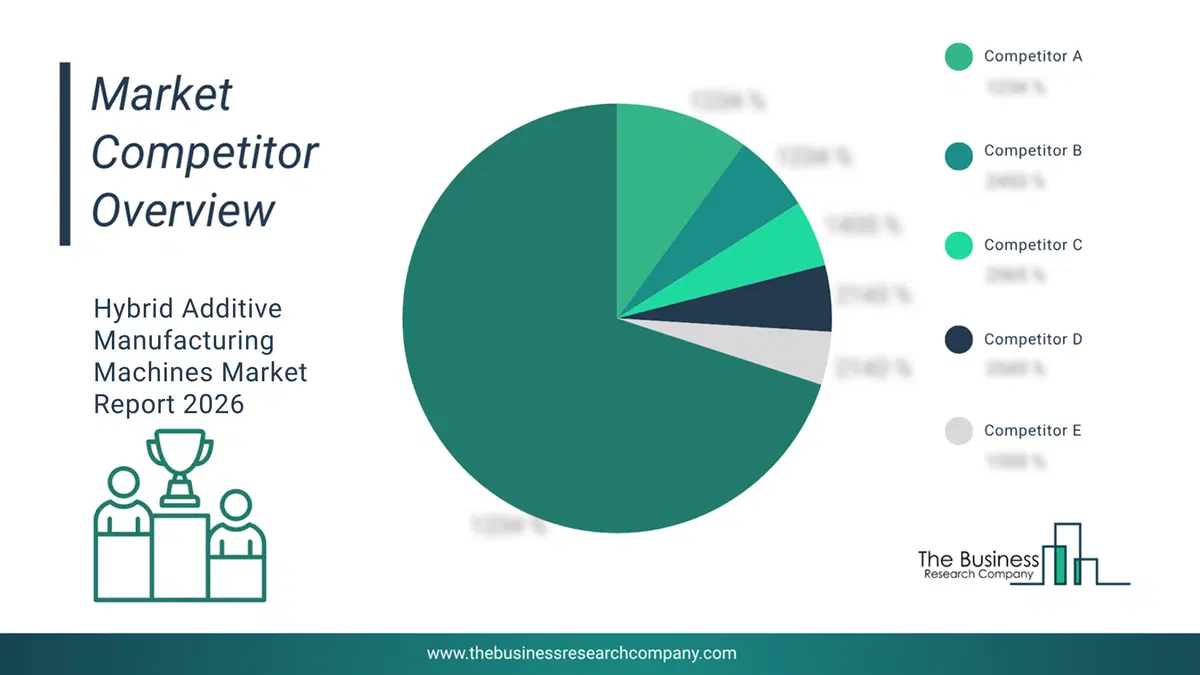
This chart is for illustrative purposes; the full report includes a detailed competitor analysis and comprehensive overview of the top 10 companies in the market.
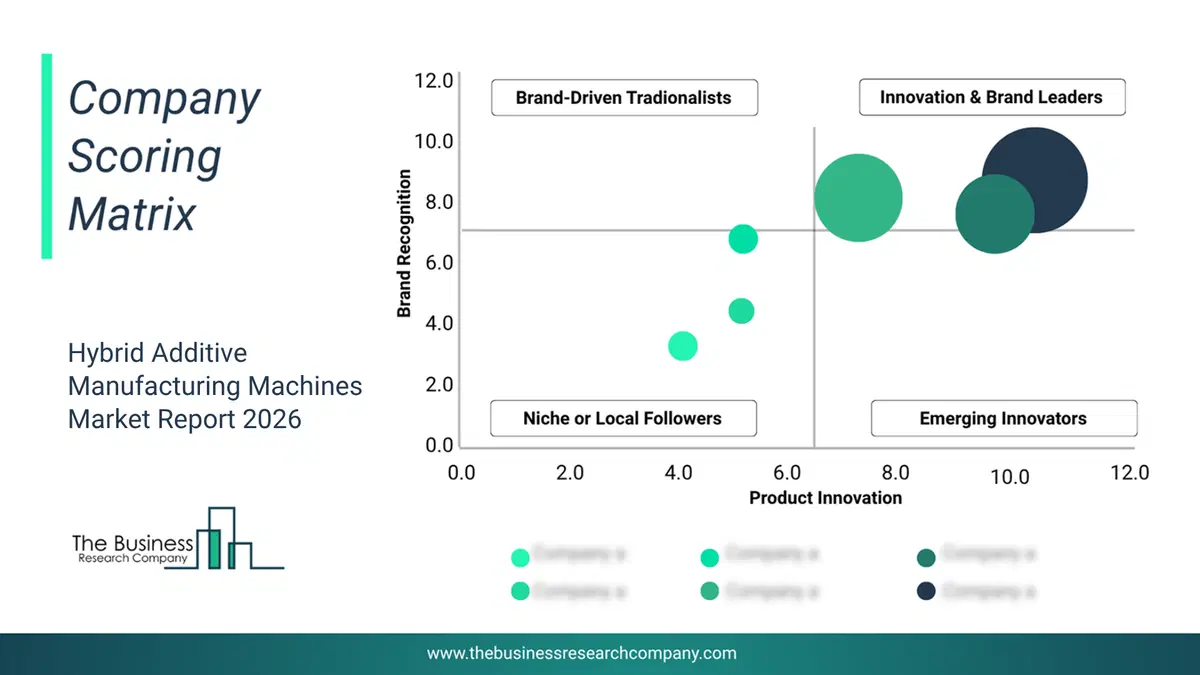
This chart maps companies by product innovation and brand strength, with bubble size indicating relative revenue, helping identify market leaders, challengers, and niche players. This is an illustrative chart; the full report provides a complete and accurate competitive analysis.
Global Hybrid Additive Manufacturing Machines Market Trends and Insights
Major companies operating in the hybrid additive manufacturing machines market are focusing on developing advanced features, such as adaptive beam control, to integrate laser control, optimized recoating mechanisms, and hybrid toolpath strategies to improve part quality, production efficiency, and cost-effectiveness. Adaptive beam control refers to dynamically adjusting a light or signal beam’s direction shape and intensity in real time to maximize target illumination or reception while minimizing glare interference or wasted energy. For instance, in May 2023, DMG MORI Co. Ltd., a Japan-based machine tool company, launched the LASERTEC 30 SLM US powder-bed metal 3D printer. The system provides a 300 × 300 × 300 mm build volume, incorporates adaptive beam control that dynamically adjusts laser power, speed, and beam profile, uses non-contact powder recoating for more flexible and consistent material spreading, and supports an optional hybrid toolpath strategy with a 1.2 kW laser to optimize cost per part and overall productivity. This launch represents a significant advancement by integrating intelligent laser modulation with improved material handling and hybrid processing, offering a scalable, high-performance solution for precision metal manufacturing in aerospace, tooling, medical, and industrial production environments.What Are Latest Mergers And Acquisitions In The Hybrid Additive Manufacturing Machines Market?
In November 2025, Angstrom Group, a US-based provider of manufacturing-focused services and tooling solutions, acquired Mantle Inc. for an undisclosed amount. With this acquisition, Angstrom Group aims to industrialize Mantle’s hybrid additive-subtractive manufacturing technology and make it broadly accessible, thereby expanding its tooling business and enabling customers to adopt advanced hybrid metal 3D printing at scale. Mantle Inc. is a US-based provider of hybrid metal additive manufacturing and computer numerical control (CNC)-machined tooling components, offering a technology path to integrate 3D printing and subtractive finishing in a unified workflow.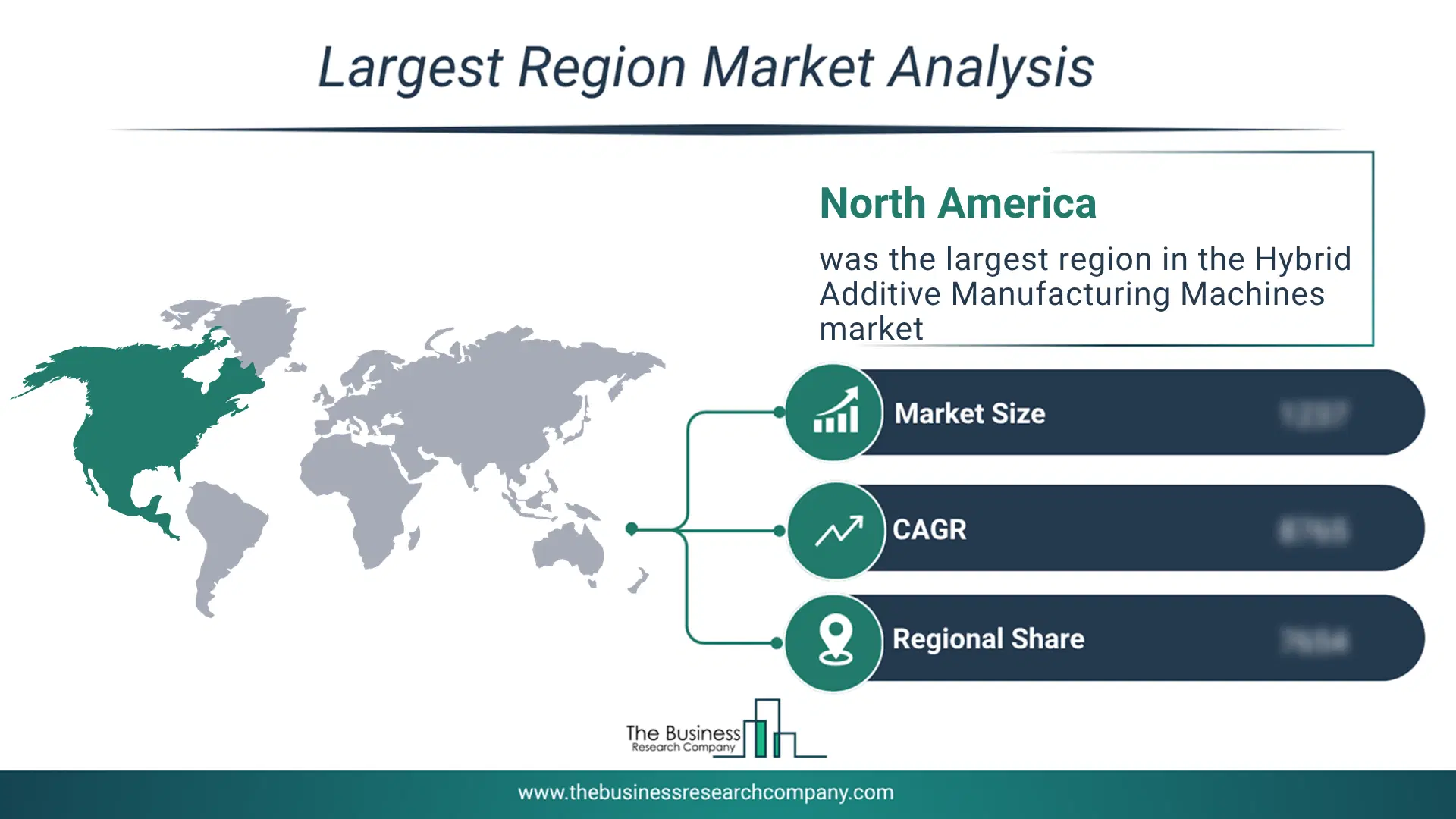
Regional Insights
North America was the largest region in the hybrid additive manufacturing machines market in 2025. Asia-Pacific is expected to be the fastest-growing region in the forecast period. The regions covered in this market report are Asia-Pacific, South East Asia, Western Europe, Eastern Europe, North America, South America, Middle East, Africa. The countries covered in this market report are Australia, Brazil, China, France, Germany, India, Indonesia, Japan, Taiwan, Russia, South Korea, UK, USA, Canada, Italy, Spain.What Defines the Hybrid Additive Manufacturing Machines Market?
The hybrid additive manufacturing machines market consists of sales of hybrid laser metal deposition machines, hybrid powder bed fusion and computer numerical control milling systems, hybrid directed energy deposition and machining centers, hybrid multi-material additive and subtractive machines, and hybrid computer numerical control integrated three-dimensional printing systems. Values in this market are ‘factory gate’ values, that is the value of goods sold by the manufacturers or creators of the goods, whether to other entities (including downstream manufacturers, wholesalers, distributors and retailers) or directly to end customers. The value of goods in this market includes related services sold by the creators of the goods.How is Market Value Defined and Measured?
The market value is defined as the revenues that enterprises gain from the sale of goods and/or services within the specified market and geography through sales, grants, or donations in terms of the currency (in USD unless otherwise specified). The revenues for a specified geography are consumption values that are revenues generated by organizations in the specified geography within the market, irrespective of where they are produced. It does not include revenues from resales along the supply chain, either further along the supply chain or as part of other products.
This chart presents market attractiveness based on a quantitative evaluation of growth, competition, strategic alignment, and risk, offering a clear view of opportunity areas for decision-making. This chart is for illustrative purposes; the full report contains the complete analysis.

This chart highlights the Total Addressable Market (TAM) by estimating the maximum revenue opportunity using an assumption-driven approach, supporting strategic planning and opportunity sizing across markets. The chart is illustrative; the full report provides a more comprehensive analysis.
What Key Data and Analysis Are Included in the Hybrid Additive Manufacturing Machines Market Report 2026?
The hybrid additive manufacturing machines market research report is one of a series of new reports from The Business Research Company that provides market statistics, including industry global market size, regional shares, competitors with the market share, detailed market segments, market trends and opportunities, and any further data you may need to thrive in the hybrid additive manufacturing machines industry. The market research report delivers a complete perspective of everything you need, with an in-depth analysis of the current and future state of the industry.Hybrid Additive Manufacturing Machines Market Report Forecast Analysis
| Report Attribute | Details |
|---|---|
| Market Size Value In 2026 | $2.80 billion |
| Revenue Forecast In 2030 | $5.45 billion |
| Growth Rate | CAGR of 18.1% from 2026 to 2030 |
| Base Year For Estimation | 2025 |
| Actual Estimates/Historical Data | 2020-2025 |
| Forecast Period | 2026 - 2030 |
| Market Representation | Revenue in USD Billion and CAGR from 2026 to 2030 |
| Segments Covered | Component, Technology Type, Machine Size, Application, End-Use Industry |
| Regional Scope | Asia-Pacific, Western Europe, Eastern Europe, North America, South America, Middle East, Africa |
| Key Companies Profiled | Major companies operating in the hybrid additive manufacturing machines market are <b> Siemens AG, DMG MORI Co. Ltd., TRUMPF SE CO. KG, KUKA AG, Makino Inc., Renishaw plc, EOS GmbH , Yamazaki Mazak Corporation, Hexagon AB, Nikon SLM Solutions AG, Stratasys Ltd., Okuma Corporation, Maschinenfabrik Berthold Hermle AG, AddUp, Maschinenbau Kitz GmbH, Optomec Inc., Intech Additive Solutions, General Electric Company (GE Additive), Matsuura Machinery Corporation, Multiax International S.R.L., </b> |
| Customization Scope | Request for Customization |
| Pricing And Purchase Options | Explore Purchase Options |