

Hybrid Electric Vehicle Battery Market Report 2026
Global Outlook – By Type (Lithium-Ion Battery, Nickel-Metal Hydride Battery, Lead-Acid Battery, Solid-State Battery, Other Battery Types), By Battery Capacity (Below 1 Kilowatt-Hour (kWh), 1 Kilowatt-Hour (kWh) To 2 Kilowatt-Hours (kWh), 2 Kilowatt-Hours (kWh) To 5 Kilowatt-Hours (kWh), 5 Kilowatt-Hours (kWh) To 10 Kilowatt-Hours (kWh)), By Propulsion Type (Full Hybrid Electric Vehicles, Mild Hybrid Electric Vehicles, Plug-In Hybrid Electric Vehicles), By Vehicle Type (Passenger Hybrid Electric Vehicles (HEVs), Commercial Hybrid Vehicles, Hybrid Two-Wheelers, Hybrid Buses and Coaches, Other Hybrid Vehicles), By Application (Original Equipment Manufacturers (OEM), Battery Replacement, Battery Refurbishment, Battery Upgrade Or Retrofit) – Market Size, Trends, Strategies, and Forecast to 2030
Hybrid Electric Vehicle Battery Market Overview
• Hybrid Electric Vehicle Battery market size has reached to $19.57 billion in 2025 • Expected to grow to $45.15 billion in 2030 at a compound annual growth rate (CAGR) of 18.1% • Growth Driver: Growing Demand For Fuel-Efficient Vehicles Fueling The Growth Of The Market Due To Increasing Adoption Of Hybrid Electric Vehicles (HEVs) • Market Trend: Innovations in Superfast-Charging Batteries Accelerate Hybrid Vehicle Electrification • Asia-Pacific was the largest region and fastest growing region.What Is Covered Under Hybrid Electric Vehicle Battery Market?
A hybrid electric vehicle battery is a rechargeable energy storage system that supplies electrical power to the electric motor and supports the internal combustion engine during vehicle operation. It captures and stores energy recovered through regenerative braking and provides power to improve fuel efficiency and reduce emissions. A hybrid electric vehicle battery continuously charges and discharges as part of the hybrid powertrain, enabling efficient energy management without requiring external charging. The main types of hybrid electric vehicle battery include lithium-ion battery, nickel-metal hydride battery, lead-acid battery, solid-state battery, and others. Lithium-ion batteries refer to rechargeable battery systems that use lithium-based electrochemical cells to store and deliver electrical energy for hybrid electric vehicle propulsion and auxiliary power functions, offering high energy density, efficient charging and discharging, and suitable power output for vehicle applications. These batteries are available in capacities such as below 1 kilowatt-hour (kWh), 1 kilowatt-hour (kWh) to 2 kilowatt-hours (kWh), 2 kilowatt-hours (kWh) to 5 kilowatt-hours (kWh), and 5 kilowatt-hours (kWh) to 10 kilowatt-hours (kWh), and are used in propulsion types such as full hybrid electric vehicles, mild hybrid electric vehicles, and plug-in hybrid electric vehicles. They are used in vehicle types such as passenger hybrid electric vehicles (HEVs), commercial hybrid vehicles, hybrid two-wheelers, hybrid buses and coaches, and others for applications such as original equipment manufacturers (OEM), battery replacement, battery refurbishment, and battery upgrade or retrofit.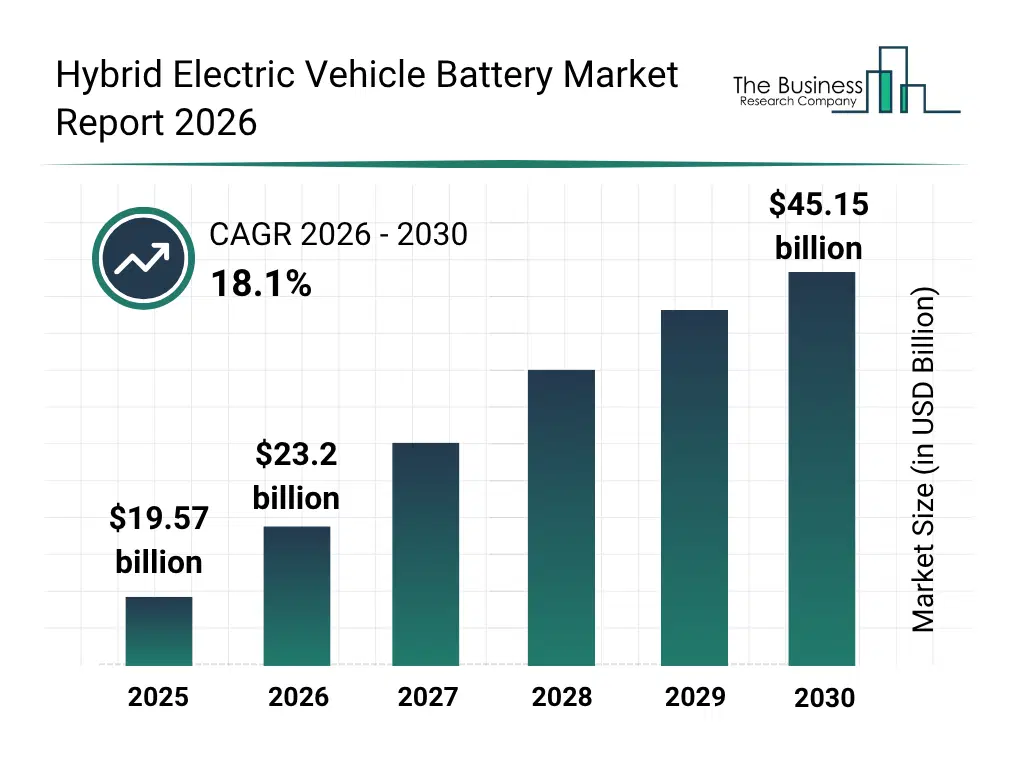
What Is The Hybrid Electric Vehicle Battery Market Size and Share 2026?
The hybrid electric vehicle battery market size has grown rapidly in recent years. It will grow from $19.57 billion in 2025 to $23.2 billion in 2026 at a compound annual growth rate (CAGR) of 18.5%. The growth in the historic period can be attributed to rising hybrid vehicle production, increasing demand for fuel efficiency, tightening vehicle emission standards, growing adoption of regenerative braking systems, declining battery manufacturing costs.What Is The Hybrid Electric Vehicle Battery Market Growth Forecast?
The hybrid electric vehicle battery market size is expected to see rapid growth in the next few years. It will grow to $45.15 billion in 2030 at a compound annual growth rate (CAGR) of 18.1%. The growth in the forecast period can be attributed to advancements in battery energy density, increasing demand for low-emission vehicles, expansion of hybrid vehicle model offerings, growing investment in battery manufacturing capacity, increasing adoption of advanced battery management systems. Major trends in the forecast period include increasing adoption of high-energy-density battery chemistries, growing development of advanced battery thermal management systems, rising demand for longer battery life and improved cycle durability, increasing integration of battery management and monitoring systems, growing use of lightweight battery pack designs.Tariff Impact On Hybrid Electric Vehicle Battery Market
Tariffs are impacting the hybrid electric vehicle battery market by increasing the cost of imported battery cells, raw materials, battery components, and manufacturing equipment required for hybrid vehicle battery production. Battery-intensive segments such as lithium-ion batteries, solid-state batteries, and higher-capacity battery systems are most affected, with regions dependent on imported battery materials and components such as Asia-Pacific and North America facing greater supply-chain cost pressures. Higher input costs can increase battery production expenses and affect the pricing and availability of hybrid electric vehicle batteries. However, tariffs are also encouraging local battery manufacturing, regional sourcing diversification, and increased investment in domestic battery supply chains, creating long-term resilience in the market.
Global Hybrid Electric Vehicle Battery Market Segmentation
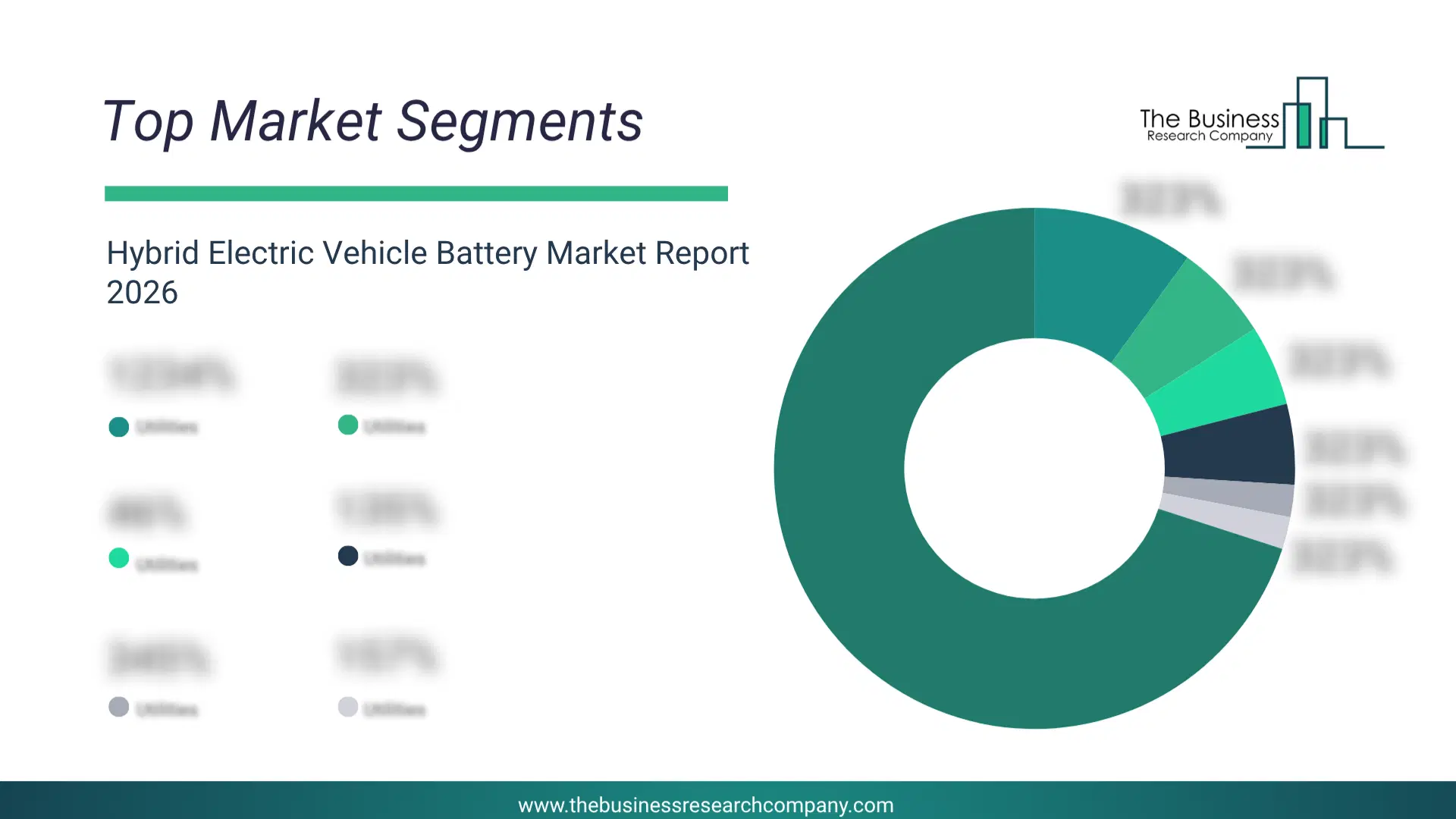
1) By Type: Lithium-Ion Battery, Nickel-Metal Hydride Battery, Lead-Acid Battery, Solid-State Battery, Other Battery Types 2) By Battery Capacity: Below 1 Kilowatt-Hour (kWh), 1 Kilowatt-Hour (kWh) To 2 Kilowatt-Hours (kWh), 2 Kilowatt-Hours (kWh) To 5 Kilowatt-Hours (kWh), 5 Kilowatt-Hours (kWh) To 10 Kilowatt-Hours (kWh) 3) By Propulsion Type: Full Hybrid Electric Vehicles, Mild Hybrid Electric Vehicles, Plug-In Hybrid Electric Vehicles 4) By Vehicle Type: Passenger Hybrid Electric Vehicles (HEVs), Commercial Hybrid Vehicles, Hybrid Two-Wheelers, Hybrid Buses and Coaches, Other Hybrid Vehicles 5) By Application: Original Equipment Manufacturers (OEM), Battery Replacement, Battery Refurbishment, Battery Upgrade Or Retrofit Subsegments: 1) By Lithium-Ion Battery: Prismatic Lithium-Ion Battery, Pouch Lithium-Ion Battery, Lithium Iron Phosphate Battery, Lithium Nickel Manganese Cobalt Battery, Lithium Nickel Cobalt Aluminum Battery 2) By Nickel-Metal Hydride Battery: High Power Nickel-Metal Hydride Battery, High Energy Nickel-Metal Hydride Battery, Sealed Nickel-Metal Hydride Battery, Prismatic Nickel-Metal Hydride Battery, Cylindrical Nickel-Metal Hydride Battery 3) By Lead-Acid Battery: Flooded Lead-Acid Battery, Valve Regulated Lead-Acid Battery, Absorbent Glass Mat Battery, Gel Lead-Acid Battery, Enhanced Flooded Battery 4) By Solid-State Battery: Sulfide Solid-State Battery, Oxide Solid-State Battery, Polymer Solid-State Battery, Thin Film Solid-State Battery, Composite Electrolyte Solid-State Battery 5) By Other Battery Types: Sodium Ion Battery, Lithium Sulfur Battery, Zinc Air Battery, Nickel Zinc Battery, Dual Carbon BatteryWhat Is The Driver Of The Hybrid Electric Vehicle Battery Market?
The growing demand for fuel-efficient vehicles is expected to propel the growth of the hybrid electric vehicle battery market going forward. Fuel-efficient vehicles are designed to consume less fuel while traveling the same distance, helping reduce operating costs, lower carbon emissions, and enhance overall transportation efficiency. The demand for fuel-efficient vehicles is rising as consumers seek to minimize fuel expenses amid fluctuating fuel prices, while governments continue to promote lower vehicle emissions through increasingly stringent fuel efficiency regulations. The growing demand for fuel-efficient vehicles is driving the adoption of hybrid electric vehicle batteries by accelerating the deployment of hybrid powertrain technologies that improve fuel economy, reduce emissions, and enhance overall vehicle performance. For instance, in February 2026, according to the Environmental Protection Agency, a US-based government department, preliminary data showed that average new-vehicle real-world fuel economy increased to 28.1 mpg in 2025 from 27.2 mpg in 2024. Therefore, the growing demand for fuel-efficient vehicles is driving the growth of the hybrid electric vehicle battery industry.Key Players In The Global Hybrid Electric Vehicle Battery Market
Major companies operating in the hybrid electric vehicle battery market are BYD Company Limited, Contemporary Amperex Technology Co. Limited, Toshiba Corporation, LG Energy Solution Ltd., Panasonic Holdings Corporation, SK On Co. Ltd., Samsung SDI Co. Ltd., EVE Energy Co. Ltd., CALB Group Co. Ltd., Gotion High-Tech Co. Ltd., Sunwoda Electronic Co. Ltd., GS Yuasa Corporation, Automotive Energy Supply Corporation, TotalEnergies SE, SVOLT Energy Technology Co. Ltd., Farasis Energy Inc., Automotive Cells Company SE, Iveco Group N.V., Leclanché SA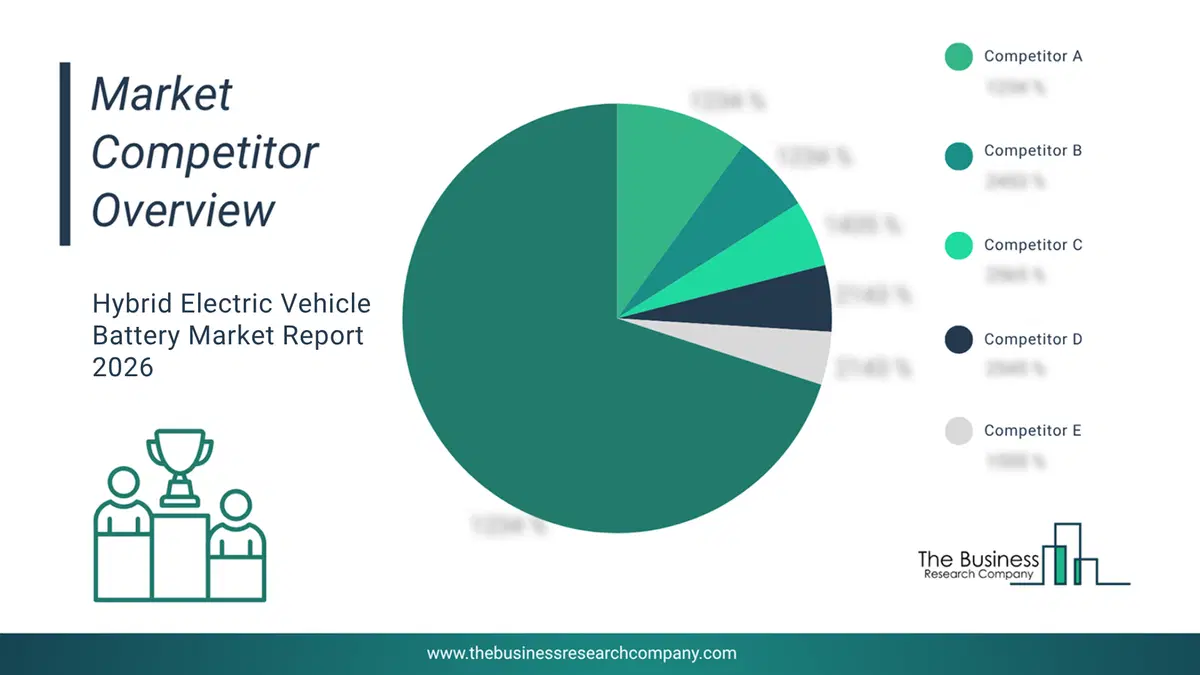
This chart is for illustrative purposes; the full report includes a detailed competitor analysis and comprehensive overview of the top 10 companies in the market.
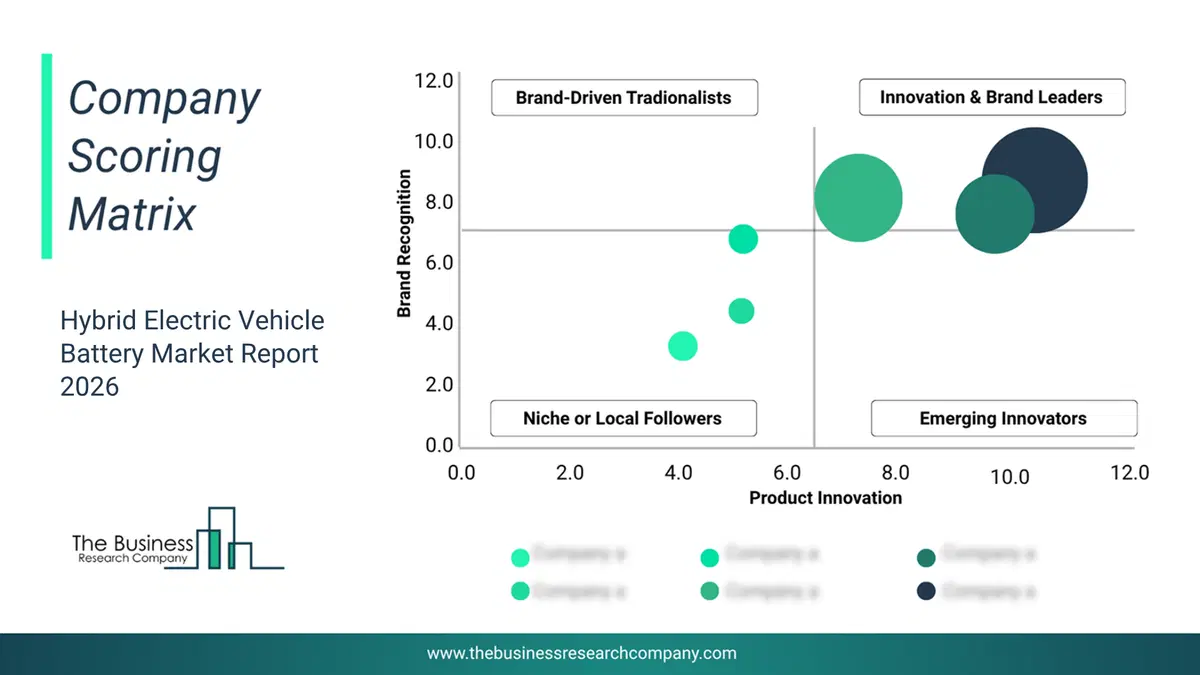
This chart maps companies by product innovation and brand strength, with bubble size indicating relative revenue, helping identify market leaders, challengers, and niche players. This is an illustrative chart; the full report provides a complete and accurate competitive analysis.
Global Hybrid Electric Vehicle Battery Market Trends and Insights
Major companies operating in the hybrid electric vehicle battery market are focusing on developing advanced hybrid battery technologies with higher energy density, faster charging capabilities, extended electric driving range, and improved safety to meet the growing demand for efficient and high-performance hybrid vehicles. Advanced hybrid battery technologies refer to innovative battery systems designed to improve the energy efficiency, electric driving range, charging speed, performance, and overall reliability of hybrid vehicles. For instance, in April 2026, Contemporary Amperex Technology Co., Limited (CATL), a China-based battery manufacturer, launched the second-generation Freevoy Super Hybrid Battery, featuring LFP and NCM material integration, an energy density of 230 Wh/kg, 10C superfast charging, and an all-electric range of up to 600 km. The launch aims to extend the electric driving range of hybrid vehicles, improve charging performance, and support a wider range of mainstream and high-end hybrid applications.What Are Latest Mergers And Acquisitions In The Hybrid Electric Vehicle Battery Market?
In April 2026, Toyota Astra Motor, an Indonesia-based produces Hybrid Electric Vehicle (HEV) battery packs locally partnered with Contemporary Amperex Technology Co. Ltd to strengthen local battery production capabilities and support the development of electrified vehicles in Indonesia. Through this partnership, Toyota Astra Motor and CATL aim to improve local battery manufacturing capabilities and strengthen Indonesia’s electrified vehicle ecosystem. Contemporary Amperex Technology Co. Ltd, a China-based Battery manufacturing company.
Regional Outlook
Asia-Pacific was the largest region in the hybrid electric vehicle battery market in 2025. Asia-Pacific is expected to be the fastest-growing region in the forecast period. The regions covered in this market report are Asia-Pacific, South East Asia, Western Europe, Eastern Europe, North America, South America, Middle East, Africa. The countries covered in this market report are Australia, Brazil, China, France, Germany, India, Indonesia, Japan, Taiwan, Russia, South Korea, UK, USA, Canada, Italy, Spain.What Defines the Hybrid Electric Vehicle Battery Market?
The hybrid electric vehicle battery market consists of sales of battery management systems, battery thermal management systems, battery junction boxes, high-voltage battery disconnect units, and battery cell monitoring and balancing modules. Values in this market are ‘factory gate’ values, that is, the value of goods sold by the manufacturers or creators of the goods, whether to other entities (including downstream manufacturers, wholesalers, distributors, and retailers) or directly to end customers. The value of goods in this market includes related services sold by the creators of the goods.How is Market Value Defined and Measured?
The market value is defined as the revenues that enterprises gain from the sale of goods and/or services within the specified market and geography through sales, grants, or donations in terms of the currency (in USD unless otherwise specified). The revenues for a specified geography are consumption values that are revenues generated by organizations in the specified geography within the market, irrespective of where they are produced. It does not include revenues from resales along the supply chain, either further along the supply chain or as part of other products.
This chart presents market attractiveness based on a quantitative evaluation of growth, competition, strategic alignment, and risk, offering a clear view of opportunity areas for decision-making. This chart is for illustrative purposes; the full report contains the complete analysis.

This chart highlights the Total Addressable Market (TAM) by estimating the maximum revenue opportunity using an assumption-driven approach, supporting strategic planning and opportunity sizing across markets. The chart is illustrative; the full report provides a more comprehensive analysis.
What Key Data and Analysis Are Included in the Hybrid Electric Vehicle Battery Market Report 2026?
The hybrid electric vehicle battery market research report is one of a series of new reports from The Business Research Company that provides market statistics, including industry global market size, regional shares, competitors with the market share, detailed market segments, market trends and opportunities, and any further data you may need to thrive in the hybrid electric vehicle battery industry. The market research report delivers a complete perspective of everything you need, with an in-depth analysis of the current and future state of the industry.Hybrid Electric Vehicle Battery Market Report Forecast Analysis
| Report Attribute | Details |
|---|---|
| Market Size Value In 2026 | $23.2 billion |
| Revenue Forecast In 2030 | $45.15 billion |
| Growth Rate | CAGR of 18.1% from 2026 to 2030 |
| Base Year For Estimation | 2025 |
| Actual Estimates/Historical Data | 2020-2025 |
| Forecast Period | 2026 - 2030 |
| Market Representation | Revenue in USD Billion and CAGR from 2026 to 2030 |
| Segments Covered | Type, Battery Capacity, Propulsion Type, Vehicle Type, Application |
| Regional Scope | Asia-Pacific, Western Europe, Eastern Europe, North America, South America, Middle East, Africa |
| Country Scope | The countries covered in the report are Australia, Brazil, China, France, Germany, India, Indonesia, Japan, Taiwan, Russia, South Korea, UK, USA, Canada, Italy, Spain. |
| Key Companies Profiled | BYD Company Limited, Contemporary Amperex Technology Co. Limited, Toshiba Corporation, LG Energy Solution Ltd., Panasonic Holdings Corporation, SK On Co. Ltd., Samsung SDI Co. Ltd., EVE Energy Co. Ltd., CALB Group Co. Ltd., Gotion High-Tech Co. Ltd., Sunwoda Electronic Co. Ltd., GS Yuasa Corporation, Automotive Energy Supply Corporation, TotalEnergies SE, SVOLT Energy Technology Co. Ltd., Farasis Energy Inc., Automotive Cells Company SE, Iveco Group N.V., Leclanché SA |
| Customization Scope | Request for Customization |
| Pricing And Purchase Options | Explore Purchase Options |