

Hybrid Vehicle Turbocharger Market Report 2026
Global Outlook – By Turbocharger Type (Single Turbo, Twin Turbo), By Hybrid Vehicle Type (Full Hybrid, Mild Hybrid Twelve Volt System, Mild Hybrid Forty Eight Volt System, Plug In Hybrid), By Component (Bearing, Compressor, Control System, Actuator, Sensor, Housing, Turbine), By Materials (Aluminum, Cast Iron, Titanium, Alloy Compositions), By Sales Channel (Original Equipment Manufacturer, Aftermarket Authorized Dealer, Aftermarket Third Party Supplier) – Market Size, Trends, Strategies, and Forecast to 2030
Hybrid Vehicle Turbocharger Market Overview
• Hybrid Vehicle Turbocharger market size has reached to $3.11 billion in 2025 • Expected to grow to $5.04 billion in 2030 at a compound annual growth rate (CAGR) of 10.1% • Growth Driver: Growing Adoption Of Hybrid Vehicles Driving The Market Growth Due To Increasing Demand For Efficient And High-Performance Powertrains • Market Trend: Technological Advancements Driving The Development Of Next-Generation Turbocharged Hybrid Propulsion Systems • North America was the largest region in 2025 and Asia-Pacific is the fastest growing region.What Is Covered Under Hybrid Vehicle Turbocharger Market?
Hybrid vehicle turbochargers refer to forced-induction components designed to increase the power and efficiency of internal combustion engines used in hybrid vehicles. They use exhaust-gas energy to compress intake air and deliver a greater volume of air to the engine, enabling improved combustion, power output, and fuel efficiency. These turbochargers are engineered to operate alongside hybrid powertrain components while supporting efficient engine operation across varying driving and load conditions. The main turbocharger types of hybrid vehicle turbochargers include single turbo and twin turbo. Single turbo refers to a turbocharging system that uses one turbocharger to compress intake air and improve engine performance and efficiency. These turbochargers are used in full hybrid, mild hybrid twelve volt system, mild hybrid forty eight volt system, and plug in hybrid vehicles, and consist of components such as bearings, compressors, control systems, actuators, sensors, housings, and turbines. They are manufactured using materials such as aluminum, cast iron, titanium, and alloy compositions, and are distributed through sales channels including original equipment manufacturers, aftermarket authorized dealers, and aftermarket third party suppliers.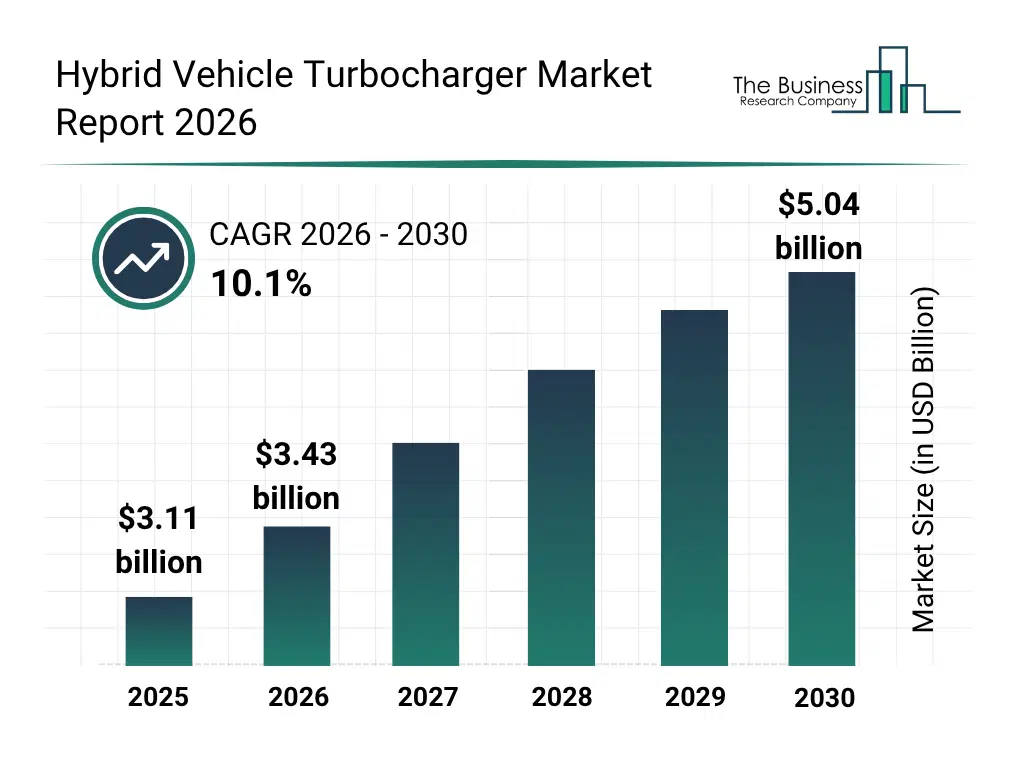
What Is The Hybrid Vehicle Turbocharger Market Size and Share 2026?
The hybrid vehicle turbocharger market size has grown rapidly in recent years. It will grow from $3.11 billion in 2025 to $3.43 billion in 2026 at a compound annual growth rate (CAGR) of 10.5%. The growth in the historic period can be attributed to increasing hybrid vehicle production, rising demand for engine downsizing, growing emphasis on fuel efficiency, tightening vehicle emission standards, increasing adoption of turbocharged internal combustion engines.What Is The Hybrid Vehicle Turbocharger Market Growth Forecast?
The hybrid vehicle turbocharger market size is expected to see rapid growth in the next few years. It will grow to $5.04 billion in 2030 at a compound annual growth rate (CAGR) of 10.1%. The growth in the forecast period can be attributed to rising adoption of 48-volt mild hybrid systems, increasing demand for high-efficiency hybrid powertrains, advancements in electric-assisted turbocharging, growing use of lightweight turbocharger materials, expansion of plug-in hybrid vehicle production. Major trends in the forecast period include increasing adoption of electrically assisted turbochargers, growing use of variable geometry turbochargers in hybrid powertrains, rising integration of advanced turbocharger control systems, increasing demand for lightweight turbocharger components, growing adoption of high-temperature and durable turbocharger materials.Tariff Impact On Hybrid Vehicle Turbocharger Market
Tariffs are impacting the hybrid vehicle turbochargers market by increasing the cost of imported turbocharger components, precision automotive parts, specialty materials, and manufacturing equipment required for production. This is increasing production costs for hybrid powertrain components, particularly in regions dependent on imported automotive components such as Asia-Pacific and North America. Hardware-intensive segments like compressors, turbines, bearings, control systems, and actuators are most affected due to global supply chain dependencies. However, tariffs are also encouraging local component manufacturing, regional supplier diversification, and increased investment in domestic automotive supply chains, creating long-term resilience in the market.
Global Hybrid Vehicle Turbocharger Market Segmentation
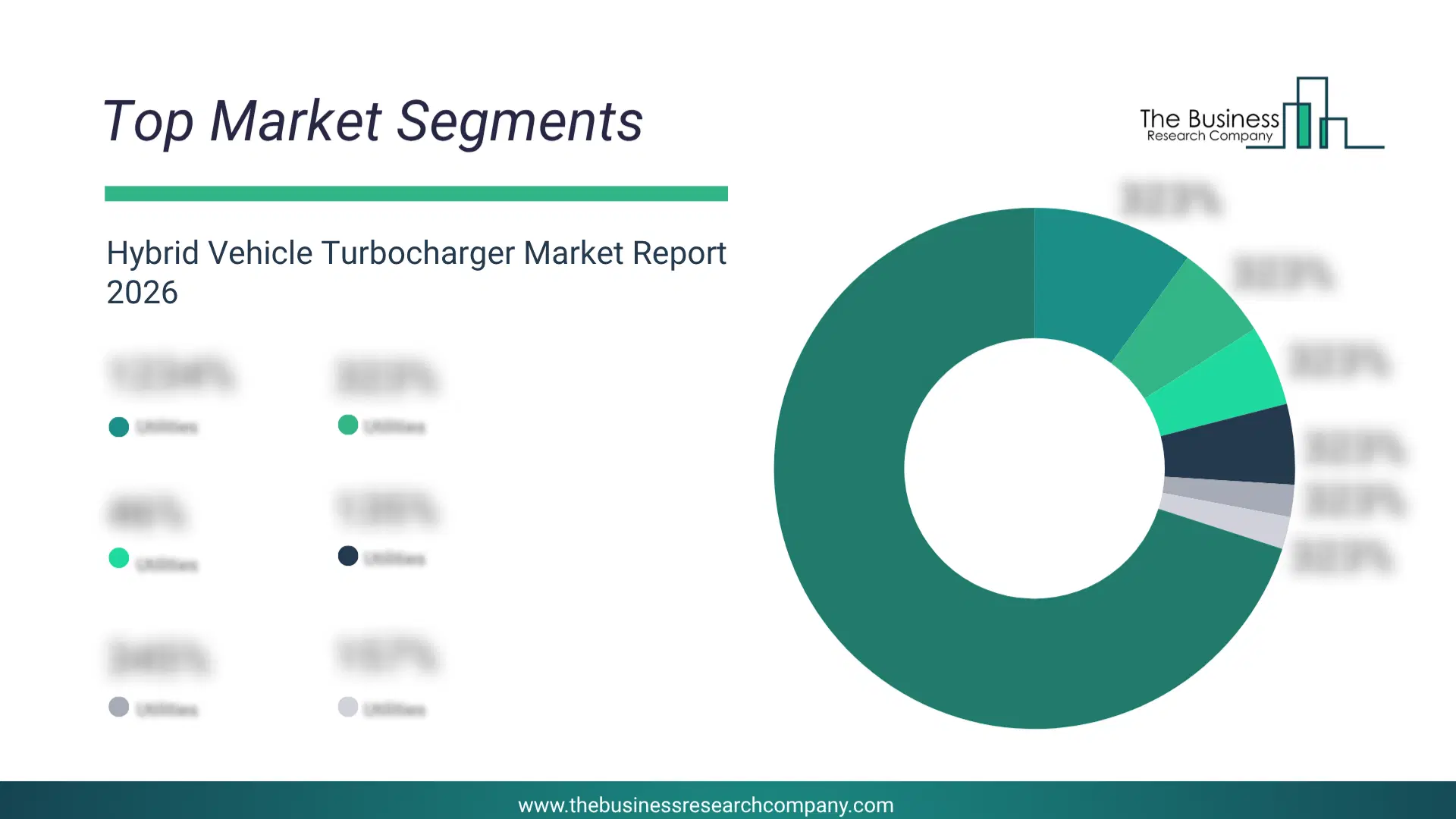
1) By Turbocharger Type: Single Turbo, Twin Turbo 2) By Hybrid Vehicle Type: Full Hybrid, Mild Hybrid Twelve Volt System, Mild Hybrid Forty Eight Volt System, Plug In Hybrid 3) By Component: Bearing, Compressor, Control System, Actuator, Sensor, Housing, Turbine 4) By Materials: Aluminum, Cast Iron, Titanium, Alloy Compositions 5) By Sales Channel: Original Equipment Manufacturer, Aftermarket Authorized Dealer, Aftermarket Third Party Supplier Subsegments: 1) By Single Turbo: Fixed Geometry Single Turbochargers, Variable Geometry Single Turbochargers, Electric Assisted Single Turbochargers, Wastegate Equipped Single Turbochargers, Variable Nozzle Single Turbochargers 2) By Twin Turbo: Parallel Twin Turbochargers, Sequential Twin Turbochargers, Two Stage Twin Turbochargers, Series Twin Turbochargers, Electric Assisted Twin TurbochargersWhat Is The Driver Of The Hybrid Vehicle Turbocharger Market?
The growing adoption of hybrid vehicles is expected to propel the growth of the hybrid vehicle turbocharger market going forward. Hybrid vehicles are automobiles that combine an internal combustion engine with one or more electric motors and battery systems to improve fuel efficiency and reduce emissions compared to conventional vehicles. The demand for hybrid vehicles is increasing due to growing environmental concerns, as hybrid vehicles produce lower greenhouse gas emissions and consume less fuel compared to conventional vehicles, supporting the transition toward cleaner and more sustainable transportation. Rising adoption of hybrid vehicles drives demand for hybrid vehicle turbochargers by increasing the need for advanced engine technologies that deliver higher power output, improved fuel efficiency, faster engine response, and lower emissions from downsized internal combustion engines. For instance, in July 2026, according to the U.S. Energy Information Administration, a US-based government agency, combined sales of hybrid, plug-in hybrid, and battery electric vehicles (BEVs) reached 24% of total new light-duty vehicle sales in the second quarter of 2026 (2Q26), up from 22% in the second quarter of 2025 (2Q25). Therefore, the growing adoption of hybrid vehicles is driving the growth of the hybrid vehicle turbocharger industry.Key Players In The Global Hybrid Vehicle Turbocharger Market
Major companies operating in the hybrid vehicle turbocharger market are Continental Aktiengesellschaft, Valeo SE, BorgWarner Inc., Mitsubishi Heavy Industries Ltd., MAHLE GmbH, Cummins Inc., IHI Corporation, Garrett Motion Inc., Wuxi Weifu High-Technology Group Co. Ltd., Hunan Tyen Machinery Co. Ltd., BMTS Technology GmbH & Co. KG, Keyyang Precision Co. Ltd., Turbo Energy Private Limited, Ningbo Fengmao Power Technology Co. Ltd., Turbo International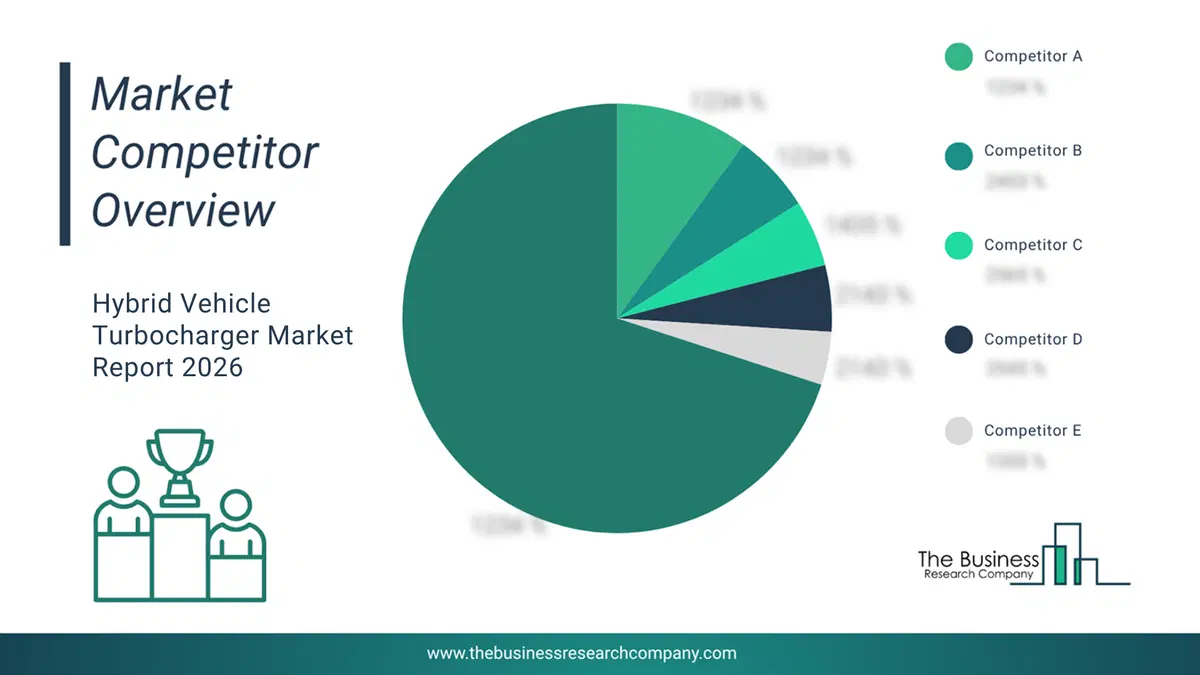
This chart is for illustrative purposes; the full report includes a detailed competitor analysis and comprehensive overview of the top 10 companies in the market.
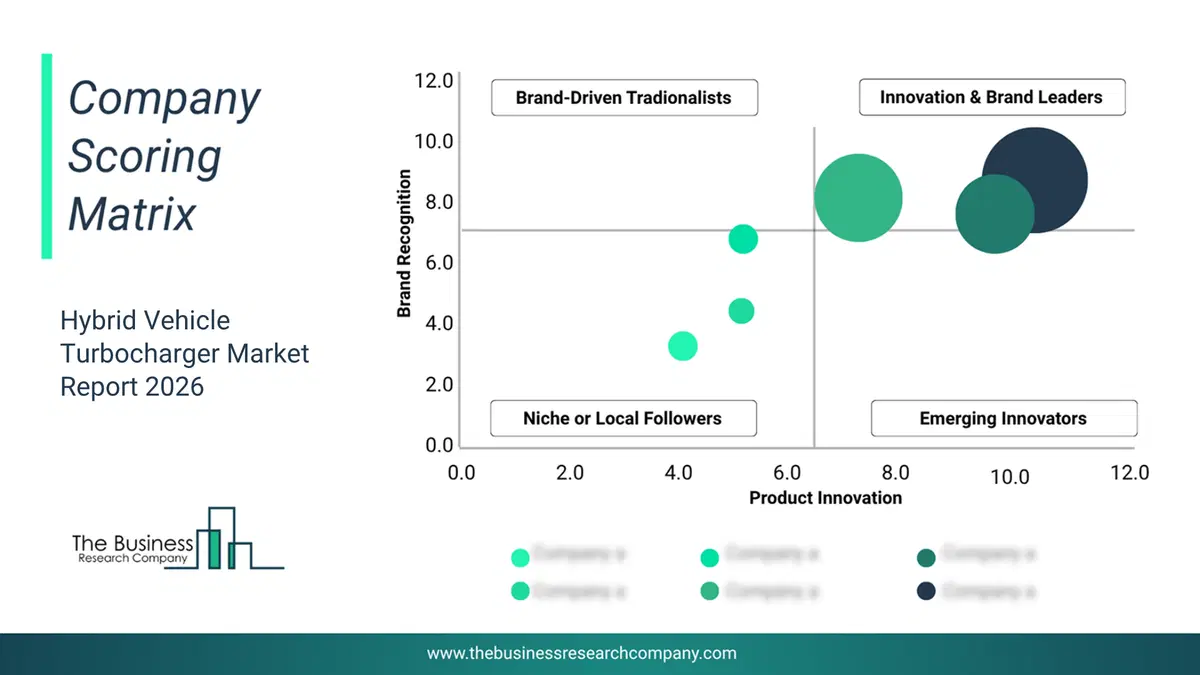
This chart maps companies by product innovation and brand strength, with bubble size indicating relative revenue, helping identify market leaders, challengers, and niche players. This is an illustrative chart; the full report provides a complete and accurate competitive analysis.
Global Hybrid Vehicle Turbocharger Market Trends and Insights
Major companies operating in the hybrid vehicle turbocharger market are focusing on developing innovative systems, such as, turbocharged hybrid propulsion systems, to enhance fuel efficiency, improve engine performance, reduce emissions, and provide smoother and more responsive driving experiences. Turbocharged hybrid propulsion systems integrate a turbocharged internal combustion engine with an electric motor and battery system, enabling higher power output from smaller engines while supporting electric-assisted driving and improved energy efficiency compared with conventional internal combustion powertrains. For instance, in January 2026, KG Mobility Corporation, a South Korea-based automotive manufacturing company, launched new hybrid powertrain featuring silent drive and real-world performance. The powertrain combines a turbocharged gasoline engine with electric propulsion to deliver improved efficiency and responsive performance across different driving conditions. The system enables electric-only operation during suitable driving conditions, helping reduce fuel consumption and engine emissions. It also provides smooth transitions between electric and engine-powered driving while maintaining strong acceleration and driving performance. The integration of turbocharging with hybrid technology allows the vehicle to achieve enhanced power and efficiency without relying solely on a larger conventional engine. This technology is applicable to hybrid passenger vehicles and supports the automotive industry's shift toward more efficient, lower-emission propulsion systems.What Are Latest Mergers And Acquisitions In The Hybrid Vehicle Turbocharger Market?
In March 2025, Garrett Motion Inc., a Switzerland-based automotive technology company that specializes in providing advanced turbochargers and electric boosting solutions specifically designed for hybrid vehicles. Through this partnership, Garrett Motion Inc. and Hyundai Motor Company aim to support the performance, efficiency, and reliability of Genesis vehicles by supplying turbochargers for 2.0L, 3.3L, and 3.5L V6 engines, strengthen advanced powertrain technologies, and enhance next-generation hybrid and zero-emission mobility solutions through innovations such as E-Compressors and E-Powertrain technologies. Hyundai Motor Company is a South Korea-based automotive manufacturer that specializes in designing, manufacturing, and selling passenger vehicles, commercial vehicles, and advanced mobility solutions.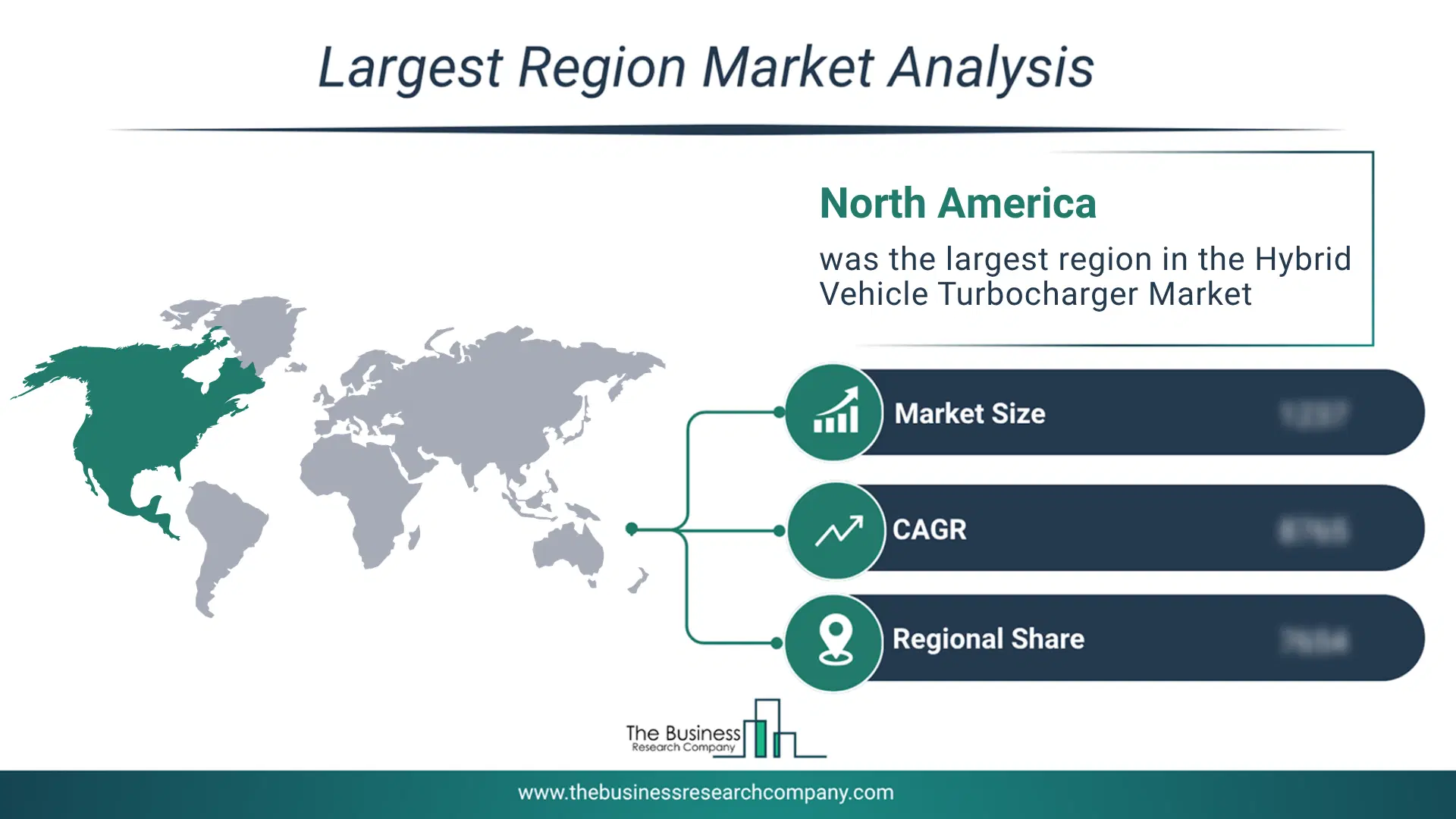
Regional Outlook
North America was the largest region in the hybrid vehicle turbocharger market in 2025. Asia-Pacific is expected to be the fastest-growing region in the forecast period. The regions covered in this market report are Asia-Pacific, South East Asia, Western Europe, Eastern Europe, North America, South America, Middle East, Africa. The countries covered in this market report are Australia, Brazil, China, France, Germany, India, Indonesia, Japan, Taiwan, Russia, South Korea, UK, USA, Canada, Italy, Spain.What Defines the Hybrid Vehicle Turbocharger Market?
The hybrid vehicle turbocharger market consists of sales of variable geometry turbochargers, conventional exhaust-gas turbochargers, twin-scroll turbochargers, turbocharger compressors, turbocharger turbines, turbocharger housings, wastegates, and turbocharger actuator systems. Values in this market are ‘factory gate’ values, that is, the value of goods sold by the manufacturers or creators of the goods, whether to other entities (including downstream manufacturers, wholesalers, distributors, and retailers) or directly to end customers. The value of goods in this market includes related services sold by the creators of the goods.How is Market Value Defined and Measured?
The market value is defined as the revenues that enterprises gain from the sale of goods and/or services within the specified market and geography through sales, grants, or donations in terms of the currency (in USD unless otherwise specified). The revenues for a specified geography are consumption values that are revenues generated by organizations in the specified geography within the market, irrespective of where they are produced. It does not include revenues from resales along the supply chain, either further along the supply chain or as part of other products.
This chart presents market attractiveness based on a quantitative evaluation of growth, competition, strategic alignment, and risk, offering a clear view of opportunity areas for decision-making. This chart is for illustrative purposes; the full report contains the complete analysis.

This chart highlights the Total Addressable Market (TAM) by estimating the maximum revenue opportunity using an assumption-driven approach, supporting strategic planning and opportunity sizing across markets. The chart is illustrative; the full report provides a more comprehensive analysis.
What Key Data and Analysis Are Included in the Hybrid Vehicle Turbocharger Market Report 2026?
The hybrid vehicle turbocharger market research report is one of a series of new reports from The Business Research Company that provides market statistics, including industry global market size, regional shares, competitors with the market share, detailed market segments, market trends and opportunities, and any further data you may need to thrive in the hybrid vehicle turbocharger industry. The market research report delivers a complete perspective of everything you need, with an in-depth analysis of the current and future state of the industry.Hybrid Vehicle Turbocharger Market Report Forecast Analysis
| Report Attribute | Details |
|---|---|
| Market Size Value In 2026 | $3.43 billion |
| Revenue Forecast In 2030 | $5.04 billion |
| Growth Rate | CAGR of 10.1% from 2026 to 2030 |
| Base Year For Estimation | 2025 |
| Actual Estimates/Historical Data | 2020-2025 |
| Forecast Period | 2026 - 2030 |
| Market Representation | Revenue in USD Billion and CAGR from 2026 to 2030 |
| Segments Covered | Turbocharger Type, Hybrid Vehicle Type, Component, Materials, Sales Channel |
| Regional Scope | Asia-Pacific, Western Europe, Eastern Europe, North America, South America, Middle East, Africa |
| Country Scope | The countries covered in the report are Australia, Brazil, China, France, Germany, India, Indonesia, Japan, Taiwan, Russia, South Korea, UK, USA, Canada, Italy, Spain. |
| Key Companies Profiled | Continental Aktiengesellschaft, Valeo SE, BorgWarner Inc., Mitsubishi Heavy Industries Ltd., MAHLE GmbH, Cummins Inc., IHI Corporation, Garrett Motion Inc., Wuxi Weifu High-Technology Group Co. Ltd., Hunan Tyen Machinery Co. Ltd., BMTS Technology GmbH & Co. KG, Keyyang Precision Co. Ltd., Turbo Energy Private Limited, Ningbo Fengmao Power Technology Co. Ltd., Turbo International |
| Customization Scope | Request for Customization |
| Pricing And Purchase Options | Explore Purchase Options |