
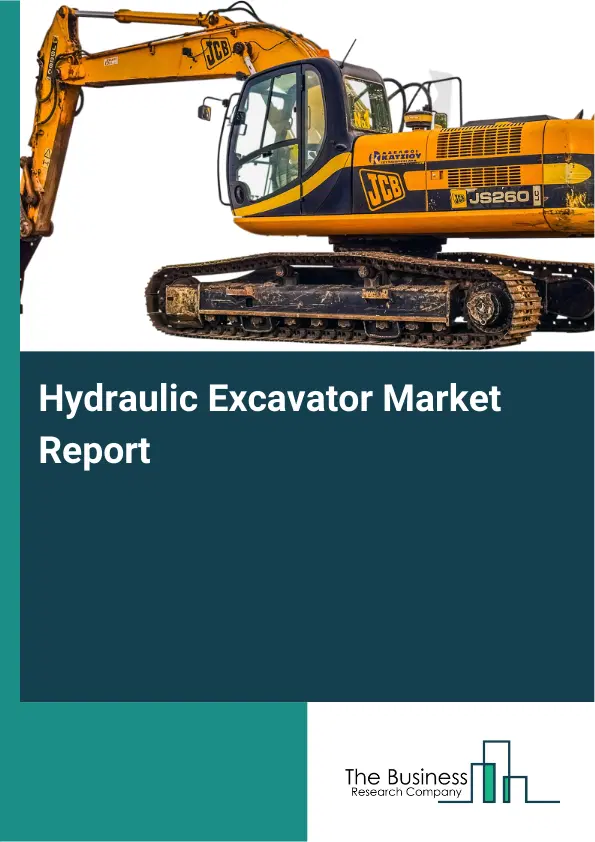
Hydraulic Excavator Market Report 2026
Global Outlook – By Type (Crawler, Wheeled), By Power Rating (0-300 HP, 301-500 HP, Above 501 HP), By Size (Upto 8T, 8 - 12T, 12 - 20T), By Operating Mechanism (Electric, Conventional, Hybrid), By End-User (Contractors, Rental Providers, Other End Users) – Market Size, Trends, Strategies, and Forecast to 2030
Hydraulic Excavator Market Overview
• Hydraulic Excavator market size has reached to $71.28 billion in 2025 • Expected to grow to $82.74 billion in 2030 at a compound annual growth rate (CAGR) of 3.1% • Growth Driver: The Role Of Booming Construction In Hydraulic Excavator Market Growth • Market Trend: Advancement In Automated And Digitally-Enhanced Excavation Solutions • Asia Pacific was the largest region in 2025 and North America is the fastest growing region.Market Gains By 2030 – Top Opportunities By Segment
Market Gain identifies the most promising market opportunities by highlighting the segments or products expected to generate the highest incremental revenue growth over the next five years.
What Is Covered Under Hydraulic Excavator Market?
A hydraulic excavator is a heavy construction machine equipped with a hydraulic system to perform various earthmoving tasks. It consists of a boom, dipper (or stick), bucket, and cab on a rotating platform. A hydraulic excavator uses hydraulic fluid under pressure to power and move its components, allowing it to dig, lift, and move large amounts of material. The main types of hydraulic excavators are crawler, mini, and wheeled. Crawler excavators are equipped with tracks instead of wheels, providing stability and traction, making them suitable for rough terrains and heavy-duty applications like mining and construction. The different power ratings include 0-300 hp, 301-500 hp, and above 501 hp with various sizes such as up to 8t, 8 - 12t, and 12 - 20t. The different operating mechanisms include electric, conventional, and hybrid that are used by various end-users such as contractors, rental providers, and others.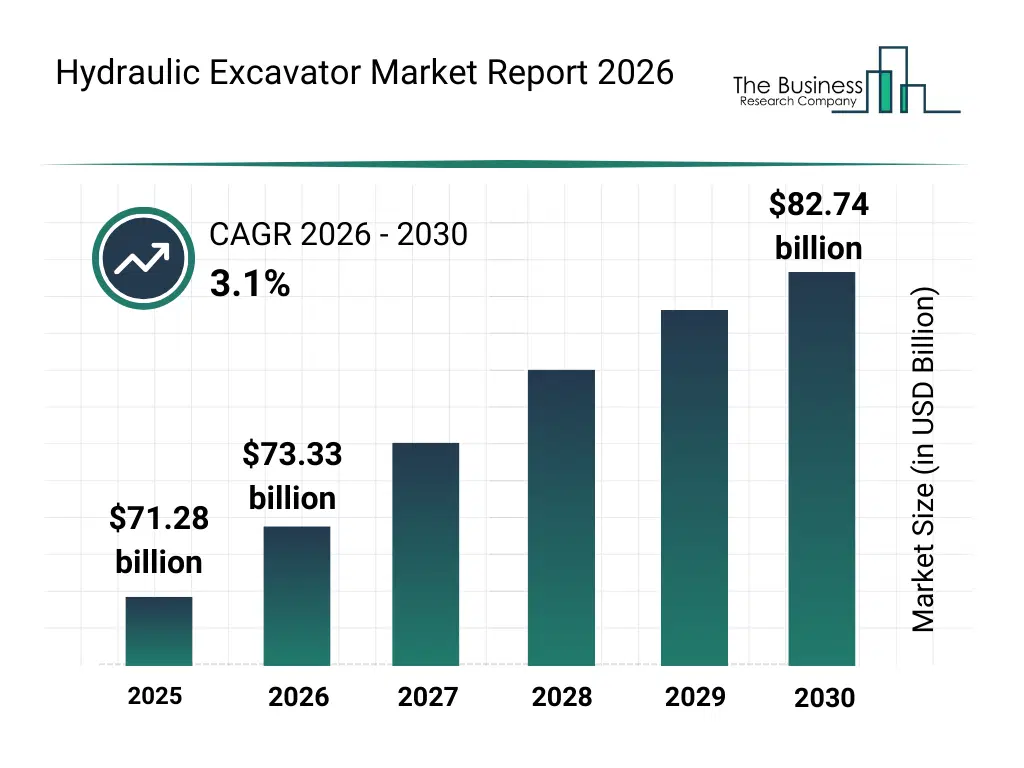
What Is The Hydraulic Excavator Market Size and Share 2026?
The hydraulic excavator market size has grown steadily in recent years. It will grow from $71.28 billion in 2025 to $73.33 billion in 2026 at a compound annual growth rate (CAGR) of 2.9%. The growth in the historic period can be attributed to urbanization and infrastructure growth, traditional earthmoving methods, expansion of contractor fleets, mechanized construction adoption, availability of diesel excavators.What Is The Hydraulic Excavator Market Growth Forecast?
The hydraulic excavator market size is expected to see steady growth in the next few years. It will grow to $82.74 billion in 2030 at a compound annual growth rate (CAGR) of 3.1%. The growth in the forecast period can be attributed to electrification of construction equipment, smart jobsite integration, emission regulations, growth of rental services, demand for fuel efficient machinery. Major trends in the forecast period include shift toward compact and mini excavators, rising rental equipment demand, adoption of hybrid and electric excavators, focus on operator comfort and safety, expansion of urban construction projects.
Global Hydraulic Excavator Market Segmentation
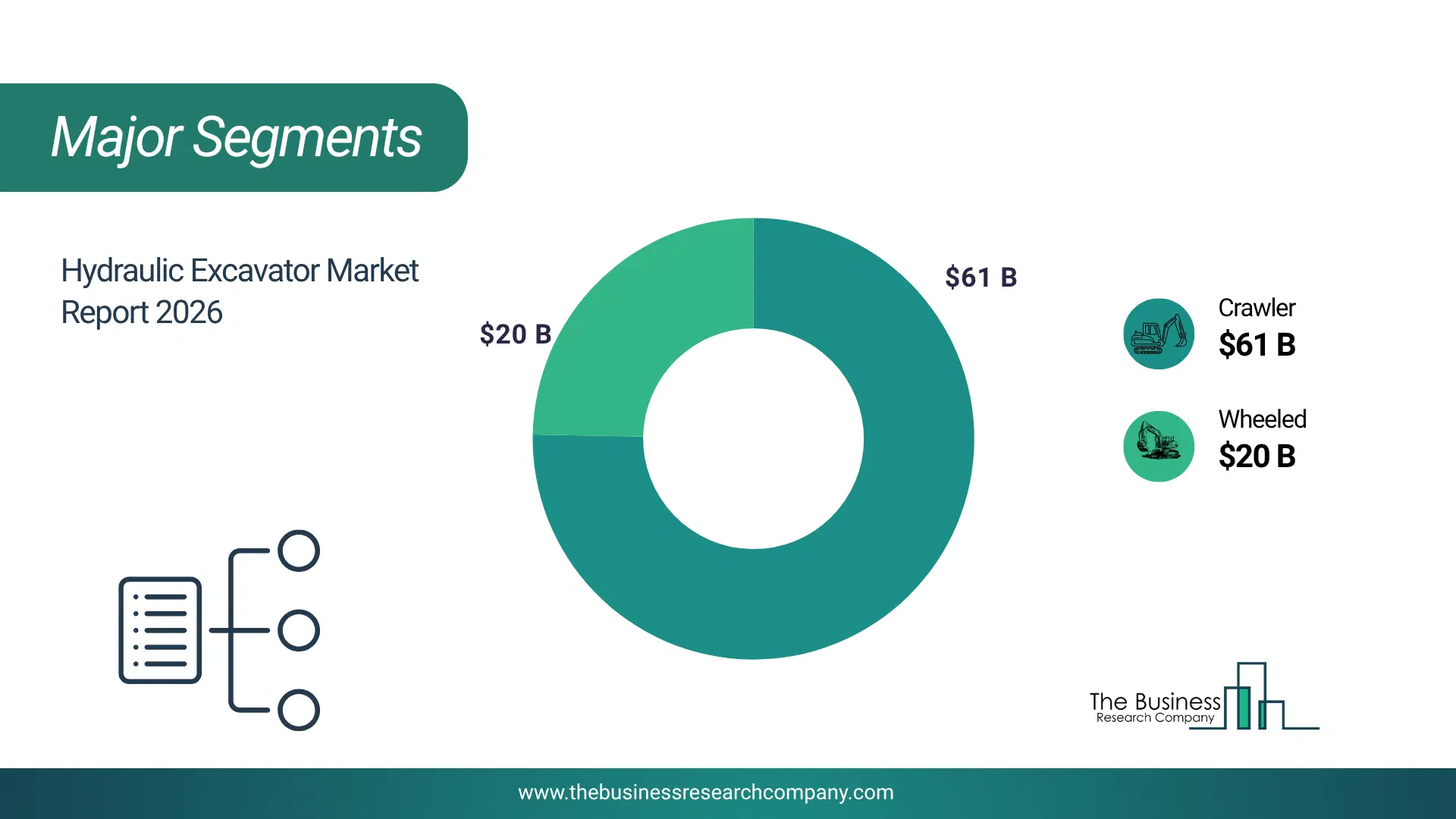
1) By Type: Crawler, Wheeled 2) By Power Rating: 0-300 HP, 301-500 HP, Above 501 HP 3) By Size: Upto 8T, 8 - 12T, 12 - 20T 4) By Operating Mechanism: Electric, Conventional, Hybrid 5) By End-User: Contractors, Rental Providers, Other End Users Subsegments: 1) By Crawler: Standard Crawler Excavators, Heavy-Duty Crawler Excavators, Compact Crawler Excavators 2) By Wheeled: Standard Wheeled Excavators, Compact Wheeled Excavators, All-Terrain Wheeled Excavators The top segments in the hydraulic excavator market will be: • Crawler will reach $61.37 Billion by 2030. • Wheeled will reach $20.24 Billion by 2030.What Is The Driver Of The Hydraulic Excavator Market?
The increasing construction activities are expected to propel the growth of the hydraulic excavators market going forward. Construction activities involve the physical development of buildings, infrastructure, and other structures. The increasing construction activities are due to rapid urbanization, infrastructure development, and a focus on efficiency and accuracy in building projects. Hydraulic excavators are indispensable in modern construction, providing the power, efficiency, and versatility to handle diverse and demanding tasks. For instance, in July 2024, according to the Bureau of National Statistics, a Kazakhstan-based government agency, an estimated in 2023, the total value of construction services was 7,612.8 billion tenge, reflecting a 15.1% increase compared to 2022. Therefore, the increasing construction drives the hydraulic excavators industry.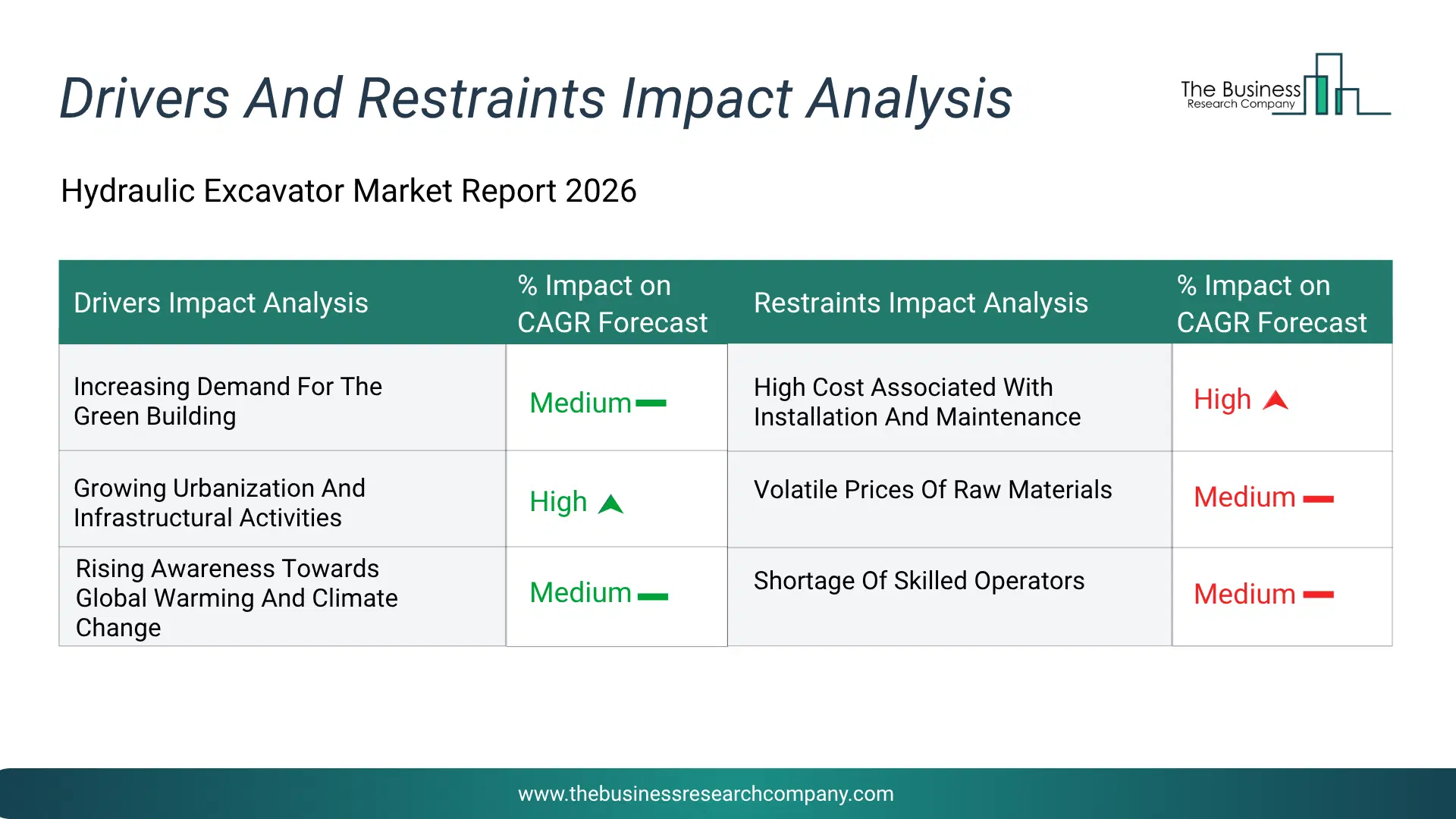
Infographic Chart Showing Key Market Drivers Analysis And Restraints For Hydraulic Excavator Market
The chart presents an impact analysis of key drivers and restraints, quantifying their relative influence on the market's growth rate and helping assess the balance between growth enablers and limiting factors. This chart offers a high-level perspective; the full report contains more detailed insights.
How Will The Drivers Impact Growth In The Global Hydraulic Excavator Market?
• Increasing Demand For The Green Building (Medium) – During the forecast period, the increasing demand for green building is expected to become a key growth driver for the hydraulic excavator market by 2030. The increasing demand for green building is significantly driving the hydraulic excavator market by promoting sustainable construction practices. Environmentally conscious projects require efficient excavation, site preparation, and material handling, which depend heavily on advanced hydraulic excavators. Contractors are increasingly opting for fuel-efficient and low-emission machinery to comply with green building standards and environmental regulations. The integration of energy-saving technologies and hybrid systems in excavators further aligns with sustainability goals. Governments and regulatory bodies are also supporting eco-friendly infrastructure development, boosting equipment adoption. This trend encourages manufacturers to innovate and develop environmentally responsible machinery. Consequently, the growing focus on green construction expands the demand for hydraulic excavators across various sectors. • Growing Urbanization And Infrastructural Activities (High) – During the forecast period, the growing urbanization and infrastructural activities is expected to emerge as a major factor driving the expansion of the hydraulic excavator market by 2030. The growing urbanization and infrastructural activities are fueling the hydraulic excavator market by increasing the need for large-scale construction and development projects. Rapid population growth and migration to urban areas are driving the construction of residential complexes, commercial spaces, and public infrastructure. Hydraulic excavators play a vital role in these activities due to their efficiency in excavation, demolition, and material handling. Governments worldwide are investing heavily in smart cities, transportation networks, and industrial infrastructure, further boosting demand. The need for faster project execution and improved productivity also encourages the adoption of advanced excavators. Additionally, ongoing industrialization in emerging economies contributes to consistent market growth. As a result, expanding urban landscapes significantly increase the demand for hydraulic excavators. • Rising Awareness Towards Global Warming And Climate Change (Medium) – During the forecast period, the rising awareness towards global warming and climate change is expected to act as a key growth catalyst for the hydraulic excavator market by 2030. The rising awareness towards global warming and climate change is driving the hydraulic excavator market by encouraging the adoption of environmentally friendly construction equipment. Increasing concerns about carbon emissions have led to stricter environmental regulations, pushing manufacturers to develop cleaner and more efficient excavators. This has resulted in the introduction of electric and hybrid models that reduce fuel consumption and environmental impact. Construction companies are also prioritizing sustainable practices to enhance their corporate responsibility and comply with regulations. The shift towards low-emission machinery is gaining momentum across both developed and developing regions. Furthermore, global sustainability initiatives are influencing infrastructure development strategies. Consequently, heightened environmental awareness is accelerating innovation and boosting demand in the hydraulic excavator market.How Will The Restraints Impact Growth In The Global Hydraulic Excavator Market?
• High Cost Associated With Installation And Maintenance (Medium) – During the forecast period, the high cost associated with installation and maintenance acts as a significant restraint on the hydraulic excavator market by limiting adoption among small and medium-sized contractors. Hydraulic excavators require substantial upfront investment, including purchase, transportation, and setup costs, which can strain capital budgets. Additionally, ongoing maintenance expenses such as spare parts, servicing, and skilled labor further increase the total cost of ownership. Advanced models with sophisticated technologies demand specialized technicians, adding to operational complexity and cost. Fluctuations in component prices and downtime during repairs can also impact project timelines and profitability. Many construction firms hesitate to invest in new equipment due to these financial burdens, opting for rentals instead. Consequently, high installation and maintenance costs restrict market growth by reducing the pace of new equipment adoption. • Volatile Prices Of Raw Materials (High) – During the forecast period, the volatile prices of raw materials act as a key restraint on the hydraulic excavator market by increasing production and procurement uncertainties. Essential inputs such as steel, rubber, and hydraulic components often experience price fluctuations due to global supply chain disruptions and changing trade policies. These variations raise manufacturing costs, which are eventually passed on to end users in the form of higher equipment prices. As a result, construction companies may delay or scale down their investment in new machinery. Unpredictable material costs also affect profit margins for manufacturers, limiting their ability to maintain stable pricing. Additionally, long-term project planning becomes more challenging due to cost instability. Consequently, raw material price volatility hinders steady market growth and investment confidence. • Shortage Of Skilled Operators (Medium) – During the forecast period, the shortage of skilled operators is another major restraint impacting the hydraulic excavator market by limiting efficient equipment utilization. Modern excavators are equipped with advanced technologies that require trained professionals for safe and optimal operation. However, many regions face a lack of adequately skilled labor, leading to underutilization or improper handling of machinery. This can result in increased wear and tear, higher maintenance costs, and reduced operational efficiency. Construction companies may also experience project delays due to insufficient workforce capabilities. Training programs require time and investment, which further adds to operational expenses. As a result, the shortage of skilled operators slows down equipment adoption and overall market expansion.Key Players In The Global Hydraulic Excavator Market
Major companies operating in the hydraulic excavator market are Caterpillar Inc., Deere & Company, Komatsu Ltd., Kubota Corporation, Liebherr Group, Sany Heavy Industry Co. Ltd., Volvo Construction Equipment, Hitachi Construction Machinery Co. Ltd., Sumitomo Heavy Industries Construction Crane Co. Ltd., Zoomlion Heavy Industry Science & Technology Co. Ltd., Terex Corporation, JCB Inc., Wacker Neuson SE, Lonking Holdings Limited, Shantui Construction Machinery Co. Ltd., Bobcat Co., Sunward Intelligent Equipment Co. Ltd., Kobelco Construction Machinery Inc., Guangxi LiuGong Machinery Co. Ltd., Takeuchi Manufacturing Co. Ltd., Hyundai Construction Equipment Co. Ltd., Doosan Infracore Co. Ltd., XCMG Construction Machinery Co. Ltd., Yanmar Holdings Co. Ltd., Shandong Huitong Heavy Industry Co. Ltd.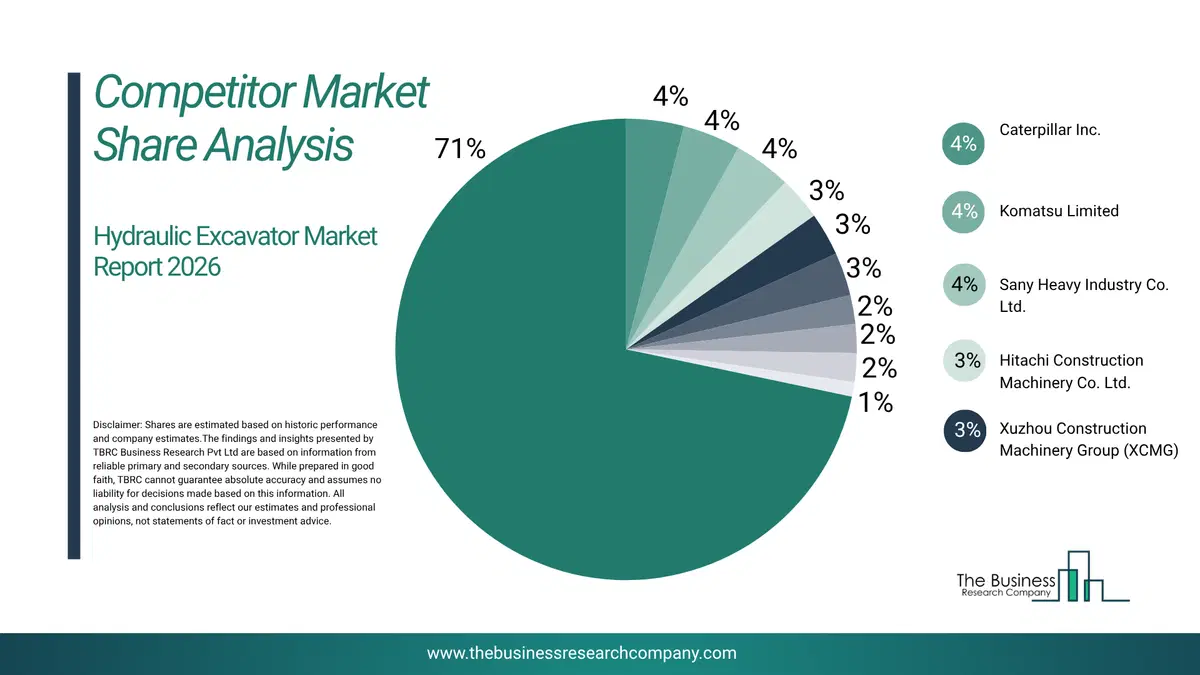
This chart is for illustrative purposes; the full report includes a detailed competitor analysis and comprehensive overview of the top 10 companies in the market.
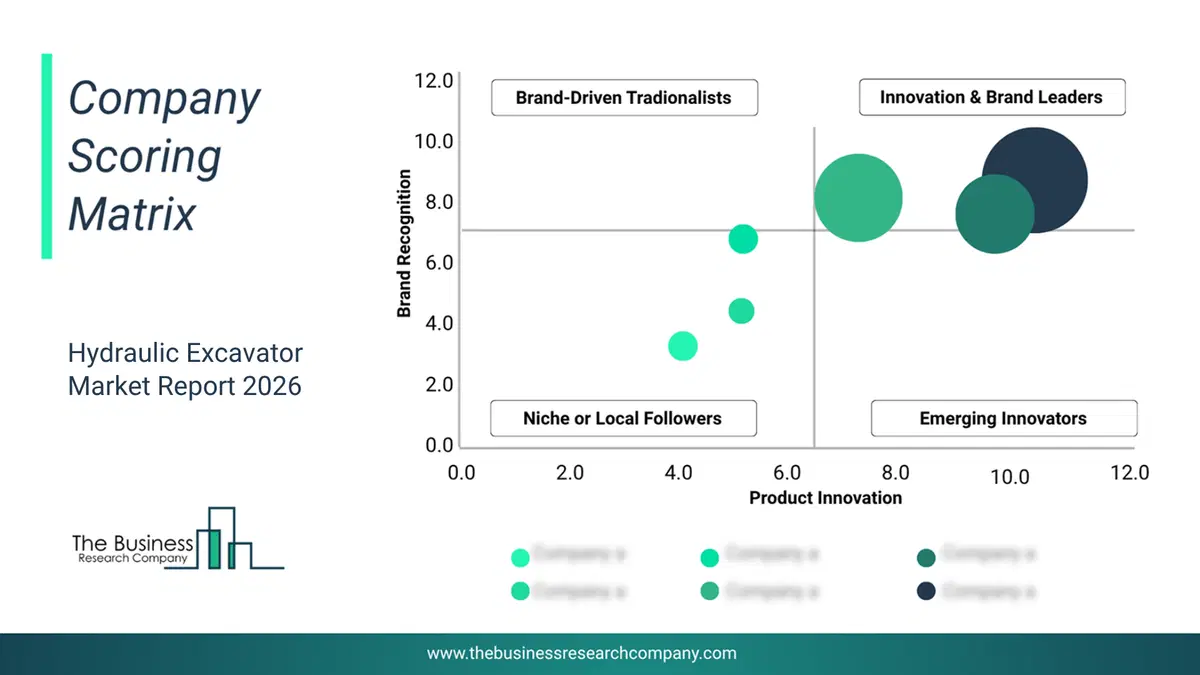
This chart maps companies by product innovation and brand strength, with bubble size indicating relative revenue, helping identify market leaders, challengers, and niche players. This is an illustrative chart; the full report provides a complete and accurate competitive analysis.
Global Hydraulic Excavator Market Trends and Insights
Major companies operating in the hydraulic excavator market are emphasizing the development of advanced solutions such as intelligent machine control (IMC) 3.0 to boost operational productivity and deliver greater precision for clients. Intelligent machine control (IMC) 3.0 is an advanced, sensor- and GNSS-enabled automation system that uses 3D design data to guide and control excavator movements in real time, helping operators achieve higher digging accuracy, automate key tasks, reduce rework and improve overall productivity on construction sites. For instance, in April 2025, Komatsu Ltd., a Japan-based global construction-machinery manufacturer, launched the PC220LCi-12 intelligent excavator designed for automated and highly accurate site operations, featuring factory-integrated 3D boundary control, automatic bucket-movement adjustments to match design specifications and real-time payload and bucket-edge monitoring. PC220LCi-12 improves productivity, reduces rework, minimizes the need for on-site survey personnel and enhances decision-making through precise digital excavation control.What Are Latest Mergers And Acquisitions In The Hydraulic Excavator Market?
In September 2024, Epiroc AB, a Sweden-based mining company that develops and provides innovative and safe equipment, acquired ACB Morin for an undisclosed amount. With this acquisition, Epiroc AB aims to enhance its product offerings in excavator attachments and quick couplers, strengthen its market presence in Europe, and drive innovation in sustainable construction practices. ACB Morin is a France-based manufacturing company that provides critical hydraulic components that enhance the performance and efficiency of hydraulic excavators.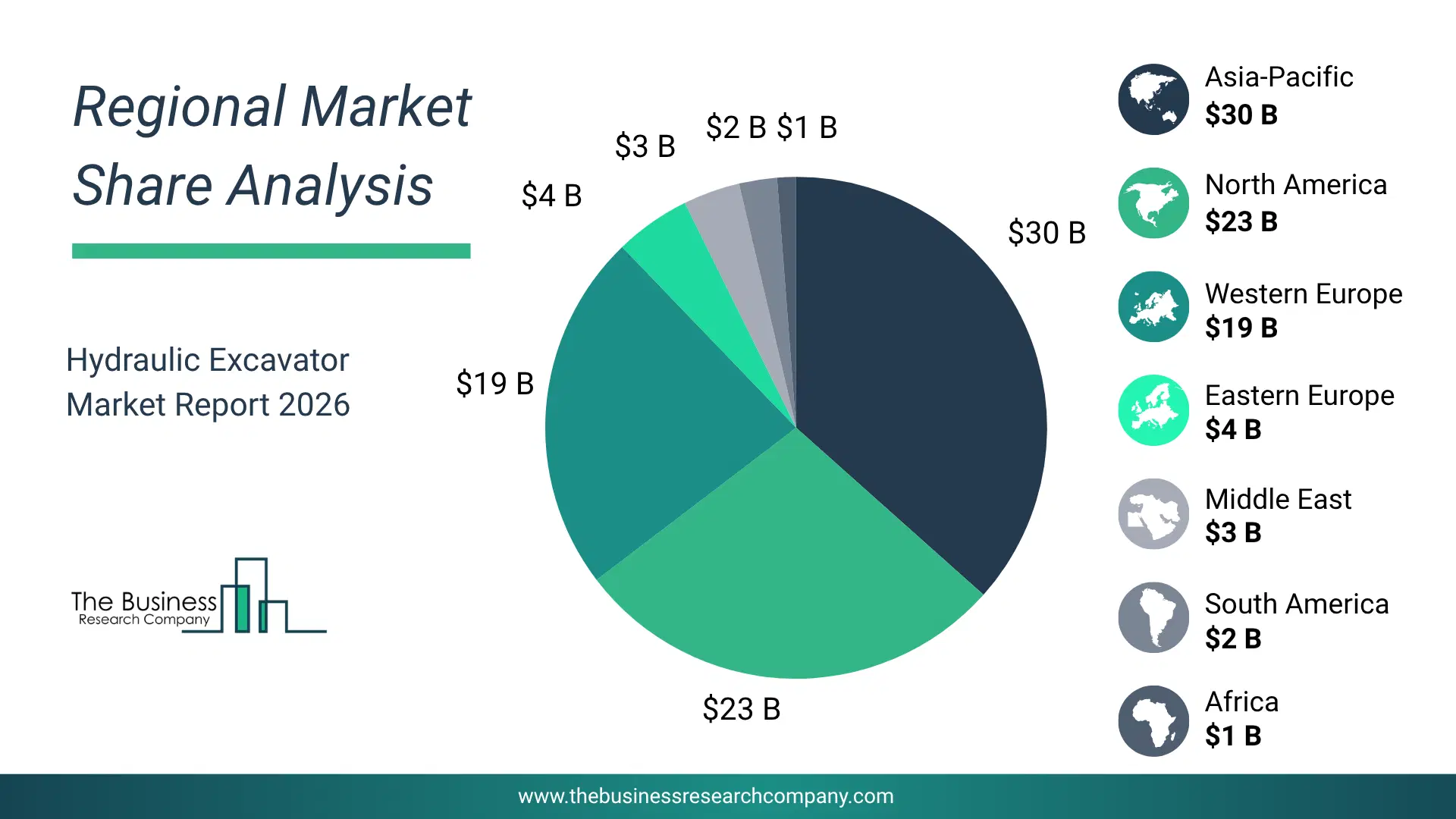
Regional Outlook
Asia Pacific was the largest region in the hydraulic excavator market in 2025. North America is expected to be the fastest-growing region in the forecast period. The regions covered in this market report are Asia-Pacific, South East Asia, Western Europe, Eastern Europe, North America, South America, Middle East, Africa The countries covered in this market report are Australia, Brazil, China, France, Germany, India, Indonesia, Japan, Taiwan, Russia, South Korea, UK, USA, Canada, Italy, Spain.What Defines the Hydraulic Excavator Market?
The hydraulic excavator market consists of sales of short-swing radius excavators, long-reach excavators, and compact excavators. Values in this market are ‘factory gate’ values, that is the value of goods sold by the manufacturers or creators of the goods, whether to other entities (including downstream manufacturers, wholesalers, distributors, and retailers) or directly to end customers. The value of goods in this market includes related services sold by the creators of the goods.How is Market Value Defined and Measured?
The market value is defined as the revenues that enterprises gain from the sale of goods and/or services within the specified market and geography through sales, grants, or donations in terms of the currency (in USD unless otherwise specified). The revenues for a specified geography are consumption values that are revenues generated by organizations in the specified geography within the market, irrespective of where they are produced. It does not include revenues from resales along the supply chain, either further along the supply chain or as part of other products.
This chart presents market attractiveness based on a quantitative evaluation of growth, competition, strategic alignment, and risk, offering a clear view of opportunity areas for decision-making. This chart is for illustrative purposes; the full report contains the complete analysis.

This chart highlights the Total Addressable Market (TAM) by estimating the maximum revenue opportunity using an assumption-driven approach, supporting strategic planning and opportunity sizing across markets. The chart is illustrative; the full report provides a more comprehensive analysis.
What Key Data and Analysis Are Included in the Hydraulic Excavator Market Report 2026?
The hydraulic excavator market research report is one of a series of new reports from The Business Research Company that provides market statistics, including industry global market size, regional shares, competitors with the market share, detailed market segments, market trends and opportunities, and any further data you may need to thrive in the hydraulic excavator industry. The market research report delivers a complete perspective of everything you need, with an in-depth analysis of the current and future state of the industry.Hydraulic Excavator Market Report Forecast Analysis
| Report Attribute | Details |
|---|---|
| Market Size Value In 2026 | $73.33 billion |
| Revenue Forecast In 2030 | $82.74 billion |
| Growth Rate | CAGR of 2.9% from 2026 to 2030 |
| Base Year For Estimation | 2025 |
| Actual Estimates/Historical Data | 2020-2025 |
| Forecast Period | 2026 - 2030 |
| Market Representation | Revenue in USD Billion and CAGR from 2026 to 2030 |
| Segments Covered | Type, Power Rating, Size, Operating Mechanism, End-User |
| Regional Scope | Asia-Pacific, Western Europe, Eastern Europe, North America, South America, Middle East, Africa |
| Country Scope | The countries covered in the report are Australia, Brazil, China, France, Germany, India, Indonesia, Japan, Taiwan, Russia, South Korea, UK, USA, Canada, Italy, Spain. |
| Key Companies Profiled | Caterpillar Inc., Deere & Company, Komatsu Ltd., Kubota Corporation, Liebherr Group, Sany Heavy Industry Co. Ltd., Volvo Construction Equipment, Hitachi Construction Machinery Co. Ltd., Sumitomo Heavy Industries Construction Crane Co. Ltd., Zoomlion Heavy Industry Science & Technology Co. Ltd., Terex Corporation, JCB Inc., Wacker Neuson SE, Lonking Holdings Limited, Shantui Construction Machinery Co. Ltd., Bobcat Co., Sunward Intelligent Equipment Co. Ltd., Kobelco Construction Machinery Inc., Guangxi LiuGong Machinery Co. Ltd., Takeuchi Manufacturing Co. Ltd., Hyundai Construction Equipment Co. Ltd., Doosan Infracore Co. Ltd., XCMG Construction Machinery Co. Ltd., Yanmar Holdings Co. Ltd., Shandong Huitong Heavy Industry Co. Ltd. |
| Customization Scope | Request for Customization |
| Pricing And Purchase Options | Explore Purchase Options |