
Hydrogen Fueling Station Market Report 2026
Global Outlook – By Station Type (Fixed Hydrogen Station, Mobile Hydrogen Station), By Solution (Engineering, Procurement And Construction, Components), By Station Size (Small, Medium, Large), By Supply Type (On-Site, Off-Site), By End-Use (Marine, Railways, Commercial Vehicles, Aviation) – Market Size, Trends, Strategies, and Forecast to 2030
Hydrogen Fueling Station Market Overview
• Hydrogen Fueling Station market size has reached to $0.95 billion in 2025 • Expected to grow to $2.47 billion in 2030 at a compound annual growth rate (CAGR) of 20.8% • Growth Driver: Rising Demand For Zero-Emission Vehicles Fuels Expansion Of Hydrogen Fueling Stations • Market Trend: Innovative Solutions Driving Growth With The Rise Of Automatic Mobile Hydrogen Stations • Asia-Pacific was the largest region and fastest growing region.Market Gains By 2030 – Top Opportunities By Segment
Market Gain identifies the most promising market opportunities by highlighting the segments or products expected to generate the highest incremental revenue growth over the next five years.
What Is Covered Under Hydrogen Fueling Station Market?
A hydrogen fueling station refers to a facility designed to supply hydrogen as a fuel for vehicles powered by hydrogen fuel cells. These stations typically compress and store hydrogen gas on-site and dispense it to vehicles either as compressed hydrogen gas or as a liquid. The main types of hydrogen fueling stations are fixed hydrogen stations and mobile hydrogen stations. A fixed hydrogen fueling station is a stationary facility designed to dispense hydrogen fuel to vehicles. It is typically integrated into existing fueling infrastructure and provides a convenient and permanent refueling solution for hydrogen-powered vehicles in specific locations, such as urban centers or along highways. They are used to offer various solutions, such as engineering, procurement, construction, and components, with stations of several sizes available, including small, medium, and large. The several supply types include on-site and off-site, which are used for various end users, including marine, railways, commercial vehicles, and aviation.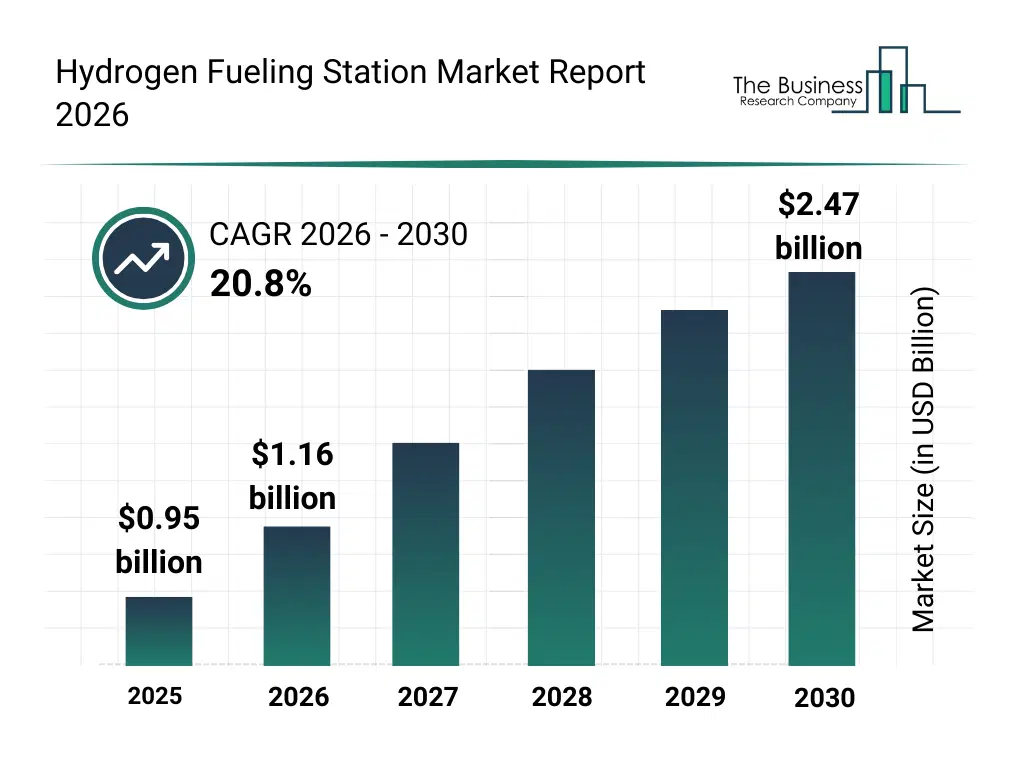
What Is The Hydrogen Fueling Station Market Size and Share 2026?
The hydrogen fueling station market size has grown exponentially in recent years. It will grow from $0.95 billion in 2025 to $1.16 billion in 2026 at a compound annual growth rate (CAGR) of 21.2%. The growth in the historic period can be attributed to early fuel cell vehicle deployment, government pilot hydrogen projects, initial clean mobility investments, demonstration of hydrogen technologies, public sector funding support.What Is The Hydrogen Fueling Station Market Growth Forecast?
The hydrogen fueling station market size is expected to see exponential growth in the next few years. It will grow to $2.47 billion in 2030 at a compound annual growth rate (CAGR) of 20.8%. The growth in the forecast period can be attributed to growth of hydrogen powered vehicles, decarbonization of transport sector, national hydrogen roadmaps, investments in green hydrogen production, expansion of commercial fuel cell fleets. Major trends in the forecast period include expansion of hydrogen refueling infrastructure, growing deployment of fixed hydrogen stations, rising adoption of mobile hydrogen fueling solutions, increasing integration with fuel cell vehicle fleets, rising investment in large scale hydrogen stations.
Global Hydrogen Fueling Station Market Segmentation
1) By Station Type: Fixed Hydrogen Station, Mobile Hydrogen Station 2) By Solution: Engineering, Procurement And Construction, Components 3) By Station Size: Small, Medium, Large 4) By Supply Type: On-Site, Off-Site 5) By End-Use: Marine, Railways, Commercial Vehicles, Aviation Subsegments: 1) By Fixed Hydrogen Station: On-Site Hydrogen Production Stations, Off-Site Hydrogen Delivery Stations, Public Hydrogen Refueling Stations, Private Or Commercial Hydrogen Refueling Stations 2) By Mobile Hydrogen Station: Trailer-Based Mobile Hydrogen Stations, Containerized Mobile Hydrogen Stations, Truck-Based Mobile Hydrogen Stations The top segments in the consumer electronics e-commerce market will be: • Video Products will reach $932.84 Billion by 2030. • Audio Products will reach $573.39 Billion by 2030. • Other Products will reach $349.14 Billion by 2030. The top segments in the hydrogen fueling station market will be: • Fixed Hydrogen Station will reach $1.47 Billion by 2030. • Mobile Hydrogen Station will reach $0.83 Billion by 2030.What Is The Driver Of The Hydrogen Fueling Station Market?
The increasing demand for zero-emission vehicles is expected to propel the growth of the hydrogen fueling station market going forward. A zero-emission vehicle refers to any vehicle that uses propulsion technology that does not produce internal combustion engine exhaust or other carbon emissions when it operates. The demand for zero-emission vehicles is increasing due to growing concerns about environmental sustainability, coupled with government regulations aimed at reducing greenhouse gas emissions and promoting clean transportation. Hydrogen fueling stations enable the efficient and sustainable operation of zero-emission vehicles, particularly fuel cell electric vehicles (FCEVs), by providing a convenient refueling experience similar to traditional gasoline stations. These stations allow FCEV drivers to fill up their tanks in a matter of minutes. For instance, in January 2024, according to the China Association of Automobile Manufacturers (CAAM), a China-based organization that represents the interests of automobile manufacturers, approximately 6,000 fuel-cell electric vehicles (FCEVs) were sold in China in 2023, representing a significant year-on-year increase of 72%. Moreover, the Chinese government targets 50,000 FCEVs on the road and 100,000–200,000 metric tons of annual renewable hydrogen production capacity by 2025. Therefore, the increasing demand for zero-emission vehicles is driving the growth of the hydrogen fueling station industry.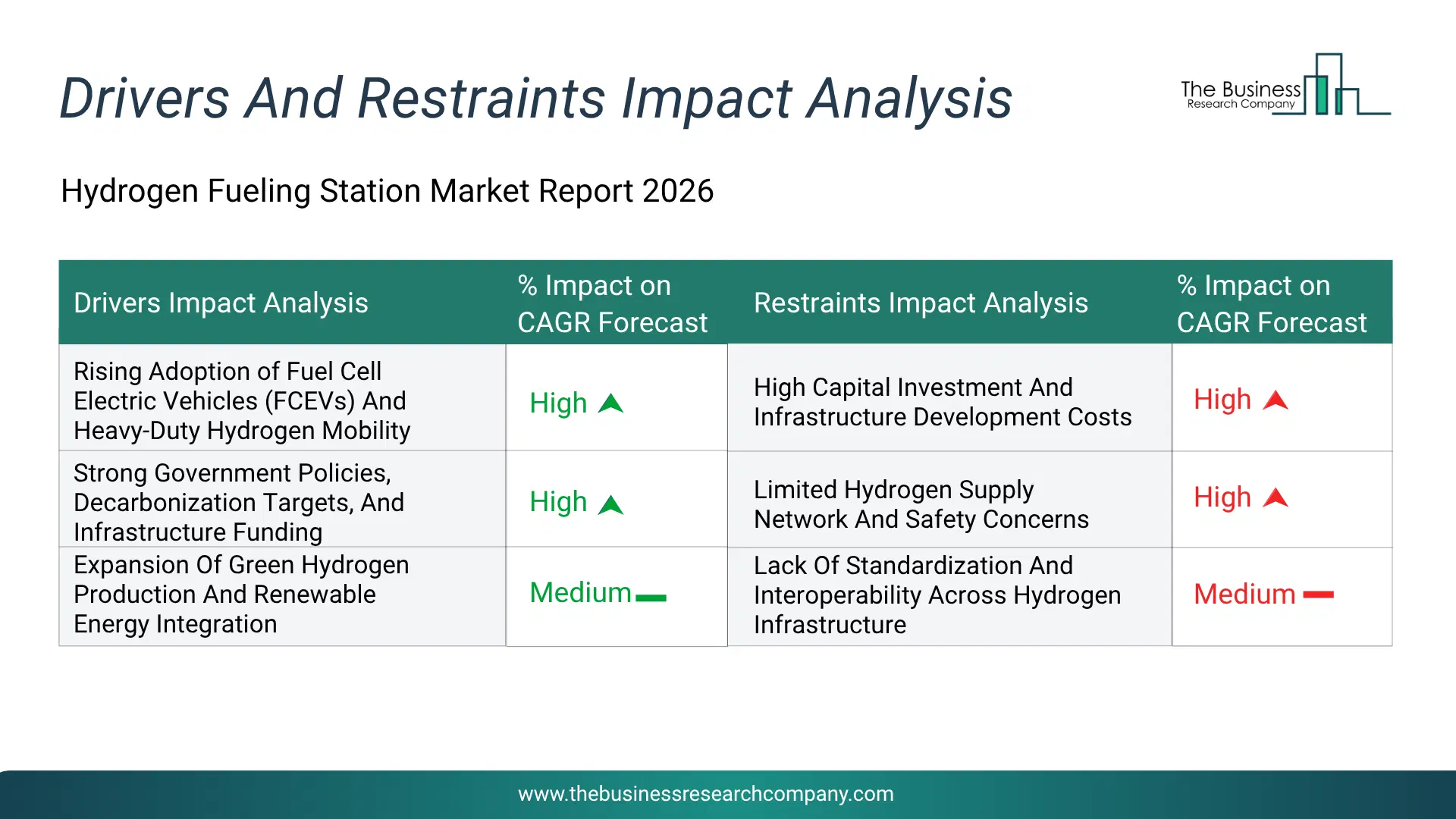
Infographic Chart Showing Key Market Drivers Analysis And Restraints For Hydrogen Fueling Station Market
The chart presents an impact analysis of key drivers and restraints, quantifying their relative influence on the market's growth rate and helping assess the balance between growth enablers and limiting factors. This chart offers a high-level perspective; the full report contains more detailed insights.
How Will The Drivers Impact Growth In The Global Hydrogen Fueling Station Market?
• Rising Adoption of Fuel Cell Electric Vehicles (FCEVs) And Heavy-Duty Hydrogen Mobility (High) – During the forecast period, the rising adoption of fuel cell electric vehicles (FCEVs) and heavy-duty hydrogen mobility is expected to become a key growth driver for the hydrogen fueling station market by 2030. Increasing deployment of hydrogen-powered buses, trucks, and commercial fleets is accelerating demand for advanced hydrogen refueling infrastructure. As transportation operators and logistics companies focus on reducing emissions and improving operational efficiency, they increasingly require reliable fueling stations capable of supporting high-capacity and long-range hydrogen mobility applications. This expansion is encouraging investments in fixed and mobile fueling systems equipped with advanced compression, storage, and dispensing technologies. Additionally, the growing commercialization of hydrogen-powered transportation highlights the need for dependable fueling networks capable of supporting continuous fleet operations. • Strong Government Policies, Decarbonization Targets, And Infrastructure Funding (High) – During the forecast period, the strong government policies, decarbonization targets, and infrastructure funding are expected to emerge as major factors driving the expansion of the hydrogen fueling station market by 2030. Increasing policy support and public funding initiatives strongly support market growth by enabling energy companies and transportation authorities to invest in hydrogen refueling infrastructure. With greater financial incentives and regulatory backing, stakeholders can accelerate the deployment of advanced fueling stations that align with national clean energy and carbon neutrality objectives. Such initiatives are often supported by long-term hydrogen roadmaps and transportation decarbonization programs, which further increase demand for hydrogen supply and dispensing networks. Higher infrastructure spending also enables the development of large-scale hydrogen mobility corridors and integrated fueling ecosystems. • Expansion Of Green Hydrogen Production And Renewable Energy Integration (Medium) – During the forecast period, the expansion of green hydrogen production and renewable energy integration is expected to act as a key growth catalyst for the hydrogen fueling station market by 2030. The increasing production of green hydrogen using renewable energy sources is accelerating demand for hydrogen fueling infrastructure as energy providers and mobility operators focus on building sustainable transportation ecosystems. The expansion of electrolyzer installations and renewable-powered hydrogen generation facilities requires efficient distribution and refueling networks to support end-use applications. This growing clean hydrogen supply encourages investments in advanced fueling stations equipped with on-site production, storage, and dispensing capabilities. Furthermore, increasing integration of renewable energy into hydrogen production systems underscores the importance of reliable infrastructure for large-scale hydrogen mobility adoption.How Will The Restraints Impact Growth In The Global Hydrogen Fueling Station Market?
• High Capital Investment And Infrastructure Development Costs (High) – During the forecast period, the hydrogen fueling stations require substantial upfront investments for compressors, storage systems, dispensing equipment, safety systems, and hydrogen transportation infrastructure. The high cost of producing, storing, and distributing hydrogen significantly increases total project expenditure, limiting rapid infrastructure expansion in developing regions. Additionally, low station utilization rates during the early adoption phase reduce profitability for operators. These economic barriers continue to slow large-scale commercialization of hydrogen refueling networks. • Limited Hydrogen Supply Network And Safety Concerns (High) – During the forecast period, the hydrogen distribution infrastructure remains underdeveloped in many countries, creating logistical and operational challenges for fueling station operators. Transportation and storage of hydrogen require specialized high-pressure systems and strict safety compliance measures due to risks associated with leakage, flammability, and explosion hazards. Concerns regarding infrastructure reliability and safety regulations can delay project approvals and reduce investor confidence. The limited availability of hydrogen supply chains also restricts the expansion of fueling stations outside major pilot regions. • Lack Of Standardization And Interoperability Across Hydrogen Infrastructure (Medium) – During the forecast period, the the hydrogen fueling station market faces challenges due to the lack of standardized fueling protocols, storage specifications, and interoperability frameworks across regions and vehicle platforms. Variations in dispensing pressure standards, connector technologies, and fueling system designs are creating compatibility issues between infrastructure providers and fuel cell vehicle manufacturers. Additionally, the absence of unified regulatory frameworks and technical standards increases deployment complexity and slows cross-border infrastructure expansion. These factors are limiting network scalability and delaying broader adoption of hydrogen fueling ecosystems.Key Players In The Global Hydrogen Fueling Station Market
Major companies operating in the hydrogen fueling station market are China Petrochemical Corporation (Sinopec), TotalEnergies SE, Shell plc, Linde PLC, Air Liquide S.A., Cummins Inc., NTPC Limited, McPhy Energy SAS, Air Products and Chemicals Inc., Nano Sun Ltd., ITM Power PLC, Black and Veatch Holding Company, ATCO Ltd., Chart Industries, Plug Power Inc., FuelCell Energy Inc., NEL ASA, Hexagon Purus ASA, Ballard Power Systems, Nuvera Fuel Cells LLC, Nikola Corporation, Ceres Power, PDC Machines Inc., Green Hydrogen Systems, Humble Hydrogen Private Limited, TrueZero, FirstElement Fuel Inc., H2 MOBILITY Deutschland GmbH & Co. KG, HyGear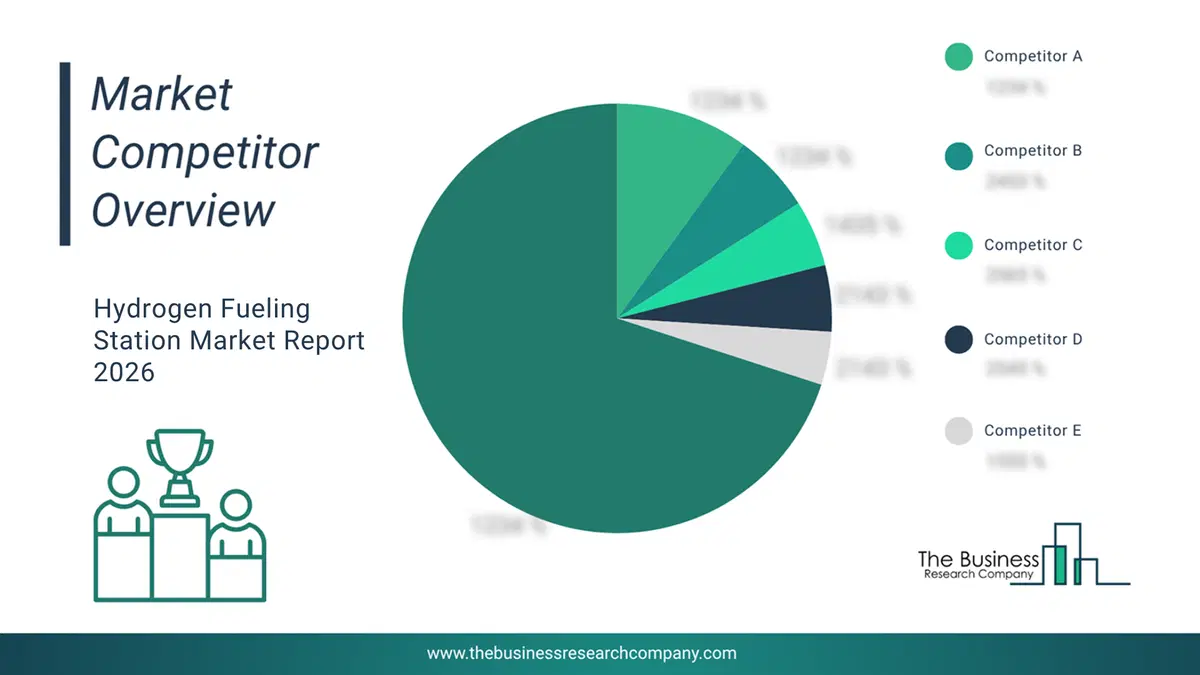
This chart is for illustrative purposes; the full report includes a detailed competitor analysis and comprehensive overview of the top 10 companies in the market.
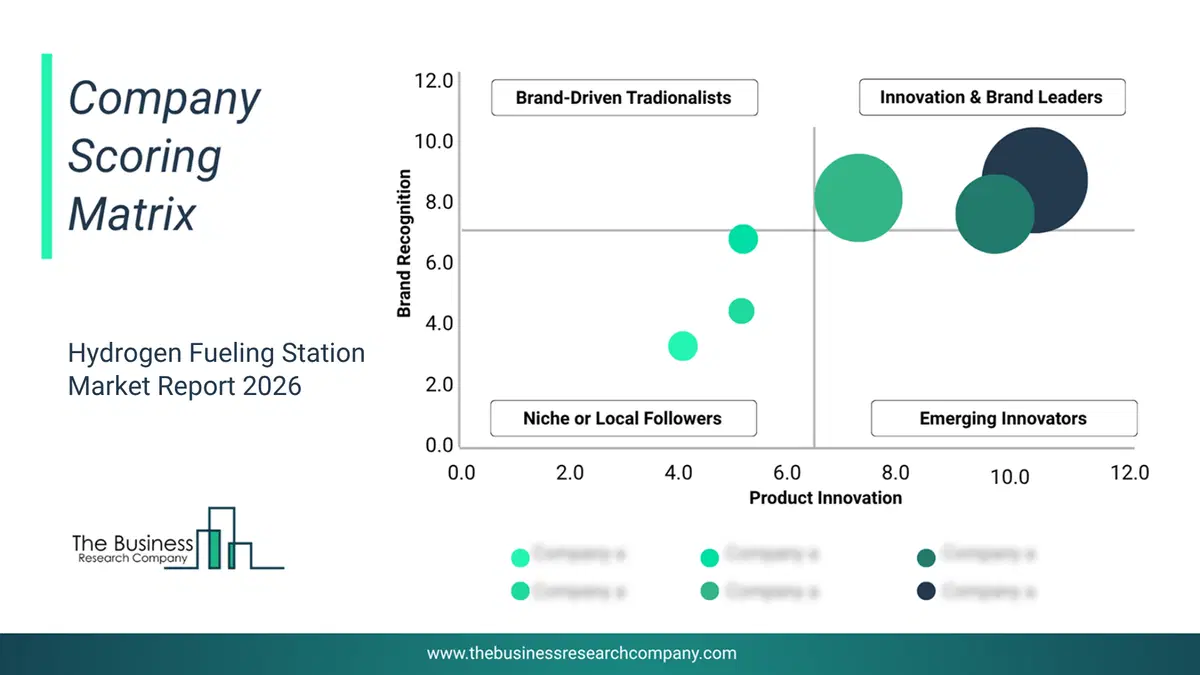
This chart maps companies by product innovation and brand strength, with bubble size indicating relative revenue, helping identify market leaders, challengers, and niche players. This is an illustrative chart; the full report provides a complete and accurate competitive analysis.
Global Hydrogen Fueling Station Market Trends and Insights
Major companies operating in the hydrogen fueling station market are focused on developing innovative technologies, such as automatic mobile hydrogen stations, to increase their profitability in the market. Automatic mobile hydrogen stations are designed to be movable and deployable, allowing for temporary refueling solutions in areas without fixed hydrogen fueling infrastructure or during events, emergencies, or construction projects. For instance, in June 2024, Honda, a Japan-based automobiles, motorcycles, and power equipment manufacturer, launched 2025 Honda CR-V e:FCEV. The 2025 Honda CR-V e:FCEV vehicle encompasses fuel cell system with plug-in EV charging capability along with driving range of 270 miles (435 km), with an additional 29 miles (47 km) on battery power. This development supports the broader deployment of hydrogen mobility, addressing various vehicle refueling needs.What Are Latest Mergers And Acquisitions In The Hydrogen Fueling Station Market?
In July 2024, Atawey S.A., a France-based hydrogen distribution equipment company, acquired McPhy’s hydrogen refueling station business for an undisclosed amount. With this acquisition, Atawey aimed to strengthen its European market leadership in hydrogen refueling infrastructure by expanding production capacity, technological expertise, and installed station network. McPhy Energy S.A. is a France-based hydrogen technology unit that specialized in the design, production, and deployment of hydrogen refueling station solutions as part of its broader clean hydrogen equipment portfolio.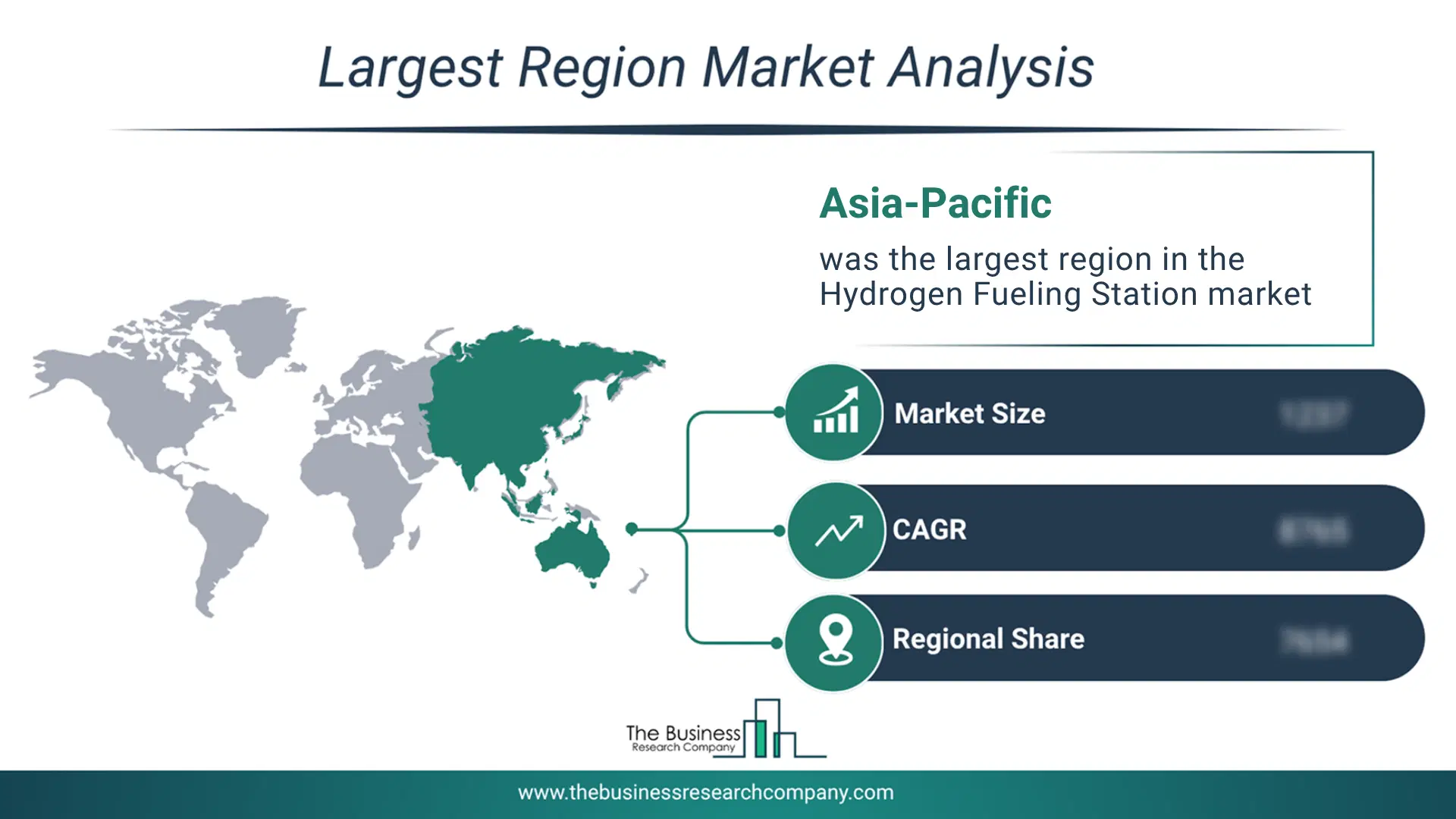
Regional Outlook
Asia-Pacific was the largest region in the hydrogen fueling station market in 2025. It is expected to be the fastest-growing region in the forecast period. The regions covered in this market report are Asia-Pacific, South East Asia, Western Europe, Eastern Europe, North America, South America, Middle East, Africa. The countries covered in this market report are Australia, Brazil, China, France, Germany, India, Indonesia, Japan, Taiwan, Russia, South Korea, UK, USA, Canada, Italy, SpainWhat Defines the Hydrogen Fueling Station Market?
The hydrogen fueling station market consists of revenues earned by entities providing services such as integration with fleet operations, maintenance and monitoring, safety instructions and assistance, payment and transactions, hydrogen dispensing, and others. The market value includes the value of related goods sold by the service provider or included within the service offering. The hydrogen fueling station market also includes sales of electrolyzers, compression equipment, fuel quality assurance systems, dispensing nozzles and hoses, compressors, and hydrogen production systems. Values in this market are ‘factory gate’ values, that is the value of goods sold by the manufacturers or creators of the goods, whether to other entities (including downstream manufacturers, wholesalers, distributors and retailers) or directly to end customers. The value of goods in this market includes related services sold by the creators of the goods.How is Market Value Defined and Measured?
The market value is defined as the revenues that enterprises gain from the sale of goods and/or services within the specified market and geography through sales, grants, or donations in terms of the currency (in USD unless otherwise specified). The revenues for a specified geography are consumption values that are revenues generated by organizations in the specified geography within the market, irrespective of where they are produced. It does not include revenues from resales along the supply chain, either further along the supply chain or as part of other products.
This chart presents market attractiveness based on a quantitative evaluation of growth, competition, strategic alignment, and risk, offering a clear view of opportunity areas for decision-making. This chart is for illustrative purposes; the full report contains the complete analysis.

This chart highlights the Total Addressable Market (TAM) by estimating the maximum revenue opportunity using an assumption-driven approach, supporting strategic planning and opportunity sizing across markets. The chart is illustrative; the full report provides a more comprehensive analysis.
What Key Data and Analysis Are Included in the Hydrogen Fueling Station Market Report 2026?
The hydrogen fueling station market research report is one of a series of new reports from The Business Research Company that provides market statistics, including industry global market size, regional shares, competitors with the market share, detailed market segments, market trends and opportunities, and any further data you may need to thrive in the hydrogen fueling station industry. The market research report delivers a complete perspective of everything you need, with an in-depth analysis of the current and future state of the industry.Hydrogen Fueling Station Market Report Forecast Analysis
| Report Attribute | Details |
|---|---|
| Market Size Value In 2026 | $1.16 billion |
| Revenue Forecast In 2030 | $2.47 billion |
| Growth Rate | CAGR of 20.8% from 2026 to 2030 |
| Base Year For Estimation | 2025 |
| Actual Estimates/Historical Data | 2020-2025 |
| Forecast Period | 2026 - 2030 |
| Market Representation | Revenue in USD Billion and CAGR from 2026 to 2030 |
| Segments Covered | Station Type, Solution, Station Size, Supply Type, End-Use |
| Regional Scope | Asia-Pacific, Western Europe, Eastern Europe, North America, South America, Middle East, Africa |
| Country Scope | The countries covered in the report are Australia, Brazil, China, France, Germany, India, Indonesia, Japan, Taiwan, Russia, South Korea, UK, USA, Canada, Italy, Spain. |
| Key Companies Profiled | China Petrochemical Corporation (Sinopec), TotalEnergies SE, Shell plc, Linde PLC, Air Liquide S.A., Cummins Inc., NTPC Limited, McPhy Energy SAS, Air Products and Chemicals Inc., Nano Sun Ltd., ITM Power PLC, Black and Veatch Holding Company, ATCO Ltd., Chart Industries, Plug Power Inc., FuelCell Energy Inc., NEL ASA, Hexagon Purus ASA, Ballard Power Systems, Nuvera Fuel Cells LLC, Nikola Corporation, Ceres Power, PDC Machines Inc., Green Hydrogen Systems, Humble Hydrogen Private Limited, TrueZero, FirstElement Fuel Inc., H2 MOBILITY Deutschland GmbH & Co. KG, HyGear |
| Customization Scope | Request for Customization |
| Pricing And Purchase Options | Explore Purchase Options |