
Hydrogen Generation Market Report 2026
Global Outlook – By Type (On-Site, Portable), By Source (Blue Hydrogen, Gray Hydrogen, Green Hydrogen), By Generation And Delivery Mode (Captive, Merchant), By Technologies (Steam Methane Reforming, Coal Gasification, Electrolysis, Partial Oxidation), By Application (Methanol Production, Ammonia Production, Petroleum Refining, Transportation, Power Generation, Other Applications) – Market Size, Trends, Strategies, and Forecast to 2030
Hydrogen Generation Market Overview
• Hydrogen Generation market size has reached to $164.31 billion in 2025 • Expected to grow to $238.79 billion in 2030 at a compound annual growth rate (CAGR) of 7.6% • Growth Driver: Increasing Demand For Hydrogen In The Industrial Sector Propelling The Growth Of The Hydrogen Generation Market • Market Trend: Pipeline Conversion Initiatives Driving Hydrogen Generation Growth • Asia Pacific was the largest region in 2025 and Asia-Pacific is the fastest growing region.What Is Covered Under Hydrogen Generation Market?
Hydrogen generation refers to the process of generating hydrogen from a variety of domestic sources, such as biomass, fossil fuels, and water electrolysis. It is used to provide a clean fuel source for various applications, including fuel cells, industrial processes, and renewable energy storage. The main types of hydrogen generation include on-site and portable. The sources include blue hydrogen, grey hydrogen, and green hydrogen generated and delivered by captive merchants with different technologies such as steam methane reforming, coal gasification, electrolysis, and partial oxidation used in various applications such as methanol production, ammonia production, petroleum refining, transportation, power generation, and other applications.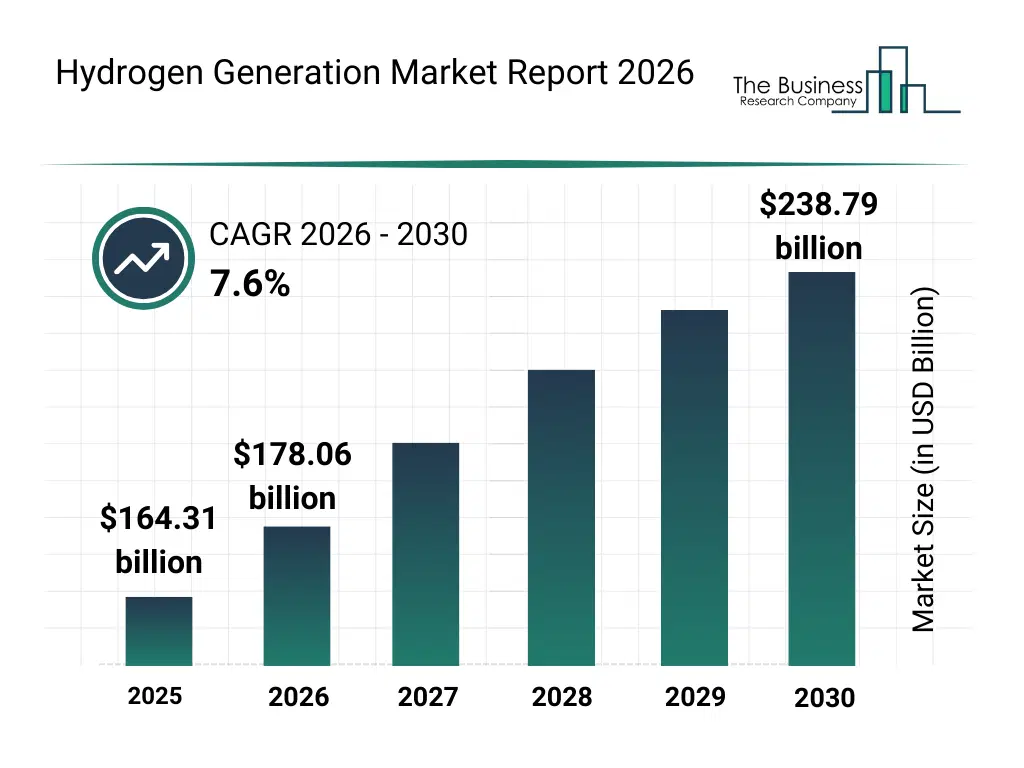
What Is The Hydrogen Generation Market Size and Share 2026?
The hydrogen generation market size has grown strongly in recent years. It will grow from $164.31 billion in 2025 to $178.06 billion in 2026 at a compound annual growth rate (CAGR) of 8.4%. The growth in the historic period can be attributed to expansion of industrial hydrogen demand, widespread use of steam methane reforming, growth of petroleum refining applications, availability of fossil fuel-based hydrogen production, early adoption of hydrogen fuel technologies.What Is The Hydrogen Generation Market Growth Forecast?
The hydrogen generation market size is expected to see strong growth in the next few years. It will grow to $238.79 billion in 2030 at a compound annual growth rate (CAGR) of 7.6%. The growth in the forecast period can be attributed to increasing government support for clean hydrogen, rising investments in renewable energy integration, expansion of hydrogen mobility infrastructure, growing demand for low-carbon industrial fuels, accelerating deployment of large-scale electrolyzers. Major trends in the forecast period include rapid expansion of green hydrogen projects, increasing adoption of electrolysis technologies, growing use of hydrogen in energy storage, rising integration with renewable power sources, expansion of on-site hydrogen generation systems.
Global Hydrogen Generation Market Segmentation
1) By Type: On-Site, Portable 2) By Source: Blue Hydrogen, Gray Hydrogen, Green Hydrogen 3) By Generation And Delivery Mode: Captive, Merchant 4) By Technologies: Steam Methane Reforming, Coal Gasification, Electrolysis, Partial Oxidation 5) By Application: Methanol Production, Ammonia Production, Petroleum Refining, Transportation, Power Generation, Other Applications Subsegments: 1) By On-Site: Electrolysis Systems, Steam Methane Reforming (SMR), Gasification, Biomass Gasification 2) By Portable: Portable Electrolyzers, Hydrogen Generation Units, Chemical Hydrogen GeneratorsWhat Is The Driver Of The Hydrogen Generation Market?
The increasing demand for hydrogen in the industrial sector is expected to propel the growth of the hydrogen generation market going forward. The industrial sector refers to a sector of the economy made up of companies that assist other companies in the production, transportation, or manufacture of their goods. The industrial sector uses a large amount of hydrogen, as it is a component of many chemical products and is used in hydrocracking, which produces petroleum products including gasoline and diesel. For instance, in 2024, according to the International Energy Agency (IEA), a France-based autonomous intergovernmental organization, in 2023, global hydrogen demand reached 97 million tonnes, up 2.5% from 2022. Therefore, increasing demand for hydrogen in the industrial sector is driving the growth of the hydrogen generation industry.Key Players In The Global Hydrogen Generation Market
Major companies operating in the hydrogen generation market are Air Liquide SA, Air Products Inc., Iwatani Corporation, McPhy Energy SA, Messer Group GmbH, Altergy Systems, Ballard Power Systems Inc., BayoTech Inc., Doosan Fuel Cell Co. Ltd., EKME S.A., Enapter AG, Frame Power India Pvt. Ltd., Giner ELX Inc., Green Hydrogen Systems AS, Greenlane Renewables Inc., GRZ Technologies Ltd., Cummins Inc., ITM Power PLC, Linde PLC, Nel ASA, Plug Power Europe GmbH, Proton OnSite LLC, Siemens Energy AG, Taiyo Nippon Sanso Corporation, Teijin Engineering Ltd., Teledyne Energy Systems Inc., Toshiba Energy Systems & Solutions Corp., VRV SpA
This chart is for illustrative purposes; the full report includes a detailed competitor analysis and comprehensive overview of the top 10 companies in the market.
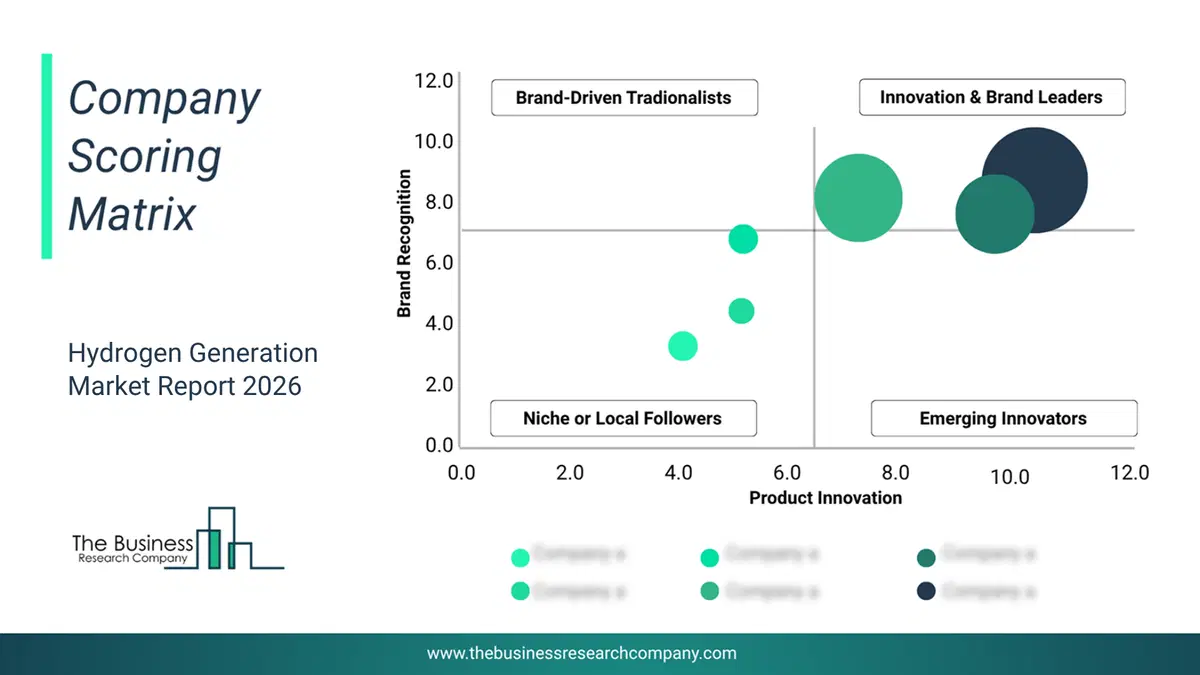
This chart maps companies by product innovation and brand strength, with bubble size indicating relative revenue, helping identify market leaders, challengers, and niche players. This is an illustrative chart; the full report provides a complete and accurate competitive analysis.
Global Hydrogen Generation Market Trends and Insights
Major companies operating in the hydrogen generation market are focusing on developing innovative solutions, such as green hydrogen production and transportation technologies, to meet the rising demand for low-carbon fuel and support global energy-transition goals. Green-hydrogen technologies enable hydrogen production and movement with minimal emissions by leveraging renewable power and reconfigured infrastructure, offering a cleaner alternative to traditional fossil-fuel-derived hydrogen systems that contribute to carbon output. For instance, in May 2024, DORIS (engineering), a France-based privately held engineering and project‑management company; ROSEN Group (pipeline inspection), a Switzerland-based private, family-owned engineering and industrial services company; and SPIECAPAG (EPC services), a Germany‑based engineering and construction company, formed the Pipeline Transition Alliance, a collaboration dedicated to repurposing existing natural‑gas pipelines for hydrogen transport. This alliance aims to offer a full service from integrity assessment and pipeline inspection (ROSEN) to engineering of hydrogen conditioning and production systems (DORIS) to construction and EPC delivery of repurposed infrastructure (SPIECAPAG).What Are Latest Mergers And Acquisitions In The Hydrogen Generation Market?
In December 2023, Hy2gen, a Germany-based developer, financier, builder, owner, and operator of renewable hydrogen and hydrogen-derived fuel plants, acquired kiwi AG for an undisclosed amount. With this acquisition, Hy2gen expanded its footprint into hydrogen production and its derivatives by gaining kiwi AG’s operational plant and a project pipeline totaling 300 MW, thereby advancing its strategic objective of scaling up renewable hydrogen (and e-fuel) output capacity in Germany. Kiwi AG was a Germany-based company that operated hydrogen and power-to-eMethane facilities and maintained a pipeline of hydrogen and methanation projects.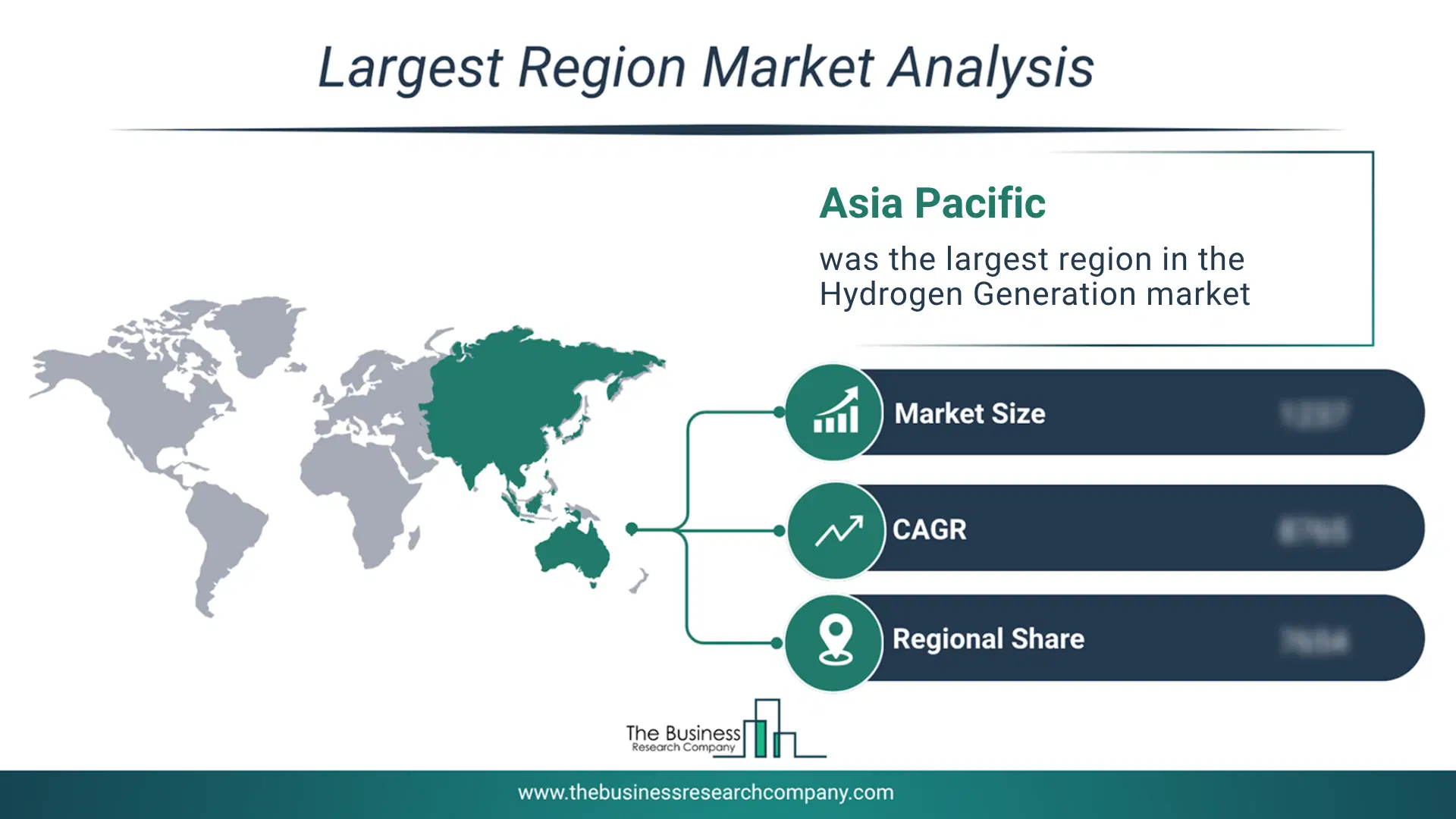
Regional Insights
Asia Pacific was the largest region in the hydrogen generation market in 2025. Asia Pacific is expected to be the fastest-growing region in the forecast period. The regions covered in this market report are Asia-Pacific, South East Asia, Western Europe, Eastern Europe, North America, South America, Middle East, Africa The countries covered in this market report are Australia, Brazil, China, France, Germany, India, Indonesia, Japan, Taiwan, Russia, South Korea, UK, USA, Canada, Italy, SpainWhat Defines the Hydrogen Generation Market?
The hydrogen generation market consists of sales of brown hydrogen, yellow hydrogen, turquoise hydrogen, and pink hydrogen. Values in this market are ‘factory gate’ values, that is, the value of goods sold by the manufacturers or creators of the goods, whether to other entities (including downstream manufacturers, wholesalers, distributors, and retailers) or directly to end customers. The value of goods in this market includes related services sold by the creators of the goods.How is Market Value Defined and Measured?
The market value is defined as the revenues that enterprises gain from the sale of goods and/or services within the specified market and geography through sales, grants, or donations in terms of the currency (in USD unless otherwise specified). The revenues for a specified geography are consumption values that are revenues generated by organizations in the specified geography within the market, irrespective of where they are produced. It does not include revenues from resales along the supply chain, either further along the supply chain or as part of other products.
This chart presents market attractiveness based on a quantitative evaluation of growth, competition, strategic alignment, and risk, offering a clear view of opportunity areas for decision-making. This chart is for illustrative purposes; the full report contains the complete analysis.

This chart highlights the Total Addressable Market (TAM) by estimating the maximum revenue opportunity using an assumption-driven approach, supporting strategic planning and opportunity sizing across markets. The chart is illustrative; the full report provides a more comprehensive analysis.
What Key Data and Analysis Are Included in the Hydrogen Generation Market Report 2026?
The hydrogen generation market research report is one of a series of new reports from The Business Research Company that provides market statistics, including industry global market size, regional shares, competitors with the market share, detailed market segments, market trends and opportunities, and any further data you may need to thrive in the hydrogen generation industry. The market research report delivers a complete perspective of everything you need, with an in-depth analysis of the current and future state of the industry.Hydrogen Generation Market Report Forecast Analysis
| Report Attribute | Details |
|---|---|
| Market Size Value In 2026 | $178.06 billion |
| Revenue Forecast In 2030 | $238.79 billion |
| Growth Rate | CAGR of 8.4% from 2026 to 2030 |
| Base Year For Estimation | 2025 |
| Actual Estimates/Historical Data | 2020-2025 |
| Forecast Period | 2026 - 2030 |
| Market Representation | Revenue in USD Billion and CAGR from 2026 to 2030 |
| Segments Covered | Type, Source, Generation And Delivery Mode, Technologies, Application |
| Regional Scope | Asia-Pacific, Western Europe, Eastern Europe, North America, South America, Middle East, Africa |
| Country Scope | The countries covered in this market report are Australia, Brazil, China, France, Germany, India, Indonesia, Japan, Taiwan, Russia, South Korea, UK, USA, Canada, Italy, Spain |
| Key Companies Profiled | Air Liquide SA, Air Products Inc., Iwatani Corporation, McPhy Energy SA, Messer Group GmbH, Altergy Systems, Ballard Power Systems Inc., BayoTech Inc., Doosan Fuel Cell Co. Ltd., EKME S.A., Enapter AG, Frame Power India Pvt. Ltd., Giner ELX Inc., Green Hydrogen Systems AS, Greenlane Renewables Inc., GRZ Technologies Ltd., Cummins Inc., ITM Power PLC, Linde PLC, Nel ASA, Plug Power Europe GmbH, Proton OnSite LLC, Siemens Energy AG, Taiyo Nippon Sanso Corporation, Teijin Engineering Ltd., Teledyne Energy Systems Inc., Toshiba Energy Systems & Solutions Corp., VRV SpA |
| Customization Scope | Request for Customization |
| Pricing And Purchase Options | Explore Purchase Options |