
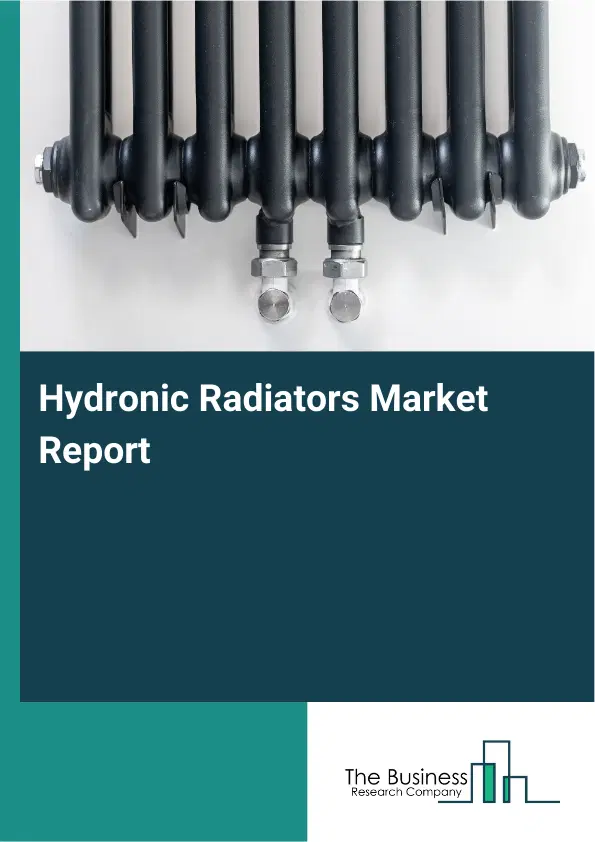
Hydronic Radiators Market Report 2026
Global Outlook – By Product Type (Panel Radiators, Column Radiators, Towel Radiators, Custom Radiators), By Material (Steel, Aluminium, Cast Iron, Other Materials), By Distribution Channel (Online Sales, Retail Sales, Wholesale Distribution, Direct Sales), By End-Use (Residential, Commercial) – Market Size, Trends, Strategies, and Forecast to 2030
Hydronic Radiators Market Overview
• Hydronic Radiators market size has reached to $5.54 billion in 2025 • Expected to grow to $7.56 billion in 2030 at a compound annual growth rate (CAGR) of 6.3% • Growth Driver: Rise In Construction And Renovation Activities Fueling The Growth Of The Market Due To Increased Urbanization And Infrastructure Demand • Market Trend: Advancing Sustainability In Household Heating Through Low-Carbon Material Integration • Europe was the largest region in 2025 and Asia-Pacific is the fastest growing region.What Is Covered Under Hydronic Radiators Market?
Hydronic radiators are heating systems that operate by circulating hot water or steam from a central boiler through a network of pipes to radiators installed in various rooms, where the heat is then transferred to the air through a combination of radiation and convection. These systems are known for delivering consistent, energy-efficient warmth and are widely used in residential and commercial settings for their quiet operation and enhanced comfort. The main types of products in hydronic radiators are panel radiators, column radiators, towel radiators, underfloor heating radiators, baseboard radiators, and custom radiators. Panel radiators are flat heating units with internal water channels that distribute warmth evenly through both radiation and convection. These radiators are available in various materials, such as steel, aluminum, cast iron, and others, and they function using different technologies, including heating systems and cooling systems. They are distributed through channels such as online sales, retail sales, wholesale distribution, and direct sales, serving a wide range of end users across residential, commercial, and industrial sectors.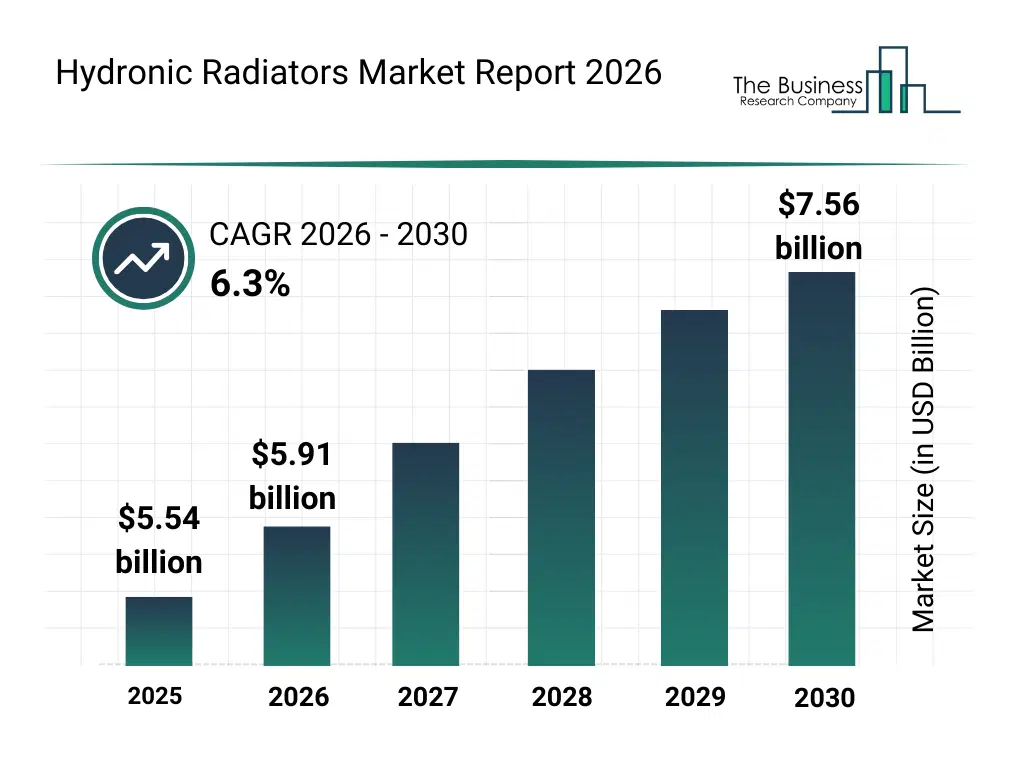
What Is The Hydronic Radiators Market Size and Share 2026?
The hydronic radiators market size has grown strongly in recent years. It will grow from $5.54 billion in 2025 to $5.91 billion in 2026 at a compound annual growth rate (CAGR) of 6.7%. The growth in the historic period can be attributed to cold climate housing demand, expansion of residential construction, energy cost considerations, replacement of traditional heating systems, growth in commercial buildings.What Is The Hydronic Radiators Market Growth Forecast?
The hydronic radiators market size is expected to see strong growth in the next few years. It will grow to $7.56 billion in 2030 at a compound annual growth rate (CAGR) of 6.3%. The growth in the forecast period can be attributed to net zero building initiatives, adoption of smart home heating, demand for low emission heating systems, urban residential expansion, renovation of aging infrastructure. Major trends in the forecast period include growing demand for energy efficient heating, adoption of smart heating controls, expansion of underfloor heating systems, shift toward modern radiator designs, rising use in green buildings.Tariff Impact On Hydronic Radiators Market
Tariffs have affected the hydronic radiators market by increasing costs of imported steel, aluminum, and cast iron components. The impact is notable in Europe and North America where radiator manufacturing relies on metal imports. These costs influence product pricing. At the same time, tariffs support domestic radiator manufacturing and regional supply chains.
Global Hydronic Radiators Market Segmentation
1) By Product Type: Panel Radiators, Column Radiators, Towel Radiators, Custom Radiators 2) By Material: Steel, Aluminium, Cast Iron, Other Materials 3) By Distribution Channel: Online Sales, Retail Sales, Wholesale Distribution, Direct Sales 4) By End-Use: Residential, Commercial Subsegments: 1) By Panel Radiators: Single Panel, Double Panel, Triple Panel 2) By Column Radiators: 2-Column, 3-Column, 4-Column And Above 3) By Towel Radiators: Straight Towel Radiators, Curved Towel Radiators, Designer Towel Radiators 4) By Custom Radiators: Material-Based Customization, Design-Based CustomizationWhat Is The Driver Of The Hydronic Radiators Market?
The increasing construction and renovation activities are expected to propel the growth of the hydronic radiators market going forward. Construction and renovation activities refer to the processes involved in building new structures or modifying, repairing, or upgrading existing ones to improve functionality, aesthetics, or compliance with updated standards. Construction and renovation activities are increasing due to urbanization and population growth as more people are moving into cities, creating higher demand for housing, transportation, and public services. Hydronic radiators support construction activities by providing energy-efficient, customizable heating solutions that integrate seamlessly with modern building systems, ensuring comfort and sustainability in residential and commercial projects. For instance, in February 2024, according to Eurostat, a Luxembourg-based government agency, construction production rose 1.9% in the eurozone and 2.4% in the broader European union when comparing December 2023 to December 2022 levels. Therefore, the increasing construction and renovation activities are driving the growth of the hydronic radiator industry.Key Players In The Global Hydronic Radiators Market
Major companies operating in the hydronic radiators market are Purmo Group Plc, Zehnder Group AG, Stelrad Group Ltd., Arbonia AG, JAGA N.V., Vasco Group NV, Runtal Radiators Inc., Vogel & Noot Heiztechnik GmbH, Deltacalor S.r.l., Myson Inc., Hudson Reed Group Ltd., Castrads Ltd., Sterling Radiator Company, IRSAP S.p.A., Fondital S.p.A., Kermi GmbH, Radson, Biasi Radiators S.p.A., De’Longhi Radiators (De’Longhi Group), Hudevad Radiator Design (a brand of Rettig Group), Henrad Radiators
This chart is for illustrative purposes; the full report includes a detailed competitor analysis and comprehensive overview of the top 10 companies in the market.
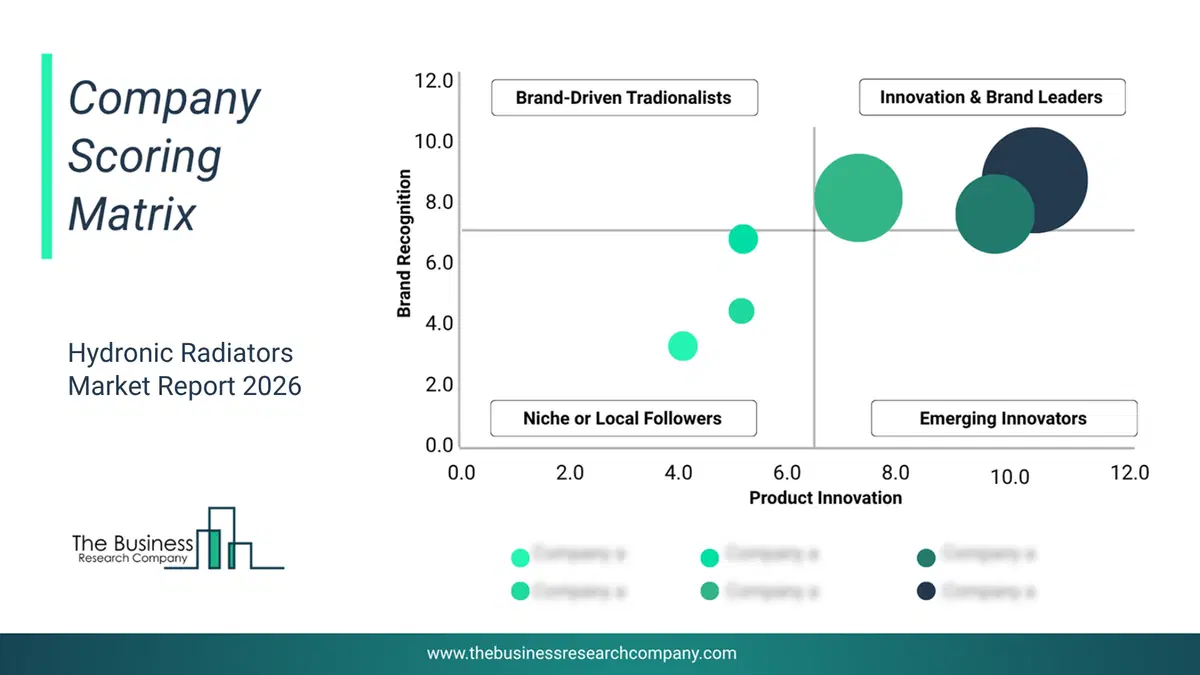
This chart maps companies by product innovation and brand strength, with bubble size indicating relative revenue, helping identify market leaders, challengers, and niche players. This is an illustrative chart; the full report provides a complete and accurate competitive analysis.
Global Hydronic Radiators Market Trends and Insights
Major companies operating in the hydronic radiators market are focusing on incorporating sustainability initiatives such as low-carbon steel manufacturing to enhance environmental efficiency and reduce embodied emissions. Low-carbon steel manufacturing refers to producing steel using cleaner energy sources and recycled content to significantly lower the carbon footprint during production, enabling capabilities such as greener construction choices and reduced lifecycle emissions. For instance, in December 2023, Stelrad Group plc, a UK-based manufacturing company, launched its Green Series radiator range, a low-carbon steel product line designed to cut embodied CO₂ emissions while maintaining standard hydronic heating performance, featuring up to 90 percent lower carbon steel, 100 percent recyclability, and plastic-free packaging. The Green Series improves sustainability by enabling climate-friendly radiator installations and helping customers and builders reduce environmental impact.What Are Latest Mergers And Acquisitions In The Hydronic Radiators Market?
In October 2024, Purmo Group, a Finland-based provider of sustainable indoor climate comfort solutions, acquired UniTherm Heating Systems Ltd. for an undisclosed amount. With this acquisition, Purmo Group aims to enhance its heating and energy-efficient technology portfolio by integrating UniTherm’s specialized offerings in pre-plumbed underfloor heating manifolds, piping systems, and renewable energy-based heating solutions. UniTherm Heating Systems Ltd. is an Ireland-based company that offers hydronic radiators.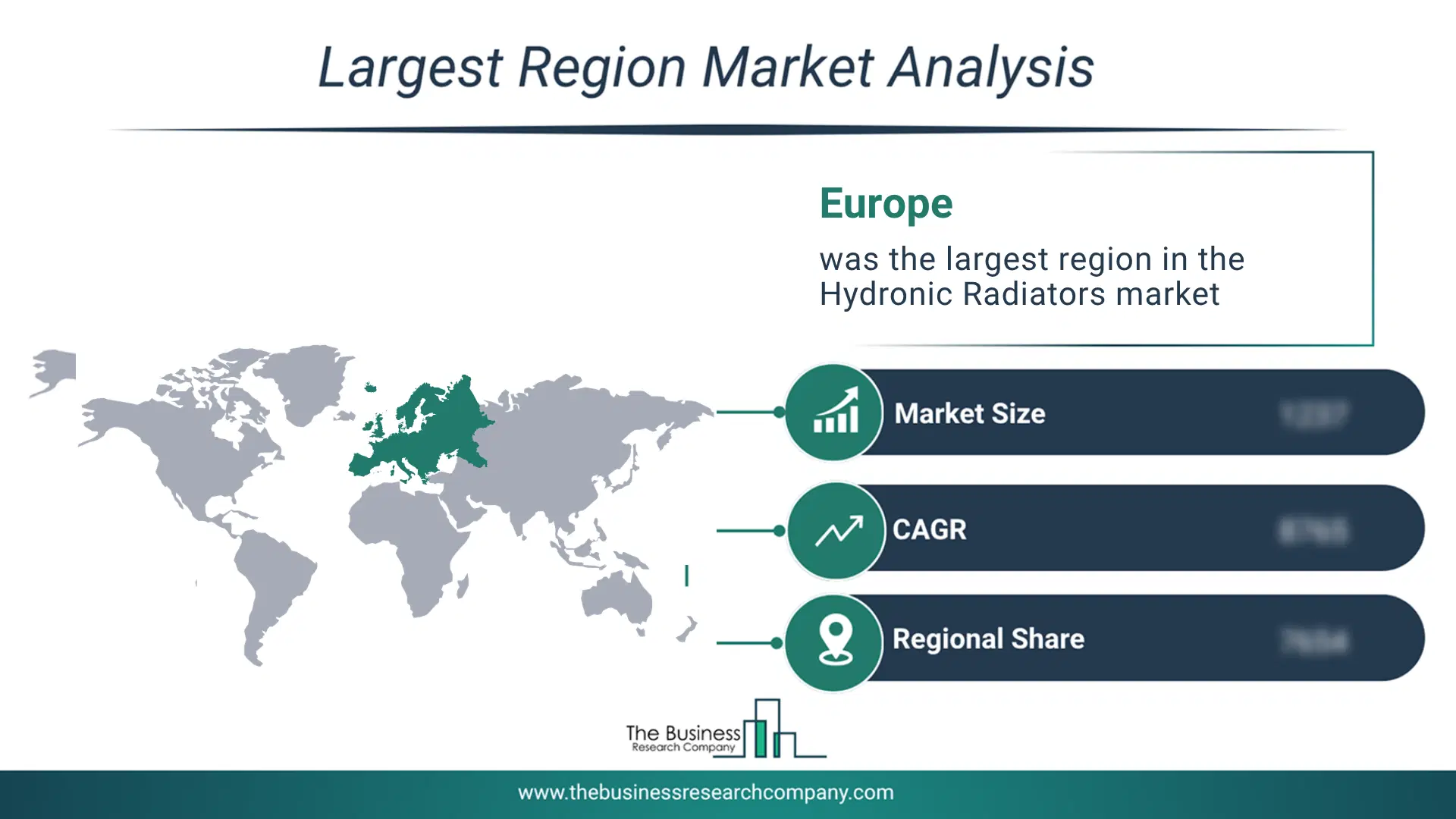
Regional Outlook
Europe was the largest region in the hydronic radiators market in 2025. Asia-Pacific is expected to be the fastest-growing region in the forecast period. The regions covered in this market report are Asia-Pacific, South East Asia, Western Europe, Eastern Europe, North America, South America, Middle East, Africa The countries covered in this market report are Australia, Brazil, China, France, Germany, India, Indonesia, Japan, Taiwan, Russia, South Korea, UK, USA, Canada, Italy, Spain.What Defines the Hydronic Radiators Market?
The hydronic radiators market consists of sales of products, including designer radiators, compact radiators, recessed hydronic radiators, towel warmer radiators, and freestanding radiators. Values in this market are ‘factory gate’ values, that is, the value of goods sold by the manufacturers or creators of the goods, whether to other entities (including downstream manufacturers, wholesalers, distributors, and retailers) or directly to end customers. The value of goods in this market includes related services sold by the creators of the goods.How is Market Value Defined and Measured?
The market value is defined as the revenues that enterprises gain from the sale of goods and/or services within the specified market and geography through sales, grants, or donations in terms of the currency (in USD unless otherwise specified). The revenues for a specified geography are consumption values that are revenues generated by organizations in the specified geography within the market, irrespective of where they are produced. It does not include revenues from resales along the supply chain, either further along the supply chain or as part of other products.
This chart presents market attractiveness based on a quantitative evaluation of growth, competition, strategic alignment, and risk, offering a clear view of opportunity areas for decision-making. This chart is for illustrative purposes; the full report contains the complete analysis.

This chart highlights the Total Addressable Market (TAM) by estimating the maximum revenue opportunity using an assumption-driven approach, supporting strategic planning and opportunity sizing across markets. The chart is illustrative; the full report provides a more comprehensive analysis.
What Key Data and Analysis Are Included in the Hydronic Radiators Market Report 2026?
The hydronic radiators market research report is one of a series of new reports from The Business Research Company that provides market statistics, including industry global market size, regional shares, competitors with the market share, detailed market segments, market trends and opportunities, and any further data you may need to thrive in the hydronic radiators industry. The market research report delivers a complete perspective of everything you need, with an in-depth analysis of the current and future state of the industry.Hydronic Radiators Market Report Forecast Analysis
| Report Attribute | Details |
|---|---|
| Market Size Value In 2026 | $5.91 billion |
| Revenue Forecast In 2030 | $7.56 billion |
| Growth Rate | CAGR of 6.3% from 2026 to 2030 |
| Base Year For Estimation | 2025 |
| Actual Estimates/Historical Data | 2020-2025 |
| Forecast Period | 2026 - 2030 |
| Market Representation | Revenue in USD Billion and CAGR from 2026 to 2030 |
| Segments Covered | Product Type, Material, Distribution Channel, End-Use |
| Regional Scope | Asia-Pacific, Western Europe, Eastern Europe, North America, South America, Middle East, Africa |
| Key Companies Profiled | Purmo Group Plc, Zehnder Group AG, Stelrad Group Ltd., Arbonia AG, JAGA N.V., Vasco Group NV, Runtal Radiators Inc., Vogel & Noot Heiztechnik GmbH, Deltacalor S.r.l., Myson Inc., Hudson Reed Group Ltd., Castrads Ltd., Sterling Radiator Company, IRSAP S.p.A., Fondital S.p.A., Kermi GmbH, Radson, Biasi Radiators S.p.A., De’Longhi Radiators (De’Longhi Group), Hudevad Radiator Design (a brand of Rettig Group), Henrad Radiators |
| Customization Scope | Request for Customization |
| Pricing And Purchase Options | Explore Purchase Options |