

Hyper-Converged Infrastructure (HCI) Solutions Market Report 2026
Global Outlook – By Component (Software, Hardware, Services), By Deployment Model (On-Premises, Cloud-Based, Hybrid Deployment), By Enterprise Size (Small And Medium Enterprises, Large Enterprises), By Application (Data Center Consolidation, Virtualization, Backup and Recovery, Cloud Computing, Other Applications), By End-User (Banking, Financial Services, And Insurance (BFSI), Healthcare, Information Technology (IT) And Telecommunications, Government, Education, Manufacturing, Other End-Users) – Market Size, Trends, Strategies, and Forecast to 2030
Hyper-Converged Infrastructure (HCI) Solutions Market Overview
• Hyper-Converged Infrastructure (HCI) Solutions market size has reached to $14.9 billion in 2025 • Expected to grow to $32.5 billion in 2030 at a compound annual growth rate (CAGR) of 16.8% • Growth Driver: Increasing Adoption Of Cloud Computing Driving Market Growth Due To Enhance Scalability, Cost Efficiency, And Accelerated Digital Transformation • Market Trend: Optimized Infrastructure Solutions Ensure Business Continuity And Flexibility • North America was the largest region in 2025 and Asia-Pacific is the fastest growing region.Market Gains By 2030 – Top Opportunities By Segment
Market Gain identifies the most promising market opportunities by highlighting the segments or products expected to generate the highest incremental revenue growth over the next five years.
What Is Covered Under Hyper-Converged Infrastructure (HCI) Solutions Market?
Hyper-converged infrastructure (HCI) solutions integrate compute, storage, and networking into a single software-defined system, simplifying management and scaling. They use virtualization to consolidate resources, enabling efficient workload deployment and optimized performance. HCI solutions also provide centralized control, automation, and improved resource utilization across the infrastructure, reducing operational complexity, lowering costs, and enhancing overall system reliability and scalability. The main components of hyper-converged infrastructure (HCI) solutions are software, hardware, and services. Software in hyper-converged infrastructure (HCI) solutions is the layer that unifies compute, storage, and networking, enabling seamless resource management, virtualization, and scalability. They are deployed through various models such as on-premises, cloud-based, and hybrid deployment, and are used by organizations of different sizes, including small and medium enterprises (SMEs) and large enterprises. They are applied for various applications including data center consolidation, virtualization, backup and recovery, cloud computing, and other applications, and are utilized by end-users including banking, financial services, and insurance (BFSI), healthcare, information technology (IT) and telecommunications, government, education, manufacturing, and other organizations.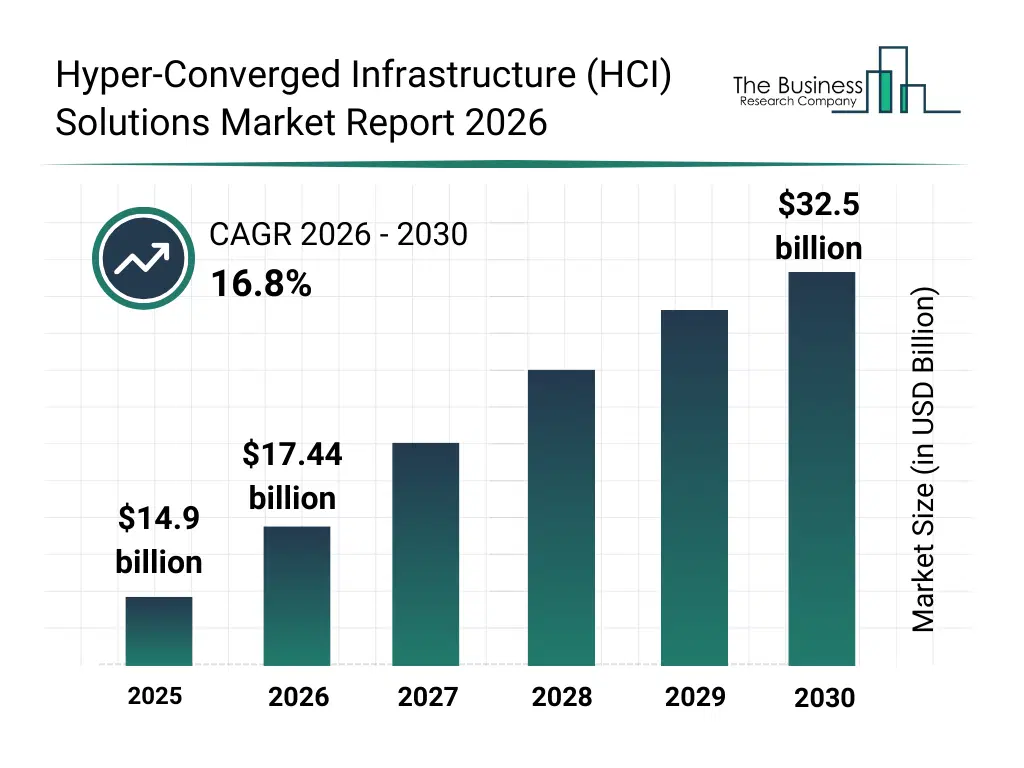
What Is The Hyper-Converged Infrastructure (HCI) Solutions Market Size and Share 2026?
The hyper-converged infrastructure (hci) solutions market size has grown rapidly in recent years. It will grow from $14.9 billion in 2025 to $17.44 billion in 2026 at a compound annual growth rate (CAGR) of 17.1%. The growth in the historic period can be attributed to growth of virtualization adoption, rising data center consolidation needs, increasing demand for scalable infrastructure, need to reduce it operational complexity, expansion of enterprise storage requirements.What Is The Hyper-Converged Infrastructure (HCI) Solutions Market Growth Forecast?
The hyper-converged infrastructure (hci) solutions market size is expected to see rapid growth in the next few years. It will grow to $32.5 billion in 2030 at a compound annual growth rate (CAGR) of 16.8%. The growth in the forecast period can be attributed to adoption of hybrid cloud architectures, rising demand for edge-ready hci, increased focus on automation and orchestration, growing cybersecurity requirements, need for cost-efficient infrastructure modernization. Major trends in the forecast period include software-defined infrastructure adoption, simplified data center consolidation demand, hybrid cloud enablement through hci, integrated security and compliance features, automation-driven infrastructure management.
Global Hyper-Converged Infrastructure (HCI) Solutions Market Segmentation
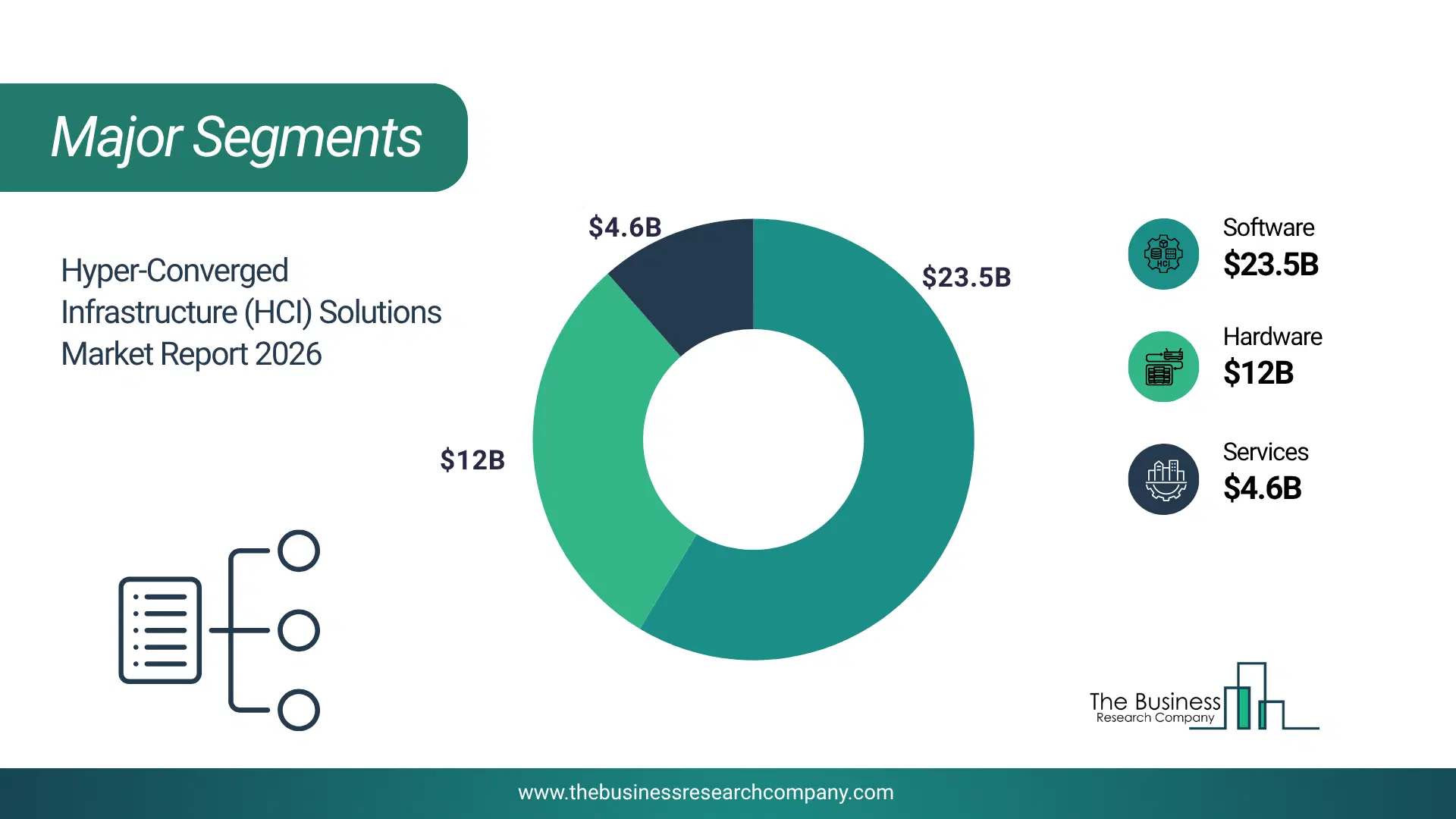
1) By Component: Software, Hardware, Services 2) By Deployment Model: On-Premises, Cloud-Based, Hybrid Deployment 3) By Enterprise Size: Small And Medium Enterprises, Large Enterprises 4) By Application: Data Center Consolidation, Virtualization, Backup and Recovery, Cloud Computing, Other Applications 5) By End-User: Banking, Financial Services, And Insurance (BFSI), Healthcare, Information Technology (IT) And Telecommunications, Government, Education, Manufacturing, Other End-Users Subsegments: 1) By Software: Virtualization Software, Management And Orchestration Software, Storage Software, Security And Compliance Software 2) By Hardware: Servers, Storage Devices, Networking Equipment, Integrated Appliances 3) By Services: Deployment Services, Maintenance Services, Consulting Services, Training Services The top segments in the hyper-converged infrastructure (hci) solutions market will be: • Software will reach $23.47 billion by 2030. • Hardware will reach $11.9 billion by 2030. • Services will reach $4.52 billion by 2030.What Is The Driver Of The Hyper-Converged Infrastructure (HCI) Solutions Market?
The increasing adoption of cloud computing is expected to propel the growth of the hyper-converged infrastructure (HCI) solutions market going forward. Cloud computing is the delivery of computing services including servers, storage, databases, networking, and software over the internet to offer faster innovation and flexible resources. The adoption of cloud computing is rising due to digital transformation initiatives, as organizations migrate their workloads to the cloud to achieve greater scalability, cost efficiency, and operational agility in managing their IT infrastructure. Cloud computing supports Hyper-converged Infrastructure (HCI) solutions by providing scalable, on-demand resources, seamless virtualization, centralized management, and flexible deployment models that enhance HCI’s integrated compute, storage, and networking capabilities, enabling organizations to efficiently optimize performance, reduce operational complexity, and accelerate infrastructure provisioning. For instance, in December 2023, according to the Eurostat, a Luxembourg-based government agency, in 2023, 45.2% of EU enterprises used cloud computing services such as internet-based software, computing power, or storage, representing a 4.2 percentage point increase. Therefore, increasing adoption of cloud computing is driving the growth of the hyper-converged infrastructure (HCI) solutions industry.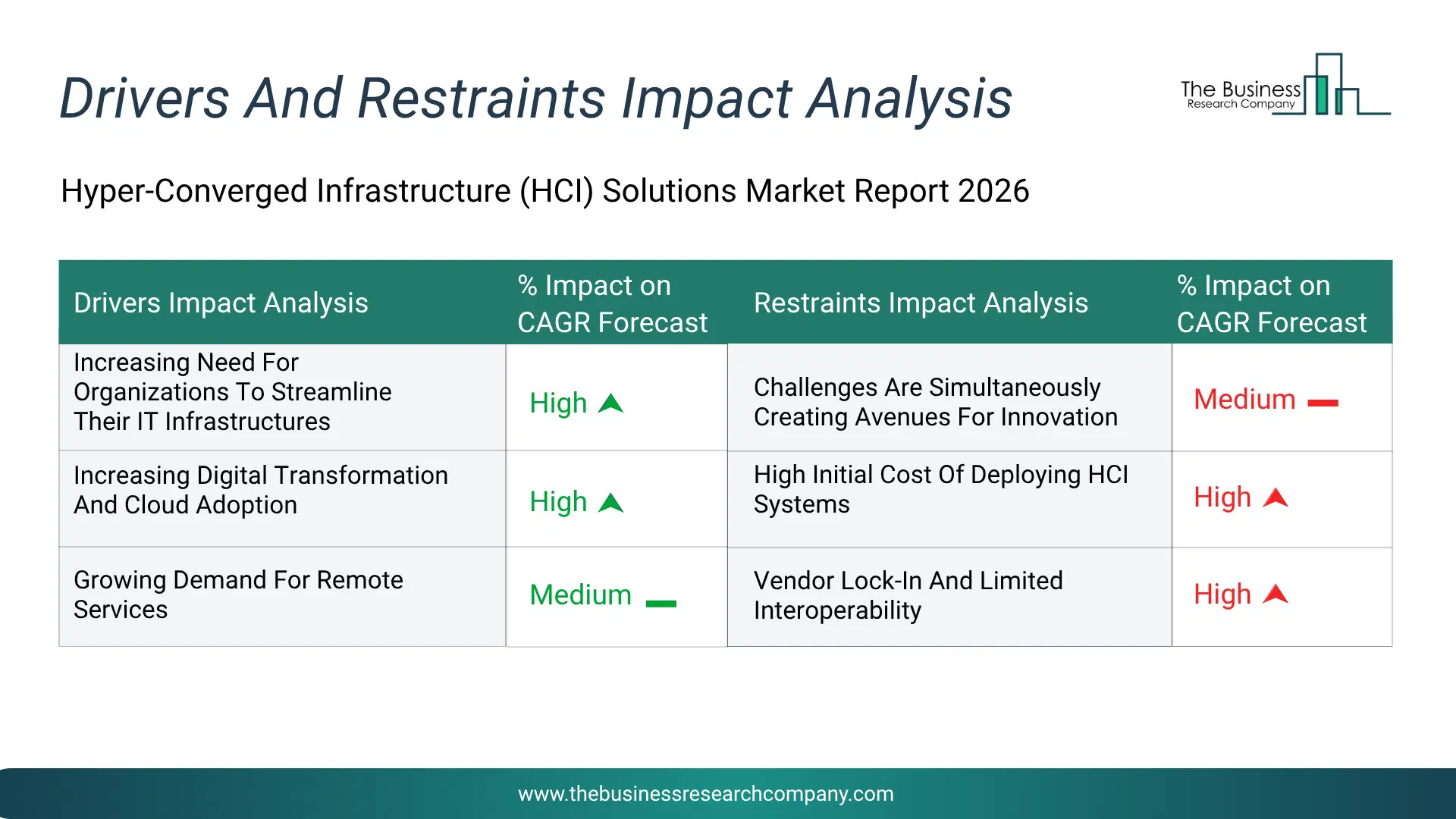
Infographic Chart Showing Key Market Drivers Analysis And Restraints For Hyper-Converged Infrastructure (Hci) Solutions Market
The chart presents an impact analysis of key drivers and restraints, quantifying their relative influence on the market's growth rate and helping assess the balance between growth enablers and limiting factors. This chart offers a high-level perspective; the full report contains more detailed insights.
How Will The Drivers Impact Growth In The Global Hyper-Converged Infrastructure (HCI) Solutions Market?
• Increasing Need For Organizations To Streamline Their IT Infrastructures (High) – During the forecast period, the increasing need for organizations to streamline their it infrastructures is expected to become a key growth driver for the hyper converged infrastructure (hci) solutions market by 2030. The growing need for organizations to streamline and unify their it environments is a key factor accelerating the adoption of hyper-converged infrastructure (hci) solutions. By combining compute, storage, and networking resources into a single, integrated platform, hci minimizes the challenges associated with managing disparate systems. This consolidation supports quicker deployment, seamless scalability, and improved cost efficiency. As a result, enterprises can dedicate more resources to strategic innovation instead of routine infrastructure management. • Increasing Digital Transformation And Cloud Adoption (High) – During the forecast period, the increasing digital transformation and cloud adoption is expected to emerge as a major factor driving the expansion of the hyper converged infrastructure (hci) solutions market by 2030. The rapid pace of digital transformation and expanding cloud adoption are fueling demand for hyper-converged infrastructure (hci) solutions, as organizations seek more efficient ways to modernize their it operations. With the migration of workloads to cloud environments, hci delivers centralized management and streamlined deployment, minimizing operational complexity. It also provides scalable and adaptable infrastructure that evolves with changing business requirements, eliminating the need for significant upfront hardware investments. • Growing Demand For Remote Services (Medium) – During the forecast period, the growing demand for remote services is expected to act as a key growth catalyst for the hyper converged infrastructure (hci) solutions market by 2030. The increasing need for remote services is accelerating the adoption of hyper-converged infrastructure (hci) solutions, as they enable secure and efficient access to applications and data from any location. Organizations are leveraging cloud-based and virtualized environments to support distributed workforces, creating a requirement for simplified management and high-performance infrastructure. Hci integrates compute, storage, and networking into a unified platform, minimizing operational complexity while maintaining consistent performance for remote operations. This consolidated architecture also enhances scalability, allowing businesses to dynamically allocate resources in response to changing remote service demands.How Will The Restraints Impact Growth In The Global Hyper-Converged Infrastructure (HCI) Solutions Market?
• Challenges Are Simultaneously Creating Avenues For Innovation (Medium) – During the forecast period, the challenges in hyper-converged human-computer interaction (hci) solutions, such as managing complex data environments, ensuring seamless integration, and maintaining high performance, are driving innovation by pushing companies to develop smarter, more efficient architectures. The need for simplified management and faster processing encourages the creation of unified platforms that combine compute, storage, and networking seamlessly. Security and scalability concerns are prompting the design of adaptive solutions that can handle growing workloads with minimal downtime. User experience challenges are leading to more intuitive interfaces and ai-driven automation. Overall, these obstacles act as catalysts, turning limitations into opportunities for technological advancement in hci solutions. • High Initial Cost Of Deploying HCI Systems (High) – During the forecast period, the high initial cost of deploying hyper-converged infrastructure (hci) systems can act as a driver for adoption because organizations recognize that investing upfront leads to long-term savings and operational efficiency. By consolidating compute, storage, and networking into a single platform, businesses reduce ongoing maintenance and management expenses. This investment also simplifies it operations, minimizes downtime, and enhances scalability for future growth. Companies often prefer hci as it enables predictable budgeting and faster deployment of applications. Ultimately, the upfront cost is justified by the cumulative benefits of reduced complexity and improved performance. • Vendor Lock-In And Limited Interoperability (High) – During the forecast period, the vendor lock-in and limited interoperability act as a restraint for the hyper-converged infrastructure (hci) solutions market by restricting flexibility in choosing hardware and software components across different providers. Many hci platforms are built on proprietary architectures, making it difficult for organizations to integrate third-party tools or migrate to alternative systems without significant cost and technical challenges. This reduces it infrastructure flexibility and increases long-term dependency on a single vendor ecosystem. As a result, enterprises may face higher switching costs and reduced bargaining power, which slows broader adoption of hci solutions.Key Players In The Global Hyper-Converged Infrastructure (HCI) Solutions Market
Major companies operating in the hyper-converged infrastructure (hci) solutions market are Microsoft Corporation, Huawei Technologies Co. Ltd., Dell Technologies Inc., Hitachi Ltd., International Business Machines Corporation (IBM), Cisco Systems Inc., Lenovo Group Limited, Oracle Corporation, Hewlett Packard Enterprise Company (HPE), Fujitsu Limited, NEC Corporation, Rakuten Group Inc., NetApp Inc., Nutanix Inc., Sangfor Technologies Inc., Quantum Corporation, DataCore Software Corporation, Diamanti Inc., Virtuozzo International GmbH, StorMagic Limited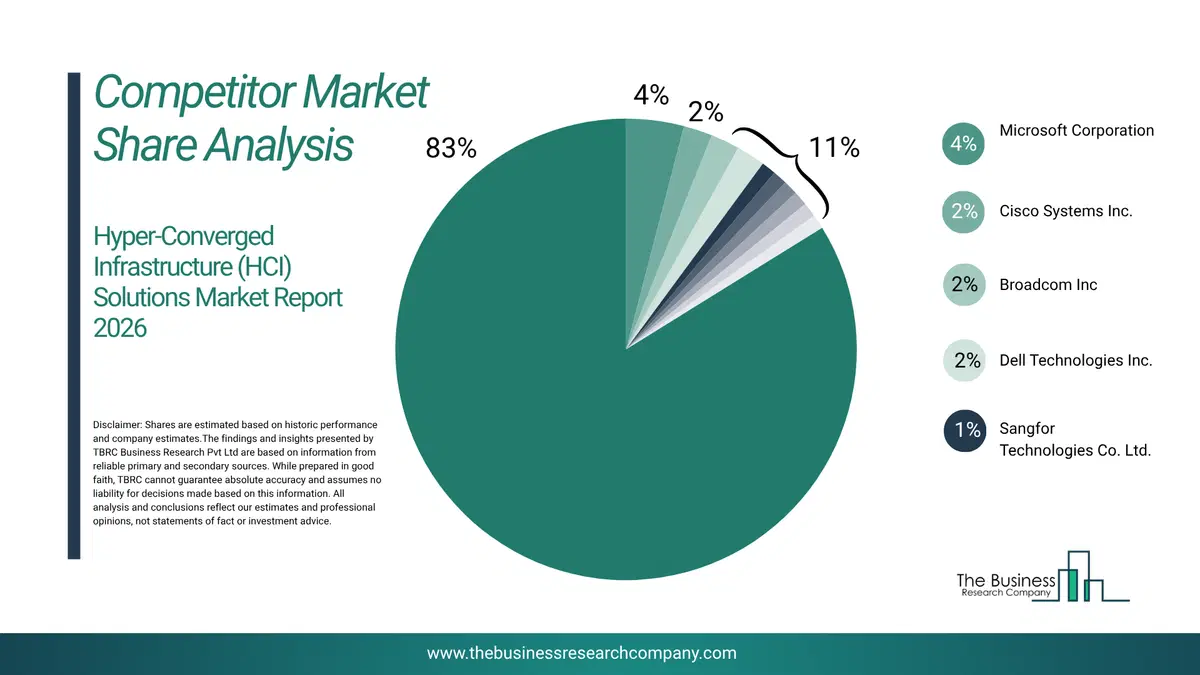
This chart is for illustrative purposes; the full report includes a detailed competitor analysis and comprehensive overview of the top 10 companies in the market.
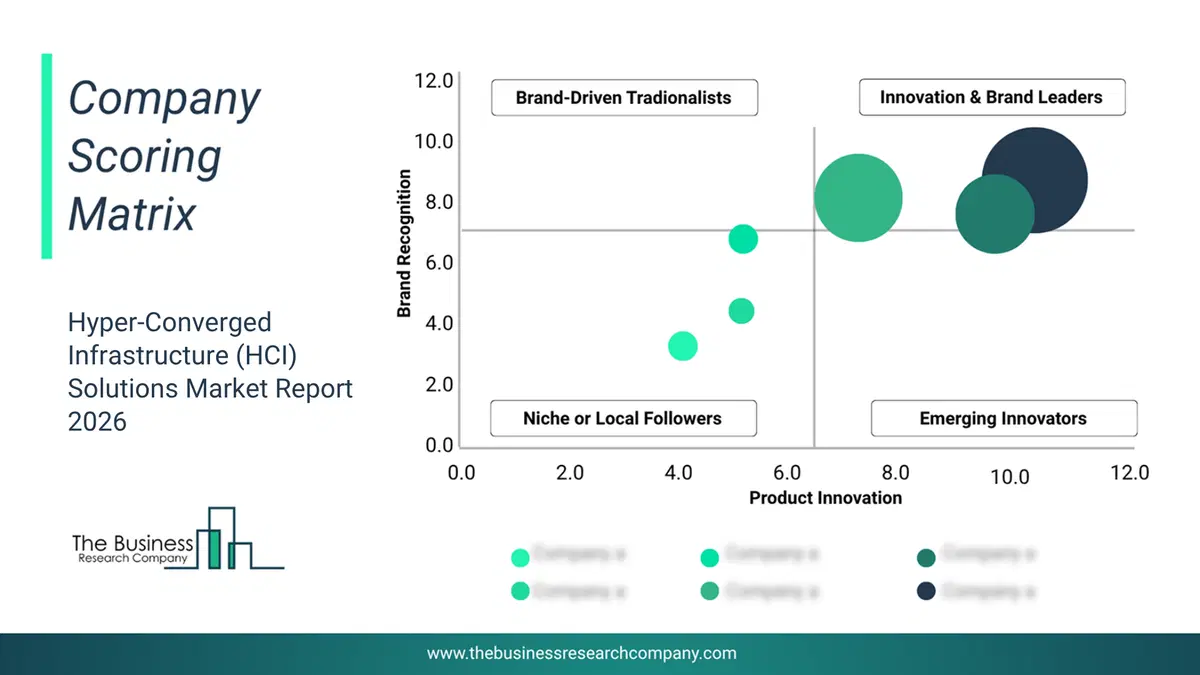
This chart maps companies by product innovation and brand strength, with bubble size indicating relative revenue, helping identify market leaders, challengers, and niche players. This is an illustrative chart; the full report provides a complete and accurate competitive analysis.
Global Hyper-Converged Infrastructure (HCI) Solutions Market Trends and Insights
Major companies operating in the hyper-converged infrastructure (HCI) solutions market are focusing on leveraging innovative technologies such as virtual storage technology to improve efficiency, scalability, and cost-effectiveness. Virtual storage technology is a method that abstracts physical storage into a centralized virtual pool, helping simplify management, improve resource utilization, enhance data protection, enable high availability, and support seamless scalability across multiple servers and locations. For instance, in June 2024, StorMagic Ltd., a UK-based software company, launched SvHCI, a full-stack hyper-converged infrastructure solution designed specifically for edge and small to medium-sized business (SMB) environments. The platform integrates a KVM-based hypervisor, advanced virtual networking, and StorMagic’s proven SvSAN virtual storage technology to deliver high availability, simplified management, and cost savings of up to 62% compared to traditional VMware solutions. Organizations can run reliable applications with just two servers, achieving a scalable, efficient, and cost-effective alternative to conventional HCI systems without sacrificing enterprise-class features. SvHCI also supports seamless deployment on new or existing hardware, allowing businesses to maximize the value of their current infrastructure while reducing the complexity associated with multiple software layers. With continuous 24x7x365 customer support and a focus on minimizing downtime, the solution ensures that critical operations remain uninterrupted, making it particularly suitable for remote or distributed locations.What Are Latest Mergers And Acquisitions In The Hyper-Converged Infrastructure (HCI) Solutions Market?
In November 2023, Broadcom Inc., a US-based manufacturing company, acquired VMware Inc. for an undisclosed amount. With this acquisition, Broadcom aims to strengthen its position as a leading infrastructure technology company by investing in VMware Cloud Foundation and enabling enterprises to build, modernize, and secure their private and hybrid cloud environments, while also expanding its portfolio with VMware Tanzu, advanced security and load balancing services, and software-defined edge solutions. VMware Inc. was a US-based cloud computing and virtualization technology company that specializes in providing hyper-converged infrastructure (HCI) solutions.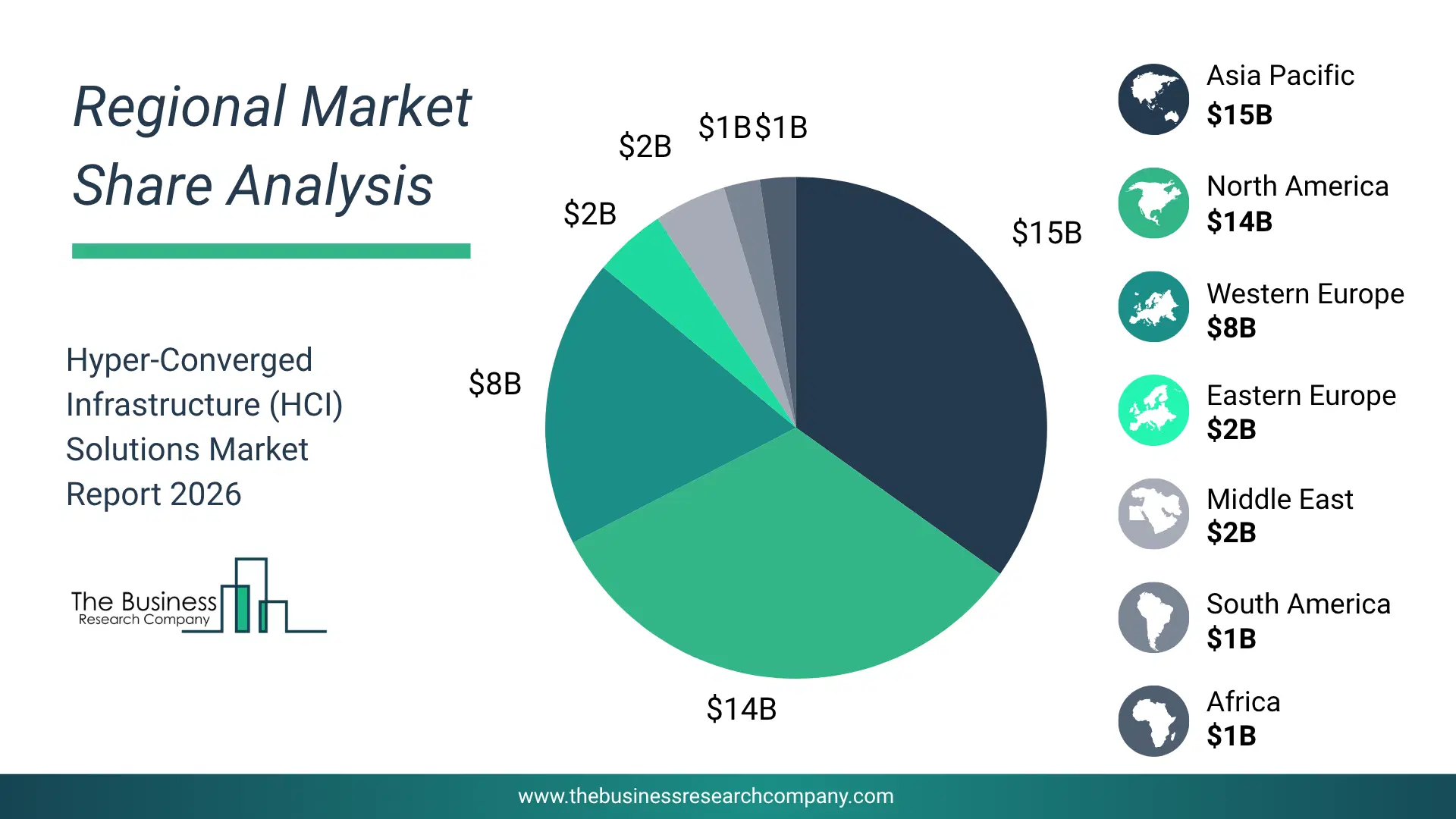
Regional Insights
North America was the largest region in the hyper-converged infrastructure (HCI) solutions market in 2025. Asia-Pacific is expected to be the fastest-growing region in the forecast period. The regions covered in this market report are Asia-Pacific, South East Asia, Western Europe, Eastern Europe, North America, South America, Middle East, Africa. The countries covered in this market report are Australia, Brazil, China, France, Germany, India, Indonesia, Japan, Taiwan, Russia, South Korea, UK, USA, Canada, Italy, Spain.What Defines the Hyper-Converged Infrastructure (HCI) Solutions Market?
The hyper-converged infrastructure (HCI) solutions market consists of revenues earned by entities by providing services such as integration services, deployment services, support and maintenance, workload optimization, migration services, managed security services, and disaster recovery services. The market value includes the value of related goods sold by the service provider or included within the service offering. The hyper-converged infrastructure (HCI) solutions market also includes sales of hypervisors, storage nodes, compute nodes, network switches, data deduplication tools, orchestration tools, and replication software. Values in this market are ‘factory gate’ values, that is the value of goods sold by the manufacturers or creators of the goods, whether to other entities (including downstream manufacturers, wholesalers, distributors and retailers) or directly to end customers. The value of goods in this market includes related services sold by the creators of the goods.How is Market Value Defined and Measured?
The market value is defined as the revenues that enterprises gain from the sale of goods and/or services within the specified market and geography through sales, grants, or donations in terms of the currency (in USD unless otherwise specified). The revenues for a specified geography are consumption values that are revenues generated by organizations in the specified geography within the market, irrespective of where they are produced. It does not include revenues from resales along the supply chain, either further along the supply chain or as part of other products.
This chart presents market attractiveness based on a quantitative evaluation of growth, competition, strategic alignment, and risk, offering a clear view of opportunity areas for decision-making. This chart is for illustrative purposes; the full report contains the complete analysis.

This chart highlights the Total Addressable Market (TAM) by estimating the maximum revenue opportunity using an assumption-driven approach, supporting strategic planning and opportunity sizing across markets. The chart is illustrative; the full report provides a more comprehensive analysis.
What Key Data and Analysis Are Included in the Hyper-Converged Infrastructure (HCI) Solutions Market Report 2026?
The hyper-converged infrastructure (hci) solutions market research report is one of a series of new reports from The Business Research Company that provides market statistics, including industry global market size, regional shares, competitors with the market share, detailed market segments, market trends and opportunities, and any further data you may need to thrive in the hyper-converged infrastructure (hci) solutions industry. The market research report delivers a complete perspective of everything you need, with an in-depth analysis of the current and future state of the industry.Hyper-Converged Infrastructure (HCI) Solutions Market Report Forecast Analysis
| Report Attribute | Details |
|---|---|
| Market Size Value In 2026 | $17.44 billion |
| Revenue Forecast In 2030 | $32.5 billion |
| Growth Rate | CAGR of 16.8% from 2026 to 2030 |
| Base Year For Estimation | 2025 |
| Actual Estimates/Historical Data | 2020-2025 |
| Forecast Period | 2026 - 2030 |
| Market Representation | Revenue in USD Billion and CAGR from 2026 to 2030 |
| Segments Covered | Component, Deployment Model, Enterprise Size, Application, End-User |
| Regional Scope | Asia-Pacific, Western Europe, Eastern Europe, North America, South America, Middle East, Africa |
| Country Scope | The countries covered in the report are Australia, Brazil, China, France, Germany, India, ... |
| Key Companies Profiled | Microsoft Corporation, Huawei Technologies Co. Ltd., Dell Technologies Inc., Hitachi Ltd., International Business Machines Corporation (IBM), Cisco Systems Inc., Lenovo Group Limited, Oracle Corporation, Hewlett Packard Enterprise Company (HPE), Fujitsu Limited, NEC Corporation, Rakuten Group Inc., NetApp Inc., Nutanix Inc., Sangfor Technologies Inc., Quantum Corporation, DataCore Software Corporation, Diamanti Inc., Virtuozzo International GmbH, StorMagic Limited |
| Customization Scope | Request for Customization |
| Pricing And Purchase Options | Explore Purchase Options |