

Hyperscale Cloud Market Report 2026
Global Outlook – By Type (Platform As A Service (PaaS), Software As A Service (SaaS), Infrastructure As A Service (IaaS), Business Process As A Service (BPaaS), Cloud Management And Security Services), By Deployment Type (Public Cloud, Private Cloud, Hybrid Cloud, Multi-Cloud, Community Cloud), By Enterprise Type (Small And Medium Enterprises, Large Enterprises), By Application (Internet Of Things (IoT) Applications, Cloud Computing, Big Data Analytics, Other Applications), By Industry (Manufacturing, Energy And Utilities, Banking, Financial Services And Insurance (BFSI), Healthcare, E-Commerce And Retail, Information Technology (IT) And Telecom, Automotive, Other Industries) – Market Size, Trends, Strategies, and Forecast to 2030
Hyperscale Cloud Market Overview
• Hyperscale Cloud market size has reached to $461.17 billion in 2025 • Expected to grow to $1091.05 billion in 2030 at a compound annual growth rate (CAGR) of 18.7% • Growth Driver: Rising Level of Internet Penetration Fueling the Hyperscale Cloud Market Growth Due to Expanding Digital Connectivity • Market Trend: Boosting Artificial Intelligence (AI) Innovation With High-Performance Cloud Services • North America was the largest region in 2025 and Asia-Pacific is the fastest growing region.What Is Covered Under Hyperscale Cloud Market?
Hyperscale cloud is a type of large-scale online service that can quickly grow or shrink to handle changing demand. It uses massive networks of computers to store data and run applications for many users at once. This approach allows companies to serve millions of people without slowing down. It is designed to be flexible, reliable, and able to support very big workloads. The main types of hyperscale cloud are platform as a service (PaaS), software as a service (SaaS), infrastructure as a service (IaaS), business process as a service (BPaaS), and cloud management and security services. Platform as a service (PaaS) refers to a cloud computing model that provides developers with a ready-to-use platform of tools, infrastructure, and services to build, deploy, and manage applications without handling the underlying hardware or software management. There are different deployment types such as public cloud, private cloud, hybrid cloud, multi-cloud, and community cloud, and it is used across various enterprise types, including small and medium-sized enterprises (SMEs) and large enterprises. It is applied in different areas such as Internet of Things (IoT) applications, cloud computing, big data analytics, and others, and serves industries including manufacturing, energy and utilities, banking, financial services and insurance (BFSI), healthcare, e-commerce and retail, information technology (IT) and telecom, automotive, and others.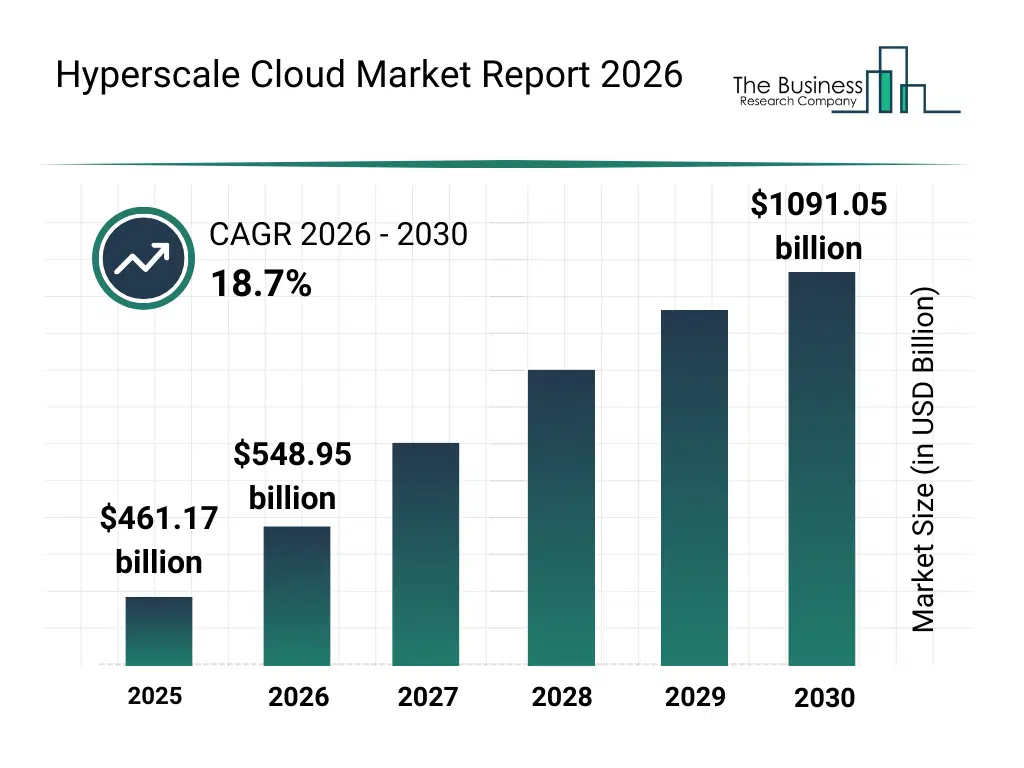
What Is The Hyperscale Cloud Market Size and Share 2026?
The hyperscale cloud market size has grown rapidly in recent years. It will grow from $461.17 billion in 2025 to $548.95 billion in 2026 at a compound annual growth rate (CAGR) of 19.0%. The growth in the historic period can be attributed to growth in cloud adoption, expansion of digital transformation initiatives, rising demand for scalable computing resources, increase in online service usage, growth in enterprise application hosting.What Is The Hyperscale Cloud Market Growth Forecast?
The hyperscale cloud market size is expected to see rapid growth in the next few years. It will grow to $1091.05 billion in 2030 at a compound annual growth rate (CAGR) of 18.7%. The growth in the forecast period can be attributed to expansion of AI workload deployment, rising adoption of multi cloud strategies, growth in hyperscale data center investments, increasing edge cloud integration, demand for real time data processing. Major trends in the forecast period include massively scalable cloud infrastructure, automated resource orchestration, high density data center deployment, multi region cloud expansion, elastic workload management.
Global Hyperscale Cloud Market Segmentation
1) By Type: Platform As A Service (PaaS), Software As A Service (SaaS), Infrastructure As A Service (IaaS), Business Process As A Service (BPaaS), Cloud Management And Security Services 2) By Deployment Type: Public Cloud, Private Cloud, Hybrid Cloud, Multi-Cloud, Community Cloud 3) By Enterprise Type: Small And Medium Enterprises, Large Enterprises 4) By Application: Internet Of Things (IoT) Applications, Cloud Computing, Big Data Analytics, Other Applications 5) By Industry: Manufacturing, Energy And Utilities, Banking, Financial Services And Insurance (BFSI), Healthcare, E-Commerce And Retail, Information Technology (IT) And Telecom, Automotive, Other Industries Subsegments: 1) By Platform As A Service (PaaS): Application Development Tools, Database Management Systems, Integration Platforms, Analytics And Business Intelligence Platforms, Middleware Services. 2) By Software As A Service (SaaS): Customer Relationship Management (CRM), Enterprise Resource Planning (ERP), Human Capital Management (HCM), Collaboration And Productivity Tools, Content Management Systems 3) By Infrastructure As A Service (IaaS): Compute Services, Storage Services, Networking Services, Backup And Disaster Recovery, Load Balancing 4) By Business Process As A Service (BPaaS): Finance And Accounting Services, Human Resource Services, Supply Chain Management Services, Procurement Services, Customer Service And Support 5) By Cloud Management And Security Services: Identity And Access Management, Security Information And Event Management, Data Loss Prevention, Encryption Services, Cloud Monitoring And OptimizationWhat Is The Driver Of The Hyperscale Cloud Market?
The rising level of internet penetration is expected to propel the growth of the hyperscale cloud market going forward. Internet penetration refers to the proportion of a population that has access to and uses the internet. This penetration is increasing because global digital infrastructure investments and mobile network expansion are bringing more people online. The hyperscale cloud market benefits from this trend since more internet users generate higher demand for scalable compute, storage, and data services. For instance, in November 2024, according to the International Telecommunication Union (ITU), a Switzerland-based specialized agency of the United Nations, the estimated number of people online grew to 5.5 billion, or 68% of the world’s population, up from 65% in 2023. Therefore, the rising internet penetration is driving the growth of the hyperscale cloud industry.Key Players In The Global Hyperscale Cloud Market
Major companies operating in the hyperscale cloud market are Google LLC, Microsoft Corporation, Alibaba Group Holding Limited, NTT Communications Corporation, Amazon Web Services Inc., Huawei Technologies Co. Ltd., Tencent Holdings Limited, International Business Machines Corporation, Cisco Systems Inc., Oracle Corporation, SAP SE, Lumen Technologies Inc., Salesforce Inc., DigitalOcean LLC, Altus Group Limited, OVH Groupe SAS, Wasabi Technologies Inc., Baidu Cloud, Yandex Cloud, G42 Cloud (Core42)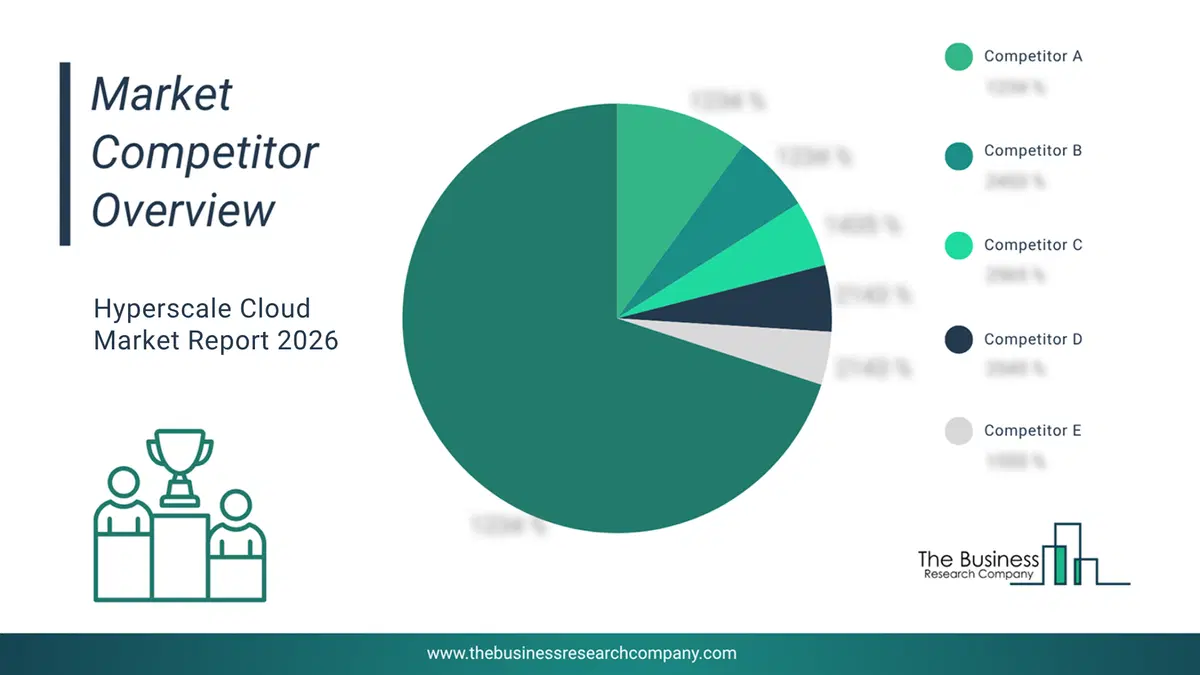
This chart is for illustrative purposes; the full report includes a detailed competitor analysis and comprehensive overview of the top 10 companies in the market.
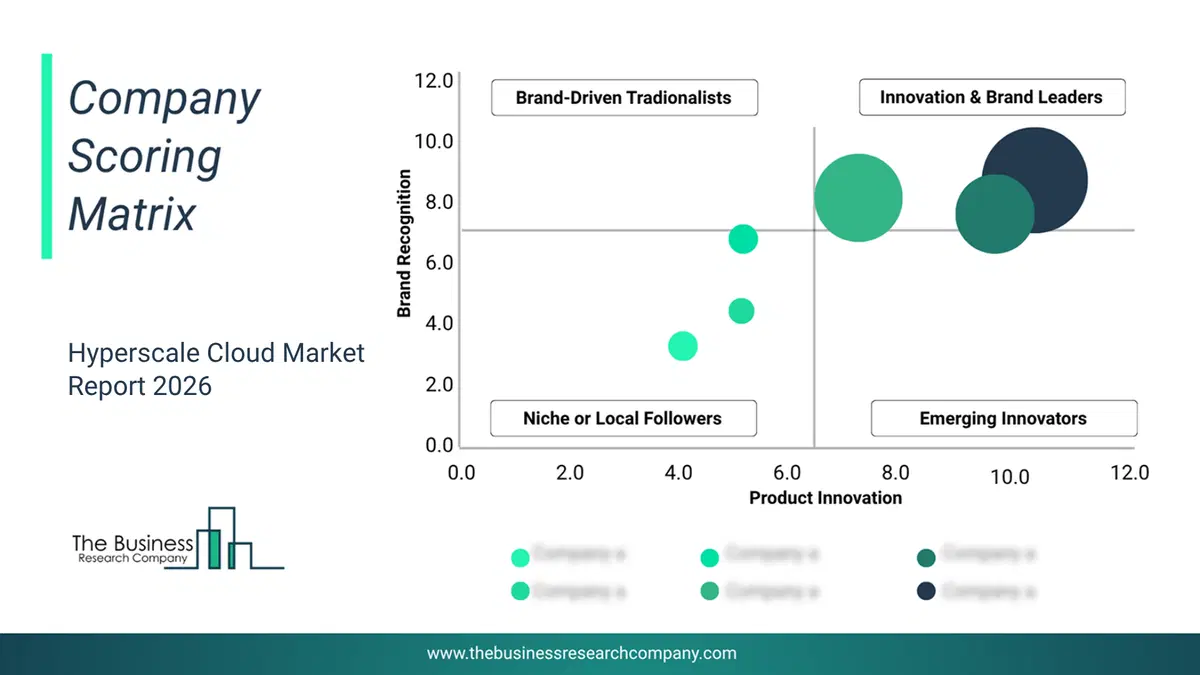
This chart maps companies by product innovation and brand strength, with bubble size indicating relative revenue, helping identify market leaders, challengers, and niche players. This is an illustrative chart; the full report provides a complete and accurate competitive analysis.
Global Hyperscale Cloud Market Trends and Insights
Major companies operating in the hyperscale cloud market are focusing on innovative technologies such as large-scale workloads with auto-scaling to enhance efficiency, optimize resource utilization, and deliver seamless scalability for enterprises. Large-scale workloads with auto-scaling refer to computing tasks that automatically adjust resources up or down based on demand to ensure performance and cost efficiency. For instance, in June 2025, Advanced Info Service Public Company Limited (AIS), a Thailand-based telecommunications and digital services provider, launched a hyperscale cloud service designed for local artificial intelligence (AI) workloads. This service offers high-performance computing capabilities and low-latency connections to support artificial intelligence (AI) model training. It is optimized for large-scale data processing and artificial intelligence (AI) applications, enabling businesses and developers to run compute-intensive workloads efficiently. This provides local cloud resources that enhance data sovereignty and ensure compliance with regional data regulations.What Are Latest Mergers And Acquisitions In The Hyperscale Cloud Market?
In August 2024, Advanced Micro Devices (AMD) Inc., a US-based semiconductor company, acquired ZT Systems Inc. for $4.9 billion. The acquisition aims to significantly expand AMD’s data center artificial intelligence systems capabilities by leveraging ZT Systems' expertise in hyperscale server design and manufacturing. ZT Systems Inc. is a US-based company that offers hyperscale cloud services.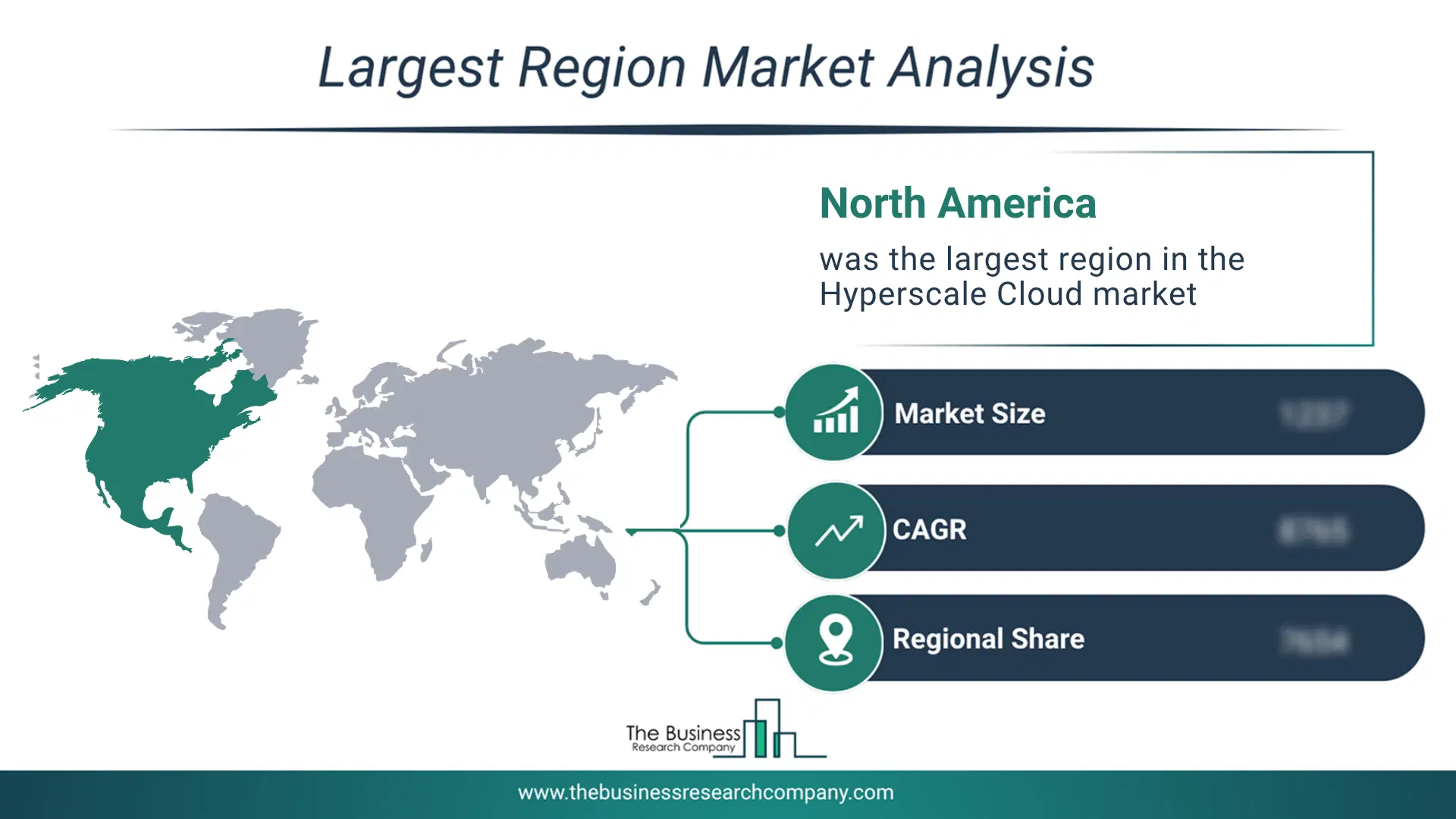
Regional Insights
North America was the largest region in the hyperscale cloud market in 2025. Asia-Pacific is expected to be the fastest-growing region in the forecast period. The regions covered in this market report are Asia-Pacific, South East Asia, Western Europe, Eastern Europe, North America, South America, Middle East, Africa. The countries covered in this market report are Australia, Brazil, China, France, Germany, India, Indonesia, Japan, Taiwan, Russia, South Korea, UK, USA, Canada, Italy, Spain.What Defines the Hyperscale Cloud Market?
The hyperscale cloud market consists of revenues earned by entities by providing services such as networking services, security services, storage services, disaster recovery, and backup services. The market value includes the value of related goods sold by the service provider or included within the service offering. The hyperscale cloud market also includes sales of cloud infrastructure systems, high-capacity storage devices, networking equipment, and supporting software tools. Values in this market are ‘factory gate’ values, that is, the value of goods sold by the manufacturers or creators of the goods, whether to other entities (including downstream manufacturers, wholesalers, distributors, and retailers) or directly to end customers. The value of goods in this market includes related services sold by their creators.How is Market Value Defined and Measured?
The market value is defined as the revenues that enterprises gain from the sale of goods and/or services within the specified market and geography through sales, grants, or donations in terms of the currency (in USD unless otherwise specified). The revenues for a specified geography are consumption values that are revenues generated by organizations in the specified geography within the market, irrespective of where they are produced. It does not include revenues from resales along the supply chain, either further along the supply chain or as part of other products.
This chart presents market attractiveness based on a quantitative evaluation of growth, competition, strategic alignment, and risk, offering a clear view of opportunity areas for decision-making. This chart is for illustrative purposes; the full report contains the complete analysis.

This chart highlights the Total Addressable Market (TAM) by estimating the maximum revenue opportunity using an assumption-driven approach, supporting strategic planning and opportunity sizing across markets. The chart is illustrative; the full report provides a more comprehensive analysis.
What Key Data and Analysis Are Included in the Hyperscale Cloud Market Report 2026?
The hyperscale cloud market research report is one of a series of new reports from The Business Research Company that provides market statistics, including industry global market size, regional shares, competitors with the market share, detailed market segments, market trends and opportunities, and any further data you may need to thrive in the hyperscale cloud industry. The market research report delivers a complete perspective of everything you need, with an in-depth analysis of the current and future state of the industry.Hyperscale Cloud Market Report Forecast Analysis
| Report Attribute | Details |
|---|---|
| Market Size Value In 2026 | $548.95 billion |
| Revenue Forecast In 2030 | $1091.05 billion |
| Growth Rate | CAGR of 18.7% from 2026 to 2030 |
| Base Year For Estimation | 2025 |
| Actual Estimates/Historical Data | 2020-2025 |
| Forecast Period | 2026 - 2030 |
| Market Representation | Revenue in USD Billion and CAGR from 2026 to 2030 |
| Segments Covered | Type, Deployment Type, Enterprise Type, Application, Industry |
| Regional Scope | Asia-Pacific, Western Europe, Eastern Europe, North America, South America, Middle East, Africa |
| Country Scope | The Countries Covered In This Market Report Are Australia, Brazil, China, France, Germany, India, Indonesia, Japan, Taiwan, Russia, South Korea, Uk, Usa, Canada, Italy, Spain. |
| Key Companies Profiled | Google LLC, Microsoft Corporation, Alibaba Group Holding Limited, NTT Communications Corporation, Amazon Web Services Inc., Huawei Technologies Co. Ltd., Tencent Holdings Limited, International Business Machines Corporation, Cisco Systems Inc., Oracle Corporation, SAP SE, Lumen Technologies Inc., Salesforce Inc., DigitalOcean LLC, Altus Group Limited, OVH Groupe SAS, Wasabi Technologies Inc., Baidu Cloud, Yandex Cloud, G42 Cloud (Core42) |
| Customization Scope | Request for Customization |
| Pricing And Purchase Options | Explore Purchase Options |