

Immuno-Oncology Co-Culture Models Market Report 2026
Global Outlook – By Model Type (Two Dimensional Co Culture Model, Three Dimensional Co Culture Model, Spheroid Based Model, Microfluidic Based Model, Other Model Types), By Cancer Type (Lung Cancer, Breast Cancer, Colorectal Cancer, Melanoma, Other Cancer Types), By Application Type (Drug Discovery And Development, Preclinical Testing, Personalized Medicine, Other Application Types), By End User Type (Pharmaceutical And Biotechnology Companies, Academic And Research Institutes, Contract Research Organizations, Other End User Types) – Market Size, Trends, Strategies, and Forecast to 2030
Immuno-Oncology Co-Culture Models Market Overview
• Immuno-Oncology Co-Culture Models market size has reached to $0.93 billion in 2025 • Expected to grow to $1.76 billion in 2030 at a compound annual growth rate (CAGR) of 13.6% • Growth Driver: Surge In Cancer Burden Fueling The Growth Of The Market Due To Rising Cancer Incidence And Demand For Advanced Research Models • Market Trend: Innovations In Open Organ-on-Chip Platforms Advance Immuno-Oncology Co-Culture Model Development • North America was the largest region in 2025 and Asia-Pacific is the fastest growing region.What Is Covered Under Immuno-Oncology Co-Culture Models Market?
Immuno-oncology co-culture models are advanced in vitro experimental systems that combine immune cells with tumor cells to replicate the tumor–immune microenvironment. These models are designed to study the interactions between cancer cells and the immune system under controlled laboratory conditions. Immuno-oncology co-culture models help researchers evaluate immune responses, tumor behavior, and the efficacy of immunotherapies in a more physiologically relevant setting compared to traditional monoculture systems. The main model types of immuno-oncology co-culture models include two dimensional co culture model, three dimensional co culture model, spheroid based model, microfluidic based model, and other model types. Two dimensional co culture models refer to in vitro research systems that cultivate cancer cells and immune cells together on a flat surface to study cellular interactions, immune responses, and therapeutic effects. These models are used for lung cancer, breast cancer, colorectal cancer, melanoma, and other cancer types. The key applications of drug discovery and development, preclinical testing, personalized medicine, and others, while the end-user types pharmaceutical and biotechnology companies, academic and research institutes, contract research organizations, and others.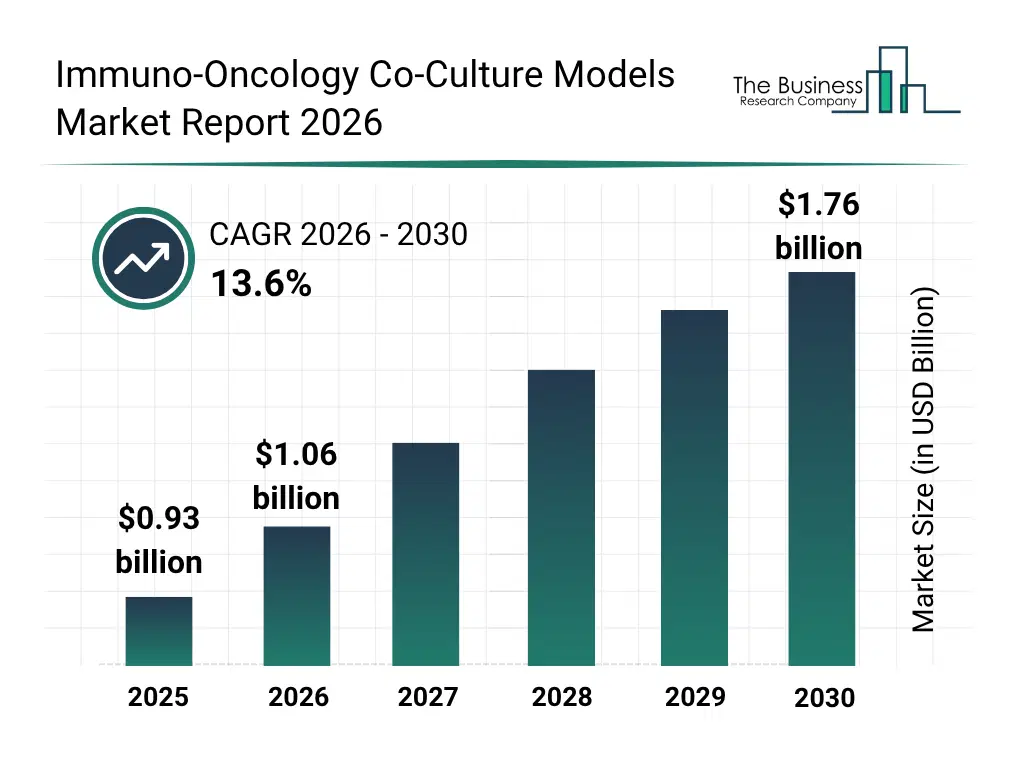
What Is The Immuno-Oncology Co-Culture Models Market Size and Share 2026?
The immuno-oncology co-culture models market size has grown rapidly in recent years. It will grow from $0.93 billion in 2025 to $1.06 billion in 2026 at a compound annual growth rate (CAGR) of 14.0%. The growth in the historic period can be attributed to growing investment in cancer research, increasing adoption of in vitro disease models, rising focus on immunotherapy development, expanding demand for predictive preclinical testing, higher use of advanced cell culture technologies.What Is The Immuno-Oncology Co-Culture Models Market Growth Forecast?
The immuno-oncology co-culture models market size is expected to see rapid growth in the next few years. It will grow to $1.76 billion in 2030 at a compound annual growth rate (CAGR) of 13.6%. The growth in the forecast period can be attributed to increasing demand for personalized immuno-oncology research, rising adoption of patient derived tumor models, growing investment in next generation preclinical platforms, expanding use of organoid and microfluidic technologies, higher focus on precision cancer therapeutics. Major trends in the forecast period include growing adoption of three dimensional tumor microenvironment models, increasing use of patient derived co culture systems, rising demand for predictive immunotherapy screening platforms, expansion of advanced tumor immune interaction studies, higher focus on physiologically relevant in vitro cancer models.
Global Immuno-Oncology Co-Culture Models Market Segmentation
1) By Model Type: Two Dimensional Co Culture Model, Three Dimensional Co Culture Model, Spheroid Based Model, Microfluidic Based Model, Other Model Types 2) By Cancer Type: Lung Cancer, Breast Cancer, Colorectal Cancer, Melanoma, Other Cancer Types 3) By Application Type: Drug Discovery And Development, Preclinical Testing, Personalized Medicine, Other Application Types 4) By End User Type: Pharmaceutical And Biotechnology Companies, Academic And Research Institutes, Contract Research Organizations, Other End User Types Subsegments: 1) By Two Dimensional Co Culture Model: Direct Co Culture Systems, Indirect Co Culture Systems, Conditioned Media Co Culture Systems, Monolayer Immune Tumor Co Culture Systems 2) By Three Dimensional Co Culture Model: Scaffold Based Three Dimensional Culture Systems, Extracellular Matrix Based Culture Systems, Organoid Based Co Culture Systems, Hydrogel Based Co Culture Systems 3) By Spheroid Based Model: Tumor Spheroids, Multicellular Tumor Spheroids, Immune Tumor Spheroid Models, Hanging Drop Spheroid Systems, Ultra Low Attachment Spheroid Systems 4) By Microfluidic Based Model: Organ On Chip Platforms, Tumor On Chip Models, Immune Cell Trafficking Chip Systems, Micro Perfusion Co Culture Systems 5) By Other Model Types: Bioprinted Tissue Models, Ex Vivo Tumor Slice Culture Models, Tumor Explant Culture Models, Hybrid Computational Experimental ModelsWhat Is The Driver Of The Immuno-Oncology Co-Culture Models Market?
The rising burden of cancer is expected to propel the growth of the immuno-oncology co-culture models market going forward. Cancer refers to a group of diseases characterized by the uncontrolled growth and spread of abnormal cells in the body. The rising burden of cancer is driven by increasing exposure to risk factors such as aging populations and lifestyle changes, leading to a higher incidence of new cancer cases globally. Immuno-oncology co-culture models help address the burden of cancer by enabling more accurate simulation of tumor–immune interactions, which improves the effectiveness of drug discovery and accelerates the development of targeted cancer therapies. For instance, in October 2025, according to the Australian Government, an Australia-based government department, around 169,759 cancer cases were diagnosed, alongside approximately 53,545 cancer-related deaths. Therefore, the rising burden of cancer is driving the growth of the immuno-oncology co-culture models industry.Key Players In The Global Immuno-Oncology Co-Culture Models Market
Major companies operating in the immuno-oncology co-culture models market are Thermo Fisher Scientific Inc., Danaher Corporation, Merck KGaA, Corning Incorporated, Lonza Group AG, Agilent Technologies Inc., Sartorius AG, Revvity Inc., Bio-Rad Laboratories Inc., Tecan Group AG, Evotec SE, STEMCELL Technologies Inc., Miltenyi Biotec, Sino Biological Inc., Champions Oncology Inc., MIMETAS B.V., Emulate Inc., CN Bio Innovations Limited, InSphero AG, Axol Bioscience Limited, Creative Biolabs Inc., KiYatec Inc., TissUse GmbH, Altis Biosystems Inc., Carcinotech Limited, Prellis Biologics Inc.
This chart is for illustrative purposes; the full report includes a detailed competitor analysis and comprehensive overview of the top 10 companies in the market.
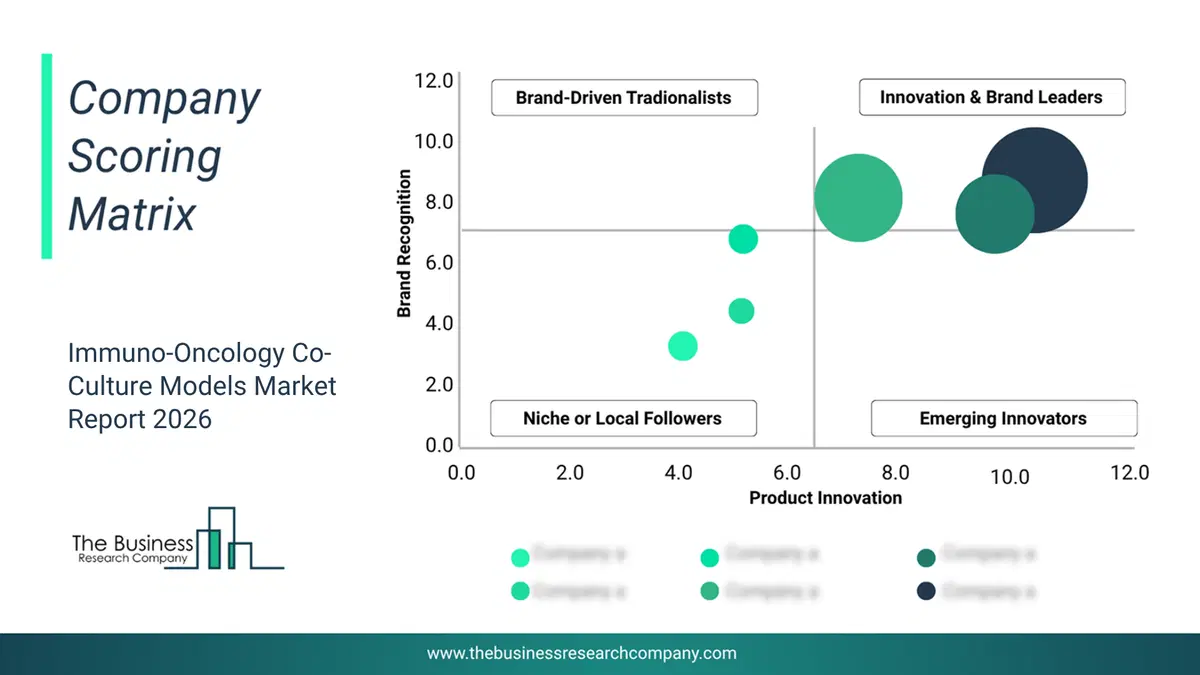
This chart maps companies by product innovation and brand strength, with bubble size indicating relative revenue, helping identify market leaders, challengers, and niche players. This is an illustrative chart; the full report provides a complete and accurate competitive analysis.
Global Immuno-Oncology Co-Culture Models Market Trends and Insights
Major companies operating in the immuno-oncology co-culture models market are focusing on developing advanced open organ-on-chip platforms to enable physiologically relevant tumor microenvironment modeling, improve immune cell and cancer cell interaction studies, and accelerate preclinical drug discovery. Open organ-on-chip platforms are modular microphysiological systems that allow researchers to build and customize complex multicellular co-culture models for studying immune responses and evaluating immunotherapies. For instance, in June 2024, Dynamic42 GmbH, a Germany-based organ-on-chip technology company, launched a DynamicOrgan System, an open organ-on-chip platform for organ model development. The platform enables researchers to develop customizable immunocompetent organ and tumor models by integrating immune cells, vascular components, and three-dimensional tissues. It supports immuno-oncology co-culture model development for cancer research, disease modeling, and preclinical drug screening with improved physiological relevance.What Are Latest Mergers And Acquisitions In The Immuno-Oncology Co-Culture Models Market?
In January 2025, MilliporeSigma, a US-based life science solutions provider, acquired HUB Organoids Holding B.V. for an undisclosed amount. Through this acquisition, MilliporeSigma aims to expand access to organoid technology and strengthen its next-generation biology portfolio to enable faster and more effective drug development. HUB Organoids Holding B.V. is a Netherlands-based biotechnology company that provides immuno-oncology co-culture model systems.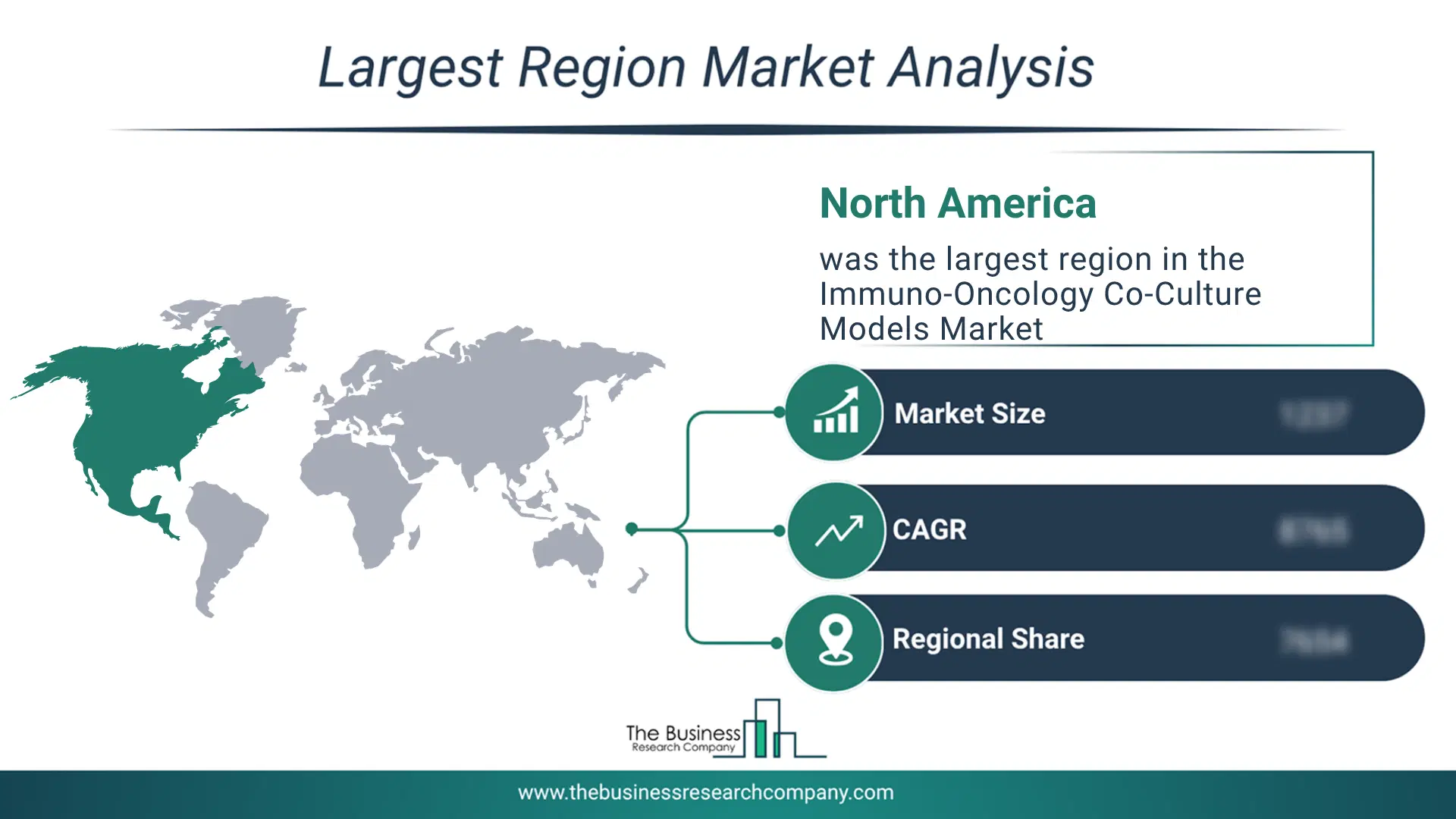
Regional Insights
North America was the largest region in the immuno-oncology co-culture models market in 2025. Asia-Pacific is expected to be the fastest-growing region in the forecast period. The regions covered in this market report are Asia-Pacific, South East Asia, Western Europe, Eastern Europe, North America, South America, Middle East, Africa. The countries covered in this market report are Australia, Brazil, China, France, Germany, India, Indonesia, Japan, Taiwan, Russia, South Korea, UK, USA, Canada, Italy, Spain.What Defines the Immuno-Oncology Co-Culture Models Market?
The immuno-oncology co-culture models market consists of sales of transwell-based co-culture models, scaffold-based co-culture models, hydrogel-based co-culture models, and bioprinted co-culture models. Values in this market are ‘factory gate’ values, that is, the value of goods sold by the manufacturers or creators of the goods, whether to other entities (including downstream manufacturers, wholesalers, distributors, and retailers) or directly to end customers. The value of goods in this market includes related services sold by the creators of the goods.How is Market Value Defined and Measured?
The market value is defined as the revenues that enterprises gain from the sale of goods and/or services within the specified market and geography through sales, grants, or donations in terms of the currency (in USD unless otherwise specified). The revenues for a specified geography are consumption values that are revenues generated by organizations in the specified geography within the market, irrespective of where they are produced. It does not include revenues from resales along the supply chain, either further along the supply chain or as part of other products.
This chart presents market attractiveness based on a quantitative evaluation of growth, competition, strategic alignment, and risk, offering a clear view of opportunity areas for decision-making. This chart is for illustrative purposes; the full report contains the complete analysis.

This chart highlights the Total Addressable Market (TAM) by estimating the maximum revenue opportunity using an assumption-driven approach, supporting strategic planning and opportunity sizing across markets. The chart is illustrative; the full report provides a more comprehensive analysis.
What Key Data and Analysis Are Included in the Immuno-Oncology Co-Culture Models Market Report 2026?
The immuno-oncology co-culture models market research report is one of a series of new reports from The Business Research Company that provides market statistics, including industry global market size, regional shares, competitors with the market share, detailed market segments, market trends and opportunities, and any further data you may need to thrive in the immuno-oncology co-culture models industry. The market research report delivers a complete perspective of everything you need, with an in-depth analysis of the current and future state of the industry.Immuno-Oncology Co-Culture Models Market Report Forecast Analysis
| Report Attribute | Details |
|---|---|
| Market Size Value In 2026 | $1.06 billion |
| Revenue Forecast In 2030 | $1.76 billion |
| Growth Rate | CAGR of 13.6% from 2026 to 2030 |
| Base Year For Estimation | 2025 |
| Actual Estimates/Historical Data | 2020-2025 |
| Forecast Period | 2026 - 2030 |
| Market Representation | Revenue in USD Billion and CAGR from 2026 to 2030 |
| Segments Covered | Model Type, Cancer Type, Application Type, End User Type |
| Regional Scope | Asia-Pacific, Western Europe, Eastern Europe, North America, South America, Middle East, Africa |
| Country Scope | The countries covered in the report are Australia, Brazil, China, France, Germany, India, Indonesia, Japan, Taiwan, Russia, South Korea, UK, USA, Canada, Italy, Spain. |
| Key Companies Profiled | Thermo Fisher Scientific Inc., Danaher Corporation, Merck KGaA, Corning Incorporated, Lonza Group AG, Agilent Technologies Inc., Sartorius AG, Revvity Inc., Bio-Rad Laboratories Inc., Tecan Group AG, Evotec SE, STEMCELL Technologies Inc., Miltenyi Biotec, Sino Biological Inc., Champions Oncology Inc., MIMETAS B.V., Emulate Inc., CN Bio Innovations Limited, InSphero AG, Axol Bioscience Limited, Creative Biolabs Inc., KiYatec Inc., TissUse GmbH, Altis Biosystems Inc., Carcinotech Limited, Prellis Biologics Inc. |
| Customization Scope | Request for Customization |
| Pricing And Purchase Options | Explore Purchase Options |