

Implantable-Grade Titanium Components Market Report 2026
Global Outlook – By Product Type (Titanium Screws, Titanium Plates, Titanium Rods, Titanium Dental Implants), By Material Type (Commercially Pure Titanium, Titanium 6 Aluminum 4 Vanadium Alloy, Other Titanium Alloys), By Manufacturing Process (Precision Machining, 3D Printing And Additive Manufacturing, Casting And Forging, Other Manufacturing Processes), By Application (Orthopedic Implants, Dental Implants, Spinal Implants, Cardiovascular Implants), By End User (Medical Device Manufacturers, Implant Manufacturers, Medical Component Manufacturers, Contract Manufacturers And Contract Development And Manufacturing Organizations, Dental Implant Manufacturers) – Market Size, Trends, Strategies, and Forecast to 2030
Implantable-Grade Titanium Components Market Overview
• Implantable-Grade Titanium Components market size has reached to $4.82 billion in 2025 • Expected to grow to $7.47 billion in 2030 at a compound annual growth rate (CAGR) of 9.2% • Growth Driver: Rise In Sports Injury Cases Fueling The Market Due To Increasing Participation In Contact And High-Intensity Sports • Market Trend: Development Of Self-Adjusting Titanium Copings For Improved Implant Restoration Fit • North America was the largest region in 2025 and Asia-Pacific is the fastest growing region.What Is Covered Under Implantable-Grade Titanium Components Market?
Implantable-grade titanium components refer to titanium-based parts manufactured from biocompatible, implant-grade titanium or titanium alloys and designed for permanent or temporary implantation in the human body. These components are engineered to provide high strength, corrosion resistance, biocompatibility, fatigue resistance, and long-term stability in physiological environments. The main product types of implantable-grade titanium components include titanium screws, titanium plates, titanium rods, and titanium dental implants. Titanium screws refer to threaded titanium components designed to secure and stabilize implants, bone structures, or other medical devices during surgical procedures. These components are manufactured using commercially pure titanium, titanium 6 aluminum 4 vanadium alloy, and other titanium alloys through precision machining, 3D printing and additive manufacturing, casting and forging, and other manufacturing processes. The various applications involved are orthopedic implants, dental implants, spinal implants, and cardiovascular implants and they are utilized by end users including medical device manufacturers, implant manufacturers, medical component manufacturers, contract manufacturers and contract development and manufacturing organizations, and dental implant manufacturers.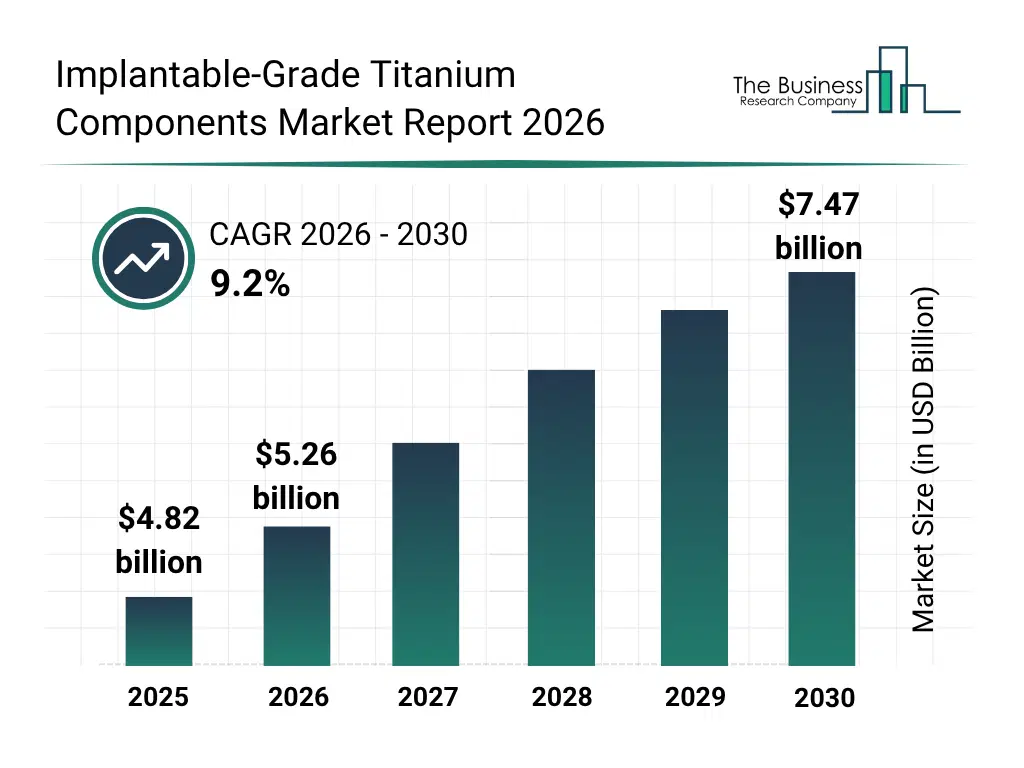
What Is The Implantable-Grade Titanium Components Market Size and Share 2026?
The implantable-grade titanium components market size has grown strongly in recent years. It will grow from $4.82 billion in 2025 to $5.26 billion in 2026 at a compound annual growth rate (CAGR) of 9.0%. The growth in the historic period can be attributed to growing adoption of titanium in orthopedic implants, increasing demand for biocompatible implant materials, rising prevalence of orthopedic surgical procedures, expanding use of titanium components in dental implants, increasing preference for corrosion-resistant implant materials.What Is The Implantable-Grade Titanium Components Market Growth Forecast?
The implantable-grade titanium components market size is expected to see strong growth in the next few years. It will grow to $7.47 billion in 2030 at a compound annual growth rate (CAGR) of 9.2%. The growth in the forecast period can be attributed to rising demand for advanced implantable titanium alloys, growing need for durable long-term implant components, increasing adoption of customized implant designs, expanding applications of titanium in reconstructive procedures, rising demand for high-strength lightweight implant components. Major trends in the forecast period include increasing demand for biocompatible titanium alloys, growing adoption of corrosion-resistant titanium components, rising development of fatigue-resistant implantable titanium components, increasing focus on lightweight high-strength titanium designs, growing demand for long-term physiological stability of titanium components.
Global Implantable-Grade Titanium Components Market Segmentation
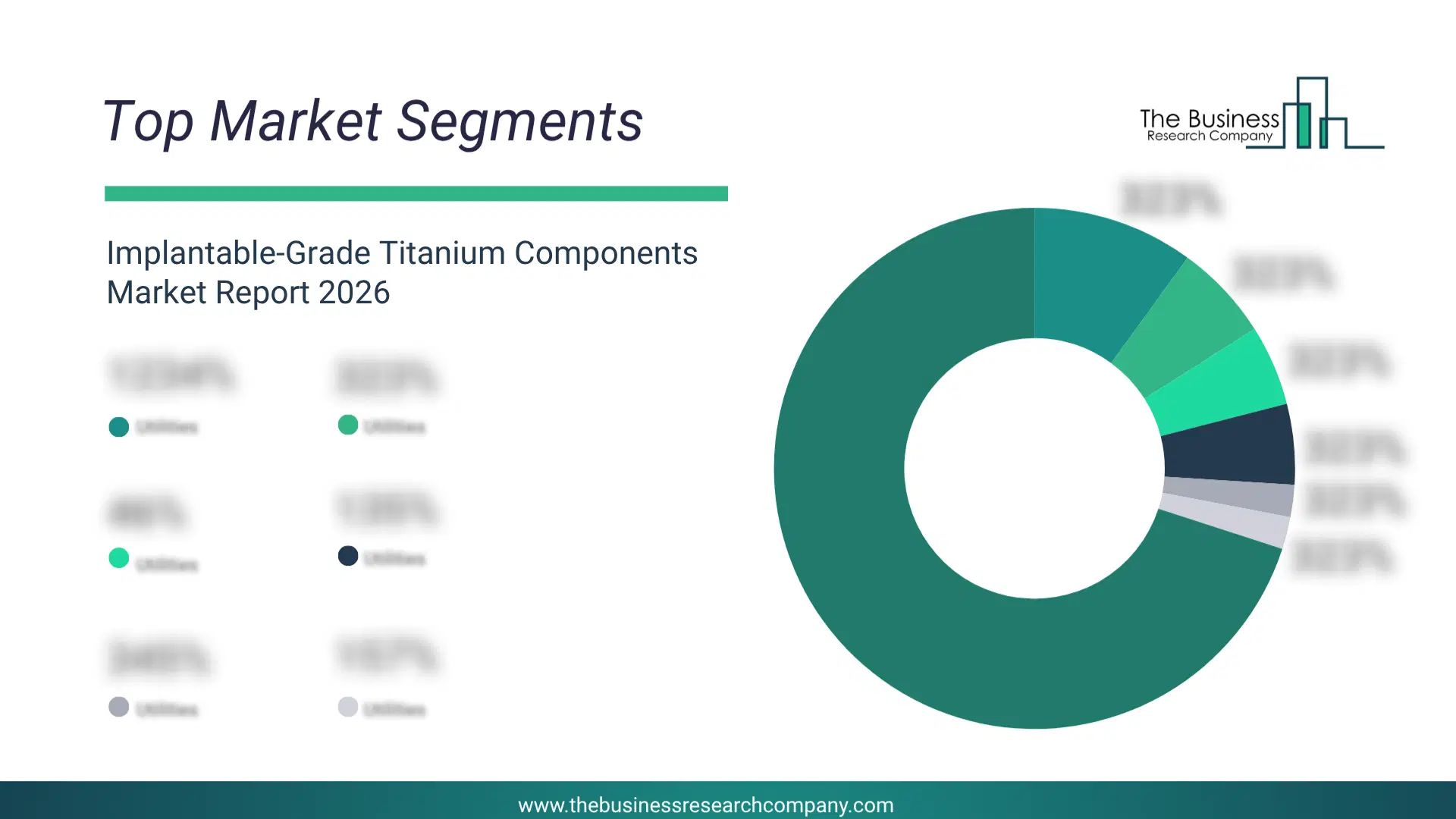
1) By Product Type: Titanium Screws, Titanium Plates, Titanium Rods, Titanium Dental Implants 2) By Material Type: Commercially Pure Titanium, Titanium 6 Aluminum 4 Vanadium Alloy, Other Titanium Alloys 3) By Manufacturing Process: Precision Machining, 3D Printing And Additive Manufacturing, Casting And Forging, Other Manufacturing Processes 4) By Application: Orthopedic Implants, Dental Implants, Spinal Implants, Cardiovascular Implants 5) By End User: Medical Device Manufacturers, Implant Manufacturers, Medical Component Manufacturers, Contract Manufacturers And Contract Development And Manufacturing Organizations, Dental Implant Manufacturers Subsegments: 1) By Titanium Screws: Cortical Bone Screws, Cancellous Bone Screws, Cannulated Screws, Locking Screws 2) By Titanium Plates: Locking Plates, Compression Plates, Reconstruction Plates, Anatomical Plates 3) By Titanium Rods: Spinal Fixation Rods, Intramedullary Rods, Harrington Rods, Elastic Titanium Rods 4) By Titanium Dental Implants: Endosteal Implants, Subperiosteal Implants, Zygomatic Implants, Mini Dental ImplantsWhat Is The Driver Of The Implantable-Grade Titanium Components Market?
The rise in sports injury cases is expected to propel the growth of the implantable-grade titanium components market going forward. A sports injury refers to damage to bones, joints, muscles, or ligaments sustained during athletic activity or competition. Rising participation in contact and high-intensity sports increases the frequency of falls, collisions, and repetitive strain, which raises the incidence of fractures and joint injuries among athletes. Implantable grade titanium components support the treatment of sports injuries by providing strong, lightweight, and biocompatible materials for orthopedic implants and fixation devices. The rising incidence of sports related injuries increases demand for durable titanium components that support bone fixation, joint repair, and faster recovery. For instance, in August 2025, according to the National Safety Council, a US-based non-profit safety organization, sports and recreational injuries rose 17% in 2024, following increases of 2% in 2023. Therefore, the rise in sports injury cases is driving the growth of the implantable-grade titanium components industry.Key Players In The Global Implantable-Grade Titanium Components Market
Major companies operating in the implantable-grade titanium components market are Stryker Corporation, Zimmer Biomet Holdings Inc., Smith & Nephew plc, Institut Straumann AG, Dentsply Sirona Inc., Globus Medical Inc., Arthrex Inc., Carpenter Technology Corporation, MicroPort Scientific Corporation, CONMED Corporation, Tecomet Inc., Corin Group Limited, Gebrüder Martin GmbH & Co. KG, Acumed LLC, Medartis AG, Paragon 28 Inc.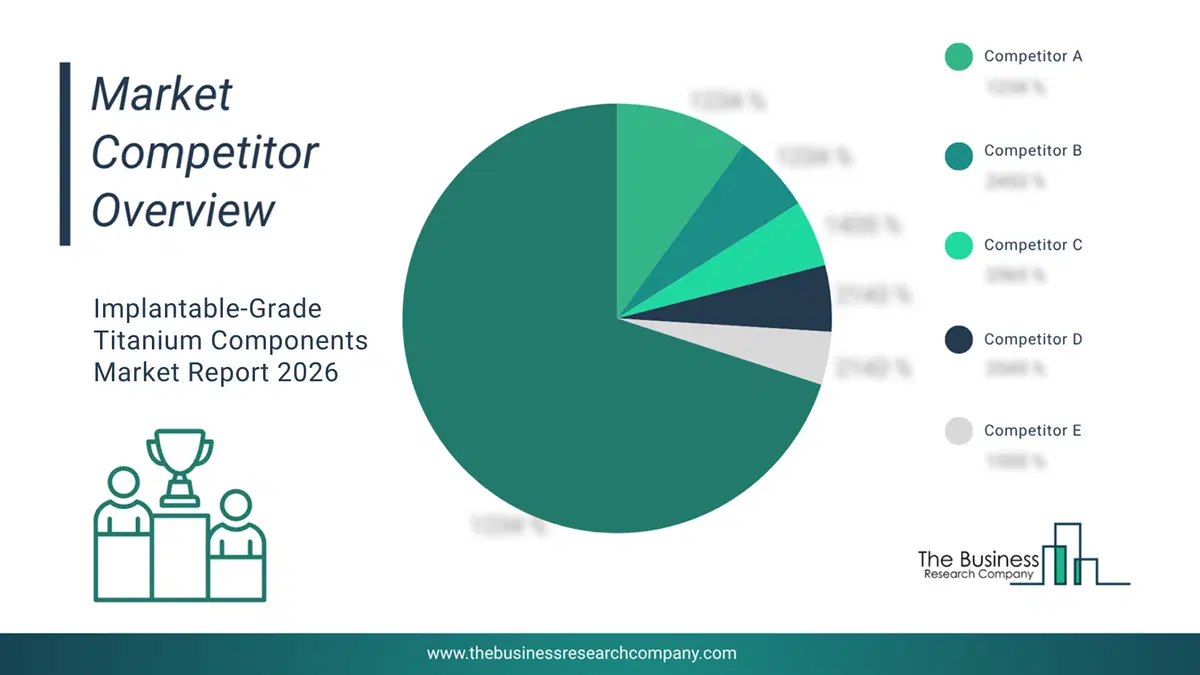
This chart is for illustrative purposes; the full report includes a detailed competitor analysis and comprehensive overview of the top 10 companies in the market.
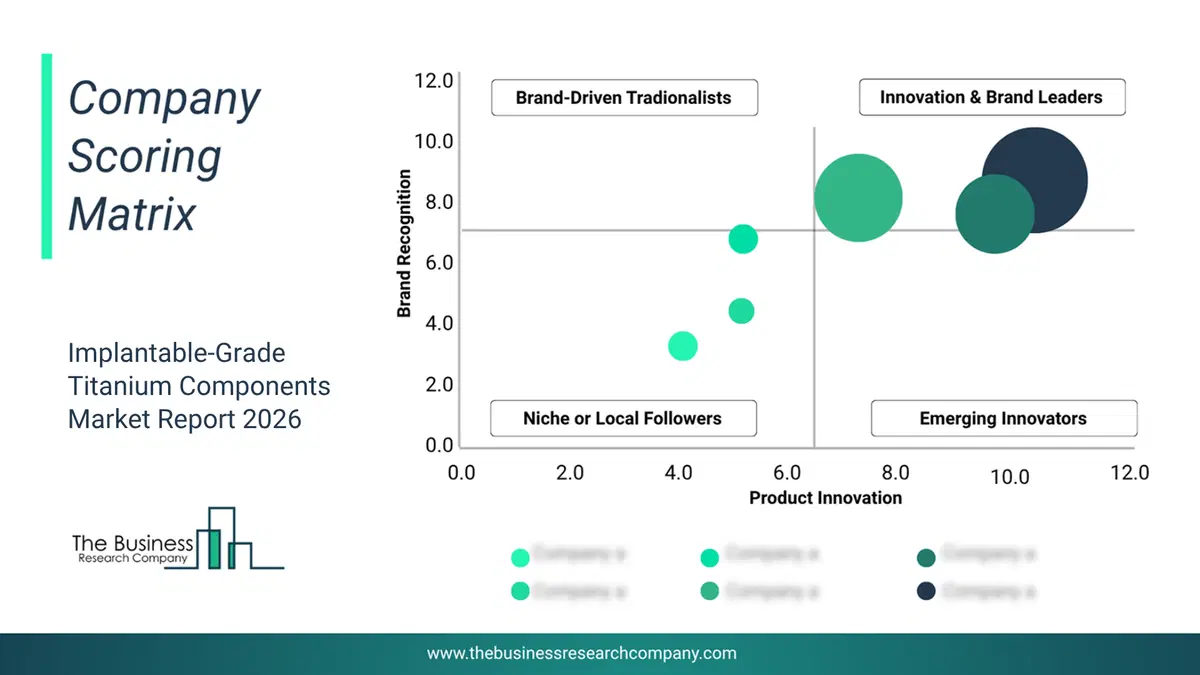
This chart maps companies by product innovation and brand strength, with bubble size indicating relative revenue, helping identify market leaders, challengers, and niche players. This is an illustrative chart; the full report provides a complete and accurate competitive analysis.
Global Implantable-Grade Titanium Components Market Trends and Insights
Major companies operating in the implantable-grade titanium components market are focusing on developing advanced products, such as self-adjusting titanium copings, to improve passive fit, reduce biomechanical stress, and minimize complications such as screw loosening and prosthesis fracture in full-arch implant restorations. Self-adjusting titanium copings are implant-restoration components designed to automatically compensate for minor dimensional discrepancies between the prosthesis and implant-abutment interface during seating, thereby enabling a more passive and stress-free connection. For instance, in May 2026, ROE Dental Laboratory, a US-based dental laboratory, launched Passivity Plus, an FDA 510(k)-cleared self-adjusting titanium coping for full-arch implant restorations. The component is manufactured from Grade 5 Titanium (Ti-6Al-4V-ELI) and incorporates a pivotable, self-adjusting cap that micro-adjusts during seating to compensate for minor fit discrepancies, helping reduce stress on implants and prosthetic components.What Are Latest Mergers And Acquisitions In The Implantable-Grade Titanium Components Market?
In January 2024, Enovis Corporation, a U.S.-based provider of medical technology solutions spanning orthopedic reconstruction, prevention and recovery, and surgical implant systems, acquired LimaCorporate S.p.A. for €800 million ($870 million). The acquisition aims to expand Enovis’ orthopedic reconstruction portfolio, strengthen its position in the global joint-reconstruction market, and enhance its capabilities in advanced 3D-printed implant technologies, including LimaCorporate’s proprietary Trabecular Titanium platform. LimaCorporate S.p.A. is an Italy-based provider of orthopedic reconstruction implants, including 3D-printed Trabecular Titanium implants and a comprehensive revision offering in shoulders, serving hip, knee, shoulder, and extremities reconstruction markets worldwide.
Regional Insights
North America was the largest region in the implantable-grade titanium components market in 2025. Asia-Pacific is expected to be the fastest-growing region in the forecast period. The regions covered in this market report are Asia-Pacific, South East Asia, Western Europe, Eastern Europe, North America, South America, Middle East, Africa. The countries covered in this market report are Australia, Brazil, China, France, Germany, India, Indonesia, Japan, Taiwan, Russia, South Korea, UK, USA, Canada, Italy, Spain.What Defines the Implantable-Grade Titanium Components Market?
The implantable-grade titanium components market consists of sales of titanium joint replacement components, titanium spinal cages, titanium intramedullary nails and titanium bone staples. Values in this market are ‘factory gate’ values, that is, the value of goods sold by the manufacturers or creators of the goods, whether to other entities (including downstream manufacturers, wholesalers, distributors, and retailers) or directly to end customers. The value of goods in this market includes related services sold by the creators of the goods.How is Market Value Defined and Measured?
The market value is defined as the revenues that enterprises gain from the sale of goods and/or services within the specified market and geography through sales, grants, or donations in terms of the currency (in USD unless otherwise specified). The revenues for a specified geography are consumption values that are revenues generated by organizations in the specified geography within the market, irrespective of where they are produced. It does not include revenues from resales along the supply chain, either further along the supply chain or as part of other products.
This chart presents market attractiveness based on a quantitative evaluation of growth, competition, strategic alignment, and risk, offering a clear view of opportunity areas for decision-making. This chart is for illustrative purposes; the full report contains the complete analysis.

This chart highlights the Total Addressable Market (TAM) by estimating the maximum revenue opportunity using an assumption-driven approach, supporting strategic planning and opportunity sizing across markets. The chart is illustrative; the full report provides a more comprehensive analysis.
What Key Data and Analysis Are Included in the Implantable-Grade Titanium Components Market Report 2026?
The implantable-grade titanium components market research report is one of a series of new reports from The Business Research Company that provides market statistics, including industry global market size, regional shares, competitors with the market share, detailed market segments, market trends and opportunities, and any further data you may need to thrive in the implantable-grade titanium components industry. The market research report delivers a complete perspective of everything you need, with an in-depth analysis of the current and future state of the industry.Implantable-Grade Titanium Components Market Report Forecast Analysis
| Report Attribute | Details |
|---|---|
| Market Size Value In 2026 | $5.26 billion |
| Revenue Forecast In 2030 | $7.47 billion |
| Growth Rate | CAGR of 9.2% from 2026 to 2030 |
| Base Year For Estimation | 2025 |
| Actual Estimates/Historical Data | 2020-2025 |
| Forecast Period | 2026 - 2030 |
| Market Representation | Revenue in USD Billion and CAGR from 2026 to 2030 |
| Segments Covered | Product Type, Material Type, Manufacturing Process, Application, End User |
| Regional Scope | Asia-Pacific, Western Europe, Eastern Europe, North America, South America, Middle East, Africa |
| Country Scope | The countries covered in the report are Australia, Brazil, China, France, Germany, India, Indonesia, Japan, Taiwan, Russia, South Korea, UK, USA, Canada, Italy, Spain. |
| Key Companies Profiled | Stryker Corporation, Zimmer Biomet Holdings Inc., Smith & Nephew plc, Institut Straumann AG, Dentsply Sirona Inc., Globus Medical Inc., Arthrex Inc., Carpenter Technology Corporation, MicroPort Scientific Corporation, CONMED Corporation, Tecomet Inc., Corin Group Limited, Gebrüder Martin GmbH & Co. KG, Acumed LLC, Medartis AG, Paragon 28 Inc. |
| Customization Scope | Request for Customization |
| Pricing And Purchase Options | Explore Purchase Options |