
Implantable Medical Device Batteries Market Report 2026
Global Outlook – By Battery Chemistry (Lithium Iodine Batteries, Lithium Ion Batteries, Lithium Silver Vanadium Oxide Batteries, Lithium Carbon Monofluoride Batteries, Other Battery Chemistries), By Battery Type (Primary Batteries, Rechargeable Batteries), By Packaging (Hermetically Sealed Batteries, Polymer Encapsulated Batteries, Other Packaging Configurations), By Application (Cardiac Rhythm Management Devices, Neurostimulation Devices, Cochlear Implants, Implantable Drug Delivery Systems, Implantable Monitoring Devices, Other Implantable Medical Devices), By End User (Medical Device Manufacturers Or Original Equipment Manufacturers, Battery Manufacturers Or Specialized Battery Suppliers, Contract Manufacturers, Research And Development Organizations) – Market Size, Trends, Strategies, and Forecast to 2030
Implantable Medical Device Batteries Market Overview
• Implantable Medical Device Batteries market size has reached to $1.12 billion in 2025 • Expected to grow to $1.6 billion in 2030 at a compound annual growth rate (CAGR) of 7.3% • Growth Driver: Rising Prevalence Of Cardiovascular And Neurological Disorders Fueling The Growth Of The Market Due To An Aging Global Population And Increasing Need For Long-term Implantable Treatments • Market Trend: Advanced High-Pulse Medical-Grade Battery Technologies Are Enhancing Power Reliability In Critical Medical Devices • North America was the largest region in 2025 and Asia-Pacific is the fastest growing region.What Is Covered Under Implantable Medical Device Batteries Market?
Implantable medical device batteries are specialized energy storage systems engineered to safely and reliably power implanted medical devices. They are designed for high energy density, predictable discharge, long-term stability, hermetic protection, and stringent safety requirements to ensure reliable device operation throughout extended implantation periods. The main battery chemistries of implantable medical device batteries include lithium iodine batteries, lithium ion batteries, lithium silver vanadium oxide batteries, lithium carbon monofluoride batteries, and other battery chemistries. Lithium iodine batteries refer to primary batteries that use lithium as the anode and iodine-based materials as the cathode system, providing stable and reliable power for certain implantable medical devices. These batteries are available as primary batteries and rechargeable batteries and are packaged as hermetically sealed batteries, polymer encapsulated batteries, and other packaging configurations. The various applications involved are cardiac rhythm management devices, neurostimulation devices, cochlear implants, implantable drug delivery systems, implantable monitoring devices, and other implantable medical devices, and they are used by several end users such as medical device manufacturers or original equipment manufacturers, battery manufacturers or specialized battery suppliers, contract manufacturers, and research and development organizations.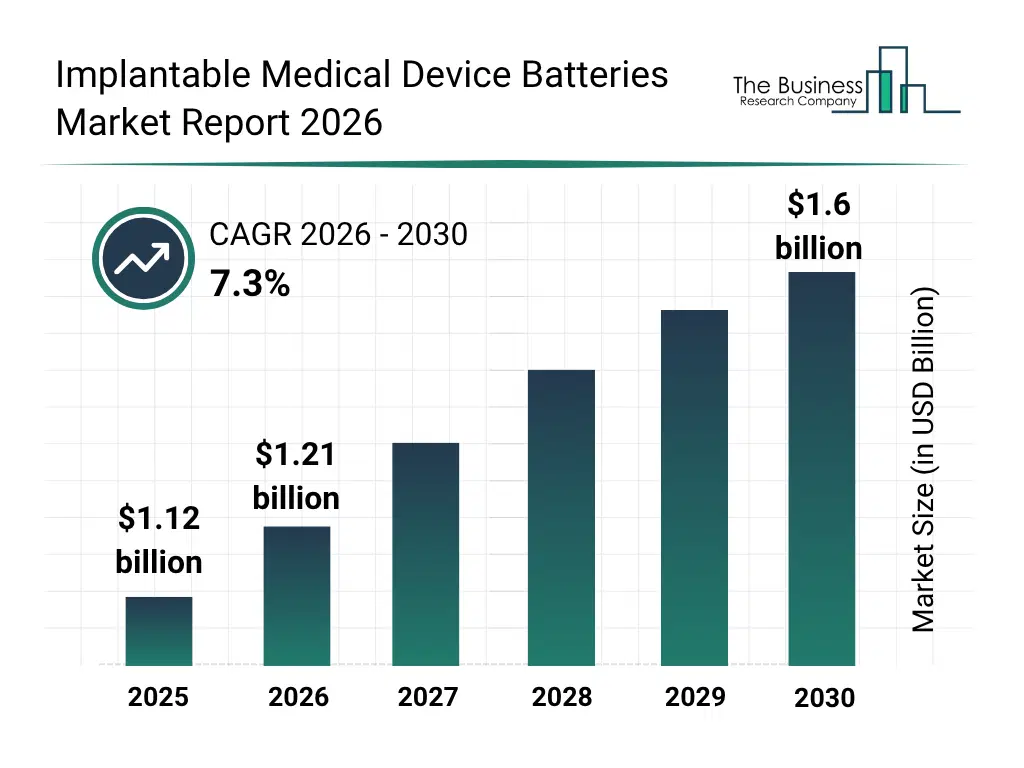
What Is The Implantable Medical Device Batteries Market Size and Share 2026?
The implantable medical device batteries market size has grown strongly in recent years. It will grow from $1.12 billion in 2025 to $1.21 billion in 2026 at a compound annual growth rate (CAGR) of 7.7%. The growth in the historic period can be attributed to increasing adoption of implantable medical devices, rising demand for long-lasting medical device power sources, growing utilization of cardiac rhythm management devices, increasing demand for reliable battery performance, rising focus on implantable device safety.What Is The Implantable Medical Device Batteries Market Growth Forecast?
The implantable medical device batteries market size is expected to see strong growth in the next few years. It will grow to $1.6 billion in 2030 at a compound annual growth rate (CAGR) of 7.3%. The growth in the forecast period can be attributed to growing adoption of advanced neurostimulation devices, increasing demand for smaller implantable medical devices, rising development of rechargeable implantable batteries, growing demand for higher energy density, increasing adoption of next-generation implantable drug delivery systems. Major trends in the forecast period include increasing development of high-energy-density implantable batteries, growing adoption of long-life primary battery technologies, rising development of miniaturized implantable power sources, increasing focus on hermetically sealed battery designs, growing demand for predictable and stable battery discharge.
Global Implantable Medical Device Batteries Market Segmentation
1) By Battery Chemistry: Lithium Iodine Batteries, Lithium Ion Batteries, Lithium Silver Vanadium Oxide Batteries, Lithium Carbon Monofluoride Batteries, Other Battery Chemistries 2) By Battery Type: Primary Batteries, Rechargeable Batteries 3) By Packaging: Hermetically Sealed Batteries, Polymer Encapsulated Batteries, Other Packaging Configurations 4) By Application: Cardiac Rhythm Management Devices, Neurostimulation Devices, Cochlear Implants, Implantable Drug Delivery Systems, Implantable Monitoring Devices, Other Implantable Medical Devices 5) By End User: Medical Device Manufacturers Or Original Equipment Manufacturers, Battery Manufacturers Or Specialized Battery Suppliers, Contract Manufacturers, Research And Development Organizations Subsegments: 1) By Lithium Iodine Batteries: Solid Cathode Lithium Iodine Batteries, Hybrid Lithium Iodine Batteries 2) By Lithium Ion Batteries: Lithium Cobalt Oxide Batteries, Lithium Manganese Oxide Batteries, Lithium Nickel Manganese Cobalt Oxide Batteries, Lithium Iron Phosphate Batteries, Lithium Titanate Batteries 3) By Lithium Silver Vanadium Oxide Batteries: Standard Lithium Silver Vanadium Oxide Batteries, Hybrid Lithium Silver Vanadium Oxide Batteries 4) By Lithium Carbon Monofluoride Batteries: Standard Lithium Carbon Monofluoride Batteries, Hybrid Lithium Carbon Monofluoride Batteries 5) By Other Battery Chemistries: Lithium Manganese Dioxide Batteries, Solid State Lithium BatteriesWhat Is The Driver Of The Implantable Medical Device Batteries Market?
The rising prevalence of cardiovascular and neurological disorders is expected to propel the growth of the implantable medical device batteries market going forward. Cardiovascular and neurological disorders refer to chronic health conditions affecting the heart, blood vessels, brain, spinal cord, and nervous system, often requiring long-term treatment through implantable medical devices such as pacemakers, implantable cardioverter defibrillators, deep brain stimulators, and neurostimulators. The rising prevalence of cardiovascular and neurological disorders is due to an aging global population, which increases the risk of chronic cardiovascular and neurological conditions among older adults. Implantable medical device batteries aid in the management of cardiovascular and neurological disorders by providing reliable, long-lasting power to implanted devices. They support the continuous operation of devices such as pacemakers, implantable cardioverter defibrillators, and neurostimulators, improving treatment effectiveness and patient outcomes. For instance, in August 2025, according to the National Institutes of Health (NIH), a US-based federal government agency, cardiovascular prevalence is projected to increase by 90.0% from 2025 to 2050, with cardiovascular deaths rising from 20.5 million in 2025 to 35.6 million in 2050. Therefore, the rising prevalence of cardiovascular and neurological disorders is driving the growth of the implantable medical device batteries industry.Key Players In The Global Implantable Medical Device Batteries Market
Major companies operating in the implantable medical device batteries market are Medtronic plc, Abbott Laboratories, Boston Scientific Corporation, MicroPort Scientific Corporation, BIOTRONIK SE & Co. KG, LivaNova PLC, Inspire Medical Systems Inc., Cochlear Limited, Mainstay Medical Holdings plc, EnerSys, Resonetics LLC, EVE Energy Co. Ltd., Maxell Ltd., Wyon AG, Ilika plc, Ensurge Micropower ASA, Cymbet Corporation, Excellatron Solid State LLC, InjectPower S.r.l., Integer Holdings Corporation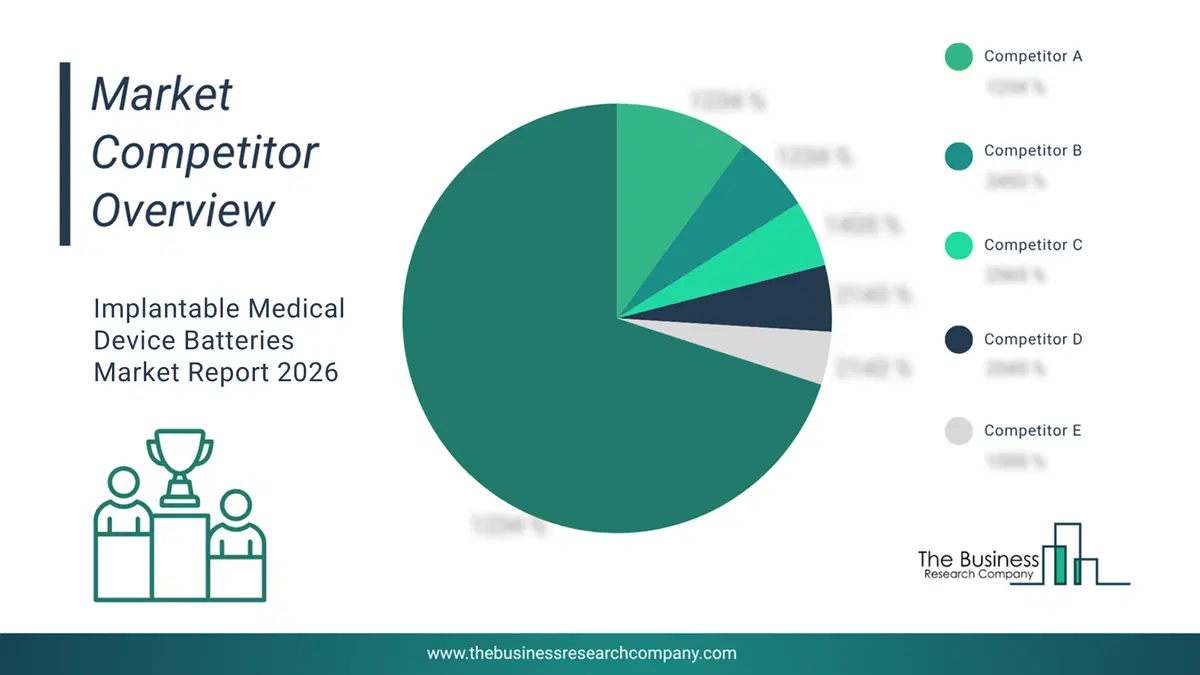
This chart is for illustrative purposes; the full report includes a detailed competitor analysis and comprehensive overview of the top 10 companies in the market.
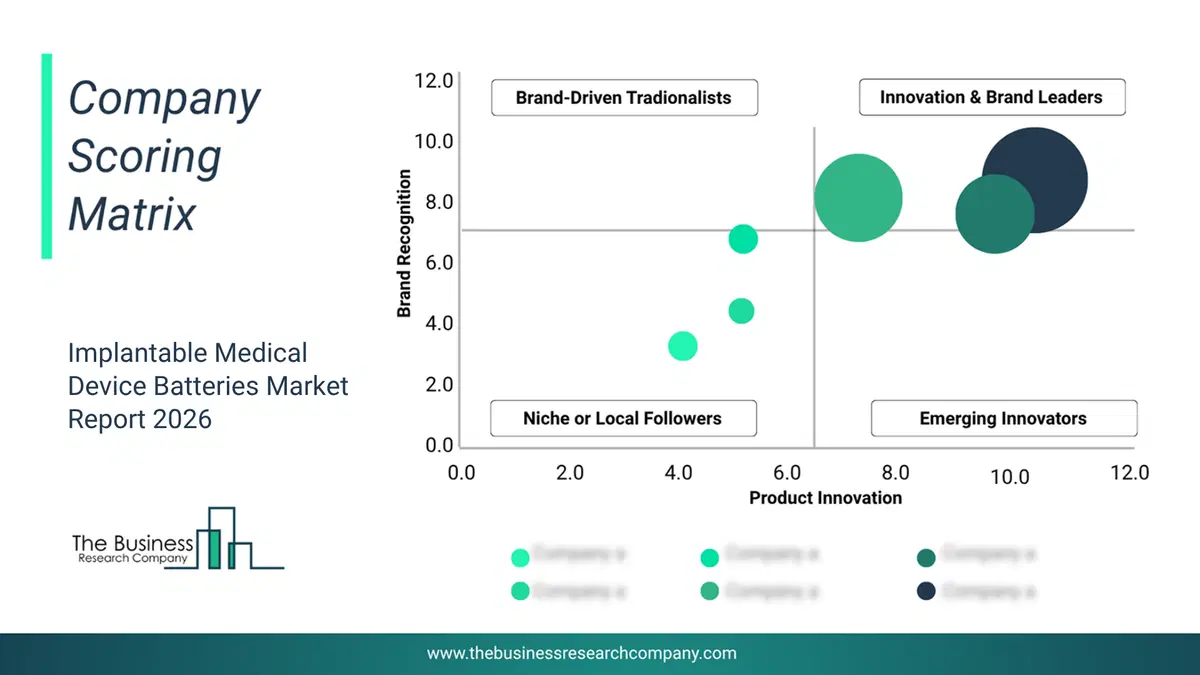
This chart maps companies by product innovation and brand strength, with bubble size indicating relative revenue, helping identify market leaders, challengers, and niche players. This is an illustrative chart; the full report provides a complete and accurate competitive analysis.
Global Implantable Medical Device Batteries Market Trends and Insights
Major companies operating in the implantable medical device batteries market are focusing on developing advanced medical battery solutions, such as high-pulse medical-grade batteries, to enhance power reliability, operational longevity, and performance in critical medical devices. High-pulse medical-grade batteries refer to specialized batteries engineered to deliver stable, high-rate power pulses while maintaining reliable performance under demanding environmental conditions and supporting the power requirements of medical devices. For instance, in April 2026, EVE Energy Co. Ltd., a China-based battery manufacturer, unveiled the CR123AP medical-grade battery at the China International Medical Equipment Fair (CMEF) Spring Edition. Designed as an advanced medical battery solution, the CR123AP incorporates high-pulse output technology, extended cycle life, superior rate capability, and enhanced low-temperature performance, delivering pulse output capability up to 5.92 times that of competing products at -20°C. The battery also uses a dry electrode manufacturing process to reduce carbon emissions while improving electrode conductivity and mechanical stability, supporting reliable power delivery across critical medical equipment and contributing to the broader medical battery ecosystem serving implantable devices.What Are Latest Mergers And Acquisitions In The Implantable Medical Device Batteries Market?
In January 2026, Ilika plc, a UK-based solid-state battery technology, partnered with Cirtec Medical LLC to manufacture batteries for active implantable medical devices. Through this partnership, the companies aim to accelerate the commercialization and integration of Ilika’s Stereax miniature solid-state batteries into next-generation implantable medical devices by combining Ilika’s battery technology expertise with Cirtec Medical’s medical device design, engineering, and manufacturing capabilities. Cirtec Medical LLC is a US-based medical device development and manufacturing company that provides implantable medical device solutions, including manufacturing support for miniature solid-state batteries used in implantable applications.
Regional Insights
North America was the largest region in the implantable medical device batteries market in 2025. Asia-Pacific is expected to be the fastest-growing region in the forecast period. The regions covered in this market report are Asia-Pacific, South East Asia, Western Europe, Eastern Europe, North America, South America, Middle East, Africa. The countries covered in this market report are Australia, Brazil, China, France, Germany, India, Indonesia, Japan, Taiwan, Russia, South Korea, UK, USA, Canada, Italy, Spain.What Defines the Implantable Medical Device Batteries Market?
The implantable medical device batteries consists of sales of implantable lithium-ion batteries, lithium-iodine batteries, lithium silver vanadium oxide batteries, lithium carbon monofluoride batteries, rechargeable implantable batteries, and primary implantable batteries. Values in this market are ‘factory gate’ values, that is the value of goods sold by the manufacturers or creators of the goods, whether to other entities (including downstream manufacturers, wholesalers, distributors and retailers) or directly to end customers. The value of goods in this market includes related services sold by the creators of the goods.How is Market Value Defined and Measured?
The market value is defined as the revenues that enterprises gain from the sale of goods and/or services within the specified market and geography through sales, grants, or donations in terms of the currency (in USD unless otherwise specified). The revenues for a specified geography are consumption values that are revenues generated by organizations in the specified geography within the market, irrespective of where they are produced. It does not include revenues from resales along the supply chain, either further along the supply chain or as part of other products.
This chart presents market attractiveness based on a quantitative evaluation of growth, competition, strategic alignment, and risk, offering a clear view of opportunity areas for decision-making. This chart is for illustrative purposes; the full report contains the complete analysis.

This chart highlights the Total Addressable Market (TAM) by estimating the maximum revenue opportunity using an assumption-driven approach, supporting strategic planning and opportunity sizing across markets. The chart is illustrative; the full report provides a more comprehensive analysis.
What Key Data and Analysis Are Included in the Implantable Medical Device Batteries Market Report 2026?
The implantable medical device batteries market research report is one of a series of new reports from The Business Research Company that provides market statistics, including industry global market size, regional shares, competitors with the market share, detailed market segments, market trends and opportunities, and any further data you may need to thrive in the implantable medical device batteries industry. The market research report delivers a complete perspective of everything you need, with an in-depth analysis of the current and future state of the industry.Implantable Medical Device Batteries Market Report Forecast Analysis
| Report Attribute | Details |
|---|---|
| Market Size Value In 2026 | $1.21 billion |
| Revenue Forecast In 2030 | $1.6 billion |
| Growth Rate | CAGR of 7.3% from 2026 to 2030 |
| Base Year For Estimation | 2025 |
| Actual Estimates/Historical Data | 2020-2025 |
| Forecast Period | 2026 - 2030 |
| Market Representation | Revenue in USD Billion and CAGR from 2026 to 2030 |
| Segments Covered | Battery Chemistry, Battery Type, Packaging, Application, End User |
| Regional Scope | Asia-Pacific, Western Europe, Eastern Europe, North America, South America, Middle East, Africa |
| Country Scope | The countries covered in the report are Australia, Brazil, China, France, Germany, India, Indonesia, Japan, Taiwan, Russia, South Korea, UK, USA, Canada, Italy, Spain. |
| Key Companies Profiled | Medtronic plc, Abbott Laboratories, Boston Scientific Corporation, MicroPort Scientific Corporation, BIOTRONIK SE & Co. KG, LivaNova PLC, Inspire Medical Systems Inc., Cochlear Limited, Mainstay Medical Holdings plc, EnerSys, Resonetics LLC, EVE Energy Co. Ltd., Maxell Ltd., Wyon AG, Ilika plc, Ensurge Micropower ASA, Cymbet Corporation, Excellatron Solid State LLC, InjectPower S.r.l., Integer Holdings Corporation |
| Customization Scope | Request for Customization |
| Pricing And Purchase Options | Explore Purchase Options |