
Implantable Neuromodulation And Spinal Cord Stimulation Devices Market Report 2026
Global Outlook – By Device Type (Spinal Cord Stimulators, Deep Brain Stimulators, Sacral Neuromodulation Devices, Peripheral Nerve Stimulators, Vagus Nerve Stimulators), By Technology (Closed Loop Adaptive Systems, Rechargeable Implantable Pulse Generators, Non Rechargeable Implantable Pulse Generators, Wireless And Remote Programmable Systems), By Application (Chronic Pain Management, Parkinson’s And Movement Disorders, Spinal Cord Injury And Paralysis Restoration, Bladder And Bowel Dysfunction, Epilepsy And Neurological Disorders), By End User (Hospitals And Multispecialty Centers, Ambulatory Surgical Centers, Specialty Pain Clinics, Neurology And Neurosurgery Clinics, Rehabilitation Centers And Long Term Care Facilities, Research And Academic Medical Centers) – Market Size, Trends, Strategies, and Forecast to 2030
Implantable Neuromodulation And Spinal Cord Stimulation Devices Market Overview
• Implantable Neuromodulation And Spinal Cord Stimulation Devices market size has reached to $9.31 billion in 2025 • Expected to grow to $16.96 billion in 2030 at a compound annual growth rate (CAGR) of 12.6% • Growth Driver: Rising Prevalence Of Neurological Disorders Driving Growth In The Market Due To Increasing Diabetes-Related Nerve Damage • Market Trend: Advancements In Adaptive Real-Time Neuromodulation Technologies For Personalized Chronic Pain Management • North America was the largest region in 2025 and Asia-Pacific is the fastest growing region.What Is Covered Under Implantable Neuromodulation And Spinal Cord Stimulation Devices Market?
Implantable neuromodulation and spinal cord stimulation devices are implantable medical devices designed to deliver controlled electrical impulses to targeted nerves or the spinal cord to modulate nerve signaling activity. These devices use programmable stimulation technology and implantable pulse generators to provide precise and long-term neuromodulation within the body. The main device types of implantable neuromodulation and spinal cord stimulation devices include spinal cord stimulators, deep brain stimulators, sacral neuromodulation devices, peripheral nerve stimulators, and vagus nerve stimulators. Spinal cord stimulators refer to implantable medical devices that deliver electrical impulses to the spinal cord to modulate pain signals and manage chronic neurological conditions. These devices use technologies such as closed loop adaptive systems, rechargeable implantable pulse generators, non rechargeable implantable pulse generators, and wireless and remote programmable systems. The various applications involved are chronic pain management, Parkinson’s and movement disorders, spinal cord injury and paralysis restoration, bladder and bowel dysfunction, and epilepsy and neurological disorders and they are utilized by end users including hospitals and multispecialty centers, ambulatory surgical centers, specialty pain clinics, neurology and neurosurgery clinics, rehabilitation centers and long term care facilities, and research and academic medical centers.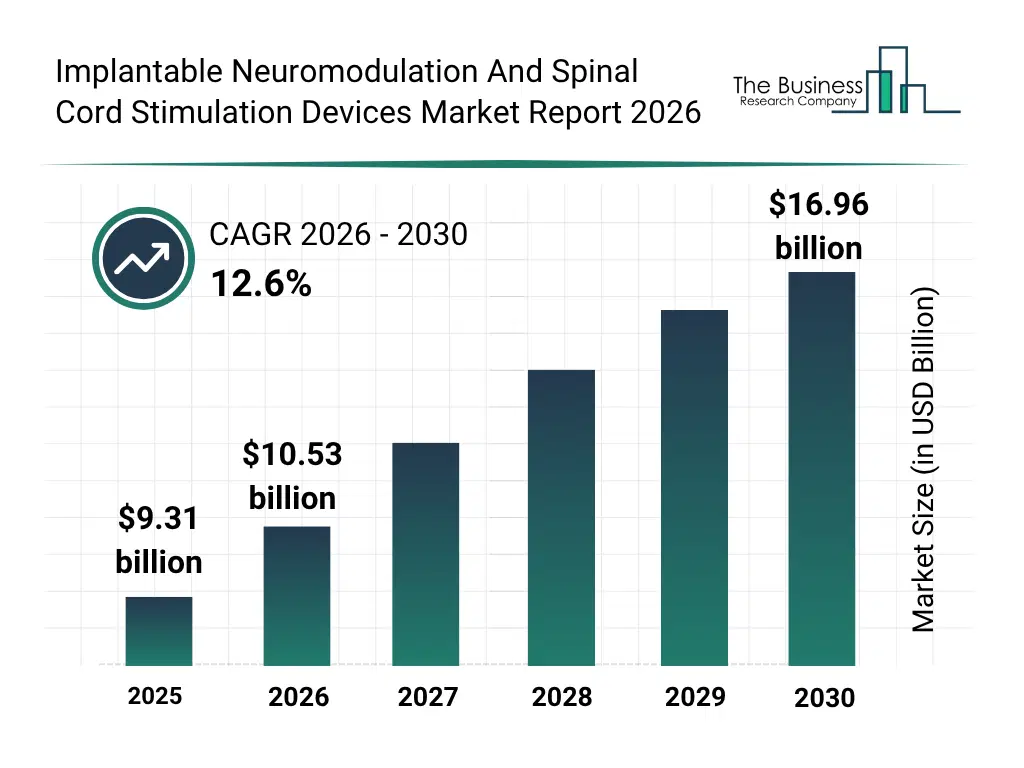
What Is The Implantable Neuromodulation And Spinal Cord Stimulation Devices Market Size and Share 2026?
The implantable neuromodulation and spinal cord stimulation devices market size has grown rapidly in recent years. It will grow from $9.31 billion in 2025 to $10.53 billion in 2026 at a compound annual growth rate (CAGR) of 13.1%. The growth in the historic period can be attributed to growth in chronic pain prevalence worldwide, increasing adoption of spinal cord stimulation for pain management, expansion of neurology treatment infrastructure, rising acceptance of implantable medical devices, early advancements in implantable pulse generator technology.What Is The Implantable Neuromodulation And Spinal Cord Stimulation Devices Market Growth Forecast?
The implantable neuromodulation and spinal cord stimulation devices market size is expected to see rapid growth in the next few years. It will grow to $16.96 billion in 2030 at a compound annual growth rate (CAGR) of 12.6%. The growth in the forecast period can be attributed to integration of ai-driven adaptive neuromodulation systems, increasing demand for minimally invasive neurological therapies, growth in personalized and precision neurology treatments, rising adoption of wireless implantable medical devices, advancement in closed-loop neurostimulation technologies. Major trends in the forecast period include rising adoption of closed loop adaptive neuromodulation systems for real time pain management optimization, increasing demand for rechargeable implantable pulse generators to reduce surgical replacement procedures, growing use of spinal cord stimulation devices for chronic pain and neuropathic conditions, expansion of wireless and remotely programmable neuromodulation devices for personalized therapy delivery, rising integration of sacral neuromodulation devices for bladder and bowel dysfunction treatments.
Global Implantable Neuromodulation And Spinal Cord Stimulation Devices Market Segmentation
1) By Device Type: Spinal Cord Stimulators; Deep Brain Stimulators; Sacral Neuromodulation Devices; Peripheral Nerve Stimulators; Vagus Nerve Stimulators 2) By Technology: Closed Loop Adaptive Systems; Rechargeable Implantable Pulse Generators; Non Rechargeable Implantable Pulse Generators; Wireless And Remote Programmable Systems 3) By Application: Chronic Pain Management; Parkinson’s And Movement Disorders; Spinal Cord Injury And Paralysis Restoration; Bladder And Bowel Dysfunction; Epilepsy And Neurological Disorders 4) By End User: Hospitals And Multispecialty Centers; Ambulatory Surgical Centers; Specialty Pain Clinics; Neurology And Neurosurgery Clinics; Rehabilitation Centers And Long Term Care Facilities; Research And Academic Medical Centers Subsegments: 1) By Spinal Cord Stimulators: Rechargeable Spinal Cord Stimulators; Non Rechargeable Spinal Cord Stimulators; Conventional Spinal Cord Stimulators; High Frequency Spinal Cord Stimulators; Burst Stimulation Spinal Cord Stimulators; Closed Loop Spinal Cord Stimulators 2) By Deep Brain Stimulators: Single Channel Deep Brain Stimulators; Dual Channel Deep Brain Stimulators; Rechargeable Deep Brain Stimulators; Non Rechargeable Deep Brain Stimulators; Constant Current Deep Brain Stimulators; Constant Voltage Deep Brain Stimulators 3) By Sacral Neuromodulation Devices: Implantable Sacral Neuromodulation Devices; Rechargeable Sacral Neuromodulation Devices; Non Rechargeable Sacral Neuromodulation Devices; Wireless Sacral Neuromodulation Devices; Percutaneous Sacral Neuromodulation Devices 4) By Peripheral Nerve Stimulators: Implantable Peripheral Nerve Stimulators; Percutaneous Peripheral Nerve Stimulators; Wireless Peripheral Nerve Stimulators; Rechargeable Peripheral Nerve Stimulators; Non Rechargeable Peripheral Nerve Stimulators; Temporary Peripheral Nerve Stimulators 5) By Vagus Nerve Stimulators: Implantable Vagus Nerve Stimulators; External Vagus Nerve Stimulators; Rechargeable Vagus Nerve Stimulators; Non Rechargeable Vagus Nerve Stimulators; Closed Loop Vagus Nerve Stimulators; Open Loop Vagus Nerve StimulatorsWhat Are The Drivers Of The Implantable Neuromodulation And Spinal Cord Stimulation Devices Market?
The growing incidence of neurological disorders is expected to propel the growth of the implantable neuromodulation and spinal cord stimulation devices market going forward. Neurological disorders are diseases of the nervous system that impair the functioning of the brain, spinal cord, or peripheral nerves, leading to physical, cognitive, or behavioral abnormalities. Neurological disorders are increasing due to the rising prevalence of diabetes, as prolonged high blood sugar levels can damage nerves and blood vessels, increasing the risk of neurological conditions such as neuropathy, stroke, and cognitive impairment. Implantable neuromodulation and spinal cord stimulation devices help manage neurological disorders by delivering controlled electrical impulses to specific nerves or areas of the spinal cord and brain, helping reduce chronic pain, restore nerve signaling, and improve symptoms associated with conditions such as Parkinson’s disease, epilepsy, and spinal cord injuries. For instance, in December 2025, according to the Australian Institute of Health and Welfare, an Australia-based government agency, in 2024, approximately 425,000 Australians were living with dementia (a type of neurological disorder), and this number is projected to increase 2.5 times to over 1.1 million by 2065, including around 662,000 women and 390,000 men. Therefore, the growing incidence of neurological disorders is driving the growth of the implantable neuromodulation and spinal cord stimulation devices industry. The increasing healthcare expenditure is expected to propel the growth of the implantable neuromodulation and spinal cord stimulation devices market going forward. Healthcare expenditure is the total spending by governments, organizations, and individuals on medical services, healthcare products, and activities aimed at maintaining or improving health. Healthcare expenditure is increasing due to advancements in medical technology, as the adoption of innovative diagnostic tools, robotic surgeries, and advanced treatment procedures improves patient care but also raises the overall cost of healthcare services. Increasing healthcare expenditure supports the growth of the implantable neuromodulation and spinal cord stimulation devices by enabling greater investment in advanced pain management technologies, improving patient access to implantable therapies, and expanding healthcare infrastructure for specialized neurological treatments. For instance, in April 2025, according to the Office for National Statistics, a UK-based independent producer of official statistics, in 2024, the UK’s healthcare spending reached around $ 370.71 billion (£317 billion), reflecting a 6.5% nominal increase compared with 2023. Therefore, the increasing healthcare expenditure is driving the growth of the implantable neuromodulation and spinal cord stimulation devices industry.Key Players In The Global Implantable Neuromodulation And Spinal Cord Stimulation Devices Market
Major companies operating in the implantable neuromodulation and spinal cord stimulation devices market are Medtronic plc; Abbott Laboratories; Boston Scientific Corporation; LivaNova PLC; Nevro Corp.; NeuroPace Inc.; Saluda Medical Pty Ltd.; Mainstay Medical Holdings plc; Integer Holdings Corporation; Biotronik SE & Co. KG; Cirtec Medical Corporation; Neuspera Medical Inc.; ONWARD Medical; Neuros Medical; Synchron; Synapse Biomedical Inc.; CorTec GmbH; Aleva Neurotherapeutics SA; Gimer Medical Co. Ltd.; SceneRay Corporation; Nexstim PlcGlobal Implantable Neuromodulation And Spinal Cord Stimulation Devices Market Trends and Insights
Major companies operating in the implantable neuromodulation and spinal cord stimulation devices market are focusing on developing innovative solutions such as closed-loop, rechargeable spinal cord stimulators to provide personalized pain management, enhance therapy effectiveness, and improve patient comfort through adaptive real-time stimulation. A closed-loop rechargeable spinal cord stimulator is an implantable device that automatically modifies electrical nerve stimulation in real time to maintain consistent pain relief and operates with a rechargeable battery for extended use. For instance, in April 2024, Medtronic, an Ireland-based medical device company, launched Inceptiv, a closed-loop rechargeable spinal cord stimulator (SCS). The product received approval from the Food and Drug Administration (FDA) for the treatment of chronic pain in the trunk and/or limbs, including unilateral or bilateral pain. The device detects evoked compound action potentials (ECAPs) or similar biological signals along the spinal cord and utilizes them as a real-time biomarker of dorsal column activation.Regional Outlook
North America was the largest region in the implantable neuromodulation and spinal cord stimulation devices market in 2025. Asia-Pacific is expected to be the fastest-growing region in the forecast period. The regions covered in this market report are Asia-Pacific, South East Asia, Western Europe, Eastern Europe, North America, South America, Middle East, Africa. The countries covered in this market report are Australia, Brazil, China, France, Germany, India, Indonesia, Japan, Taiwan, Russia, South Korea, UK, USA, Canada, Italy, Spain.What Defines the Implantable Neuromodulation And Spinal Cord Stimulation Devices Market?
The implantable neuromodulation and spinal cord stimulation devices market consists of sales of dorsal root ganglion stimulation devices, gastric electrical stimulation devices, and hypoglossal nerve stimulation devices. Values in this market are ‘factory gate’ values, that is, the value of goods sold by the manufacturers or creators of the goods, whether to other entities (including downstream manufacturers, wholesalers, distributors and retailers) or directly to end customers. The value of goods in this market includes related services sold by the creators of the goods.How is Market Value Defined and Measured?
The market value is defined as the revenues that enterprises gain from the sale of goods and/or services within the specified market and geography through sales, grants, or donations in terms of the currency (in USD unless otherwise specified). The revenues for a specified geography are consumption values that are revenues generated by organizations in the specified geography within the market, irrespective of where they are produced. It does not include revenues from resales along the supply chain, either further along the supply chain or as part of other products.What Key Data and Analysis Are Included in the Implantable Neuromodulation And Spinal Cord Stimulation Devices Market Report 2026?
The implantable neuromodulation and spinal cord stimulation devices market research report is one of a series of new reports from The Business Research Company that provides market statistics, including industry global market size, regional shares, competitors with the market share, detailed market segments, market trends and opportunities, and any further data you may need to thrive in the implantable neuromodulation and spinal cord stimulation devices industry. The market research report delivers a complete perspective of everything you need, with an in-depth analysis of the current and future state of the industry.Implantable Neuromodulation And Spinal Cord Stimulation Devices Market Report Forecast Analysis
| Report Attribute | Details |
|---|---|
| Market Size Value In 2026 | $10.53 billion |
| Revenue Forecast In 2030 | $16.96 billion |
| Growth Rate | CAGR of 12.6% from 2026 to 2030 |
| Base Year For Estimation | 2025 |
| Actual Estimates/Historical Data | 2020-2025 |
| Forecast Period | 2026 - 2030 |
| Market Representation | Revenue in USD Billion and CAGR from 2026 to 2030 |
| Segments Covered | Device Type, Technology, Application, End User |
| Regional Scope | Asia-Pacific, Western Europe, Eastern Europe, North America, South America, Middle East, Africa |
| Country Scope | The countries covered in the report are Australia, Brazil, China, France, Germany, India, ... |
| Key Companies Profiled | Medtronic plc; Abbott Laboratories; Boston Scientific Corporation; LivaNova PLC; Nevro Corp.; NeuroPace Inc.; Saluda Medical Pty Ltd.; Mainstay Medical Holdings plc; Integer Holdings Corporation; Biotronik SE & Co. KG; Cirtec Medical Corporation; Neuspera Medical Inc.; ONWARD Medical; Neuros Medical; Synchron; Synapse Biomedical Inc.; CorTec GmbH; Aleva Neurotherapeutics SA; Gimer Medical Co. Ltd.; SceneRay Corporation; Nexstim Plc |
| Customization Scope | Request for Customization |
| Pricing And Purchase Options | Explore Purchase Options |