
In-Situ Resource Utilization (ISRU) Market Report 2026
Global Outlook – By Product (Resource, Technology), By Application (Space Exploration, Lunar Missions, Planetary Missions, Asteroid Mining, Other Applications), By End-User (Government Space Agencies, Commercial Space Companies, Research Institutions) – Market Size, Trends, Strategies, and Forecast to 2030
In-Situ Resource Utilization (ISRU) Market Overview
• In-Situ Resource Utilization (ISRU) market size has reached to $2.18 billion in 2025 • Expected to grow to $5.25 billion in 2030 at a compound annual growth rate (CAGR) of 19.1% • Growth Driver: Increasing Investments In Space Exploration Driving The Market Growth Due To Rising Demand For Sustainable Deep-Space Missions • Market Trend: Advancements In Cryogenic Propulsion Boost Efficiency And Payload Capacity • North America was the largest region in 2025 and Asia-Pacific is the fastest growing region.What Is Covered Under In-Situ Resource Utilization (ISRU) Market?
In-situ resource utilization (ISRU) refers to the process of identifying, extracting, processing, and converting locally available resources in extraterrestrial environments into usable materials and consumables, thereby reducing reliance on supplies transported from Earth and enabling more sustainable and efficient space exploration and habitation. Its application is critical for supporting long-duration missions, lowering logistical costs, and advancing the long-term viability of human and robotic presence beyond Earth. The main product types of in-situ resource utilization (ISRU) are resources and technologies. Resources refer to materials obtained from celestial bodies, such as soil, gases, and metals, which are used on-site to support space missions and minimize dependence on Earth. They are applied in various areas, including space exploration, lunar missions, planetary missions, asteroid mining, and other applications. The end-users include government space agencies, commercial space companies, and research institutions.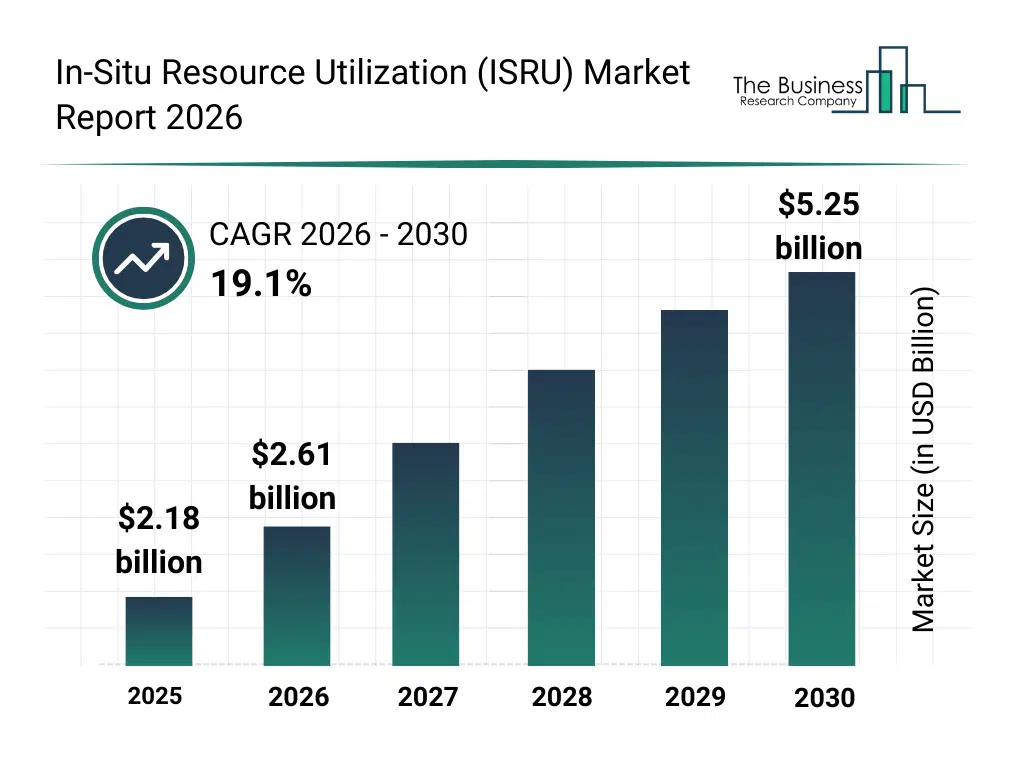
What Is The In-Situ Resource Utilization (ISRU) Market Size and Share 2026?
The in-situ resource utilization (isru) market size has grown rapidly in recent years. It will grow from $2.18 billion in 2025 to $2.61 billion in 2026 at a compound annual growth rate (CAGR) of 19.7%. The growth in the historic period can be attributed to advancements in spaceborne resource extraction and processing technologies, increasing focus on sustainable long-duration space missions, development of in-orbit propellant and oxygen production systems, growing investments in robotic and automated ISRU equipment, rising interest from space agencies in reducing dependence on earth-supplied consumables.What Is The In-Situ Resource Utilization (ISRU) Market Growth Forecast?
The in-situ resource utilization (isru) market size is expected to see rapid growth in the next few years. It will grow to $5.25 billion in 2030 at a compound annual growth rate (CAGR) of 19.1%. The growth in the forecast period can be attributed to expansion of commercial lunar and planetary exploration missions, adoption of advanced autonomous ISRU systems for mining and processing, integration of in-situ manufactured metals and materials for on-site construction, increasing investment in remote monitoring and operation services for ISRU, collaborations between space agencies and private companies for sustainable extraterrestrial resource utilization. Major trends in the forecast period include development of advanced water extraction and oxygen production systems, robotics-enabled mining and material processing in extraterrestrial environments, automation of fuel generation and storage systems for long-duration missions, integration of additive manufacturing for on-site construction and part fabrication, deployment of sensor networks and monitoring systems for resource mapping and utilization.
Global In-Situ Resource Utilization (ISRU) Market Segmentation
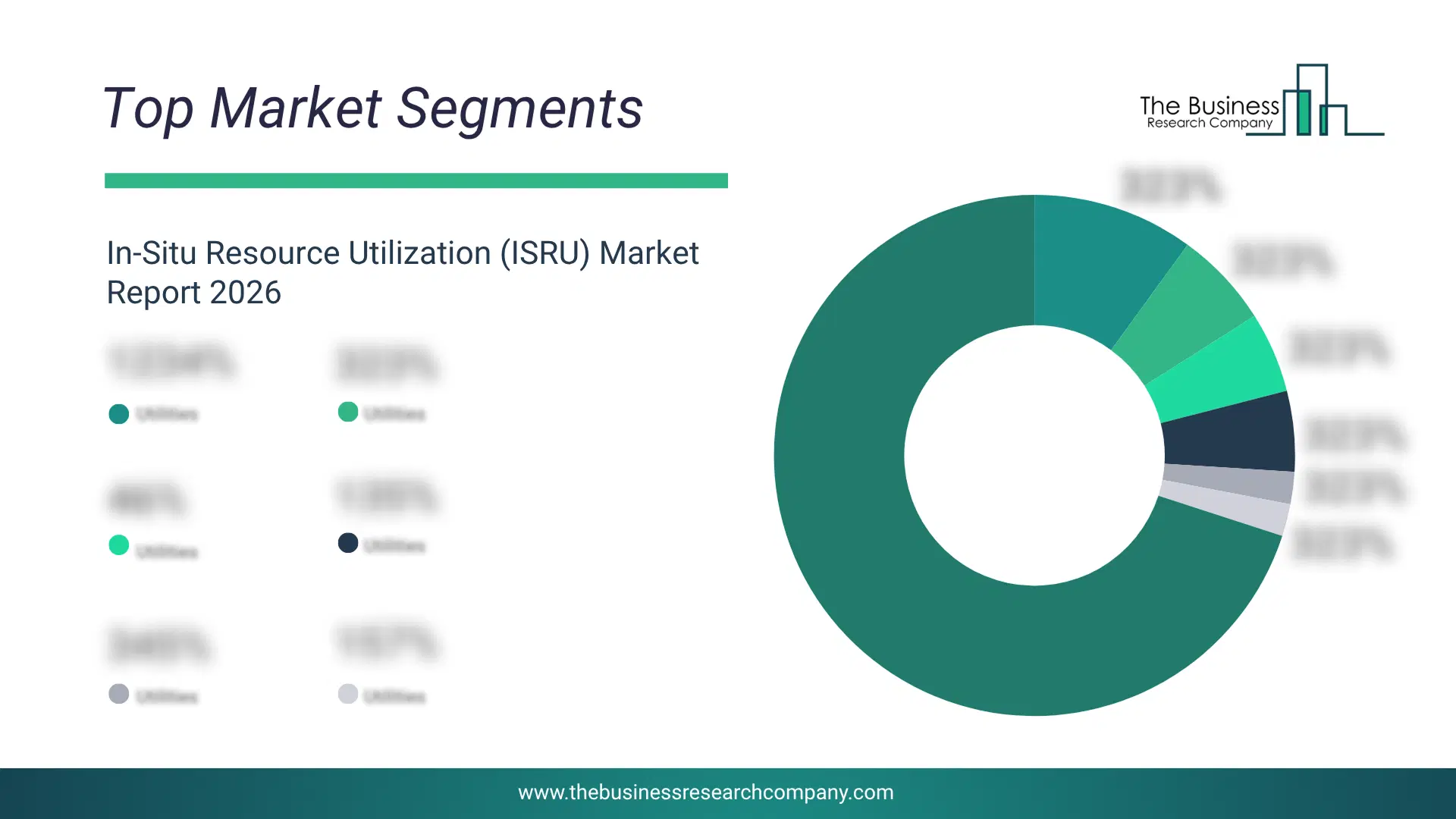
1) By Product: Resource, Technology 2) By Application: Space Exploration, Lunar Missions, Planetary Missions, Asteroid Mining, Other Applications 3) By End-User: Government Space Agencies, Commercial Space Companies, Research Institutions Subsegments: 1) By Resource: Water Extraction, Oxygen Production, Fuel Generation, Soil Analysis, Mineral Processing 2) By Technology: Additive Manufacturing, Robotics, Automation Systems, Sensors, Power SystemsWhat Is Driver Of The In-Situ Resource Utilization (ISRU) Market?
The increasing investments in space exploration are expected to propel the growth of the in-situ resource utilization (ISRU) market going forward. Space exploration refers to the investigation and study of outer space through the use of astronomy, satellites, spacecraft, and human missions beyond earth. Rising investments in space exploration are primarily due to the pursuit of economic gains, as nations and private companies aim to profit from ventures such as satellite markets, space tourism, asteroid mining, and the commercialization of new space technologies. Rising investments in space exploration accelerate the development of in-situ resource utilization (ISRU) technologies by funding research and infrastructure that enable the extraction and use of local resources such as lunar ice and martian soil for fuel, water, and construction. For instance, in June 2024, according to the Ministry of Foreign Affairs and Trade, a New Zealand-based government department, the UK has pledged to invest about USD 12.5 billion (£10 billion) in space programs over a ten-year span starting in 2023, with roughly USD 3.75 billion (£3 billion) allocated specifically in the 2023 spending review. Therefore, the increasing investments in space exploration are driving the growth of the in-situ resource utilization (ISRU) industry.Key Players In The Global In-Situ Resource Utilization (ISRU) Market
Major companies operating in the in-situ resource utilization (isru) market are Airbus SE, Northrop Grumman Corporation, Space Exploration Technologies Corp., Blue Origin L.P., Hanwha Systems Co. Ltd., Sierra Nevada Corporation, European Space Agency, China National Space Administration, Fleet Space Technologies Pty Ltd., Honeybee Robotics Ltd., Astrobotic Technology Inc., Paragon Space Development Corporation, Astronika Sp. z o.o., OffWorld Inc., ispace Inc., Masten Space Systems Inc., Lunar Resources Company, TransAstra Corporation, Maana Electric S.A., High Frontier Mining Corporation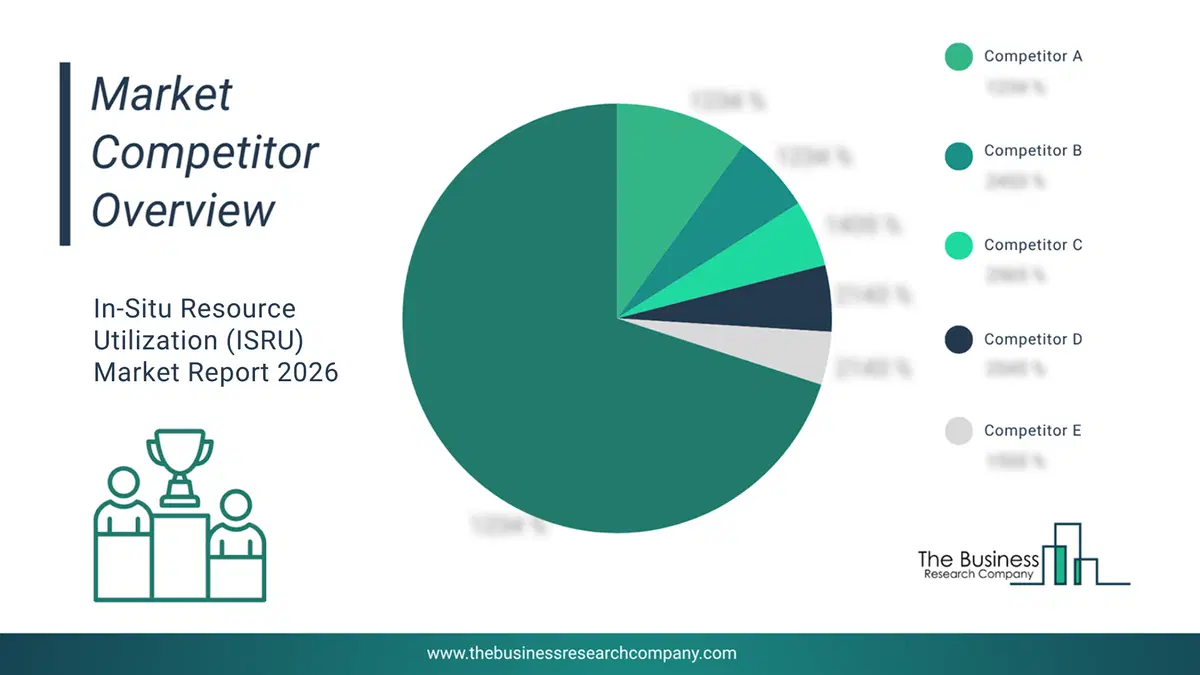
This chart is for illustrative purposes; the full report includes a detailed competitor analysis and comprehensive overview of the top 10 companies in the market.
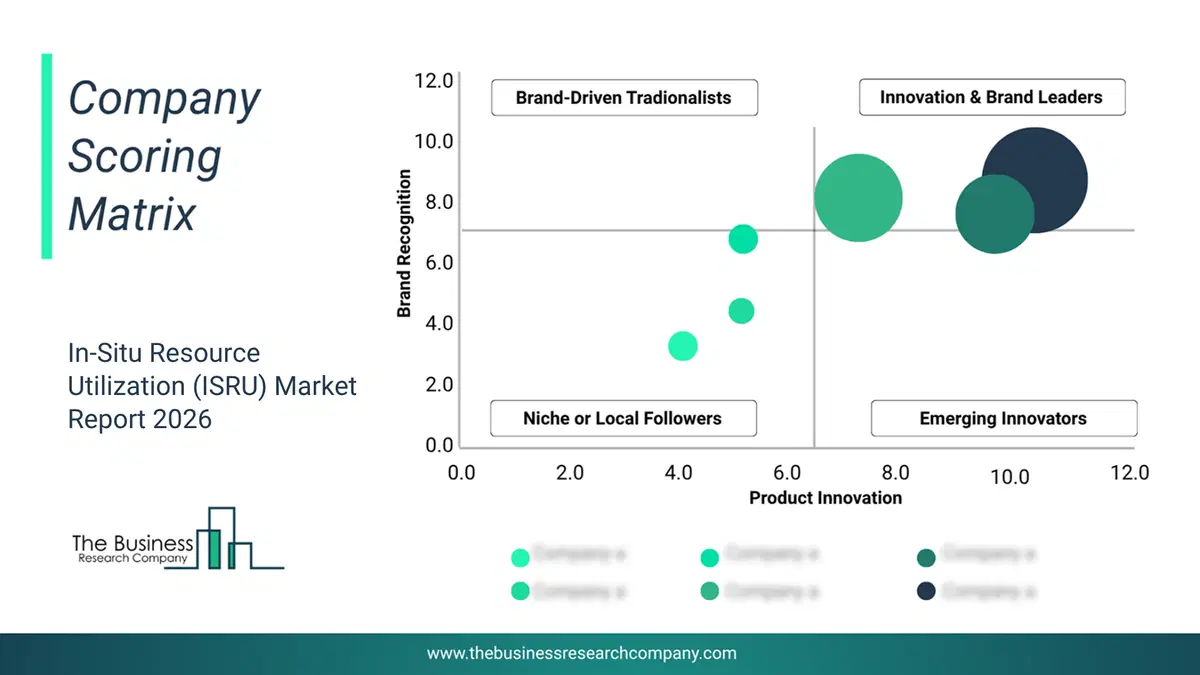
This chart maps companies by product innovation and brand strength, with bubble size indicating relative revenue, helping identify market leaders, challengers, and niche players. This is an illustrative chart; the full report provides a complete and accurate competitive analysis.
Global In-Situ Resource Utilization (ISRU) Market Trends and Insights
Major companies operating in the in-situ resource utilization (ISRU) market are focusing on advanced technologies, such as water electrolyzers, to extract and convert lunar or Martian water into hydrogen and oxygen for fuel, life support, and other mission-critical resources. Water electrolyzers are devices that use electricity to split water into hydrogen and oxygen gases for fuel, energy storage, or life-support applications. For instance, in January 2025, SpaceX, a US-based aerospace manufacturer and space transport company, launched Hakuto-R Mission 2 carrying a payload described as a “water electrolyzer,” designed to process lunar water into hydrogen and oxygen designed by ispace, Inc., a Japan-based lunar exploration company. With this launch, the aim is to demonstrate in-situ resource utilization (ISRU) technology by converting lunar resources into usable materials for future fuel and life-support systems.What Are Latest Mergers And Acquisitions In The In-Situ Resource Utilization (ISRU) Market? NASA Partners With Blue Origin To Harness Lunar Resources For Sustainable Power
In July 2023, the National Aeronautics and Space Administration (NASA), a US-based government agency, partnered with Blue Origin to develop an autonomous system that turns lunar regolith into solar power, power transmission cables, and oxygen. With this partnership, NASA and Blue Origin aim to develop and demonstrate Blue Alchemist, an autonomous system that converts lunar regolith into solar-power systems, power transmission cables, and oxygen, enabling sustainable, in-situ resource utilization on the Moon. Blue Origin Enterprises L.P. is a US-based space technology company that specializes in providing reusable rocket launch systems, spacecraft, and advanced technologies for space exploration and commercial spaceflight.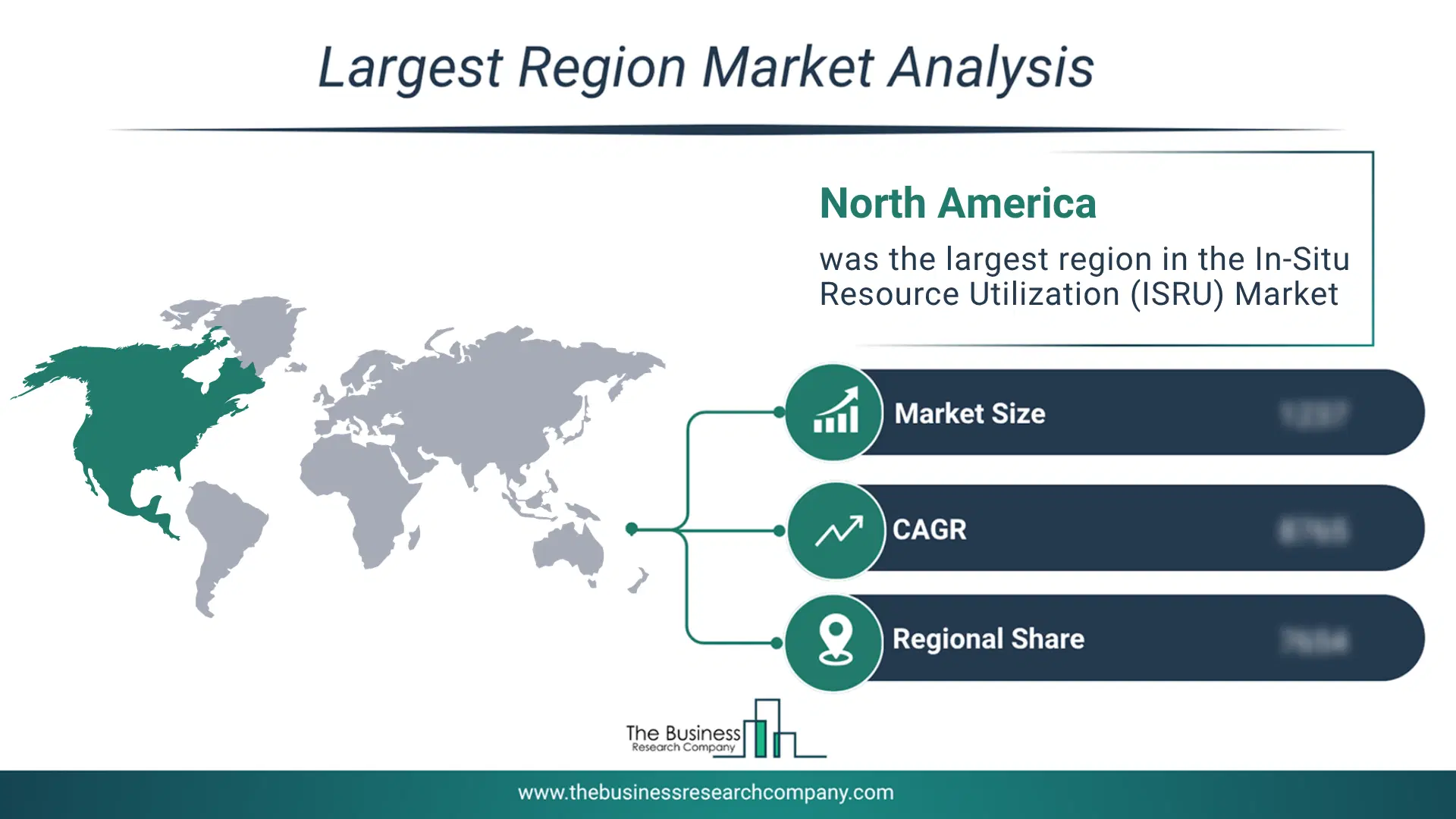
Regional Insights
North America was the largest region in the in-situ resource utilization (ISRU) market in 2025. Asia-Pacific is expected to be the fastest-growing region in the forecast period. The regions covered in this market report are Asia-Pacific, South East Asia, Western Europe, Eastern Europe, North America, South America, Middle East, Africa. The countries covered in this market report are Australia, Brazil, China, France, Germany, India, Indonesia, Japan, Taiwan, Russia, South Korea, UK, USA, Canada, Italy, SpainWhat Defines the In-Situ Resource Utilization (ISRU) Market?
The in-situ resource utilization (ISRU) market consists of revenues earned by entities by providing services such as mission planning and simulation services, remote monitoring and operation of ISRU equipment, maintenance and repair services for spaceborne machinery, logistics and transportation support for ISRU deployment, and consulting on sustainable space resource utilization. The market value includes the value of related goods sold by the service provider or included within the service offering. The in-situ resource utilization (ISRU) market also includes sales of propellants and fuels, oxygen and consumables, metals and minerals for manufacturing, spare parts and hardware fabricated. Values in this market are ‘factory gate’ values, that is, the value of goods sold by the manufacturers or creators of the goods, whether to other entities (including downstream manufacturers, wholesalers, distributors, and retailers) or directly to end customers. The value of goods in this market includes related services sold by the creators of the goods.How is Market Value Defined and Measured?
The market value is defined as the revenues that enterprises gain from the sale of goods and/or services within the specified market and geography through sales, grants, or donations in terms of the currency (in USD unless otherwise specified). The revenues for a specified geography are consumption values that are revenues generated by organizations in the specified geography within the market, irrespective of where they are produced. It does not include revenues from resales along the supply chain, either further along the supply chain or as part of other products.
This chart presents market attractiveness based on a quantitative evaluation of growth, competition, strategic alignment, and risk, offering a clear view of opportunity areas for decision-making. This chart is for illustrative purposes; the full report contains the complete analysis.

This chart highlights the Total Addressable Market (TAM) by estimating the maximum revenue opportunity using an assumption-driven approach, supporting strategic planning and opportunity sizing across markets. The chart is illustrative; the full report provides a more comprehensive analysis.
What Key Data and Analysis Are Included in the In-Situ Resource Utilization (ISRU) Market Report 2026?
The in-situ resource utilization (isru) market research report is one of a series of new reports from The Business Research Company that provides market statistics, including industry global market size, regional shares, competitors with the market share, detailed market segments, market trends and opportunities, and any further data you may need to thrive in the in-situ resource utilization (isru) industry. The market research report delivers a complete perspective of everything you need, with an in-depth analysis of the current and future state of the industry.In-Situ Resource Utilization (ISRU) Market Report Forecast Analysis
| Report Attribute | Details |
|---|---|
| Market Size Value In 2026 | $2.61 billion |
| Revenue Forecast In 2030 | $5.25 billion |
| Growth Rate | CAGR of 19.1% from 2026 to 2030 |
| Base Year For Estimation | 2025 |
| Actual Estimates/Historical Data | 2020-2025 |
| Forecast Period | 2026 - 2030 |
| Market Representation | Revenue in USD Billion and CAGR from 2026 to 2030 |
| Segments Covered | Product, Application, End-User |
| Regional Scope | Asia-Pacific, Western Europe, Eastern Europe, North America, South America, Middle East, Africa |
| Country Scope | The countries covered in the in-situ resource utilization (isru) market report are Australia, Brazil, China, France, Germany, India, Indonesia, Japan, Taiwan, Russia, South Korea, UK, USA, Canada, Italy, Spain |
| Key Companies Profiled | Airbus SE, Northrop Grumman Corporation, Space Exploration Technologies Corp., Blue Origin L.P., Hanwha Systems Co. Ltd., Sierra Nevada Corporation, European Space Agency, China National Space Administration, Fleet Space Technologies Pty Ltd., Honeybee Robotics Ltd., Astrobotic Technology Inc., Paragon Space Development Corporation, Astronika Sp. z o.o., OffWorld Inc., ispace Inc., Masten Space Systems Inc., Lunar Resources Company, TransAstra Corporation, Maana Electric S.A., High Frontier Mining Corporation |
| Customization Scope | Request for Customization |
| Pricing And Purchase Options | Explore Purchase Options |