
In-Space Manufacturing Market Report 2026
Global Outlook – By Product (Perovskite Photovoltaics Cell, Graphene And Solid-State Lithium Batteries, Quantum Dot Display,), By Point Of Use (Space, Terrestrial), By Material (Metals, Polymers, Ceramics, Composites), By Application (Communication Satellites, Medical Implants, Scientific Equipment, Automotive Components), By End-User (Commercial, Government And Military) – Market Size, Trends, Strategies, and Forecast to 2030
In-Space Manufacturing Market Overview
• In-Space Manufacturing market size has reached to $1.21 billion in 2025 • Expected to grow to $3.51 billion in 2030 at a compound annual growth rate (CAGR) of 23.6% • Growth Driver: Rising Satellite Deployments Fuel Growth In The In Space Manufacturing Market • Market Trend: Innovations In The In Space Manufacturing Advancing Production In Microgravity • North America was the largest region in 2025 and Asia-Pacific is the fastest growing region.What Is Covered Under In-Space Manufacturing Market?
In-space manufacturing refers to the process of producing, assembling, and repairing materials, components, or entire structures in the microgravity environment of space. In-specie manufacturing allows for producing components for spacecraft, satellites, and other space infrastructure directly in orbit, significantly reducing launch costs and logistical challenges. It is crucial for enhancing the efficiency and sustainability of space exploration, satellite deployment, and long-term missions beyond Earth. The main product types of in-space manufacturing are perovskite photovoltaics cells, graphene and solid-state lithium batteries, and quantum dot displays. Perovskite photovoltaic cells are a type of solar cell that utilizes perovskite-structured compounds to convert sunlight into electricity. The various points of use include space, and terrestrial. The multiple materials include metals, polymers, ceramics, and composites. These are used in multiple applications such as communication satellites, medical implants, scientific equipment, and automotive components and also by various end-users such as commercial, government, and military.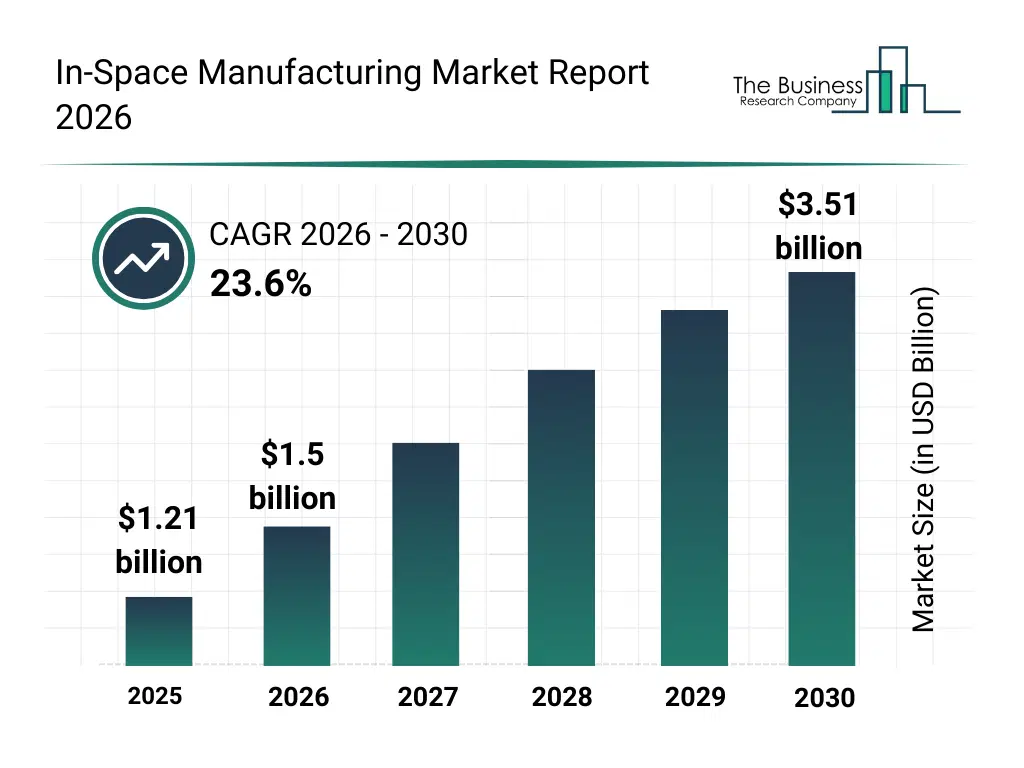
What Is The In-Space Manufacturing Market Size and Share 2026?
The in-space manufacturing market size has grown exponentially in recent years. It will grow from $1.21 billion in 2025 to $1.5 billion in 2026 at a compound annual growth rate (CAGR) of 23.7%. The growth in the historic period can be attributed to development of microgravity 3D printing technologies, early adoption of orbital satellite servicing missions, advancements in exotic metal alloy production for space applications, government funding and contracts for space manufacturing research, establishment of private companies specializing in in-space manufacturing.What Is The In-Space Manufacturing Market Growth Forecast?
The in-space manufacturing market size is expected to see exponential growth in the next few years. It will grow to $3.51 billion in 2030 at a compound annual growth rate (CAGR) of 23.6%. The growth in the forecast period can be attributed to increasing demand for on-orbit satellite assembly and repair, expansion of commercial space stations, growth in microgravity-based material research, advancements in in-space refueling infrastructure, rising investment from private and public sectors in sustainable space exploration. Major trends in the forecast period include orbital 3d printing & additive manufacturing, in-orbit satellite servicing & refueling, microgravity material innovation, modular space infrastructure assembly, space resource utilization & recycling.
Global In-Space Manufacturing Market Segmentation
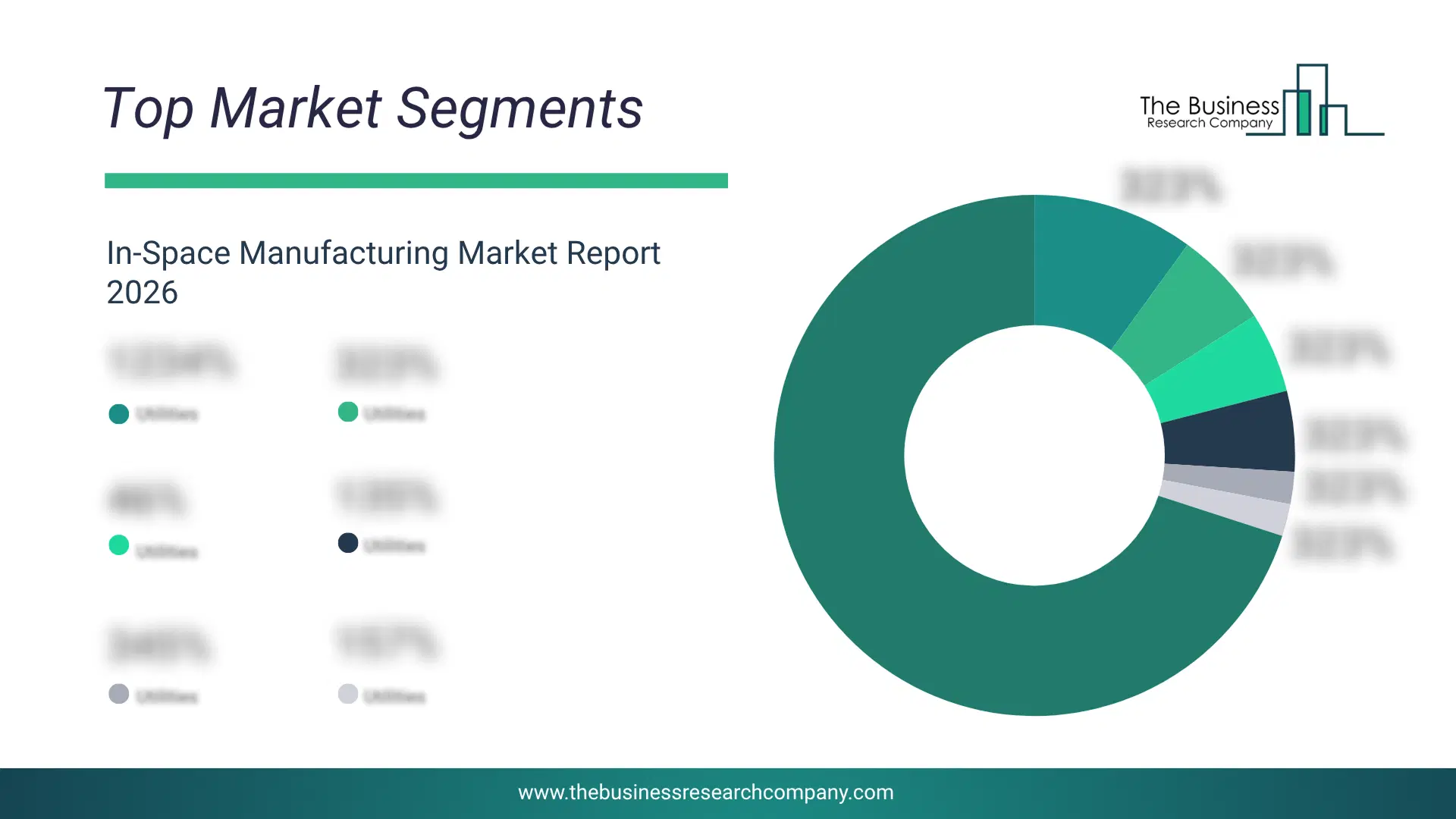
1) By Product: Perovskite Photovoltaics Cell, Graphene And Solid-State Lithium Batteries, Quantum Dot Display, 2) By Point Of Use: Space, Terrestrial 3) By Material: Metals, Polymers, Ceramics, Composites 4) By Application: Communication Satellites, Medical Implants, Scientific Equipment, Automotive Components 5) By End-User: Commercial, Government And Military Subsegments: 1) By Perovskite Photovoltaics Cell: Flexible Perovskite Solar Cells, Tandem Perovskite Solar Cells, Large-Area Perovskite Solar Modules 2) By Graphene And Solid-State Lithium Batteries: Graphene-Based Batteries, Solid-State Lithium-Ion Batteries, Hybrid Graphene-Solid-State Batteries 3) By Quantum Dot Display: Quantum Dot LED (QLED) Displays, Quantum Dot OLED Displays, Quantum Dot Solar CellsWhat Is Driver Of The In-Space Manufacturing Market?
The rising number of satellites is expected to propel the growth of the in-space manufacturing market going forward. Satellites are artificial objects that are intentionally placed into orbit around earth or other celestial bodies for communication, weather forecasting, navigation, scientific research, earth observation, and military purposes. The rising number of satellites is due to the increasing need for global communication networks, the expansion of 5G services, climate monitoring, and disaster management. In-space manufacturing is a platform for satellites to do critical tasks, such as assembling, repairing, and maintaining other satellites directly in orbit, benefiting from the microgravity environment. For instance, in April 2024, according to Slingshot Aerospace, a US-based software company that provides satellite tracking, space traffic coordination, and space modeling, there were approximately 9,241 active satellites in orbit in 2023, compared to 6,718 at the end of 2022. Therefore, the rising number of satellites drives the in-space manufacturing industry.Key Players In The Global In-Space Manufacturing Market
Major companies operating in the in-space manufacturing market are Airbus SAS, Northrop Grumman Corporation, Blue Origin LLC, Sierra Space Corp., Redwire Corporation, Axiom Space Inc., Astroscale Holdings Inc, Honeybee Robotics Ltd., Varda Space Industries Inc., Astrobotic Technology Inc., Nanoracks LLC, Orbit Fab Inc., Astra Space Inc., Xplore Inc., Le Verre Fluore Fiber Solutions, Global Graphene Group Inc., Allevi Inc., Nedstack Fuel Cell Technology B.V., Virgin Galactic Holdings Inc., Momentus Space Inc.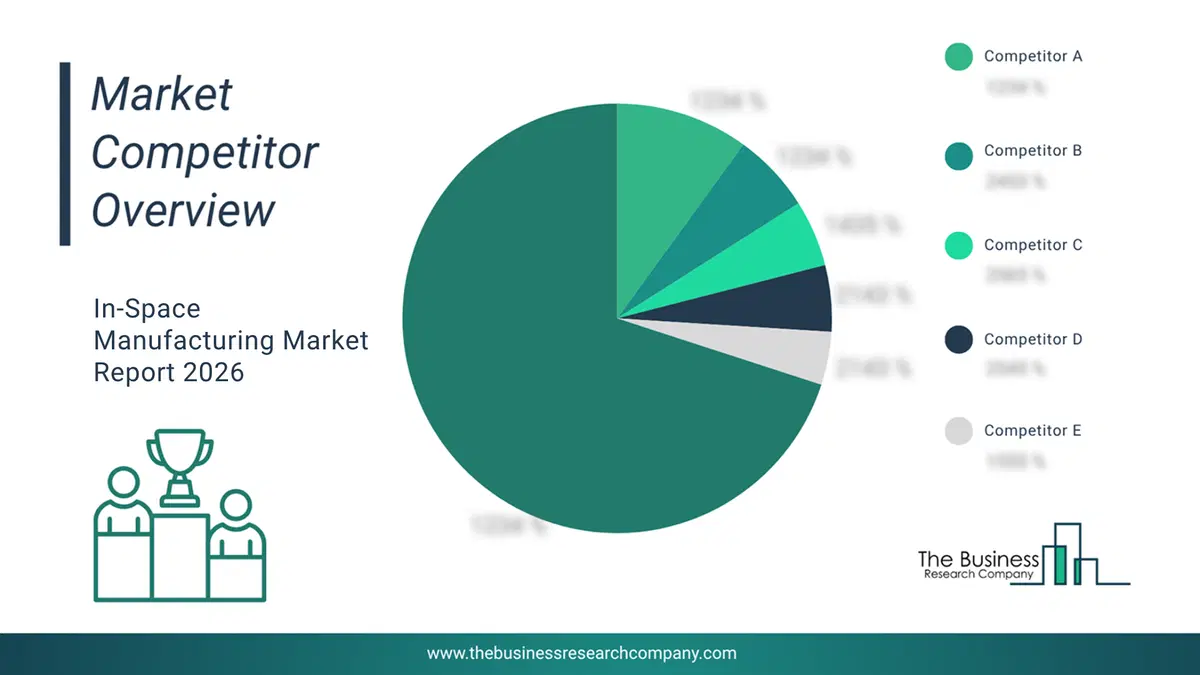
This chart is for illustrative purposes; the full report includes a detailed competitor analysis and comprehensive overview of the top 10 companies in the market.
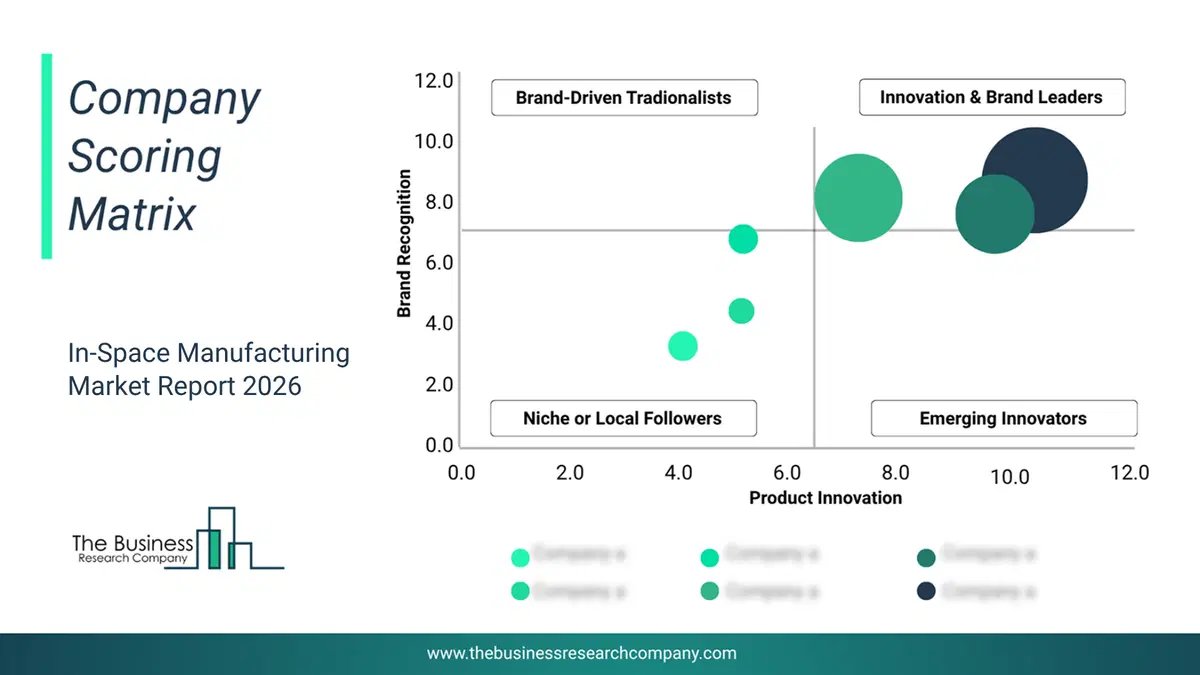
This chart maps companies by product innovation and brand strength, with bubble size indicating relative revenue, helping identify market leaders, challengers, and niche players. This is an illustrative chart; the full report provides a complete and accurate competitive analysis.
Global In-Space Manufacturing Market Trends and Insights
Major companies operating in the in-space manufacturing market are focused on developing innovative products, such as space factories to facilitate the production of advanced materials and components in microgravity, which enhances the efficiency and capabilities of space missions. A space factory is a facility or system designed to manufacture products in space, utilizing the unique environmental conditions of outer space, such as microgravity, vacuum, and radiation. For instance, in June 2023, Varda Space Industries, Inc., a US-based space industry company, launched the W-Series 1 Satellite, a spacecraft designed to function as a space factory for pharmaceutical production. The spacecraft has three main components: a satellite bus, a payload module, and a reentry capsule. This mission aims to explore the potential of manufacturing drugs in microgravity, specifically focusing on the active pharmaceutical ingredient ritonavir, used in treatments for HIV. After production, the materials will be brought back to Earth using Varda's reentry vehicle, which can withstand speeds of up to 19,000 miles per hour.What Are Latest Mergers And Acquisitions In The In-Space Manufacturing Market? Intuitive Machines Partners With Space Forge To Advance U.S. Space-Based Semiconductor Manufacturing
In July 2025, Intuitive Machines LLC, a US-based space technology and services company, partnered with Space Forge, Inc. to manufacture high-purity semiconductors in space and return them to Earth for commercial use. With this partnership, Intuitive Machines and Space Forge aim to manufacture high-purity semiconductors in space and reliably return them to Earth for commercial and technological applications, advancing domestic supply chains, supporting national security, and driving innovation in space-based materials science and microgravity manufacturing. Space Forge Inc. is a US-based aerospace and defense company focused on producing defect-free materials in microgravity for high-value semiconductor applications.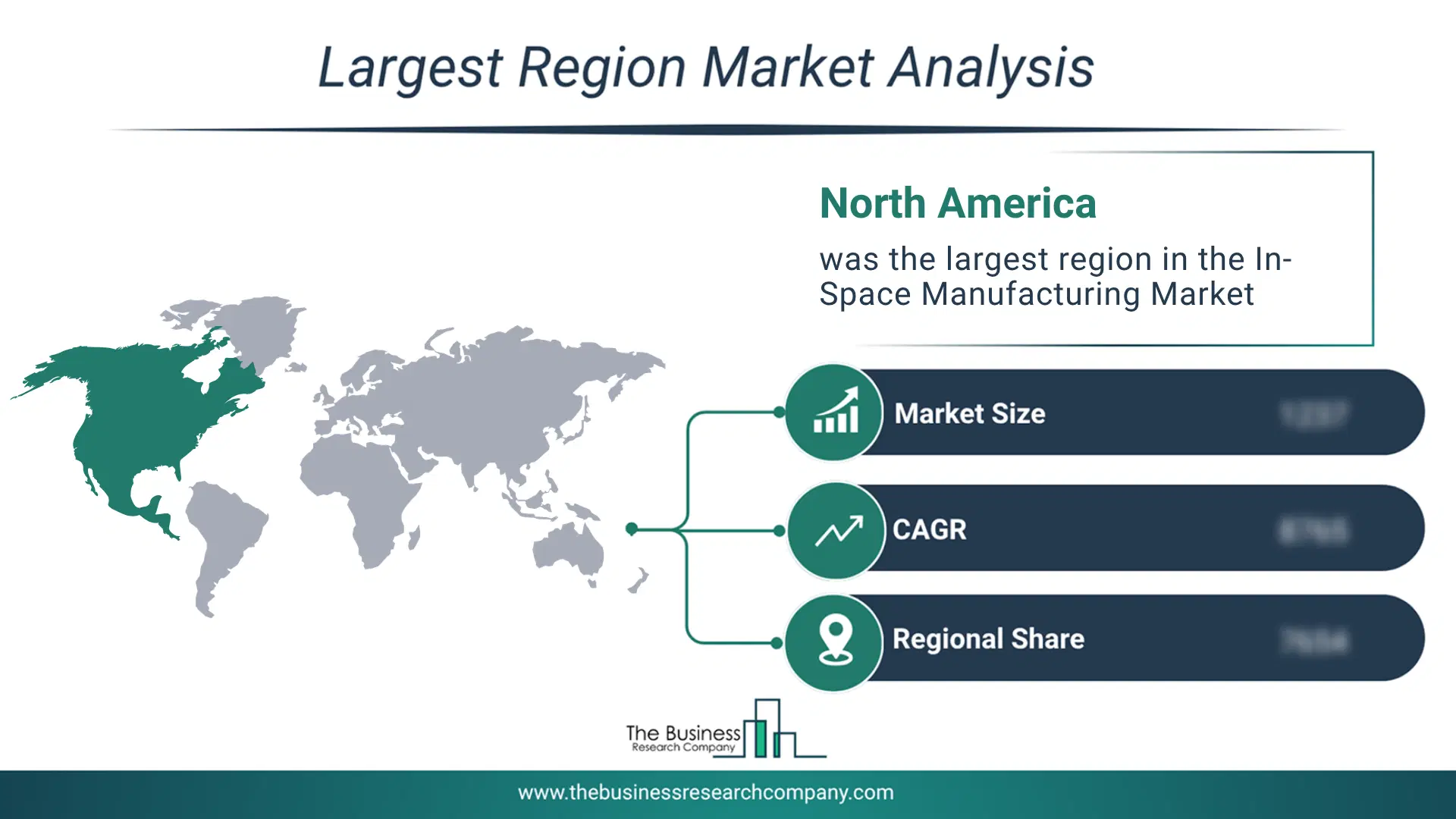
Regional Insights
North America was the largest region in the in-space manufacturing market in 2025. Asia-Pacific is expected to be the fastest-growing region in the forecast period. The regions covered in this market report are Asia-Pacific, South East Asia, Western Europe, Eastern Europe, North America, South America, Middle East, Africa. The countries covered in this market report are Australia, Brazil, China, France, Germany, India, Indonesia, Japan, Taiwan, Russia, South Korea, UK, USA, Canada, Italy, SpainWhat Defines the In-Space Manufacturing Market?
The in-space manufacturing market consists of revenue earned by entities by providing orbital construction Services, microgravity research and development services, and refueling services. The market value includes the value of related goods sold by the service provider or included within the service offering. The in-space manufacturing market also includes sales of 3D-printed parts, optical materials, and exotic metal alloys. Values in this market are ‘factory gate’ values, that is the value of goods sold by the manufacturers or creators of the goods, whether to other entities (including downstream manufacturers, wholesalers, distributors, and retailers) or directly to end customers. The value of goods in this market includes related services sold by the creators of the goods.How is Market Value Defined and Measured?
The market value is defined as the revenues that enterprises gain from the sale of goods and/or services within the specified market and geography through sales, grants, or donations in terms of the currency (in USD unless otherwise specified). The revenues for a specified geography are consumption values that are revenues generated by organizations in the specified geography within the market, irrespective of where they are produced. It does not include revenues from resales along the supply chain, either further along the supply chain or as part of other products.
This chart presents market attractiveness based on a quantitative evaluation of growth, competition, strategic alignment, and risk, offering a clear view of opportunity areas for decision-making. This chart is for illustrative purposes; the full report contains the complete analysis.

This chart highlights the Total Addressable Market (TAM) by estimating the maximum revenue opportunity using an assumption-driven approach, supporting strategic planning and opportunity sizing across markets. The chart is illustrative; the full report provides a more comprehensive analysis.
What Key Data and Analysis Are Included in the In-Space Manufacturing Market Report 2026?
The in-space manufacturing market research report is one of a series of new reports from The Business Research Company that provides market statistics, including industry global market size, regional shares, competitors with the market share, detailed market segments, market trends and opportunities, and any further data you may need to thrive in the in-space manufacturing industry. The market research report delivers a complete perspective of everything you need, with an in-depth analysis of the current and future state of the industry.In-Space Manufacturing Market Report Forecast Analysis
| Report Attribute | Details |
|---|---|
| Market Size Value In 2026 | $1.5 billion |
| Revenue Forecast In 2030 | $3.51 billion |
| Growth Rate | CAGR of 23.6% from 2026 to 2030 |
| Base Year For Estimation | 2025 |
| Actual Estimates/Historical Data | 2020-2025 |
| Forecast Period | 2026 - 2030 |
| Market Representation | Revenue in USD Billion and CAGR from 2026 to 2030 |
| Segments Covered | Product, Point Of Use, Material, Application, End-User |
| Regional Scope | Asia-Pacific, Western Europe, Eastern Europe, North America, South America, Middle East, Africa |
| Country Scope | The countries covered in the in-space manufacturing market report are Australia, Brazil, China, France, Germany, India, Indonesia, Japan, Taiwan, Russia, South Korea, UK, USA, Canada, Italy, Spain |
| Key Companies Profiled | Airbus SAS, Northrop Grumman Corporation, Blue Origin LLC, Sierra Space Corp., Redwire Corporation, Axiom Space Inc., Astroscale Holdings Inc, Honeybee Robotics Ltd., Varda Space Industries Inc., Astrobotic Technology Inc., Nanoracks LLC, Orbit Fab Inc., Astra Space Inc., Xplore Inc., Le Verre Fluore Fiber Solutions, Global Graphene Group Inc., Allevi Inc., Nedstack Fuel Cell Technology B.V., Virgin Galactic Holdings Inc., Momentus Space Inc. |
| Customization Scope | Request for Customization |
| Pricing And Purchase Options | Explore Purchase Options |