
Indoor 5G Global Market Opportunities And Strategies To 2035
By Component (Hardware, Software, Services), By Frequency Band (Sub-6 Ghz, Millimeter Wave (Mmwave), Other Frequency Bands), By End Use (Commercial Buildings, Telecom Operators, Government, Healthcare Providers, Manufacturers, Hospitality And Retail, Other End Uses), By Deployment Mode (Private 5G Networks, Hybrid Networks, Carrier-Provided Indoor Solutions, Neutral Host Networks, Network-As-A-Service (NaaS)), And By Region, Opportunities And Strategies – Global Forecast To 2035
Indoor 5G Market Definition
Indoor 5G refers to the deployment of fifth-generation (5G) wireless communication technologies within enclosed environments such as office buildings, factories, shopping malls, airports, hospitals and residential complexes to provide high-speed, low-latency, and reliable connectivity. Indoor 5G is used by enterprises, telecom operators, public sector organizations, and consumers to support applications such as high-definition video streaming, augmented and virtual reality, industrial automation, smart building systems, and mission-critical communications. The indoor 5G market consists of sales of indoor 5G by entities (organizations, sole traders and partnerships) that provide indoor 5G infrastructure, software platforms, and related services that enable high-speed wireless communication within enclosed environments. It is typically used in environments where outdoor network signals are weak or insufficient, particularly in dense urban areas or large infrastructure facilities.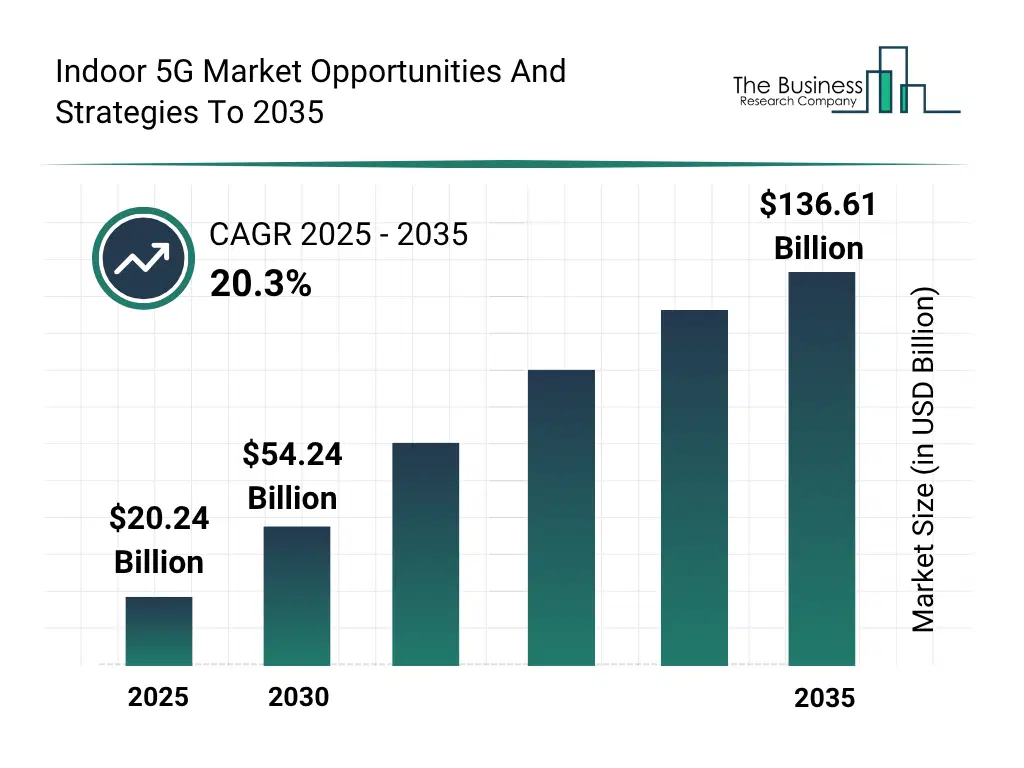
Indoor 5G Market Size
The global indoor 5G market reached a value of nearly $20,243.0 million in 2025, having grown at a compound annual growth rate (CAGR) of 90.5% since 2020. The market is expected to grow from $20,243.0 million in 2025 to $54,243.7 million in 2030 at a rate of 21.8%. The market is then expected to grow at a CAGR of 20.3% from 2029 and reach $136,608.9 million in 2035. Growth in the historic period resulted from increasing adoption of smart factories and industry 4.0 solutions, increasing use of IOT devices, rising adoption of cloud-based services and rising adoption of enterprise digital transformation initiatives. Factors that negatively affected growth in the historic period were security and cyber risk concerns and signal propagation & coverage challenges. Going forward, demand for organic products, growing investment in 5g infrastructure, increasing demand for high-speed wireless connectivity, rising adoption of smart building and automation solutions and government smart city initiatives and spectrum policies will drive the growth. Factors that could hinder the growth of the indoor 5G market in the future include high deployment and infrastructure costs, technical complexity and skill shortage, impact of trade wars and tariffs.
Indoor 5G Market Segmentation
The indoor 5G market is segmented by component, by frequency band, by end use and by deployment mode.By Component –
The indoor 5G market is segmented by component into:
- a) Hardware
- b) Software
- c) Services
By Frequency Band –
The Indoor 5G market is segmented by frequency band into:
- a) Sub-6 Ghz
- b) Millimeter Wave (Mmwave)
- c) Other Frequency Bands
By End Use –
The Indoor 5G market is segmented by end use into:
- a) Commercial Buildings
- b) Telecom Operators
- c) Government
- d) Healthcare Providers
- e) Manufacturers
- f) Hospitality And Retail
- g) Other End Uses
By Deployment Mode –
The Indoor 5G market is segmented by deployment mode into:
- a) Private 5G Networks
- b) Hybrid Networks
- c) Carrier-Provided Indoor Solutions
- d) Neutral Host Networks
- e) Network-As-A-Service (NaaS)
By Geography - The indoor 5G market is segmented by geography into:
- China
- India
- Japan
- Australia
- Indonesia
- South Korea
- USA
- Canada
- Brazil
- France
- Germany
- UK
- Italy
- Spain
- Russia
-
o Asia Pacific
o Africa