
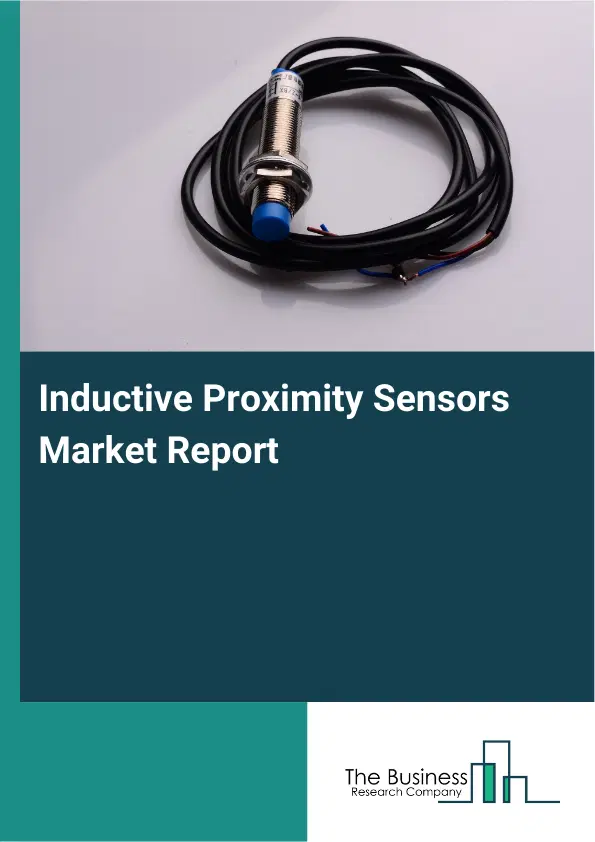
Inductive Proximity Sensors Market Report 2026
Global Outlook – By Type ( Negative-Positive-Negative (NPN) Inductive Proximity Sensor, Positive-Negative-Positive (PNP) Inductive Proximity Sensor, Shielded Sensors, Unshielded Sensors), By Technology ( High-Frequency Oscillation Inductive Sensing, Eddy Current Suppression Inductive Sensing, Magnetic Field Variation Inductive Sensing, Coil-Based Inductive Sensing), By End User ( Industrial, Automotive, Aerospace And Defense, Packaging, Other End-Users) – Market Size, Trends, Strategies, and Forecast to 2030
Inductive Proximity Sensors Market Overview
• Inductive Proximity Sensors market size has reached to $1.5 billion in 2025 • Expected to grow to $2.12 billion in 2030 at a compound annual growth rate (CAGR) of 7.2% • Growth Driver: Surge In Industrial Automation Boosts Demand For Inductive Proximity Sensors • Market Trend: Technological Advancements Drive Growth In The Inductive Proximity Sensors Market • Asia-Pacific was the largest region in 2025.Market Gains By 2030 – Top Opportunities By Segment
Market Gain identifies the most promising market opportunities by highlighting the segments or products expected to generate the highest incremental revenue growth over the next five years.
What Is Covered Under Inductive Proximity Sensors Market?
Inductive proximity sensors are non-contact devices that detect the presence of metallic objects by generating an electromagnetic field and sensing eddy current losses when a metal target enters the field. It is used for non-contact detection of metallic objects in industrial automation, robotics, automotive, and aerospace applications. The main types of inductive proximity sensors include negative-positive-negative (NPN) inductive proximity sensors, positive-negative-positive (PNP) inductive proximity sensors, shielded sensors, and unshielded sensors. A negative-positive-negative (NPN) inductive proximity sensor is a type of inductive proximity sensor that uses a transistor with a positive base and negative collector. These inductive proximity sensors include technology such as high-frequency oscillation, through-beam, and pulse-echo. The end users of inductive proximity sensors are industrial, automotive, aerospace and defense, packaging, and others.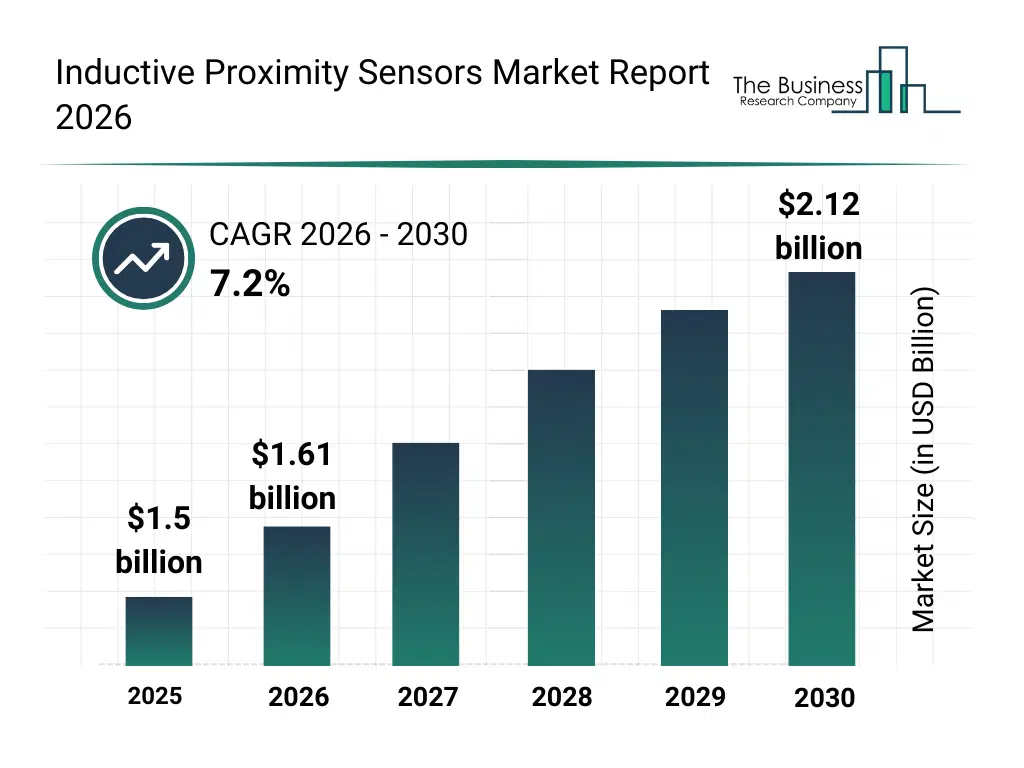
What Is The Inductive Proximity Sensors Market Size 2026 And Growth Rate?
The inductive proximity sensors market size has grown strongly in recent years. It will grow from $1.5 billion in 2025 to $1.61 billion in 2026 at a compound annual growth rate (CAGR) of 7.4%. The growth in the historic period can be attributed to growth of industrial automation, widespread use of non contact sensing, expansion of manufacturing industries, increased focus on machine safety, adoption of programmable logic controllers.What Is The Inductive Proximity Sensors Market Growth Forecast?
The inductive proximity sensors market size is expected to see strong growth in the next few years. It will grow to $2.12 billion in 2030 at a compound annual growth rate (CAGR) of 7.2%. The growth in the forecast period can be attributed to advancement of smart manufacturing systems, rising adoption of robotics and cobots, increasing demand for predictive maintenance, expansion of electric vehicle production, growth of aerospace and defense automation. Major trends in the forecast period include increasing adoption of inductive sensors in factory automation, rising demand for high precision metal detection, growing use of compact and miniature inductive sensors, expansion of sensors with extended sensing ranges, increasing integration of sensors in harsh industrial environments.
Global Inductive Proximity Sensors Market Segmentation
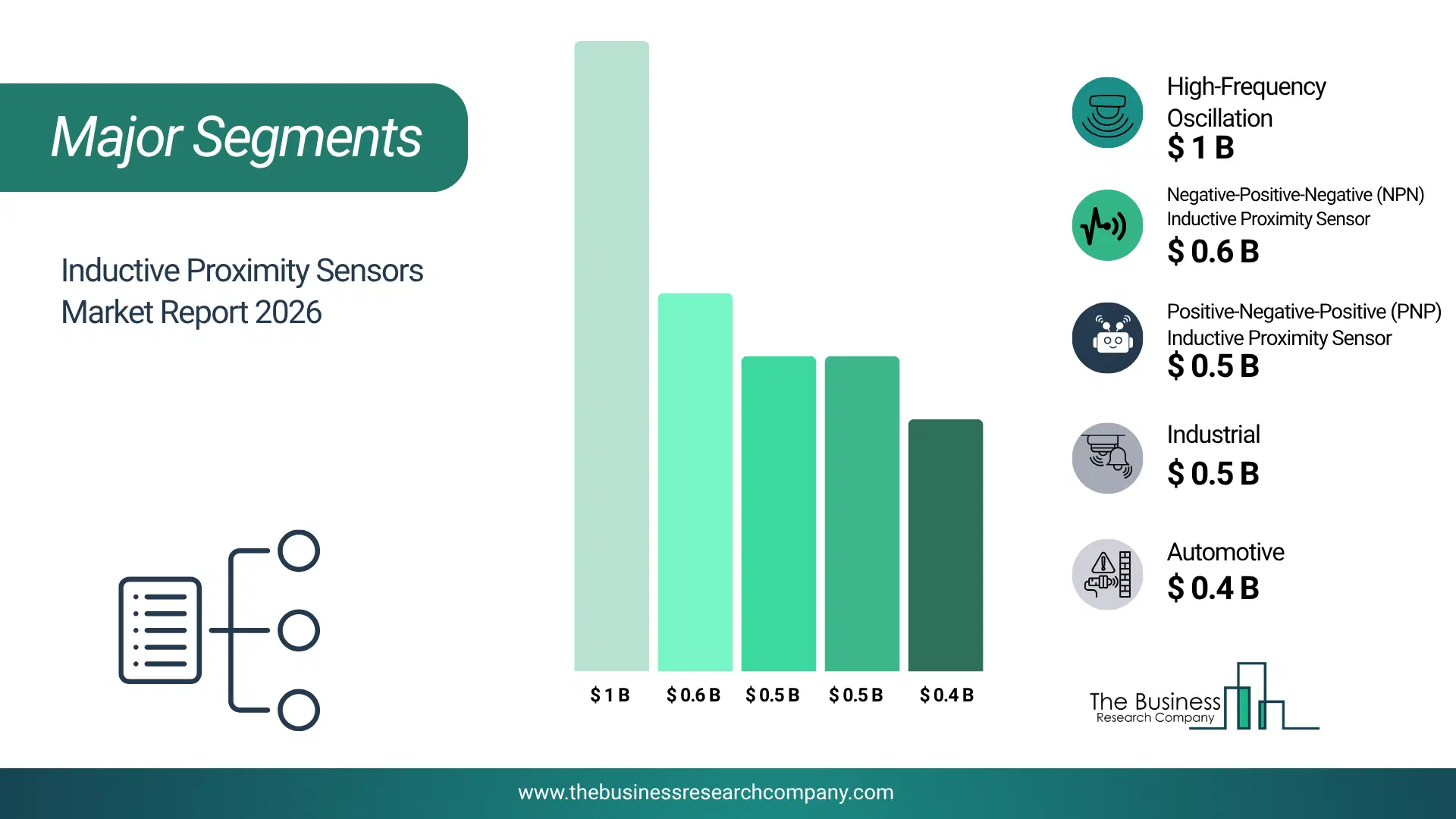
1) By Type: Negative-Positive-Negative (NPN) Inductive Proximity Sensor, Positive-Negative-Positive (PNP) Inductive Proximity Sensor, Shielded Sensors, Unshielded Sensors 2) By Technology: High-Frequency Oscillation Inductive Sensing, Eddy Current Suppression Inductive Sensing, Magnetic Field Variation Inductive Sensing, Coil-Based Inductive Sensing 3) By End User: Industrial, Automotive, Aerospace And Defense, Packaging, Other End-Users Subsegments: 1) By Negative-Positive-Negative (NPN) Inductive Proximity Sensor: NPN NO (Normally Open) Sensors, NPN NC (Normally Closed) Sensors, NPN Standard Sensors, NPN High-Sensitivity Sensors, NPN High-Temperature Sensors 2) By Positive-Negative-Positive (PNP) Inductive Proximity Sensor: PNP NO (Normally Open) Sensors, PNP NC (Normally Closed) Sensors, PNP Standard Sensors, PNP High-Sensitivity Sensors, PNP High-Temperature Sensors 3) By Shielded Sensors: Rectangular Shielded Sensors, Cylindrical Shielded Sensors, Flat Shielded Sensors, Compact Shielded Sensors, High-Performance Shielded Sensors, Miniature Shielded Sensors 4) By Unshielded Sensors: Rectangular Unshielded Sensors, Cylindrical Unshielded Sensors, Flat Unshielded Sensors, Compact Unshielded Sensors, Miniature Unshielded Sensors, High-Performance Unshielded Sensors The top segments in the inductive proximity sensors market will be: • High-Frequency Oscillation will reach $1010.32 Million by 2025. • Negative-Positive-Negative (NPN) Inductive Proximity Sensor will reach $676.29 Million by 2025. • Positive-Negative-Positive (PNP) Inductive Proximity Sensor will reach $547.91 Million by 2025. • Industrial will reach $547.86 Million by 2025. • Automotive will reach $434.13 Million by 2025.What Is The Driver Of The Inductive Proximity Sensors Market?
The growth in industrial automation is expected to propel the growth of the inductive proximity sensors market going forward. Industrial automation is the utilization of robotics, machines, and control systems to automate tasks traditionally performed by humans, enhancing productivity, quality, and safety in various industries. The rise in industrial automation is driven by the need to increase productivity, quality, and safety, as well as the advancements in robotics, artificial intelligence (AI), and communication technologies that have made automation more capable and cost-effective. Inductive proximity sensors are utilized in industrial automation for non-contact detection of metallic objects, ensuring precision and efficiency in various manufacturing processes. For instance, in September 2025, the International Federation of Robotics, a Germany-based non-profit organization, reported that in 2025, World Robotics reported 542,000 industrial robots installed in 2024, more than double the number from past years, with annual installations surpassing 500,000 for the fourth consecutive year. Therefore, growth in industrial automation is driving the growth of the inductive proximity sensors industry.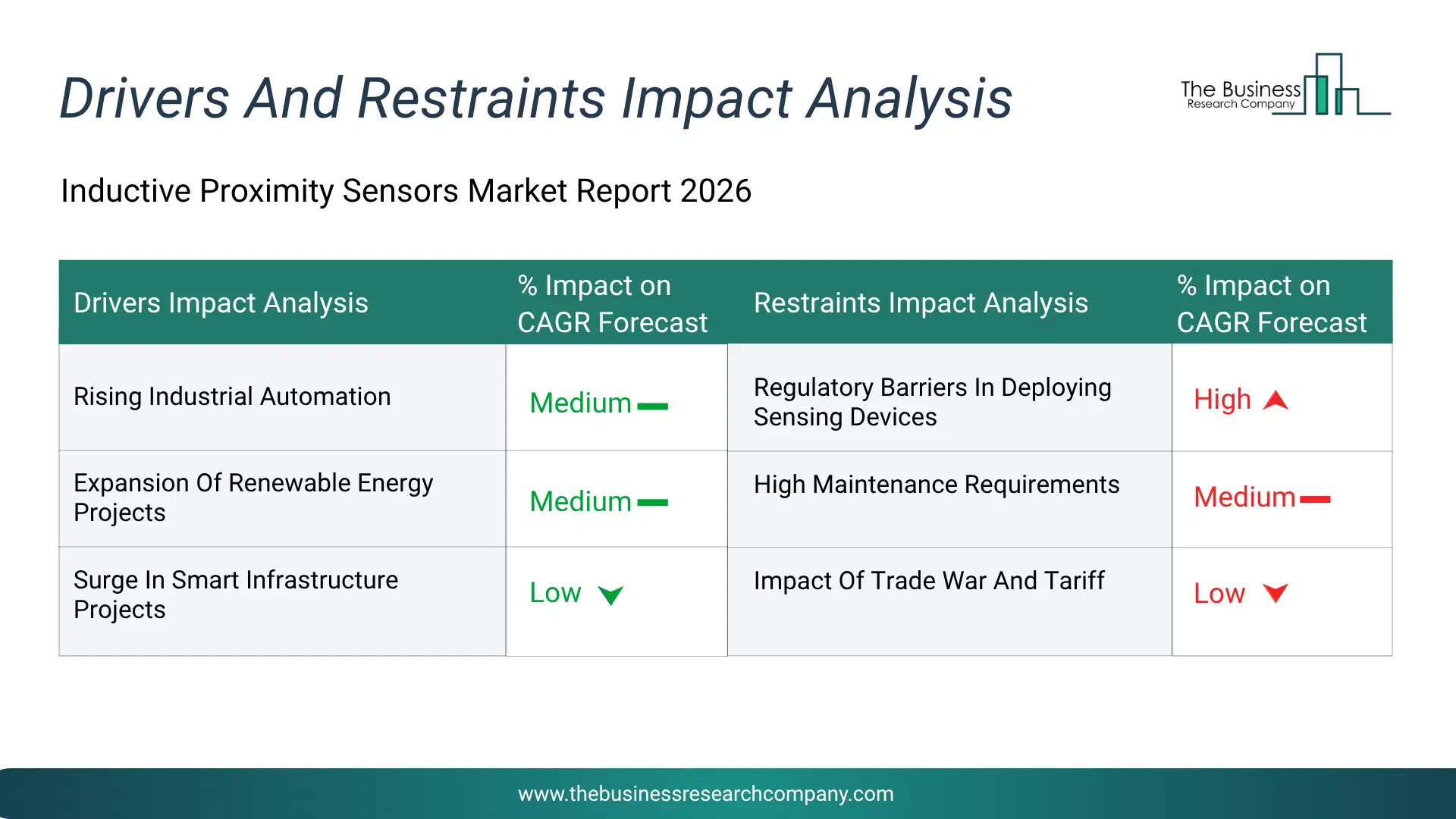
Infographic Chart Showing Key Market Drivers Analysis And Restraints For Inductive Proximity Sensors Market
The chart presents an impact analysis of key drivers and restraints, quantifying their relative influence on the market's growth rate and helping assess the balance between growth enablers and limiting factors. This chart offers a high-level perspective; the full report contains more detailed insights.
How Will The Drivers Impact Growth In The Global Inductive Proximity Sensors Market?
• Rising Industrial Automation (Medium) – The rising industrial automation will become a key driver of growth in the inductive proximity sensors market by 2030. Rising industrial automation significantly boosts the demand for inductive proximity sensors, as these sensors are critical components in automated systems across manufacturing, packaging, and process industries. They enable precise, contactless detection of metal objects, which is essential for position sensing, machine safety, and quality control in automated workflows. As industries scale up automation to improve operational speed, consistency, and compliance with safety and regulatory standards, the adoption of inductive sensors grows rapidly. Their durability, reliability, and ability to function in harsh environments make them indispensable for supporting high-throughput, standardized, and intelligent production processes. Therefore, the rising industrial automation will drive the growth of the inductive proximity sensors market. As a result, the rising industrial automation is anticipated to contributing to a 1.5% annual growth in the market. • Expansion Of Renewable Energy Projects (Medium) – The expansion of renewable energy projects will emerge as a major factor driving the expansion of the inductive proximity sensors market by 2030. Expansion of renewable energy projects, such as the growing deployment of wind farms, solar arrays, and hydropower systems, drives demand for inductive proximity sensors, as these sensors are essential for reliable, contactless detection in dynamic and often harsh operating environments. Renewable energy infrastructure depends on these sensors for accurate position sensing, component alignment, and equipment monitoring. As countries scale up clean energy investments and modernize their power grids, the need for durable and maintenance-free sensors increases. Additionally, the push for energy efficiency and system automation encourages the widespread integration of inductive proximity sensors across renewable energy operations. Therefore, expansion of renewable energy projects will drive the growth of the inductive proximity sensors market. Consequently, the expansion of renewable energy projects capabilities is projected to contributing to a 1.0% annual growth in the market. • Surge In Smart Infrastructure Projects (Low) – The surge in smart infrastructure projects will serve as a key growth catalyst for the inductive proximity sensors market by 2030. Surge in smart infrastructure projects drives the growth of inductive proximity sensors by increasing the need for precise, reliable, and automated sensing solutions across urban development initiatives. These sensors enhance the functionality of smart systems by enabling accurate position detection, motion sensing, and equipment monitoring in critical applications such as intelligent transportation, automated lighting, and smart utilities. As cities adopt data-driven infrastructure to improve efficiency, safety, and sustainability, the demand for robust and scalable sensor technologies rises. This trend also accelerates innovation in sensor integration to support the evolving requirements of interconnected and automated infrastructure environments. Therefore, the Surge in smart infrastructure projects will drive the growth of the inductive proximity sensors market. Therefore, this surge in smart infrastructure projects operations is projected to supporting to a 0.8% annual growth in the market. • Industrial Internet Of Things (IIoT) Expansion (Low) – The industrial internet of things (IIoT) expansion will become a significant driver contributing to the growth of the inductive proximity sensors market by 2030. Expansion of the Industrial Internet of Things (IIoT) is driving increased demand for inductive proximity sensors, as these sensors play a critical role in enabling smart automation across logistics and warehousing operations. IIOT-enabled systems rely on real-time data from sensors to optimize material handling, inventory tracking, and equipment positioning. In modern warehouses, inductive proximity sensors ensure accurate detection and control in applications such as conveyor systems, robotic handling, and automated storage and retrieval units. As IIOT adoption grows alongside e-commerce and just-in-time delivery models, the push for high-throughput, low-maintenance, and intelligent automation accelerates, fuelling broader integration of these sensors to enhance operational efficiency and data-driven logistics management. Therefore, industrial internet of things (IIOT) expansion will drive the growth of the inductive proximity sensors market. Consequently, the industrial internet of things (IIOT) expansion strategies is projected to contributing to a 0.5% annual growth in the market.How Will The Restraints Impact Growth In The Global Inductive Proximity Sensors Market?
• Regulatory Barriers In Deploying Sensing Devices (Medium) – Regulatory Barriers In Deploying Sensing Devices will restrict the growth of the Inductive Proximity Sensors market during the forecast period. Deployment of inductive proximity sensors in certain applications is subject to regulatory requirements for safety, electromagnetic compatibility, and performance. Compliance with varying regulations across regions adds to product development and testing costs. Regulatory barriers can delay market entry and affect the adoption of sensor technologies in certain applications. • High Maintenance Requirements (Medium) – High Maintenance Requirements will restrict the growth of the Inductive Proximity Sensors market during the forecast period. Inductive proximity sensors require regular cleaning, calibration, and replacement to maintain accuracy and reliability. Harsh industrial environments can accelerate sensor degradation, increasing maintenance frequency and costs. High maintenance requirements affect total cost of ownership and may discourage adoption in cost-sensitive applications, limiting market growth. • Impact Of Trade War And Tariff (Low) – Impact Of Trade War And Tariff will restrict the growth of the Inductive Proximity Sensors market during the forecast period. Inductive proximity sensors rely on imported electronic components, semiconductors, and specialized materials from global suppliers. Trade tariffs and restrictions increase component costs and can affect sensor pricing. Supply chain disruptions from trade tensions can lead to component shortages and delivery delays, impacting sensor production and availability.Key Players In The Global Inductive Proximity Sensors Market
Major companies operating in the inductive proximity sensors market are Panasonic Corporation, Schneider Electric SE, Honeywell International Inc., Eaton Corporation plc, STMicroelectronics N.V., Fargo Controls Inc., Delta Electronics Inc., Rockwell Automation Inc., Omron Corporation, Keyence Corporation, IFM Electronic GmbH, SICK AG, Hans Turck GmbH & Co. KG, Pepperl+Fuchs SE, Baumer Holding AG, Datalogic S.p.A., Balluff GmbH, Altech Corporation, Carlo Gavazzi Holding AG, Autonics Corporation, Contrinex AG, Red Lion Controls (a Spectris company), KRIZ Sensors.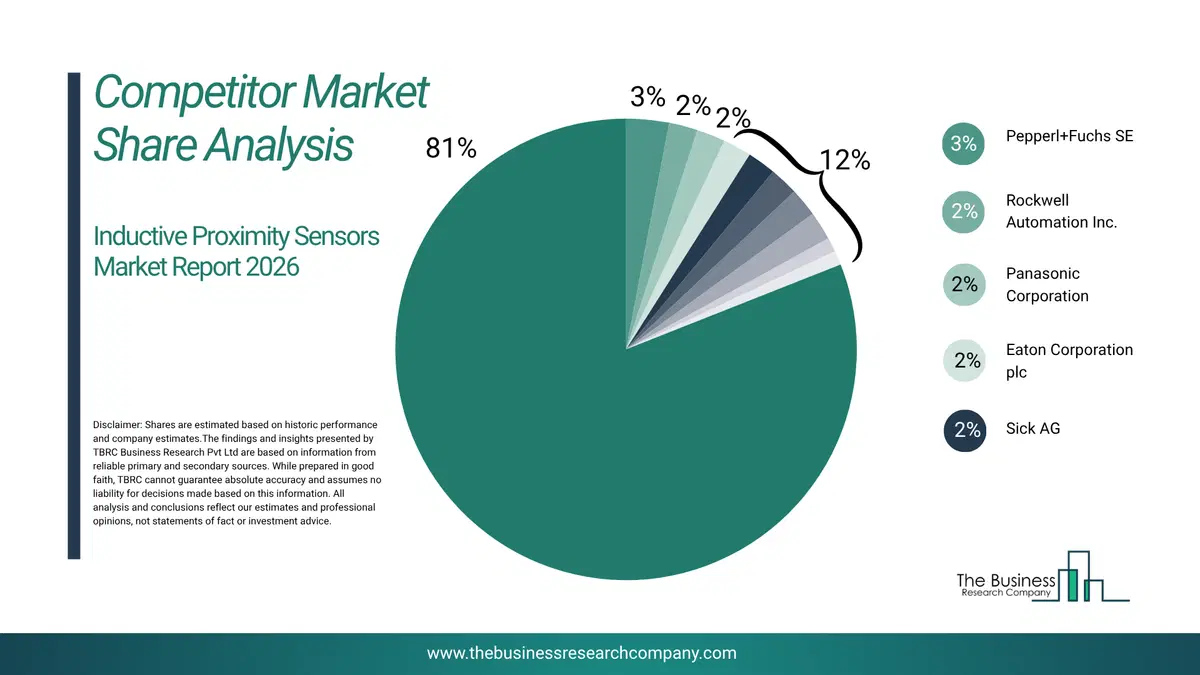
This chart is for illustrative purposes; the full report includes a detailed competitor analysis and comprehensive overview of the top 10 companies in the market.
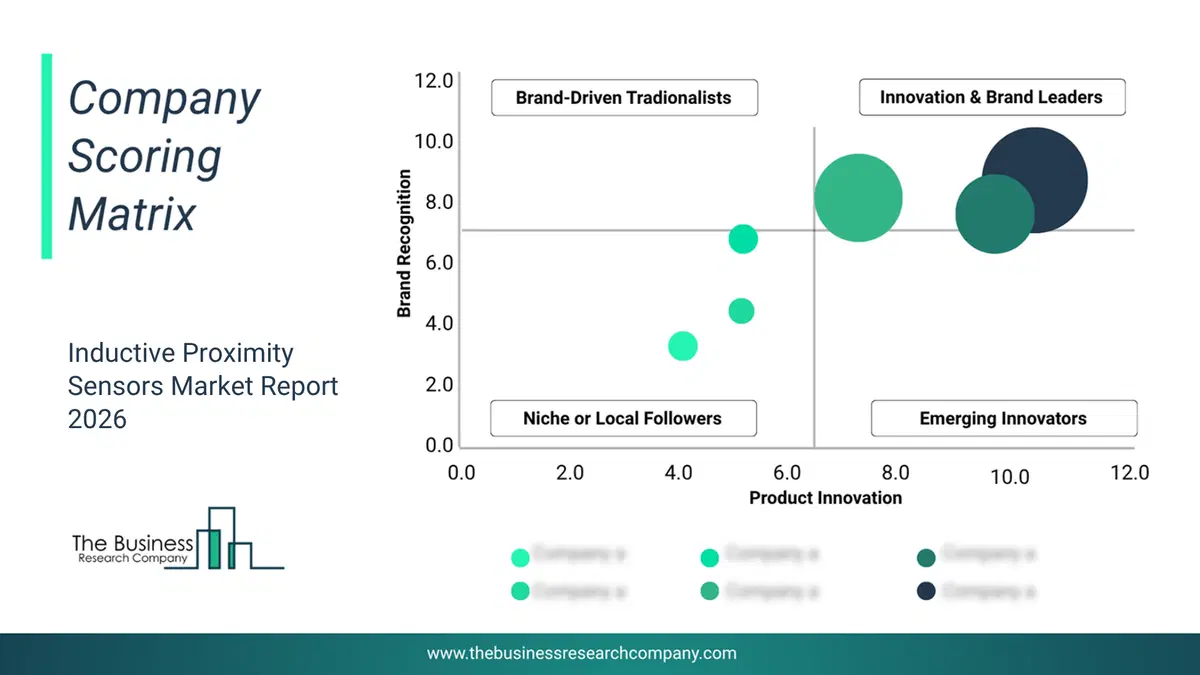
This chart maps companies by product innovation and brand strength, with bubble size indicating relative revenue, helping identify market leaders, challengers, and niche players. This is an illustrative chart; the full report provides a complete and accurate competitive analysis.
Global Inductive Proximity Sensors Market Trends and Insights
Major companies operating in the inductive proximity sensors market are focused on developing advanced technological solutions, such as input or output (IO)-link communications sensors, to sustain their position in the market. An IO-Link communications sensor refers to a sensor that incorporates IO-Link technology for enhanced functionality and communication capabilities. For instance, in February 2023, Carlo Gavazzi Holding AG, a Switzerland-based industrial automation company, launched ICF Full-Metal Inductive Sensors, an intelligent sensor that features rugged stainless-steel housing and IO-Link communications for increased uptime and intelligent monitoring in harsh environments such as agriculture, food and beverage, and machining. These sensors offer an extended lifetime with washdown capabilities, impact resistance, and a wide temperature range. They enable predictive maintenance through cyclic process data monitoring and customizable alarms, ensuring uninterrupted operations. It has endless configurations and provides reliable detection for various applications, including conveyor positioning and axle revolution counting in machinery.What Are Latest Mergers And Acquisitions In The Inductive Proximity Sensors Market?
In March 2024, Sentech Inc., a US-based manufacturer of position and proximity sensors, acquired the assets of Xensor LLC for an undisclosed amount. The acquisition is expected to help Sentech expand its industrial portfolio and provide comprehensive solutions to its global customer base. Additionally, by integrating Xensor's capabilities, Sentech aims to solidify its position in advanced sensor technology. Xensor LLC is a US-based developer and manufacturer of motion sensors, including a full-line inductive proximity sensor for standard and custom applications.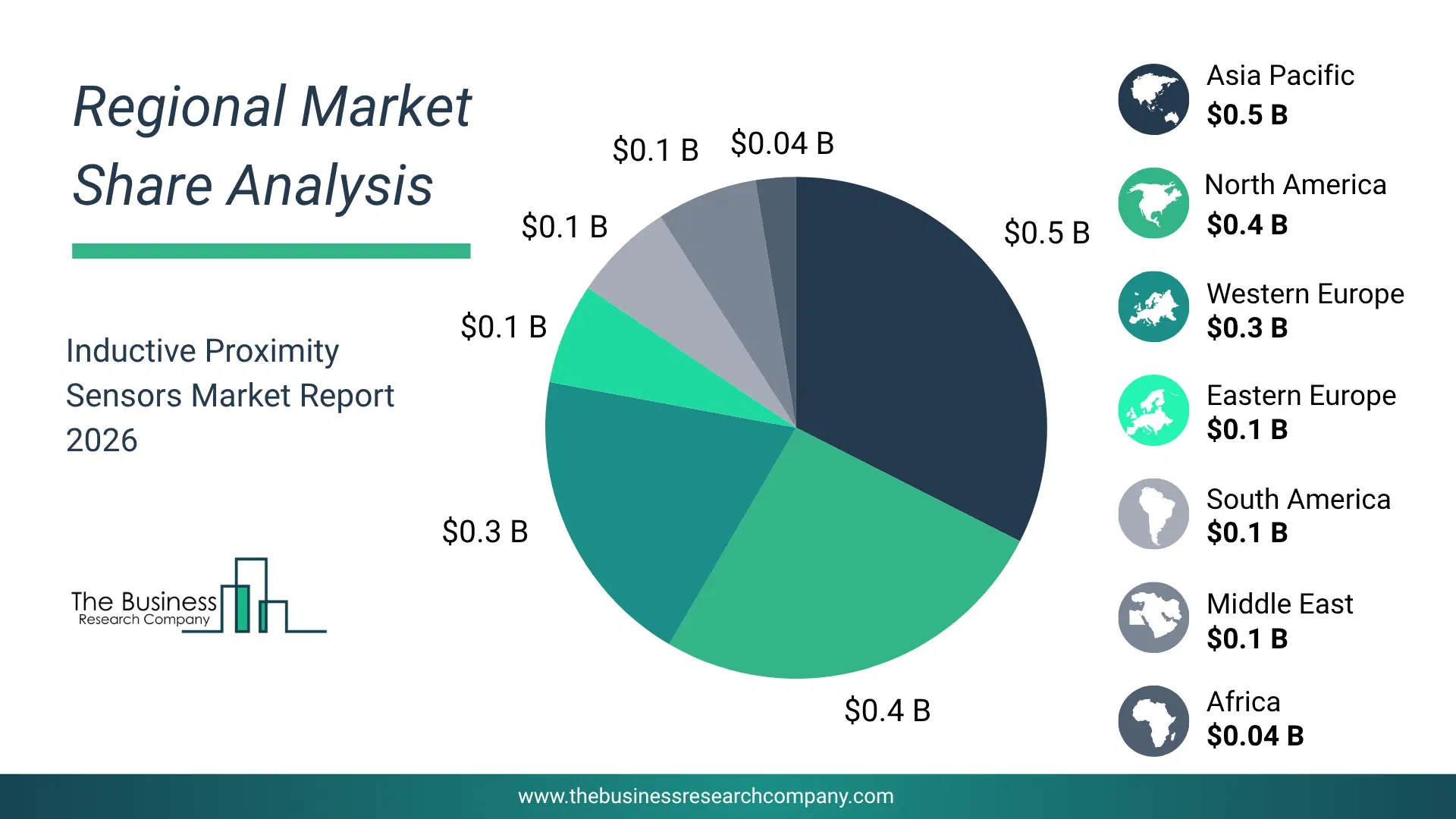
Regional Outlook
Asia-Pacific was the largest region in the inductive proximity sensors market in 2025. The regions covered in this market report are Asia-Pacific, South East Asia, Western Europe, Eastern Europe, North America, South America, Middle East, Africa. The countries covered in this market report are Australia, Brazil, China, France, Germany, India, Indonesia, Japan, Taiwan, Russia, South Korea, UK, USA, Canada, Italy, Spain.What Defines the Inductive Proximity Sensors Market?
The inductive proximity sensors market consists of sales of basic inductive proximity sensors, specialized inductive proximity sensors, application-specific sensors, and wireless inductive proximity sensors. Values in this market are ‘factory gate’ values, that is the value of goods sold by the manufacturers or creators of the goods, whether to other entities (including downstream manufacturers, wholesalers, distributors and retailers) or directly to end customers. The value of goods in this market includes related services sold by the creators of the goods.How is Market Value Defined and Measured?
The market value is defined as the revenues that enterprises gain from the sale of goods and/or services within the specified market and geography through sales, grants, or donations in terms of the currency (in USD unless otherwise specified). The revenues for a specified geography are consumption values that are revenues generated by organizations in the specified geography within the market, irrespective of where they are produced. It does not include revenues from resales along the supply chain, either further along the supply chain or as part of other products.
This chart presents market attractiveness based on a quantitative evaluation of growth, competition, strategic alignment, and risk, offering a clear view of opportunity areas for decision-making. This chart is for illustrative purposes; the full report contains the complete analysis.

This chart highlights the Total Addressable Market (TAM) by estimating the maximum revenue opportunity using an assumption-driven approach, supporting strategic planning and opportunity sizing across markets. The chart is illustrative; the full report provides a more comprehensive analysis.
What Key Data and Analysis Are Included in the Inductive Proximity Sensors Market Report 2026?
The inductive proximity sensors market research report is one of a series of new reports from The Business Research Company that provides market statistics, including industry global market size, regional shares, competitors with the market share, detailed market segments, market trends and opportunities, and any further data you may need to thrive in the inductive proximity sensors industry. The market research report delivers a complete perspective of everything you need, with an in-depth analysis of the current and future state of the industry.Inductive Proximity Sensors Market Report 2026 Market Report Forecast Analysis
| Report Attribute | Details |
|---|---|
| Market Size Value In 2026 | $1.61 billion |
| Revenue Forecast In 2030 | $2.12 billion |
| Growth Rate | CAGR of 7.4% from 2026 to 2030 |
| Base Year For Estimation | 2025 |
| Actual Estimates/Historical Data | 2020-2025 |
| Forecast Period | 2026 - 2030 |
| Market Representation | Revenue in USD Billion and CAGR from 2026 to 2030 |
| Segments Covered | Type, Technology, End User |
| Regional Scope | Asia-Pacific, Western Europe, Eastern Europe, North America, South America, Middle East, Africa |
| Country Scope | The countries covered in the report are Australia, Brazil, China, France, Germany, India, Indonesia, Japan, Taiwan, Russia, South Korea, UK, USA, Canada, Italy, Spain. |
| Key Companies Profiled | Panasonic Corporation, Schneider Electric SE, Honeywell International Inc., Eaton Corporation plc, STMicroelectronics N.V., Fargo Controls Inc., Delta Electronics Inc., Rockwell Automation Inc., Omron Corporation, Keyence Corporation, IFM Electronic GmbH, SICK AG, Hans Turck GmbH & Co. KG, Pepperl+Fuchs SE, Baumer Holding AG, Datalogic S.p.A., Balluff GmbH, Altech Corporation, Carlo Gavazzi Holding AG, Autonics Corporation, Contrinex AG, Red Lion Controls (a Spectris company), KRIZ Sensors. |
| Customization Scope | Request for Customization |
| Pricing And Purchase Options | Explore Purchase Options |