
Industrial Automation And Control Systems Market Report 2026
Global Outlook – By Component ( HMI (Human-Machine Interface), Industrial Robots, Control Valves, Sensors, Other Component), By Control System ( DCS (Distributed Control System), PLC (Programmable Logic Controller), SCADA (Supervisory Control And Data Acquisition)), By End-User Industry ( Aerospace And Defense, Automotive, Chemical, Energy And Utilities, Food And Beverage, Healthcare, Manufacturing, Mining And Metal, Oil And Gas, Transportation) – Market Size, Trends, Strategies, and Forecast to 2030
Industrial Automation And Control Systems Market Overview
• Industrial Automation And Control Systems market size has reached to $231.3 billion in 2025 • Expected to grow to $398.18 billion in 2030 at a compound annual growth rate (CAGR) of 11.5% • Growth Driver: Increasing Adoption Of Automation Fuelling The Growth Of The Market Due To Rising Operational Efficiency • Market Trend: Advanced Controller For Industrial Automation • Asia-Pacific was the largest region and fastest growing region.Market Gains By 2030 – Top Opportunities By Segment
Market Gain identifies the most promising market opportunities by highlighting the segments or products expected to generate the highest incremental revenue growth over the next five years.
What Is Covered Under Industrial Automation And Control Systems Market?
Industrial automation and control systems refer to the use of autonomous systems to control machinery and processes in numerous industries through the use of technology such as robots and computer software. It improves productivity, quality, and system performance that lowers operational expenses. The main components of industrial automation and control systems are HMI (human-machine interface), industrial robots, control valves, sensors, and others. A human-machine interface (HMI) is a user interface or dashboard that links a person to a machine, system, or device. It is available in various control systems such as DCS (Distributed Control System), PLC (Programmable Logic Controller), and SCADA (Supervisory Control and Data Acquisition) for end-user industries such as aerospace and defense, automotive, chemical, energy, and utilities, food and beverage, healthcare, manufacturing, mining and metal, oil and gas, and transportation.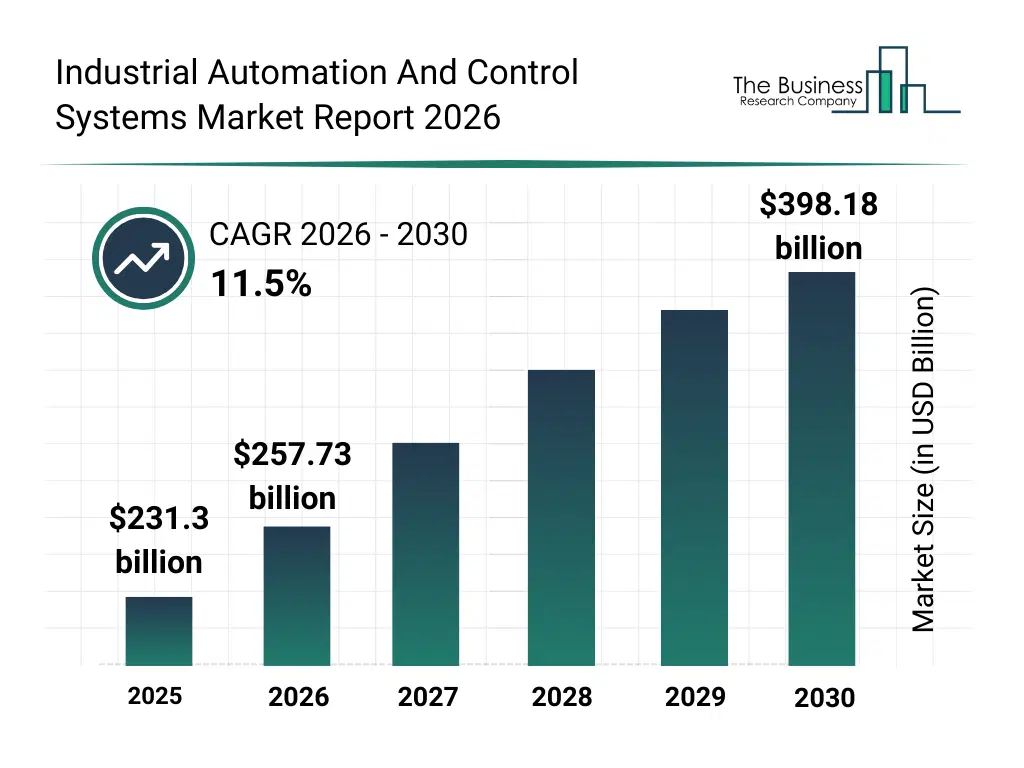
What Is The Industrial Automation And Control Systems Market Size 2026 And Growth Rate?
The industrial automation and control systems market size has grown rapidly in recent years. It will grow from $231.3 billion in 2025 to $257.73 billion in 2026 at a compound annual growth rate (CAGR) of 11.4%. The growth in the historic period can be attributed to growth in programmable logic controller usage, reliance on early scada systems, expansion of industrial robotics adoption, increased need for process consistency, development of basic machine automation technologies.What Is The Industrial Automation And Control Systems Market Growth Forecast?
The industrial automation and control systems market size is expected to see rapid growth in the next few years. It will grow to $398.18 billion in 2030 at a compound annual growth rate (CAGR) of 11.5%. The growth in the forecast period can be attributed to rising investment in smart manufacturing, increasing demand for real-time production monitoring, expansion of autonomous industrial systems, development of energy-efficient automation solutions, growing adoption of predictive maintenance technologies. Major trends in the forecast period include adoption of AI-driven industrial process optimization, integration of autonomous robotic automation, expansion of IoT-connected control architectures, advancement of digitally enhanced manufacturing systems, development of cybersecure industrial automation platforms.
Global Industrial Automation And Control Systems Market Segmentation
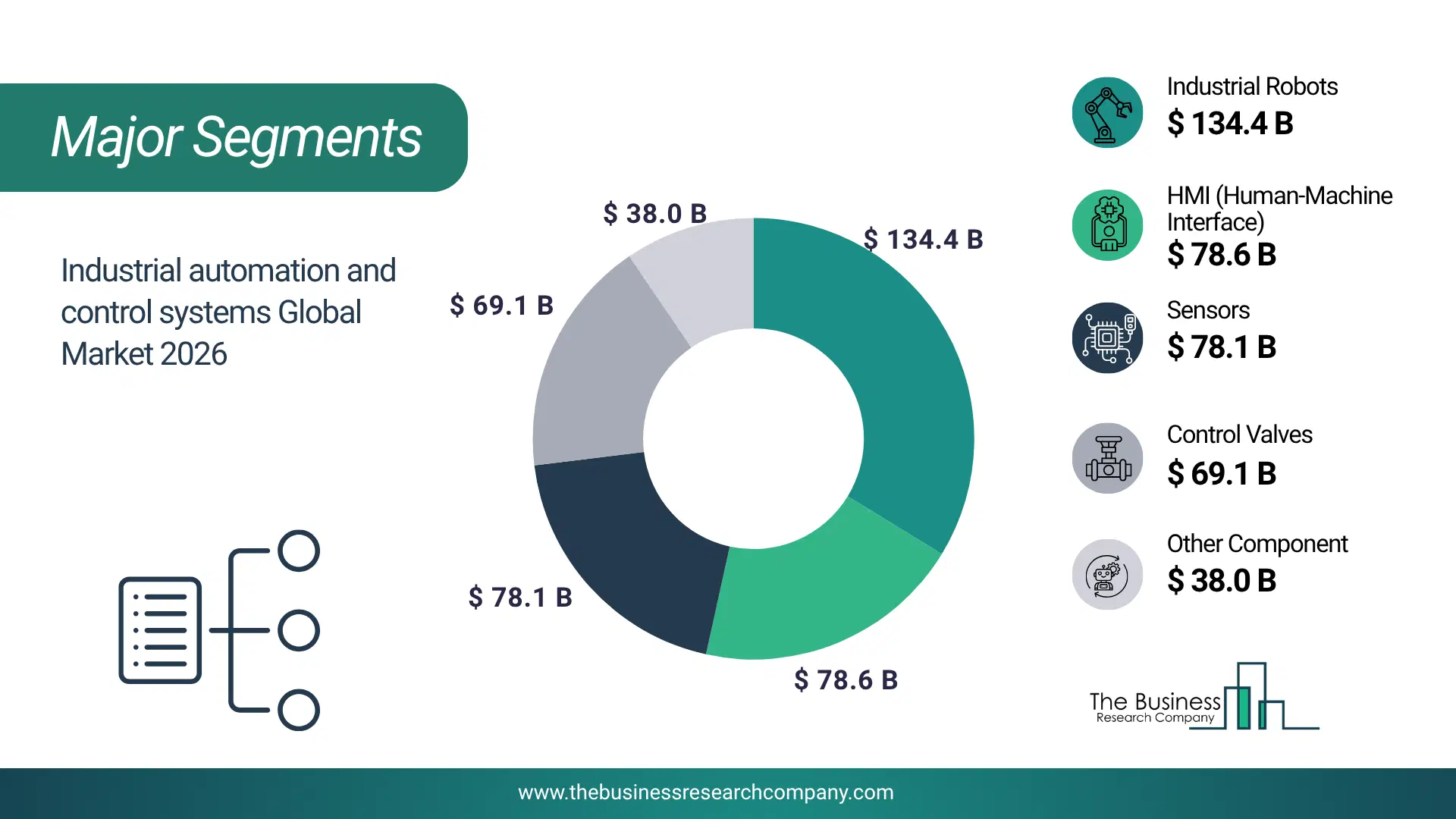
1) By Component: HMI (Human-Machine Interface), Industrial Robots, Control Valves, Sensors, Other Component 2) By Control System: DCS (Distributed Control System), PLC (Programmable Logic Controller), SCADA (Supervisory Control And Data Acquisition) 3) By End-User Industry: Aerospace And Defense, Automotive, Chemical, Energy And Utilities, Food And Beverage, Healthcare, Manufacturing, Mining And Metal, Oil And Gas, Transportation Subsegments: 1) By HMI (Human-Machine Interface): Touchscreen HMIs, Software-based HMIs, Embedded HMIs 2) By Industrial Robots: Articulated Robots, SCARA Robots, Collaborative Robots (Cobots), Cartesian Robots 3) By Control Valves: Manual Control Valves, Automatic Control Valves, Pressure Relief Valves, Flow Control Valves 4) By Sensors: Proximity Sensors, Temperature Sensors, Pressure Sensors, Flow Sensors, Level Sensors 5) By Other Components: PLCs (Programmable Logic Controllers), Drives And Motors, Networking Equipment, Safety Systems The top segments in the industrial automation and control systems market will be: • Industrial Robots will reach $134.39 billion by 2030. • HMI (Human-Machine Interface) will reach $78.6 billion by 2030. • Sensors will reach $78.1 billion by 2030. • Control Valves will reach $69.1 billion by 2030. • Other Component will reach $38 billion by 2030.What Is The Driver Of The Industrial Automation And Control Systems Market?
Increasing adoption of automation is expected to propel the growth of the industrial automation and control systems market going forward. Automation refers to the use of control systems and technologies to operate industrial processes with minimal human intervention. Adoption of automation is rising primarily due to its ability to significantly increase operational efficiency by reducing labor costs and minimizing errors. Industrial automation and control systems help drive this growth by enabling real-time process monitoring, predictive maintenance, and seamless integration of machines, thus improving productivity and product quality. For instance, in September 2024, according to the International Federation of Robotics (IFR), a Germany-based non-profit organization, reported that industrial robot installations in the UK rose by 51%, reaching 3,830 units, while in the Americas, over 50,000 units were installed for the third consecutive year, totaling 55,389 units in 2023. Therefore, increasing adoption of automation is expected to drive significant expansion in the industrial automation and control systems industry despite potentially high upfront investments.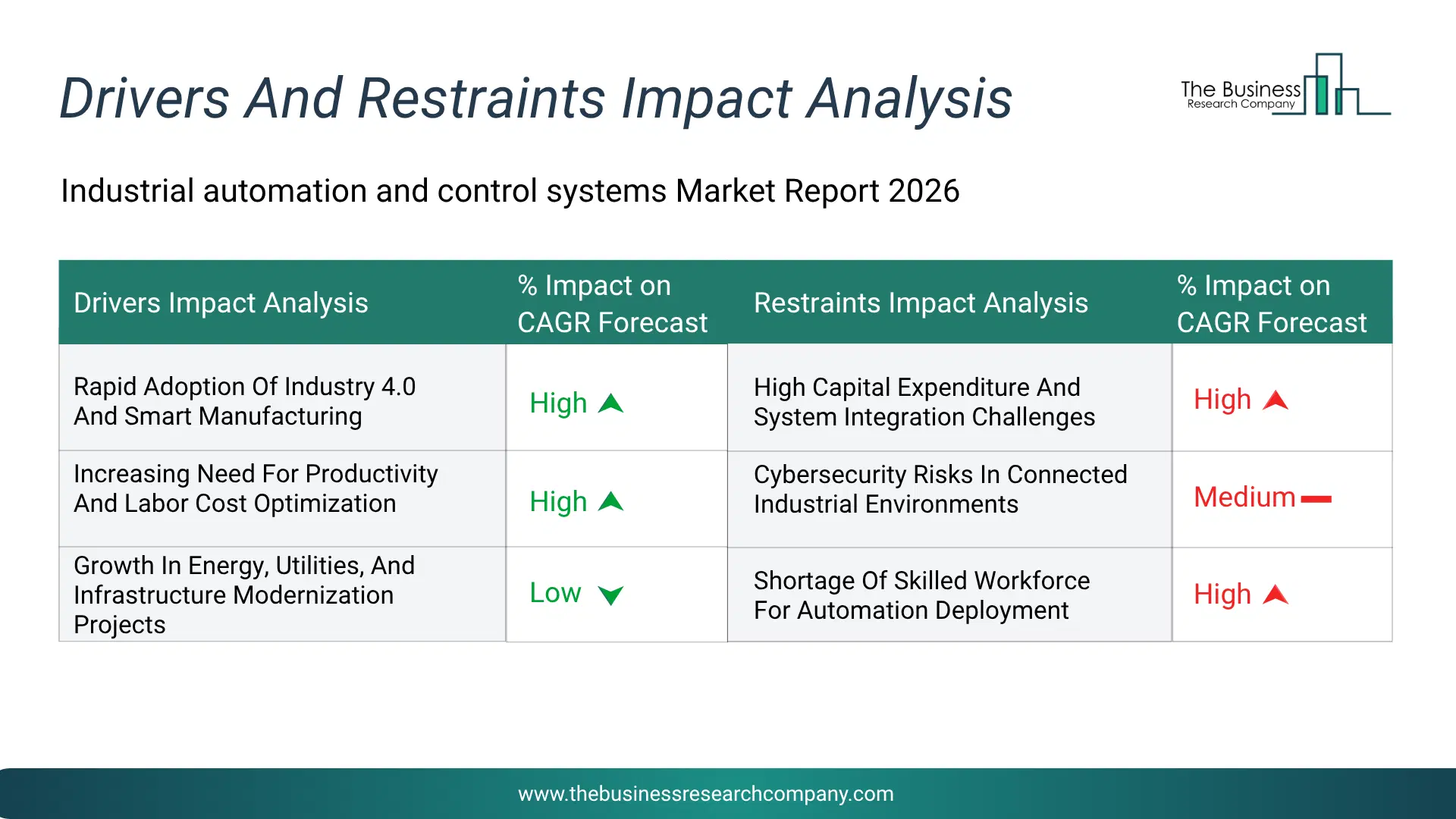
Infographic Chart Showing Key Market Drivers Analysis And Restraints For Industrial Automation And Control Systems Market
The chart presents an impact analysis of key drivers and restraints, quantifying their relative influence on the market's growth rate and helping assess the balance between growth enablers and limiting factors. This chart offers a high-level perspective; the full report contains more detailed insights.
How Will The Drivers Impact Growth In The Global Industrial Automation And Control Systems Market?
• Rapid Adoption Of Industry 4.0 And Smart Manufacturing (High) – During the forecast period, the rapid adoption of industry 4.0 and smart manufacturing is expected to become a key growth driver for the industrial automation and control systems market by 2030. The accelerating adoption of industry 4.0 and smart manufacturing initiatives is a primary driver for the industrial automation and control systems market. Manufacturers are increasingly integrating plcs, dcs, scada, robotics, and advanced sensors to enable real -time monitoring, predictive maintenance, and data -driven production optimization. Digital twins, ai -driven analytics, and machine connectivity enhance operational visibility and reduce downtime. As global industries focus on productivity enhancement and operational agility, automation investments are expected to rise significantly. • Increasing Need For Productivity And Labor Cost Optimization (High) – During the forecast period, the increasing need for productivity and labor cost optimization is expected to emerge as a major factor driving the expansion of the industrial automation and control systems market by 2030. Rising labor costs and increasing demand for operational efficiency strongly drive automation deployment across process and discrete industries. Companies are leveraging automated control systems to minimize human error, improve precision, and ensure consistent production quality. Automation also addresses workforce shortages in sectors such as automotive, pharmaceuticals, food & beverages, and energy. As cost optimization becomes a strategic priority, organizations are accelerating capital expenditure on advanced control technologies. • Growth In Energy, Utilities, And Infrastructure Modernization Projects (Low) – During the forecast period, the growth in energy, utilities, and infrastructure modernization projects is expected to act as a key growth catalyst for the industrial automation and control systems market by 2030. The expansion of renewable energy projects, oil & gas infrastructure, utilities, and smart grids further contributes to market growth. Industrial control systems are essential for monitoring complex operations, ensuring safety compliance, and maintaining grid stability. Governments worldwide are investing in energy transition and infrastructure modernization programs, increasing demand for reliable automation platforms. This infrastructure expansion supports long-term market development.How Will The Restraints Impact Growth In The Global Industrial Automation And Control Systems Market?
• High Capital Expenditure And System Integration Challenges (High) – During the forecast period, the high initial capital investment and integration complexity act as major restraints in the industrial automation and control systems market. Implementing automation solutions requires significant expenditure on hardware, software, system integration, and employee training. Integration with legacy systems can increase project timelines and operational risks. Small and medium enterprises may delay adoption due to budget constraints and uncertain return on investment. • Cybersecurity Risks In Connected Industrial Environments (Medium) – During the forecast period, the cybersecurity threats and operational vulnerabilities also restrain market growth. As industrial systems become increasingly connected through iiot and cloud platforms, they are exposed to potential cyberattacks and data breaches. Disruptions in industrial control systems can lead to production losses and safety hazards. Addressing these risks requires continuous investment in cybersecurity solutions, which can add complexity and cost to automation deployments. • Shortage Of Skilled Workforce For Automation Deployment (High) – During the forecast period, the shortage of skilled workforce for automation deployment acts as a restraint for the industrial automation and control systems market by limiting the ability of organizations to effectively implement, operate, and maintain advanced automation solutions. The lack of trained professionals in robotics, industrial software, and control system engineering slows down deployment and increases dependence on external vendors. This skill gap also leads to higher training costs and operational inefficiencies. As a result, many companies experience delays in automation adoption and reduced system performance.Key Players In The Global Industrial Automation And Control Systems Market
Major companies operating in the industrial automation and control systems market are ABB Ltd., Emerson Electric Co., Honeywell International Inc., Kawasaki Heavy Industries Ltd., Mitsubishi Electric Corporation, Omron Corporation, Rockwell Automation Inc., Schneider Electric SE, Siemens AG, Yokogawa Electric Corporation, Texas Instruments Inc., Robert Bosch GmbH, Fortive, Ametek EIG, Phoenix Contact GmbH & Co. KG, General Electric Company, Johnson Controls International plc, Fanuc Corporation, Advantech Co. Ltd., Bosch Rexroth AG, Beckhoff Automation GmbH & Co. KG, Eaton Corporation plc, National Instruments Corporation, Keyence Corporation, Delta Electronics Inc., Pilz GmbH & Co. KG, Danaher Corporation, Endress+Hauser Group, Pepperl+Fuchs AG, WAGO Kontakttechnik GmbH & Co. KG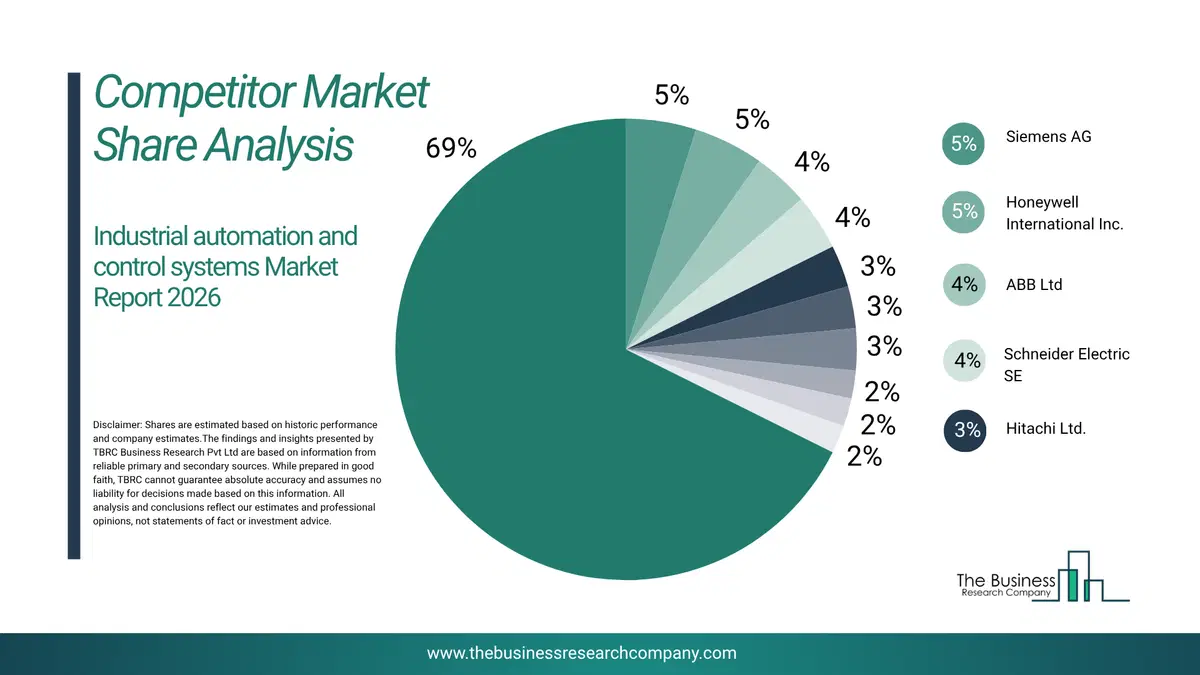
This chart is for illustrative purposes; the full report includes a detailed competitor analysis and comprehensive overview of the top 10 companies in the market.
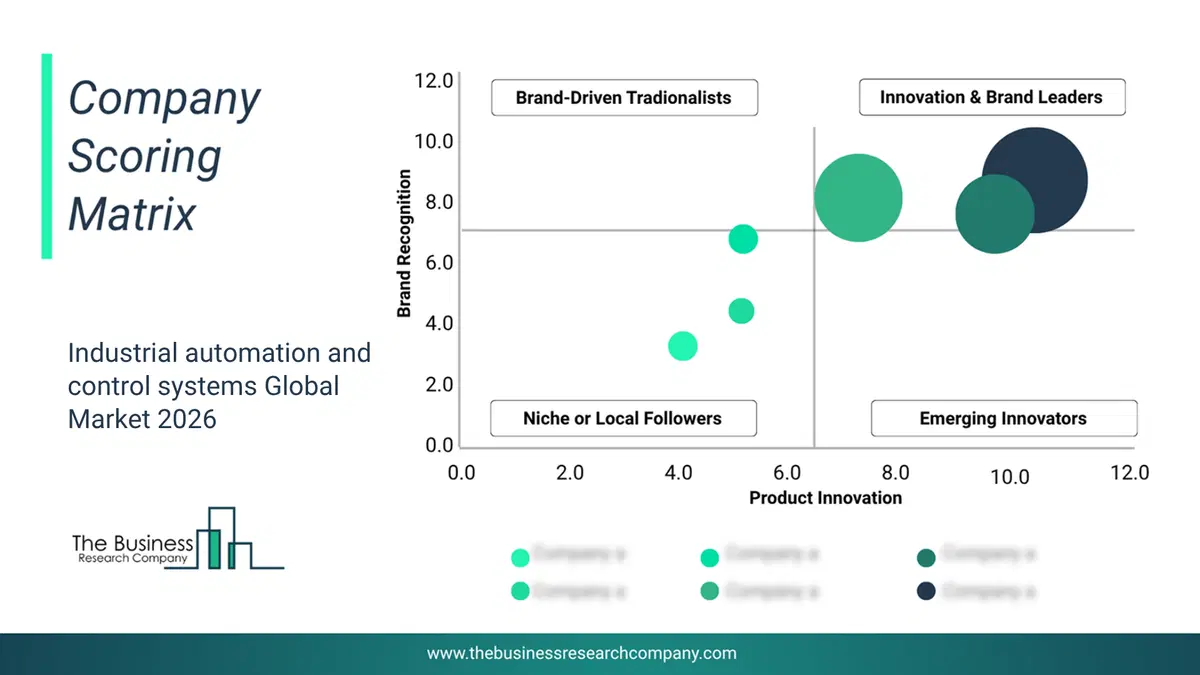
This chart maps companies by product innovation and brand strength, with bubble size indicating relative revenue, helping identify market leaders, challengers, and niche players. This is an illustrative chart; the full report provides a complete and accurate competitive analysis.
Global Industrial Automation And Control Systems Market Trends and Insights
Major companies operating in the industrial automation and control systems market are focused on developing advanced controllers, such as integrated controllers, for industrial automation. An integrated controller refers to a device or system that combines multiple control functions into a single unit. For instance, in April 2023, OMRON, a Japan-based electronics company launched NX502 CPU Unit, the latest addition to its NX series, along with the NX-EIP201 EtherNet/IP Unit. These feature world-leading precision data collection and large-capacity transfer capabilities, optimizing resource disposal losses and enabling real-time analysis. The NX502 is the first integrated controller in the OMRON NX-Series, allowing large-scale and high-speed safety, and reducing lead times in changing production lines.What Are Latest Mergers And Acquisitions In The Industrial Automation And Control Systems Market?
In July 2024, Symbotic LLC, a US-based robotics company that offers warehouse automation, acquired Veo Robotics, Inc. for $8.7 million. This acquisition aims to Veo's FreeMove intelligent 3D vision system, which enhances human-robot collaboration by ensuring safety while maintaining efficiency. Veo Robotics Inc.is a US-based company that offers industrial automation solutions.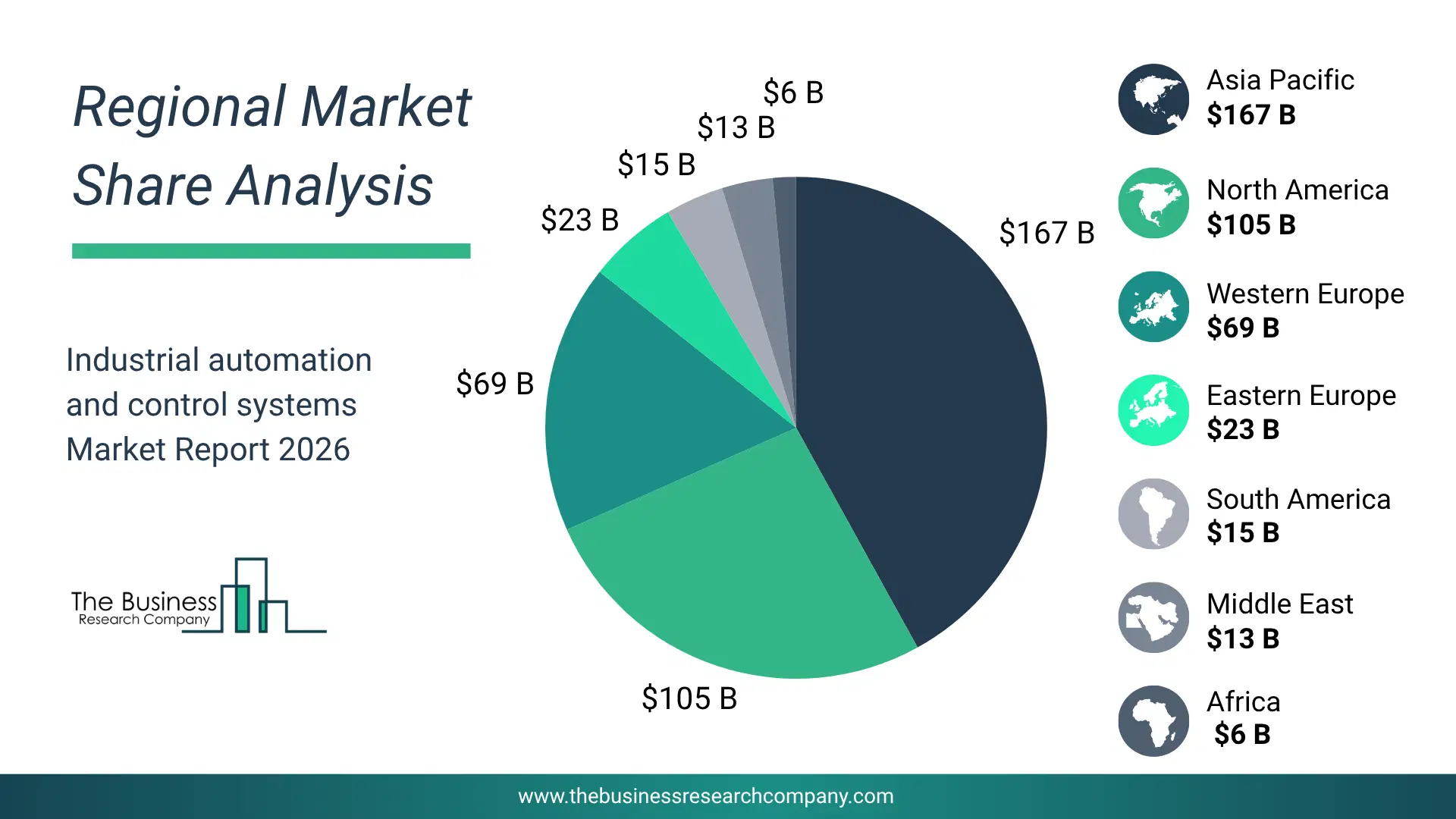
Regional Outlook
Asia-Pacific was the largest region in the industrial automation and control systems market in 2025 and is expected to be the fastest-growing region in the industrial automation and control systems market during the forecast period. The regions covered in this market report are Asia-Pacific, South East Asia, Western Europe, Eastern Europe, North America, South America, Middle East, Africa. The countries covered in this market report are Australia, Brazil, China, France, Germany, India, Indonesia, Japan, Taiwan, Russia, South Korea, UK, USA, Canada, Italy, Spain.What Defines the Industrial Automation And Control Systems Market?
The industrial automation and control systems market consists of sales of basic process control systems (BPCS), safety instrumented systems (SIS), safety sensors, safety actuators, and robot systems. Values in this market are 'factory gate’ values, that is, the value of goods sold by the manufacturers or creators of the goods, whether to other entities (including downstream manufacturers, wholesalers, distributors, and retailers) or directly to end customers. The value of goods in this market includes related services sold by the creators of the goods.How is Market Value Defined and Measured?
The market value is defined as the revenues that enterprises gain from the sale of goods and/or services within the specified market and geography through sales, grants, or donations in terms of the currency (in USD unless otherwise specified). The revenues for a specified geography are consumption values that are revenues generated by organizations in the specified geography within the market, irrespective of where they are produced. It does not include revenues from resales along the supply chain, either further along the supply chain or as part of other products.
This chart presents market attractiveness based on a quantitative evaluation of growth, competition, strategic alignment, and risk, offering a clear view of opportunity areas for decision-making. This chart is for illustrative purposes; the full report contains the complete analysis.

This chart highlights the Total Addressable Market (TAM) by estimating the maximum revenue opportunity using an assumption-driven approach, supporting strategic planning and opportunity sizing across markets. The chart is illustrative; the full report provides a more comprehensive analysis.
What Key Data and Analysis Are Included in the Industrial Automation And Control Systems Market Report 2026?
The industrial automation and control systems market research report is one of a series of new reports from The Business Research Company that provides market statistics, including industry global market size, regional shares, competitors with the market share, detailed market segments, market trends and opportunities, and any further data you may need to thrive in the industrial automation and control systems industry. The market research report delivers a complete perspective of everything you need, with an in-depth analysis of the current and future state of the industry.Industrial Automation And Control Systems Market Report 2026 Market Report Forecast Analysis
| Report Attribute | Details |
|---|---|
| Market Size Value In 2026 | $257.73 billion |
| Revenue Forecast In 2030 | $398.18 billion |
| Growth Rate | CAGR of 11.4% from 2026 to 2030 |
| Base Year For Estimation | 2025 |
| Actual Estimates/Historical Data | 2020-2025 |
| Forecast Period | 2026 - 2030 |
| Market Representation | Revenue in USD Billion and CAGR from 2026 to 2030 |
| Segments Covered | Component, Control System, End-User Industry |
| Regional Scope | Asia-Pacific, Western Europe, Eastern Europe, North America, South America, Middle East, Africa |
| Country Scope | The countries covered in the report are Australia, Brazil, China, France, Germany, India, Indonesia, Japan, Taiwan, Russia, South Korea, UK, USA, Canada, Italy, Spain. |
| Key Companies Profiled | ABB Ltd., Emerson Electric Co., Honeywell International Inc., Kawasaki Heavy Industries Ltd., Mitsubishi Electric Corporation, Omron Corporation, Rockwell Automation Inc., Schneider Electric SE, Siemens AG, Yokogawa Electric Corporation, Texas Instruments Inc., Robert Bosch GmbH, Fortive, Ametek EIG, Phoenix Contact GmbH & Co. KG, General Electric Company, Johnson Controls International plc, Fanuc Corporation, Advantech Co. Ltd., Bosch Rexroth AG, Beckhoff Automation GmbH & Co. KG, Eaton Corporation plc, National Instruments Corporation, Keyence Corporation, Delta Electronics Inc., Pilz GmbH & Co. KG, Danaher Corporation, Endress+Hauser Group, Pepperl+Fuchs AG, WAGO Kontakttechnik GmbH & Co. KG |
| Customization Scope | Request for Customization |
| Pricing And Purchase Options | Explore Purchase Options |