

Industrial Automation Cable Market Report 2026
Global Outlook – By Product Type ( Ethernet Cables, Fieldbus Cables, Servo Cables, Robot Cables, Other Product Types), By Cable Type ( Copper Cables, Fiber Optic Cables), By Sales Channel ( Direct Sales, Distributor Sales), By Application Industry ( Automotive, Oil And Gas, Energy And Power, Manufacturing, Aerospace And Defense, Chemicals And Petrochemicals, Pharmaceuticals, Food And Beverage, Other Applications) – Market Size, Trends, Strategies, and Forecast to 2030
Industrial Automation Cable Market Overview
• Industrial Automation Cable market size has reached to $8.78 billion in 2025 • Expected to grow to $12.49 billion in 2030 at a compound annual growth rate (CAGR) of 7.1% • Growth Driver: Growth in Robotics Driving Expansion of the Industrial Automation Cable Market • Market Trend: Innovative Product Development In Industrial Automation Cables Market Aids In Increasing Profitability • Europe was the largest region in 2025 and Asia-Pacific is the fastest growing region.Market Gains By 2030 – Top Opportunities By Segment
Market Gain identifies the most promising market opportunities by highlighting the segments or products expected to generate the highest incremental revenue growth over the next five years.
What Is Covered Under Industrial Automation Cable Market?
Industrial automation cables are specialized cables designed to facilitate the transmission of data, signals, and power within industrial automation systems. They ensure seamless communication and power distribution among various automated machinery and equipment in industrial settings and improve efficiency and productivity. The main product types of the industrial automation cable market are ethernet cables, fieldbus cables, servo cables, robot cables, and other product types. An Ethernet cable refers to a common type of network cable utilized in wired networks, connecting devices such as PCs, routers, and switches within a local area network. The various cable types are copper cables, and fiber optic cables distributed by various sales channels such as direct sales, and distributor sales used by various application industries including automotive, oil and gas, energy and power, manufacturing, aerospace and defense, chemicals and petrochemicals, pharmaceuticals, food and beverage, and other applications.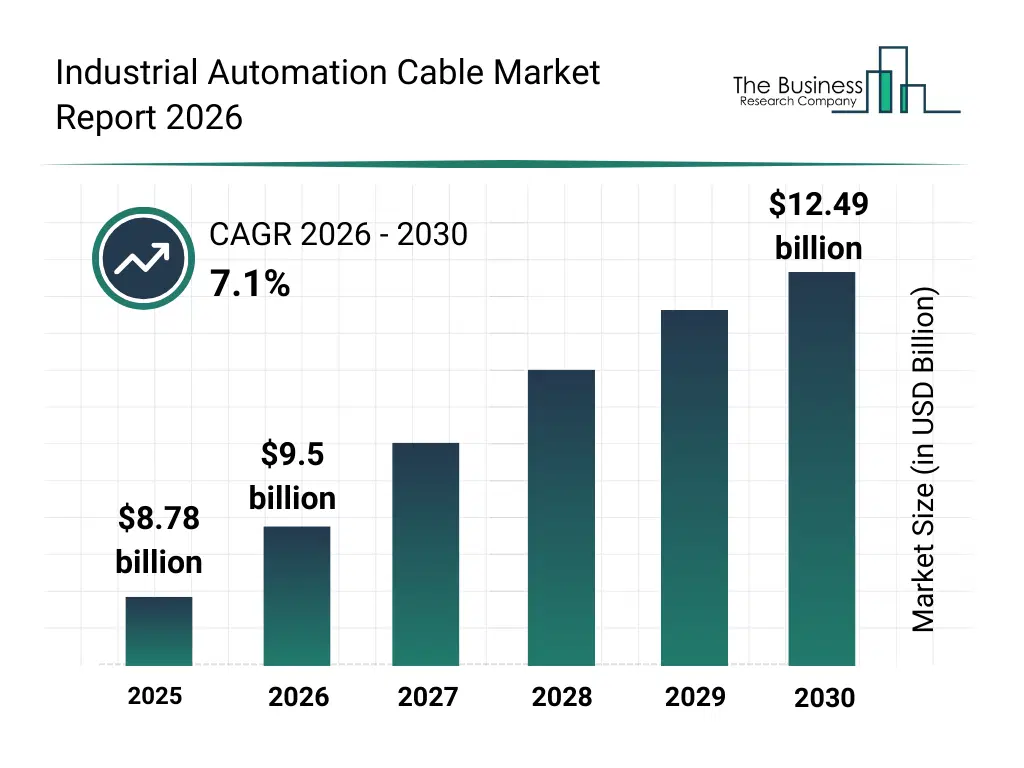
What Is The Industrial Automation Cable Market Size 2026 And Growth Rate?
The industrial automation cable market size has grown strongly in recent years. It will grow from $8.78 billion in 2025 to $9.5 billion in 2026 at a compound annual growth rate (CAGR) of 8.2%. The growth in the historic period can be attributed to early adoption of industrial automation systems, rising need for reliable factory communication, expansion of manufacturing infrastructure, increased use of servo motors, growing deployment of robotic systems.What Is The Industrial Automation Cable Market Growth Forecast?
The industrial automation cable market size is expected to see strong growth in the next few years. It will grow to $12.49 billion in 2030 at a compound annual growth rate (CAGR) of 7.1%. The growth in the forecast period can be attributed to advancement in high speed data transmission, expansion of smart factories, increasing adoption of iiot platforms, rising need for cyber secure industrial networks, development of rugged cables for extreme conditions. Major trends in the forecast period include rising deployment of high speed industrial ethernet cables, growth in demand for flexible and continuous motion robot cables, increasing integration of servo cables in automated machinery, expansion of fiber optic cables for real time industrial data transfer, growing use of durable cables for harsh industrial environments.
Global Industrial Automation Cable Market Segmentation
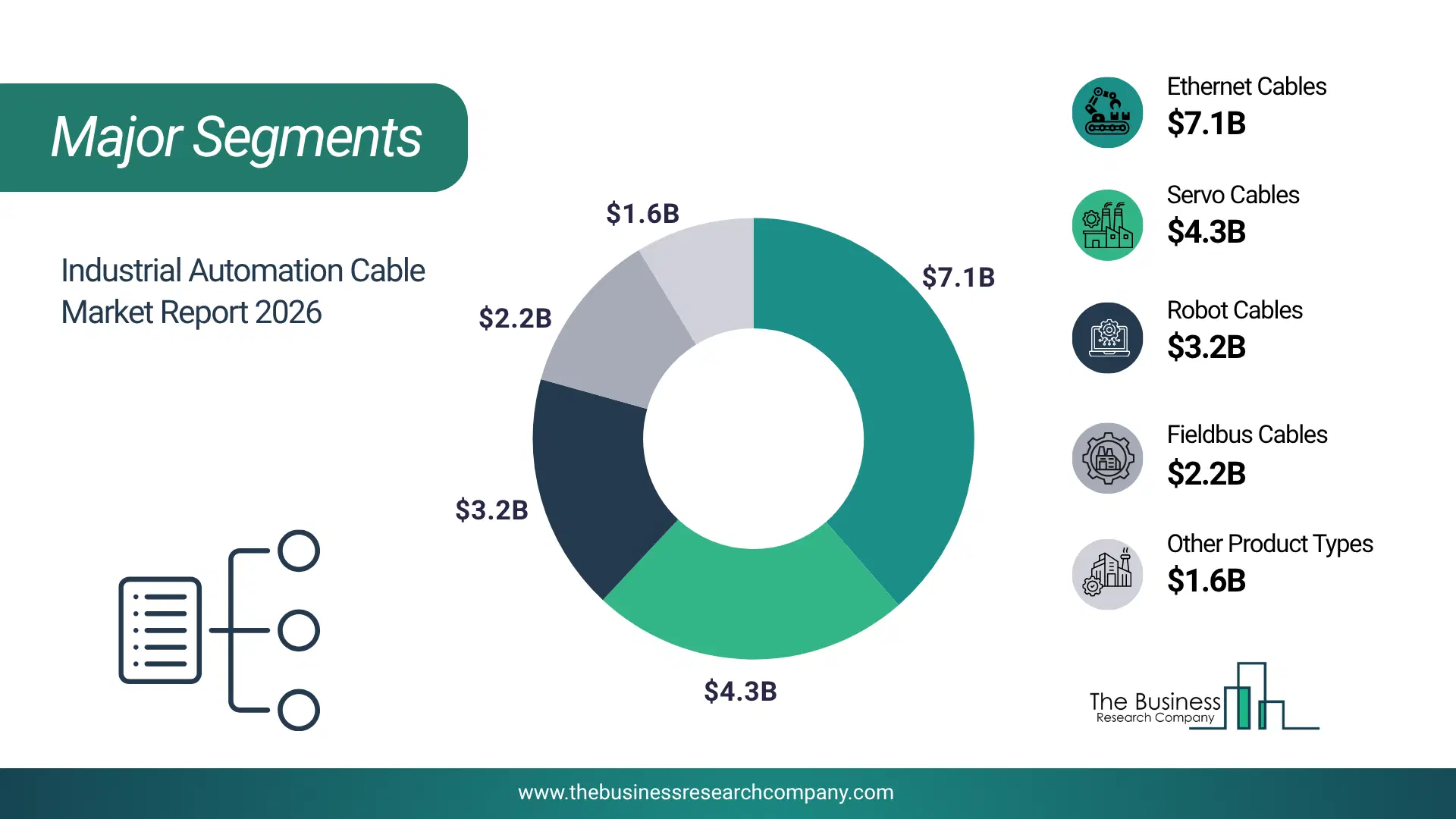
1) By Product Type: Ethernet Cables, Fieldbus Cables, Servo Cables, Robot Cables, Other Product Types 2) By Cable Type: Copper Cables, Fiber Optic Cables 3) By Sales Channel: Direct Sales, Distributor Sales 4) By Application Industry: Automotive, Oil And Gas, Energy And Power, Manufacturing, Aerospace And Defense, Chemicals And Petrochemicals, Pharmaceuticals, Food And Beverage, Other Applications Subsegments: 1) By Ethernet Cables: Industrial Ethernet Cables, Gigabit Ethernet Cables, Fiber Optic Ethernet Cables 2) By Fieldbus Cables: Profibus Cables, Can Bus Cables, Devicenet Cables 3) By Servo Cables: AC Servo Cables, DC Servo Cables, High-Performance Servo Cables 4) By Robot Cables: Flexible Robot Cables, Heavy Duty Robot Cables, Continuous Flex Cables 5) By Other Product Types: Power Cables, Control Cables, Data Cables The top segments in the industrial automation cable market will be: • Ethernet Cables will reach $7.04 billion by 2030. • Servo Cables will reach $4.29 billion by 2030. • Robot Cables will reach $3.18 billion by 2030. • Fieldbus Cables will reach $2.17 billion by 2030. • Other Product Types will reach $1.57 billion by 2030.What Is The Driver Of The Industrial Automation Cable Market?
The increasing shift towards robotics is expected to propel the growth of the industrial automation cable market going forward. Robotics is an interdisciplinary topic that studies the design, construction, use, and analysis of autonomous or semi-autonomous robots that can mimic or enhance human actions. The use of robots is rising due to the rapid breakthroughs in robotics technology, which include advancements in artificial intelligence, control systems, actuators, and sensors. Industrial automation cables are integral components of robotic systems, enabling efficient power transmission, signal communication, data exchange, flexibility, and safety in industrial automation applications. For instance, in September 2024, according to the International Federation of Robotics, a Germany based non-profit organization for industrial robotics, the number operating industrial robots have reached 4,281,585 units in 2023, indicating an increase of 10% than 2022. Therefore, the increasing shift towards robotics will drive the growth of the industrial automation cable industry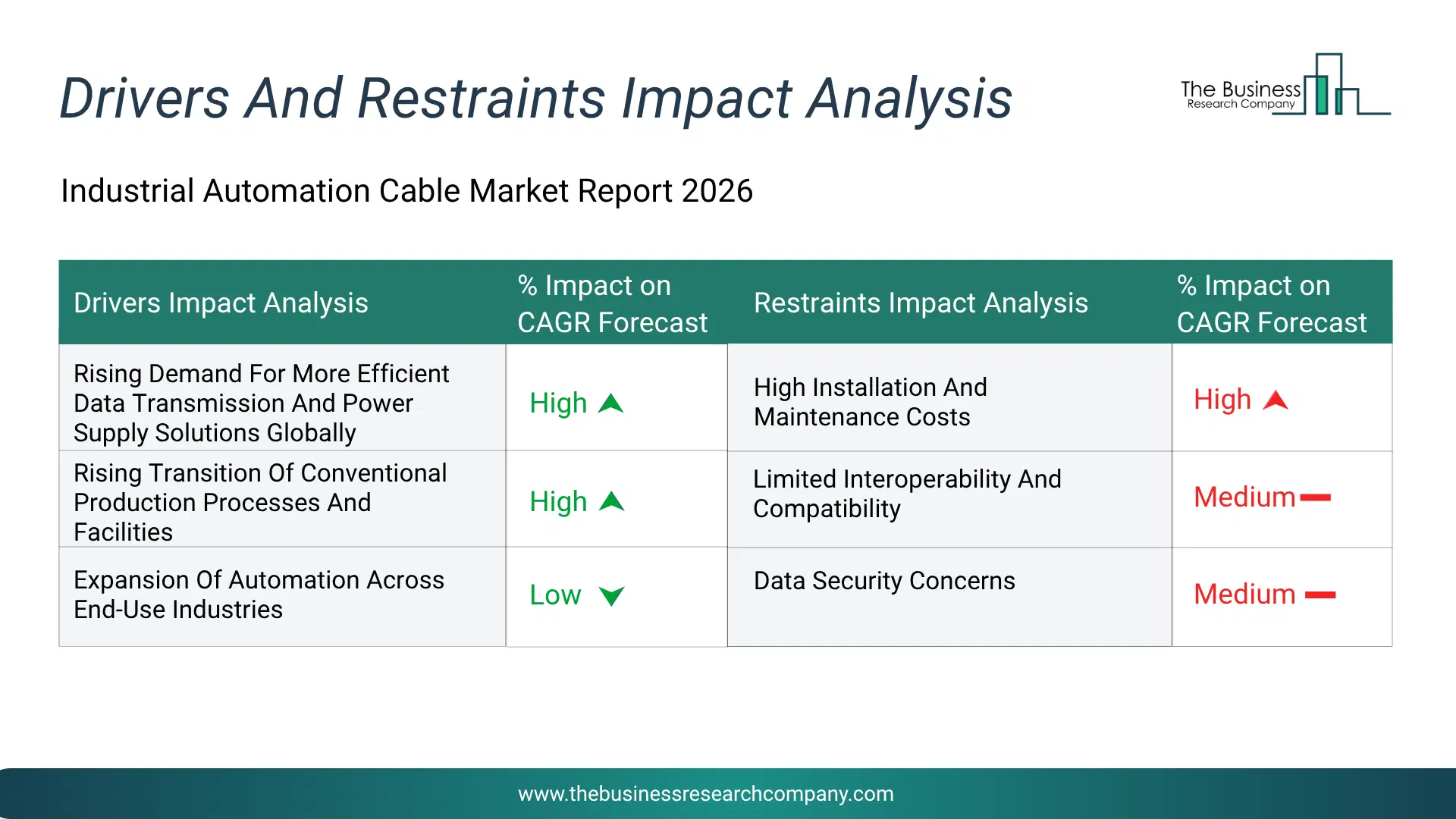
Infographic Chart Showing Key Market Drivers Analysis And Restraints For Industrial Automation Cable Market
The chart presents an impact analysis of key drivers and restraints, quantifying their relative influence on the market's growth rate and helping assess the balance between growth enablers and limiting factors. This chart offers a high-level perspective; the full report contains more detailed insights.
How Will The Drivers Impact Growth In The Global Industrial Automation Cable Market?
• Rising Demand For More Efficient Data Transmission And Power Supply Solutions Globally (High) – During the forecast period, the rising demand for more efficient data transmission and power supply solutions is expected to be a key growth driver for the industrial automation cable market by 2030. As industries increasingly adopt connected systems, iiot platforms, and real -time monitoring technologies, there is a growing need for cables that can deliver high -speed data transfer alongside stable power supply with minimal signal loss. Advanced cable solutions such as high -performance ethernet, hybrid, and fiber optic cables are being widely adopted to support seamless communication between machines, sensors, and control systems. This demand is further driven by the need for reduced downtime, enhanced operational efficiency, and improved system reliability in complex industrial environments. • Rising Transition Of Conventional Production Processes And Facilities (High) – During the forecast period, the transition of conventional production processes and facilities toward automated and digitally integrated systems is expected to significantly drive the industrial automation cable market by 2030. Manufacturers are increasingly upgrading legacy systems to smart factories equipped with robotics, automated assembly lines, and advanced control systems, all of which require reliable and high-performance cabling infrastructure. This shift is particularly evident across sectors such as automotive, electronics, and process industries, where efficiency, precision, and scalability are critical. The modernization of production facilities is also increasing demand for flexible, durable, and application-specific cables capable of operating in dynamic and harsh industrial conditions. • Expansion Of Automation Across End-Use Industries (Low) – During the forecast period, the expansion of automation across end-use industries is expected to further accelerate market growth by 2030. The expansion of automation across sectors such as manufacturing, energy, pharmaceuticals, and food processing is driving the need for specialized cables designed for motion control, robotics, and high-speed communication. These cables play a critical role in ensuring uninterrupted operations, maintaining signal integrity, and supporting complex machine-to-machine interactions. Additionally, the growing adoption of collaborative robots and automated material handling systems is reinforcing demand for high-flex, wear-resistant cable solutions.How Will The Restraints Impact Growth In The Global Industrial Automation Cable Market?
• High Installation And Maintenance Costs (High) – During the forecast period, the the installation and maintenance of industrial automation cables can involve significant costs due to the need for specialized materials, skilled labor, and complex installation processes. These cables are often designed to withstand harsh industrial environments such as extreme temperatures, vibration, and chemical exposure, which increases their cost. In addition, maintenance and replacement activities may require production downtime and technical expertise, further raising operational expenses. Small and medium-sized manufacturers may hesitate to invest in advanced cabling infrastructure due to these financial barriers. As a result, high installation and maintenance costs can limit the widespread adoption of industrial automation cables. • Limited Interoperability And Compatibility (Medium) – During the forecast period, the industrial automation environments often include equipment and systems from multiple manufacturers that operate on different communication protocols and standards. This lack of uniformity can create compatibility challenges when integrating automation cables with existing machinery and control networks. In some cases, additional adapters, connectors, or system upgrades are required to ensure seamless connectivity. These integration complexities can increase implementation time and costs for industrial operators. Consequently, limited interoperability can slow down the adoption of industrial automation cables in certain facilities. • Data Security Concerns (Medium) – During the forecast period, the as industrial automation systems increasingly rely on connected networks and data transmission, concerns related to data security have become more prominent. Industrial automation cables support the transfer of critical operational data between machines, controllers, and monitoring systems. If these networks are not properly secured, they may become vulnerable to cyber threats, data breaches, or unauthorized access. Such risks can affect production processes and compromise sensitive industrial information. Therefore, concerns about data security can act as a restraint for organizations considering the expansion of automated network infrastructures.Key Players In The Global Industrial Automation Cable Market
Major companies operating in the industrial automation cable market are Prysmian Group, Borealis AG, Southwire Company, LLC, Nexans, Hitachi Metals, Ltd, Anixter International Inc, LEONI AG, Fujikura Ltd, LS Cable & System, Oki Electric, Belden, LAPP, Wanma Cable, TKH Group NV, Bizlink Holding Inc, Helukabel, igus GmbH, SAB Brockskes, Eland Cables, Alpha Wire Company, Teldor Cables & Systems Ltd, Cicoil LLC, Lorom Industrial, TPC Wire & Cable, Cables Unlimited, Inc, General Cable, Elettrotek Kabel, Zhejiang Zhaolong, Lutze, MotionCables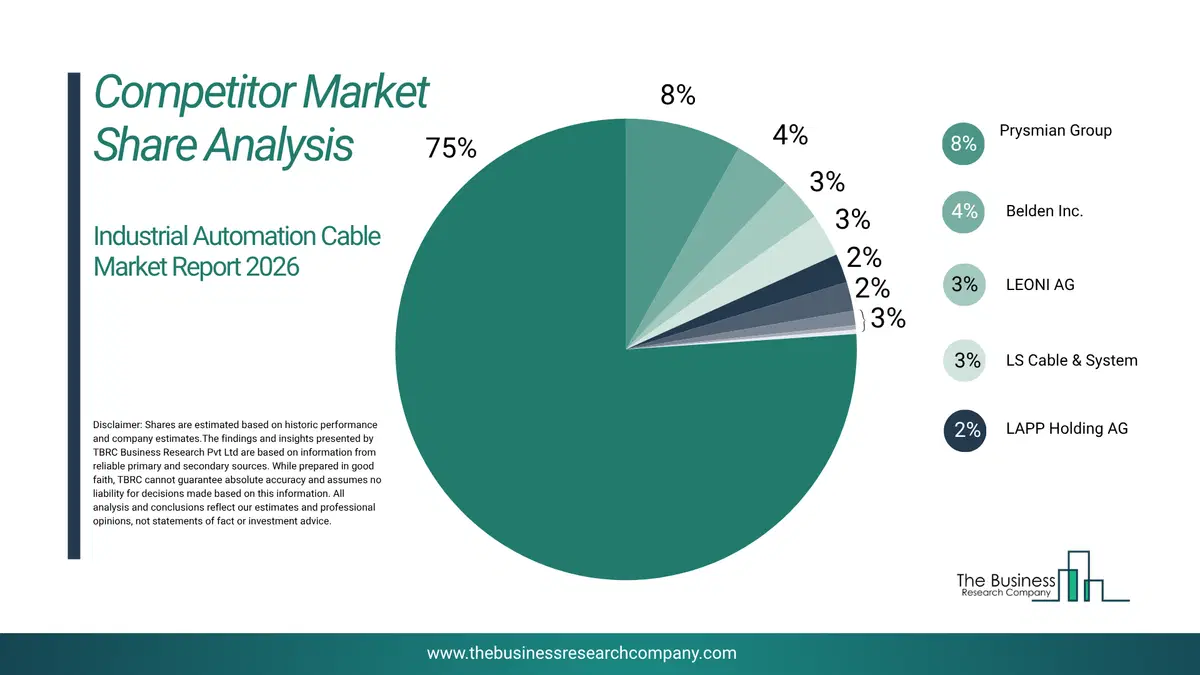
This chart is for illustrative purposes; the full report includes a detailed competitor analysis and comprehensive overview of the top 10 companies in the market.
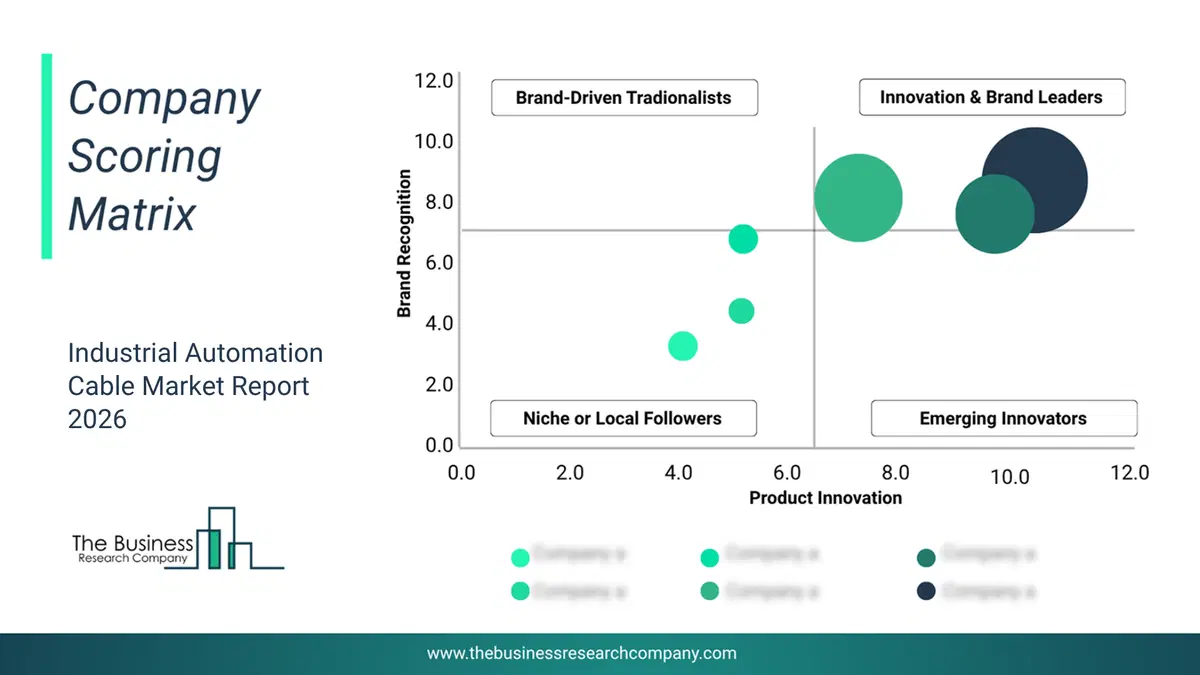
This chart maps companies by product innovation and brand strength, with bubble size indicating relative revenue, helping identify market leaders, challengers, and niche players. This is an illustrative chart; the full report provides a complete and accurate competitive analysis.
Global Industrial Automation Cable Market Trends and Insights
Major companies operating in the industrial automation cable market are focused on developing innovative products, such as continuous flex coaxial cable to increase their profitability in the market. The high-flex coaxial cables are designed for applications that demand constant cable motion and flexibility. For instance, in March 2023, Times Microwave Systems, a US-based manufacturer of innovative microwave interconnect assemblies and cables, launched XtendedFlex 178 continuous flex coaxial cable. It is tailored for use with plastic cable drag chains. The XF-178 cable is precisely engineered to meet the demands of applications characterized by continuous movement and adaptability, notably in sectors such as robotics and industrial automation utilized in expansive distribution centers.What Are Latest Mergers And Acquisitions In The Industrial Automation Cable Market?
In January 2024, Amphenol Corporation, an US-based electronic and fiber optic connectors, cable, and interconnect systems, acquired TPC Wire & Cable for an undisclosed amount. This strategic acquisition enables Amphenol Corporation to strengthen its harsh environment solutions business by integrating TPC Wire & Cable’s advanced raw cable and custom cable assemblies designed for high-tech and harsh-environment industries. TPC Wire & Cable is an US-based ruggedized electrical cabling solutions developer company offering automation cables.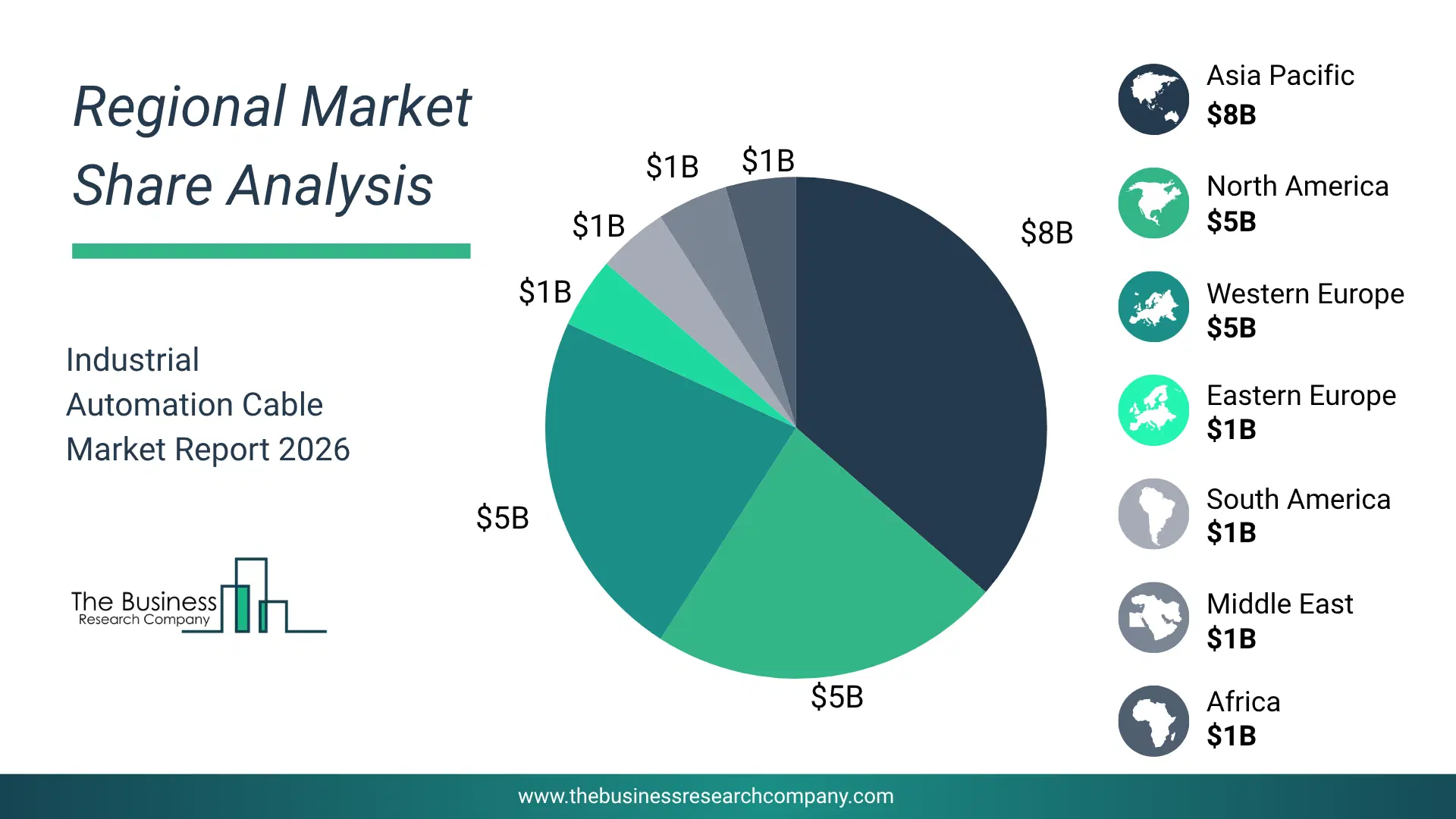
Regional Outlook
Europe was the largest region in the industrial automation cable market in 2025. Asia-Pacific is expected to be the fastest-growing region in the forecast period. The regions covered in this market report are Asia-Pacific, South East Asia, Western Europe, Eastern Europe, North America, South America, Middle East, Africa. The countries covered in this market report are Australia, Brazil, China, France, Germany, India, Indonesia, Japan, Taiwan, Russia, South Korea, UK, USA, Canada, Italy, Spain.What Defines the Industrial Automation Cable Market?
The industrial automation cable market consists of sales of connector cables, inter-bus cables, railway cables, and marine cables. Values in this market are ‘factory gate’ values, that is the value of goods sold by the manufacturers or creators of the goods, whether to other entities (including downstream manufacturers, wholesalers, distributors, and retailers) or directly to end customers. The value of goods in this market includes related services sold by the creators of the goods.How is Market Value Defined and Measured?
The market value is defined as the revenues that enterprises gain from the sale of goods and/or services within the specified market and geography through sales, grants, or donations in terms of the currency (in USD unless otherwise specified). The revenues for a specified geography are consumption values that are revenues generated by organizations in the specified geography within the market, irrespective of where they are produced. It does not include revenues from resales along the supply chain, either further along the supply chain or as part of other products.
This chart presents market attractiveness based on a quantitative evaluation of growth, competition, strategic alignment, and risk, offering a clear view of opportunity areas for decision-making. This chart is for illustrative purposes; the full report contains the complete analysis.

This chart highlights the Total Addressable Market (TAM) by estimating the maximum revenue opportunity using an assumption-driven approach, supporting strategic planning and opportunity sizing across markets. The chart is illustrative; the full report provides a more comprehensive analysis.
What Key Data and Analysis Are Included in the Industrial Automation Cable Market Report 2026?
The industrial automation cable market research report is one of a series of new reports from The Business Research Company that provides market statistics, including industry global market size, regional shares, competitors with the market share, detailed market segments, market trends and opportunities, and any further data you may need to thrive in the industrial automation cable industry. The market research report delivers a complete perspective of everything you need, with an in-depth analysis of the current and future state of the industry.Industrial Automation Cable Market Report 2026 Market Report Forecast Analysis
| Report Attribute | Details |
|---|---|
| Market Size Value In 2026 | $9.5 billion |
| Revenue Forecast In 2030 | $12.49 billion |
| Growth Rate | CAGR of 7.1% from 2026 to 2030 |
| Base Year For Estimation | 2025 |
| Actual Estimates/Historical Data | 2020-2025 |
| Forecast Period | 2026 - 2030 |
| Market Representation | Revenue in USD Billion and CAGR from 2026 to 2030 |
| Segments Covered | Product Type, Cable Type, Sales Channel, Application Industry |
| Regional Scope | Asia-Pacific, Western Europe, Eastern Europe, North America, South America, Middle East, Africa |
| Country Scope | The countries covered in the report are Australia, Brazil, China, France, Germany, India, ... |
| Key Companies Profiled | Prysmian Group, Borealis AG, Southwire Company, LLC, Nexans, Hitachi Metals, Ltd, Anixter International Inc, LEONI AG, Fujikura Ltd, LS Cable & System, Oki Electric, Belden, LAPP, Wanma Cable, TKH Group NV, Bizlink Holding Inc, Helukabel, igus GmbH, SAB Brockskes, Eland Cables, Alpha Wire Company, Teldor Cables & Systems Ltd, Cicoil LLC, Lorom Industrial, TPC Wire & Cable, Cables Unlimited, Inc, General Cable, Elettrotek Kabel, Zhejiang Zhaolong, Lutze, MotionCables |
| Customization Scope | Request for Customization |
| Pricing And Purchase Options | Explore Purchase Options |